Wine And Tobacco Packaging Market Size
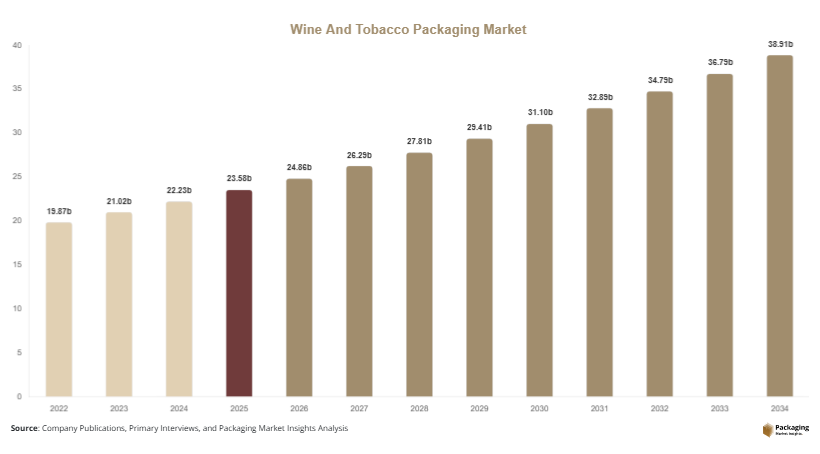
Wine And Tobacco Packaging market size is projected at USD 24.86 billion in 2026 and is expected to hit USD 38.92 billion by 2034 with a CAGR of 5.76%. The study evaluates historical performance from 2022–2024, the 2025 base year, and long-term forecasts through 2034 while assessing product innovation, production capacity, distribution channels, and competitive positioning across global manufacturers. The report further provides detailed segmentation, quantitative analysis, and competitive benchmarking to support strategic investment and expansion decisions.
The Wine And Tobacco Packaging Market comprises packaging solutions designed to preserve product quality, extend shelf life, improve branding, and comply with regulatory labeling requirements for alcoholic beverages and tobacco products. Global production exceeded 96 billion packaging units during 2025, while glass bottles represented nearly 48% of total output, metal packaging accounted for 22%, and paper-based formats contributed approximately 18%. Premium packaging adoption surpassed 36% across developed economies, whereas sustainable materials achieved penetration above 31%, reinforcing continuous Wine And Tobacco Packaging Market demand.
Explore more data points, trends and opportunities Download Free Sample Report
Wine And Tobacco Packaging Market Trends
Rising Sustainable and Premium Packaging Adoption
Growing sustainability commitments are accelerating the use of recyclable materials across the industry. More than 41 billion recyclable packaging units were manufactured during 2025, representing over 43% of total production. Lightweight glass technologies reduced material consumption by nearly 15%, while recycled paperboard utilization increased by 19% year-over-year. Premium decorative printing adoption exceeded 38%, strengthening Wine And Tobacco Packaging Market trends.
Automation and smart manufacturing continue transforming packaging operations worldwide. Digital inspection systems now operate across more than 57% of large-scale production facilities, while AI-enabled quality monitoring has improved inspection accuracy above 98%. Smart QR-enabled packaging penetration reached approximately 27%, supporting product authentication, customer engagement, and supply chain visibility, further enhancing Wine And Tobacco Packaging Market trends.
Wine And Tobacco Packaging Market Drivers
Growing Premium Beverage Consumption and Branding Investments
Expanding global wine consumption and premium tobacco branding continue driving packaging innovation. Premium wine packaging shipments exceeded 19 billion units in 2025, increasing by 8.4% compared with the previous year. Luxury packaging investments rose by 13%, while premium labeling applications expanded by 17%, supporting stronger shelf differentiation and sustained Wine And Tobacco Packaging Market growth.
Wine And Tobacco Packaging Market Restraints
Volatile Raw Material Prices and Regulatory Compliance
Fluctuating prices of glass, aluminum, specialty paper, and printing inks remain major challenges for manufacturers. Glass production costs increased by approximately 11%, aluminum inputs rose 9%, and compliance expenditures related to labeling regulations expanded by 14% during 2025. These cost pressures reduce operating margins and slow investment across the Wine And Tobacco Packaging Market growth cycle.
Wine And Tobacco Packaging Market Opportunities
Expansion of Eco-Friendly Packaging Technologies
Demand for recyclable, biodegradable, and reusable packaging continues creating new investment opportunities. Recycled-content packaging production surpassed 24 billion units, while biodegradable material utilization increased by 21%. Corporate sustainability initiatives now influence over 46% of procurement decisions, encouraging continuous innovation across the Wine And Tobacco Packaging Market demand.
Challenges in Wine And Tobacco Packaging Market
Counterfeit Prevention and Supply Chain Complexity
Counterfeit alcohol and tobacco products continue increasing the need for advanced security packaging. Authentication technologies are integrated into approximately 29% of premium packaging products, while digital tracking solutions expanded by 18% annually. Managing global logistics across more than 140 exporting countries remains challenging despite technological improvements, influencing overall Wine And Tobacco Packaging Market insights.
Report Scope
| Report Metric | Details |
|---|---|
| Market Size in 2025 | USD 23.58 billion |
| Market Size in 2026 | USD 24.86 billion |
| Market Size in 2034 | USD 38.92 billion |
| CAGR | 5.76% (2026-2034) |
| Base Year for Estimation | 2025 |
| Historical Data | 2022-2024 |
| Forecast Period | 2026-2034 |
| Report Coverage | Revenue Forecast, Competitive Landscape, Supply Chain Disruption, Growth Factors, Environment & Regulatory Landscape and Trends |
| Geographies Covered | North America, Europe, APAC, Middle East and Africa, LATAM |
| Countries Covered | U.S., Canada, U.K., Germany, France, Spain, Italy, Russia, Nordic, Benelux, Rest of Europe, China, South Korea, Japan, India, Australia, Singapore, Taiwan, South East Asia, Rest of Asia-Pacific, UAE, Turky, Saudi Arabia, South Africa, Egypt, Nigeria, Rest of MEA, Brazil, Mexico, Argentina, Chile, Colombia, Rest of LATAM |
Explore more data points, trends and opportunities Download Free Sample Report
Wine And Tobacco Packaging Market Segmentation
Material-based segmentation represented nearly 67% of total revenue during 2025, while end-user applications accounted for the remaining 33%. Glass remained the dominant packaging material because of superior barrier performance, whereas premium packaging continued expanding due to luxury branding requirements.
By Material
Glass accounted for approximately 48% of market volume with production exceeding 46 billion bottles annually. High barrier protection, recyclability above 90%, premium appearance, and chemical resistance continue supporting demand across wine packaging.
Metal packaging represented nearly 22% of global consumption with annual production above 21 billion units. Aluminum closures, decorative tins, and aerosol applications provide lightweight construction, corrosion resistance, and improved transportation efficiency.
Paper and paperboard contributed around 18% of the market with production exceeding 17 billion cartons. High printability, renewable sourcing, lightweight performance, and recyclable characteristics make these materials increasingly attractive for secondary and premium packaging.
By End User
Wine packaging held approximately 56% of total consumption with annual production exceeding 54 billion packaging units. Glass bottles, luxury labels, cork closures, and premium cartons maintain strong adoption across wineries while premium penetration surpassed 39%.
Tobacco packaging accounted for nearly 34% of market demand with more than 32 billion packs produced annually. Barrier paper, foil laminates, security printing, and regulatory labeling remain essential for product integrity and compliance.
Premium packaging represented roughly 10% of total shipments but recorded the fastest expansion. Decorative embossing, specialty coatings, rigid gift boxes, and smart authentication features achieved adoption above 28% among luxury product manufacturers.
Wine And Tobacco Packaging Market Segmentations
Material
- Glass
- Metal
- Paper & Paperboard
End User
- Wine Packaging
- Tobacco Packaging
- Premium Packaging
Wine And Tobacco Packaging Regional Counties Outlook
North America
North America accounted for approximately 31% of global revenue during 2025 with production exceeding 29 billion units. The United States represented nearly 79% of regional output, supported by premium wine demand and advanced tobacco packaging technologies.
Canada and Mexico continued expanding recyclable packaging adoption above 35%, while automated packaging facilities exceeded 61% of regional production capacity.
Europe
Europe held around 34% of the global market owing to strong wine production across France, Italy, Spain, and Germany. Regional manufacturing exceeded 33 billion packaging units, with glass packaging contributing over 52% of total production.
Premium exports and sustainability regulations accelerated recycled material utilization beyond 44%, strengthening regional competitiveness.
Asia-Pacific
Asia-Pacific captured nearly 25% of market revenue with production exceeding 24 billion units. China, Japan, India, and Australia remained key manufacturing centers supported by increasing premium beverage consumption.
Packaging automation adoption surpassed 42%, while premium packaging demand increased by approximately 11% annually.
Latin America
Latin America represented about 6% of global demand. Brazil, Argentina, and Chile remained major contributors with regional production surpassing 5 billion units driven by wine exports and improving packaging investments.
Middle East & Africa
The Middle East & Africa accounted for approximately 4% of the market. South Africa dominated regional wine packaging production, while premium packaging investments increased by 9% across export-oriented manufacturers.
Top players in Wine And Tobacco Packaging
- Amcor plc
- Berry Global Inc.
- Mondi plc
- Smurfit Westrock
- Ardagh Group
- O-I Glass Inc.
- Verallia
- Vidrala S.A.
- Crown Holdings Inc.
- Ball Corporation
- DS Smith plc
- Stora Enso Oyj
Amcor plc
-
Estimated market presence: 9%–11%
-
Global leader with extensive sustainable packaging capabilities across flexible and rigid formats.
-
Strong investments in recyclable materials, premium printing technologies, digital packaging, and multinational production facilities serving wine and tobacco manufacturers across North America, Europe, Asia-Pacific, and Latin America.
Berry Global Inc.
-
Estimated market presence: 7%–9%
-
Maintains a significant position through innovative packaging solutions, lightweight materials, advanced barrier technologies, and continuous investment in sustainable manufacturing. The company supports global consumer brands through diversified production networks and ongoing product development initiatives.