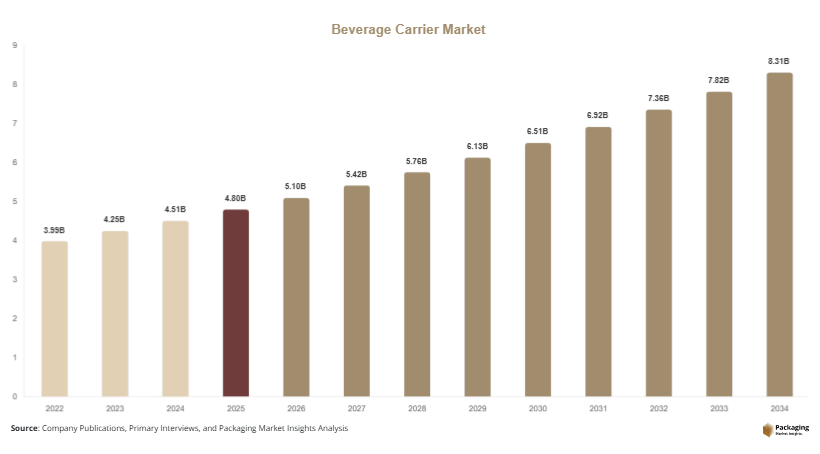
Beverage Carrier Market Size and Growth
The global beverage carrier market size was valued at USD 4.8 billion in 2025 and is estimated to reach USD 5.1 billion in 2026. By 2034, the market is projected to attain USD 8.3 billion, registering a CAGR of 6.3% during the forecast period (2025–2034). Growth is primarily supported by increasing consumption of coffee, tea, soft drinks, and specialty beverages sold through takeaway channels. Furthermore, the shift toward sustainable packaging materials is encouraging beverage retailers to adopt recyclable and biodegradable carrier solutions.
The beverage carrier market is witnessing steady growth due to the rising demand for convenient beverage transportation solutions across quick-service restaurants, coffee chains, food delivery platforms, convenience stores, and retail outlets. Beverage carriers are designed to securely hold multiple beverage containers during transport, reducing spillage risks while enhancing consumer convenience. The increasing popularity of takeaway beverages, growing urbanization, and the expansion of food delivery services continue to create favorable conditions for market expansion.
Key Highlights
- Asia Pacific dominated the market with a 38.2% share in 2025.
- Latin America is projected to grow at the fastest CAGR of 7.1% through 2034.
- Molded fiber carriers led the type segment with a 34.8% share.
- Paper-based materials dominated with a 48.6% share.
- Foodservice and beverage outlets accounted for 46.9% of market revenue.
- The US remained the dominant country with a market size of USD 0.96 billion in 2025 and USD 1.02 billion in 2026.
Explore more data points, trends and opportunities Download Free Sample Report
Market Trends
Rising Adoption of Sustainable Beverage Carriers
Sustainability has become a major trend in the beverage carrier market as restaurants, cafés, and beverage brands seek alternatives to plastic-based packaging. Molded fiber, recycled paper pulp, and biodegradable materials are increasingly being used to manufacture beverage carriers. Major coffee chains and foodservice providers are replacing traditional carriers with recyclable solutions to meet consumer expectations and regulatory requirements. This transition helps companies reduce environmental impact while improving brand perception. Looking ahead, advancements in fiber molding technologies and renewable raw materials are expected to improve product performance, enabling broader adoption of eco-friendly beverage carriers across commercial and retail sectors.
Growth of Multi-Cup and Customized Carrier Designs
The demand for customized and multi-cup beverage carriers is increasing due to the growth of takeaway and delivery services. Consumers often purchase beverages in groups, prompting retailers to adopt carriers capable of securely holding multiple cups. Manufacturers are responding with ergonomic designs featuring reinforced structures, foldable handles, and branding opportunities. For example, quick-service restaurant chains increasingly use customized beverage carriers that display promotional messaging and improve customer engagement. Future developments are expected to focus on smart packaging integration, enhanced portability, and lightweight materials, making beverage transportation more efficient while supporting marketing objectives for beverage brands.
Market Drivers
Expansion of Food Delivery and Takeaway Services
The rapid expansion of food delivery platforms has significantly increased demand for reliable beverage transportation solutions. As consumers increasingly order beverages through mobile applications, restaurants and cafés require durable carriers that minimize spills and maintain product integrity during transit. Beverage carriers provide a practical solution by securely holding cups and bottles throughout the delivery process. For instance, major delivery-focused coffee chains frequently use molded fiber carriers to ensure safe transportation. The growing number of delivery transactions globally directly contributes to higher consumption of beverage carriers, making this trend a key driver of market growth.
Increasing Consumption of Ready-to-Drink Beverages
Growing consumption of ready-to-drink coffee, tea, smoothies, and soft drinks is driving the beverage carrier market. Consumers increasingly prefer convenient beverage options that can be consumed on the go, creating demand for packaging accessories that facilitate transportation. Foodservice establishments and convenience stores rely on beverage carriers to enhance customer convenience and improve purchasing experiences. For example, specialty coffee retailers often provide carriers for customers purchasing multiple drinks. As beverage consumption continues to rise across urban centers and commercial districts, demand for efficient carrier solutions is expected to grow steadily throughout the forecast period.
Market Restraint
High Dependence on Raw Material Price Fluctuations
One of the primary restraints affecting the beverage carrier market is the volatility of raw material prices. Paper pulp, molded fiber materials, and biodegradable inputs are subject to fluctuations influenced by supply chain disruptions, energy costs, and environmental regulations. Rising material costs can increase production expenses, reducing profit margins for manufacturers and leading to higher prices for end users. Small and medium-sized producers are particularly vulnerable to these fluctuations. For example, increases in recycled paper prices can significantly affect the cost structure of paper-based beverage carriers. Furthermore, supply shortages may create production delays, impacting delivery schedules and customer relationships. These challenges can limit market growth, especially in price-sensitive regions where businesses prioritize cost efficiency. While technological innovations and recycling initiatives may mitigate some impacts, raw material price instability remains a significant concern for industry participants.
Market Opportunities
Development of Reusable Beverage Carrier Solutions
The growing emphasis on circular economy practices presents substantial opportunities for reusable beverage carrier products. Retailers and foodservice companies are exploring durable carriers designed for repeated use, reducing waste generation and supporting sustainability goals. Reusable carriers can appeal to environmentally conscious consumers while helping businesses reduce long-term packaging costs. Several beverage chains have begun pilot programs encouraging customers to return or reuse carrier products. As sustainability initiatives gain momentum globally, reusable beverage carriers are expected to become an increasingly attractive market segment with strong long-term growth potential.
Expansion Across Emerging Markets
Emerging economies offer significant growth opportunities due to rising disposable incomes, urbanization, and expanding foodservice industries. Countries across Asia Pacific, Latin America, and the Middle East are witnessing increasing demand for takeaway beverages and delivery services. Beverage carrier manufacturers can capitalize on this trend by introducing cost-effective and environmentally responsible products tailored to local market requirements. The expansion of organized retail chains and quick-service restaurants further supports adoption. As infrastructure and consumer spending continue to improve, emerging markets are expected to generate considerable demand for beverage carrier solutions during the forecast period.
Report Scope
| Report Metric | Details |
|---|---|
| Market Size in 2025 | USD 4.8 Billion |
| Market Size in 2026 | USD 5.1 Billion |
| Market Size in 2034 | USD 8.3 Billion |
| CAGR | 6.3% (2026-2034) |
| Base Year for Estimation | 2025 |
| Historical Data | 2022-2024 |
| Forecast Period | 2026-2034 |
| Report Coverage | Revenue Forecast, Competitive Landscape, Supply Chain Disruption, Growth Factors, Environment & Regulatory Landscape and Trends |
| Geographies Covered | North America, Europe, APAC, Middle East and Africa, LATAM |
| Countries Covered | U.S., Canada, U.K., Germany, France, Spain, Italy, Russia, Nordic, Benelux, Rest of Europe, China, South Korea, Japan, India, Australia, Singapore, Taiwan, South East Asia, Rest of Asia-Pacific, UAE, Turky, Saudi Arabia, South Africa, Egypt, Nigeria, Rest of MEA, Brazil, Mexico, Argentina, Chile, Colombia, Rest of LATAM |
Explore more data points, trends and opportunities Download Free Sample Report
Competitive Landscape
The beverage carrier market remains moderately fragmented, with companies focusing on sustainable materials, product innovation, and strategic partnerships. Leading manufacturers continue investing in molded fiber technologies and recyclable packaging solutions to meet evolving customer requirements.
Huhtamaki Oyj is recognized as a leading participant due to its extensive global presence and broad portfolio of sustainable foodservice packaging products. The company recently expanded its molded fiber packaging capabilities to support increasing demand for environmentally responsible beverage carriers.
Other prominent players include Pactiv Evergreen Inc., Genpak LLC, Dart Container Corporation, and Sabert Corporation. These companies emphasize innovation, lightweight designs, and sustainability-focused product development. Strategic collaborations with restaurant chains and beverage retailers are helping strengthen market positioning. Investments in manufacturing capacity expansion and recyclable materials are expected to remain key competitive strategies throughout the forecast period.
Key Players List
- Huhtamaki Oyj
- Pactiv Evergreen Inc.
- Dart Container Corporation
- Genpak LLC
- Sabert Corporation
- WestRock Company
- Sonoco Products Company
- Graphic Packaging International
- Stora Enso Oyj
- CKF Inc.
- Detmold Group
- Vegware Ltd.
- Eco-Products Inc.
- GreenGood USA
- Duni Group
Beverage Carrier Market Segmentations
By Type
- Molded Fiber Carriers
- Paperboard Carriers
- Plastic Carriers
- Reusable Carriers
By Material
- Paper
- Molded Fiber
- Plastic
- Biodegradable Composites
By End-User
- Foodservice & Beverage Outlets
- Delivery Services
- Retail Stores
- Events & Catering
Regional Analysis
North America
North America accounted for approximately 29.4% of the beverage carrier market share in 2025 and is expected to expand at a CAGR of 5.9% through 2034. The region benefits from widespread adoption of takeaway beverages, a strong café culture, and advanced food delivery networks. Sustainability initiatives are encouraging restaurants and beverage retailers to adopt recyclable molded fiber carriers. Growth is further supported by increasing consumer preference for convenience packaging and rising demand from quick-service restaurant chains.
The United States dominates the regional market due to extensive coffee consumption and high delivery service penetration. A unique growth driver is the strong adoption of premium beverage experiences, where consumers frequently purchase multiple specialty beverages. Major café chains continue introducing innovative carrier designs that enhance convenience and strengthen brand identity, contributing to sustained market demand.
Europe
Europe held around 24.8% market share in 2025 and is projected to register a CAGR of 6.1% during the forecast period. The region's market is influenced by strict environmental regulations encouraging the use of recyclable and biodegradable packaging products. Increasing takeaway beverage consumption and expansion of foodservice chains support continued demand. Manufacturers are investing in sustainable production technologies to align with evolving regulatory requirements and consumer preferences.
Germany remains the dominant country in Europe. A unique growth driver is the widespread implementation of packaging sustainability targets among retailers and foodservice operators. Many businesses are replacing conventional plastic accessories with molded fiber beverage carriers. Growing participation in recycling programs and circular economy initiatives further supports market expansion across the country.
Asia Pacific
Asia Pacific represented 38.2% of global market share in 2025 and is forecast to grow at a CAGR of 6.8% through 2034. Rapid urbanization, expanding middle-class populations, and increasing consumption of takeaway beverages contribute significantly to market growth. The region's thriving food delivery sector creates consistent demand for beverage carriers. Rising awareness regarding sustainable packaging solutions also supports adoption across commercial establishments.
China leads the regional market due to its extensive food delivery ecosystem and large beverage retail sector. A unique growth driver is the rapid expansion of digital ordering platforms that facilitate beverage deliveries on a large scale. Beverage chains increasingly require durable carriers capable of handling multiple drinks efficiently, encouraging innovation and market expansion.
Middle East & Africa
The Middle East & Africa accounted for approximately 3.9% of market share in 2025 and is expected to grow at a CAGR of 6.0% during the forecast period. Increasing urban development, expanding retail infrastructure, and rising demand for takeaway food and beverages contribute to market growth. International café chains entering the region are further supporting beverage carrier consumption.
Saudi Arabia dominates the regional market. A unique growth driver is the increasing popularity of premium coffee culture and specialty beverage outlets. New café openings across major cities are creating sustained demand for beverage transportation solutions. Investments in modern retail and hospitality sectors continue to strengthen market prospects.
Latin America
Latin America captured around 3.7% market share in 2025 and is projected to grow at the fastest CAGR of 7.1% through 2034. Growth is supported by expanding quick-service restaurant networks, increasing food delivery activity, and growing consumer spending on convenience products. Demand for affordable and sustainable beverage carriers is rising steadily throughout the region.
Brazil is the dominant country in Latin America. A unique growth driver is the rapid expansion of local beverage chains and convenience retail outlets. Businesses increasingly utilize beverage carriers to improve customer convenience and support takeaway beverage sales. Continued growth of urban populations and delivery platforms is expected to sustain demand over the coming years.
Segmental Analysis
By Type
Molded fiber beverage carriers dominated the market in 2024 with a share of 34.8%. Their leadership position is attributed to strong durability, low production costs, and favorable environmental characteristics. Foodservice operators widely prefer molded fiber carriers because they provide secure support for multiple beverages while being recyclable. Major coffee chains and restaurant brands utilize these products extensively due to their ability to balance performance and sustainability requirements.
Reusable beverage carriers represent the fastest-growing subsegment and are projected to expand at a CAGR of 7.6% through 2034. Growing environmental awareness and waste reduction initiatives are driving adoption. Retailers increasingly explore reusable solutions that support circular economy goals. Future innovations are expected to improve durability, portability, and consumer acceptance, creating new growth opportunities.
By Material
Paper-based materials held the largest market share of 48.6% in 2024. Their dominance is supported by recyclability, wide availability, and compatibility with sustainability initiatives. Paper-based carriers are extensively used across cafés, restaurants, and convenience stores. The material offers adequate strength while meeting environmental regulations increasingly adopted by governments and businesses worldwide.
Biodegradable composite materials are expected to register the fastest CAGR of 7.4% during the forecast period. Demand is increasing due to concerns regarding plastic waste and environmental sustainability. Manufacturers are investing in innovative composite formulations that combine strength with biodegradability. As technology advances and production costs decline, these materials are expected to gain wider commercial adoption.
By End-Use
Foodservice and beverage outlets accounted for 46.9% of total market revenue in 2024. This segment benefits from consistent demand generated by restaurants, cafés, coffee shops, and fast-food chains. Beverage carriers play a critical role in improving customer convenience and supporting takeaway sales. Industry participants continue adopting customized carrier solutions to strengthen brand identity and enhance consumer experiences.
Delivery services represent the fastest-growing end-use segment, with a projected CAGR of 7.8% through 2034. Increasing online ordering activity and rapid expansion of delivery platforms are driving demand. Beverage carriers help reduce spill risks and maintain product quality during transportation. Future growth will be supported by continued digitalization of foodservice operations and rising consumer reliance on delivery-based purchasing channels.
Competitive Landscape
The beverage carrier market remains moderately fragmented, with companies focusing on sustainable materials, product innovation, and strategic partnerships. Leading manufacturers continue investing in molded fiber technologies and recyclable packaging solutions to meet evolving customer requirements.
Huhtamaki Oyj is recognized as a leading participant due to its extensive global presence and broad portfolio of sustainable foodservice packaging products. The company recently expanded its molded fiber packaging capabilities to support increasing demand for environmentally responsible beverage carriers.
Other prominent players include Pactiv Evergreen Inc., Genpak LLC, Dart Container Corporation, and Sabert Corporation. These companies emphasize innovation, lightweight designs, and sustainability-focused product development. Strategic collaborations with restaurant chains and beverage retailers are helping strengthen market positioning. Investments in manufacturing capacity expansion and recyclable materials are expected to remain key competitive strategies throughout the forecast period.
Key Players List
- Huhtamaki Oyj
- Pactiv Evergreen Inc.
- Dart Container Corporation
- Genpak LLC
- Sabert Corporation
- WestRock Company
- Sonoco Products Company
- Graphic Packaging International
- Stora Enso Oyj
- CKF Inc.
- Detmold Group
- Vegware Ltd.
- Eco-Products Inc.
- GreenGood USA
- Duni Group