Beverage Packaging Machine Market Size and Growth
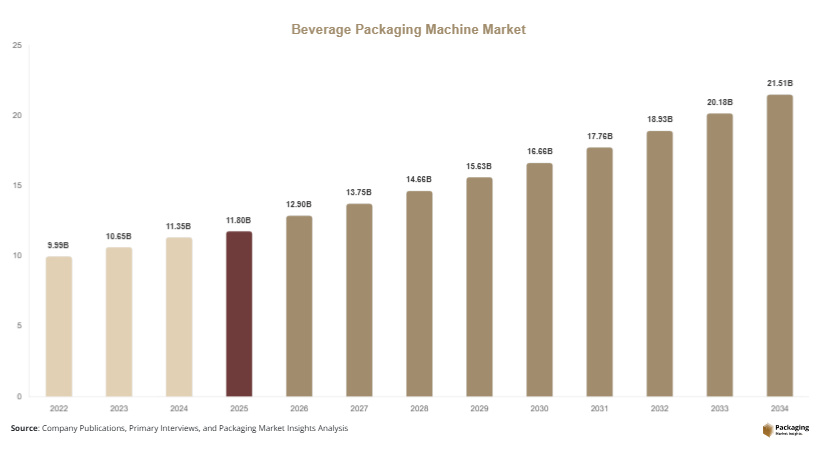
The global beverage packaging machine market size was valued at approximately USD 11.8 billion in 2025 and is projected to reach USD 12.9 billion in 2026. Over the forecast period from 2025 to 2034, the market is expected to grow at a compound annual growth rate (CAGR) of 6.6%, reaching nearly USD 22.7 billion by 2034. This growth is supported by the rising consumption of beverages, technological advancements in packaging machinery, and increasing focus on operational efficiency. The global beverage packaging machine market is witnessing steady growth due to the expanding beverage industry and increasing demand for efficient, automated packaging solutions.
One of the key growth factors is the rapid expansion of the global beverage industry, including segments such as soft drinks, bottled water, alcoholic beverages, and functional drinks. As production volumes increase, manufacturers are investing in advanced packaging machines to improve productivity and maintain product quality. Secondly, automation and digitalization are transforming the packaging sector, enabling companies to reduce labor costs and improve accuracy. Thirdly, the growing emphasis on sustainability is driving the adoption of energy-efficient machines and eco-friendly packaging processes.
Key Market Insights
- Asia Pacific dominated the market with a 38.2% share in 2025, while Latin America is projected to grow at the fastest CAGR of 7.1%.
- Filling machines led the type segment with a 34.7% share, while labeling machines are expected to grow at a CAGR of 7.4%.
- Plastic packaging dominated with a 49.8% share, while paper-based packaging is forecasted to grow at a CAGR of 6.9%.
- Non-alcoholic beverage applications led the segment with 57.3% share, while alcoholic beverages are expected to grow at a CAGR of 6.8%.
- China remained the dominant country with a market size of USD 2.6 billion in 2025 and USD 2.9 billion in 2026.
Explore more data points, trends and opportunities Download Free Sample Report
Market Trends
Increasing adoption of automation and smart packaging technologies
The beverage packaging machine market is undergoing a transformation with the adoption of automation and smart technologies. Manufacturers are integrating advanced systems such as IoT-enabled sensors, robotics, and artificial intelligence to enhance efficiency and reduce operational costs. Automated machines are capable of performing complex tasks with high precision, minimizing human intervention and reducing errors. Smart packaging technologies also enable real-time monitoring of production processes, allowing manufacturers to optimize performance and detect issues early. This trend is particularly important for large-scale beverage producers who require high-speed and reliable packaging solutions to meet growing demand.
Growing focus on sustainable and energy-efficient packaging solutions
Sustainability is becoming a key focus area in the beverage packaging machine market. Companies are investing in machines that consume less energy and support the use of eco-friendly packaging materials. Energy-efficient equipment helps reduce operational costs and environmental impact, making it an attractive option for manufacturers. Additionally, machines that can handle recyclable and biodegradable materials are gaining popularity as companies aim to meet regulatory requirements and consumer expectations. This trend is driving innovation in machine design and encouraging the development of solutions that align with sustainability goals.
Market Drivers
Rising demand for packaged beverages
The increasing consumption of packaged beverages is a major driver of the beverage packaging machine market. Urbanization, changing lifestyles, and rising disposable incomes are contributing to higher demand for ready-to-drink products. Beverage manufacturers are expanding production capacities to meet this demand, which in turn increases the need for advanced packaging machinery. The growth of segments such as bottled water, energy drinks, and functional beverages is further supporting market expansion. As consumer preferences continue to evolve, the demand for efficient packaging solutions is expected to increase.
Technological advancements in packaging machinery
Technological innovation is playing a crucial role in driving the beverage packaging machine market. Modern machines are equipped with features such as high-speed operation, precision filling, and automated quality control. These advancements improve productivity and reduce waste, making them essential for competitive manufacturing. Additionally, the integration of digital technologies allows for better data management and process optimization. As companies seek to enhance operational efficiency, the adoption of advanced packaging machinery is expected to grow.
Market Restraint
High initial investment and maintenance costs
The high cost of acquiring and maintaining advanced packaging machines is a significant restraint for the beverage packaging machine market. Small and medium-sized enterprises may find it challenging to invest in expensive equipment, limiting their ability to adopt modern technologies. Additionally, maintenance and repair costs can be substantial, particularly for complex automated systems. For example, a mid-sized beverage manufacturer may face financial constraints when upgrading to fully automated packaging lines. These cost-related challenges can slow down market adoption, especially in developing regions where budget limitations are more pronounced.
Market Opportunities
Expansion in emerging markets
Emerging economies present significant opportunities for the beverage packaging machine market. Rapid urbanization, population growth, and increasing disposable incomes are driving demand for packaged beverages in regions such as Asia Pacific, Latin America, and Africa. Beverage manufacturers are expanding their operations in these markets, creating a need for advanced packaging solutions. Companies are also establishing local manufacturing facilities to reduce costs and improve supply chain efficiency. As these markets continue to grow, the demand for packaging machinery is expected to increase.
Integration of flexible and multi-format packaging solutions
The demand for flexible packaging solutions is creating new opportunities in the beverage packaging machine market. Manufacturers require machines that can handle multiple packaging formats, including bottles, cans, cartons, and pouches. This flexibility allows companies to cater to diverse consumer preferences and adapt to changing market trends. Additionally, multi-format machines improve operational efficiency by reducing the need for multiple production lines. As the beverage industry becomes more dynamic, the adoption of flexible packaging solutions is expected to rise.
Report Scope
| Report Metric | Details |
|---|---|
| Market Size in 2025 | USD 11.8 Billion |
| Market Size in 2026 | USD 12.9 Billion |
| Market Size in 2034 | USD 22.7 Billion |
| CAGR | 6.6% (2026-2034) |
| Base Year for Estimation | 2025 |
| Historical Data | 2022-2024 |
| Forecast Period | 2026-2034 |
| Report Coverage | Revenue Forecast, Competitive Landscape, Supply Chain Disruption, Growth Factors, Environment & Regulatory Landscape and Trends |
| Geographies Covered | North America, Europe, APAC, Middle East and Africa, LATAM |
| Countries Covered | U.S., Canada, U.K., Germany, France, Spain, Italy, Russia, Nordic, Benelux, Rest of Europe, China, South Korea, Japan, India, Australia, Singapore, Taiwan, South East Asia, Rest of Asia-Pacific, UAE, Turky, Saudi Arabia, South Africa, Egypt, Nigeria, Rest of MEA, Brazil, Mexico, Argentina, Chile, Colombia, Rest of LATAM |
Explore more data points, trends and opportunities Download Free Sample Report
Segmental Analysis
By Machine Type
Filling machines accounted for the largest share of approximately 34.7% in 2024. These machines are essential for accurately dispensing beverages into containers, ensuring consistency and quality. They are widely used across various beverage segments, including bottled water, soft drinks, and alcoholic beverages. The ability to handle high production volumes and maintain precision makes filling machines a critical component of packaging lines.
Labeling machines are expected to grow at a CAGR of 7.4% during the forecast period. These machines play a crucial role in product identification and branding. The increasing demand for customized and visually appealing packaging is driving the adoption of advanced labeling solutions. Technological advancements are enabling high-speed labeling with improved accuracy, supporting market growth.
By Packaging Type
Plastic packaging dominated the market in 2024, holding a share of 49.8%. Plastic containers are widely used due to their lightweight nature and cost-effectiveness. Packaging machines designed for plastic containers are highly efficient and capable of handling large production volumes, contributing to their dominance in the market.
Paper-based packaging is expected to grow at a CAGR of 6.9%. The increasing focus on sustainability is driving the adoption of paper-based materials. Packaging machines capable of handling these materials are gaining popularity as companies aim to reduce environmental impact and meet regulatory requirements.
By Application
Non-alcoholic beverages dominated the market in 2024, with a share of 57.3%. This segment includes products such as bottled water, soft drinks, and juices, which have high consumption rates globally. The demand for efficient packaging solutions is driven by the need to meet large production volumes.
Alcoholic beverages are expected to grow at a CAGR of 6.8%. The increasing demand for premium alcoholic drinks is driving the adoption of advanced packaging machinery. These machines ensure product quality and enhance packaging aesthetics, supporting growth in this segment.
Beverage Packaging Machine Market Segmentations
By Machine Type
- Filling Machines
- Labeling Machines
- Capping Machines
- Wrapping & Palletizing Machines
By Packaging Type
- Plastic Packaging
- Glass Packaging
- Metal Packaging
- Paper-Based Packaging
By Application
- Non-Alcoholic Beverages
- Alcoholic Beverages
Regional Analysis
North America
North America accounted for approximately 24.8% of the beverage packaging machine market share in 2025 and is projected to grow at a CAGR of 5.9% during the forecast period. The region benefits from a well-established beverage industry and high adoption of advanced technologies. Companies are investing in automation to improve efficiency and meet consumer demand for packaged beverages.
The United States dominates the regional market due to its large beverage production capacity and strong presence of leading manufacturers. A key growth factor is the increasing demand for premium and functional beverages, which requires advanced packaging solutions to maintain quality and appeal.
Europe
Europe held a market share of 26.1% in 2025 and is expected to grow at a CAGR of 6.1%. The region is characterized by stringent regulations and a strong focus on sustainability. Companies are adopting energy-efficient machines and eco-friendly packaging processes to comply with regulatory requirements.
Germany leads the European market, supported by its advanced manufacturing capabilities and focus on innovation. A unique growth factor is the increasing adoption of sustainable packaging technologies, which is driving demand for modern packaging machinery.
Asia Pacific
Asia Pacific dominated the market with a 38.2% share in 2025 and is projected to grow at a CAGR of 7.1%. Rapid urbanization, population growth, and rising disposable incomes are key factors driving market expansion. The growing demand for packaged beverages further supports growth.
China is the dominant country, driven by its large consumer base and strong manufacturing sector. A unique growth factor is the rapid expansion of the beverage industry, which increases the need for efficient packaging solutions.
Middle East & Africa
The Middle East & Africa region accounted for 5.6% of the market share in 2025 and is expected to grow at a CAGR of 6.0%. The market is gradually expanding due to increasing demand for packaged beverages and improvements in retail infrastructure.
Saudi Arabia is a key market in the region, supported by its growing beverage industry. A unique growth factor is the increasing demand for bottled water, which drives the need for packaging machinery.
Latin America
Latin America accounted for 5.3% of the market share in 2025 and is projected to grow at the fastest CAGR of 7.1%. The region is experiencing growth in beverage consumption due to changing lifestyles and economic development.
Brazil dominates the regional market, supported by its large population and expanding beverage industry. A unique growth factor is the rising demand for soft drinks and alcoholic beverages, which boosts the need for packaging machines.
Competitive Landscape
The beverage packaging machine market is characterized by the presence of several global and regional players focusing on innovation and technological advancement. Companies are investing in research and development to enhance machine performance and meet evolving industry requirements. Strategic partnerships and acquisitions are also common strategies to expand market presence.
Krones AG is recognized as a leading player in the market, known for its advanced packaging solutions and strong global presence. The company recently introduced a new generation of energy-efficient packaging machines designed to reduce operational costs. Other key players, including Tetra Pak International S.A., Sidel Group, KHS GmbH, and Coesia Group, are also активно investing in innovation to maintain competitiveness.
Key Players List
- Krones AG
- Tetra Pak International S.A.
- Sidel Group
- KHS GmbH
- Coesia Group
- GEA Group AG
- IMA Group
- Barry-Wehmiller Companies
- ProMach Inc.
- Syntegon Technology GmbH
- Duravant LLC
- Accutek Packaging Equipment Companies
- Karmelle Ltd.
- Serac Group
- OPTIMA packaging group GmbH