Nordic Beverage Packaging Market Size and Growth
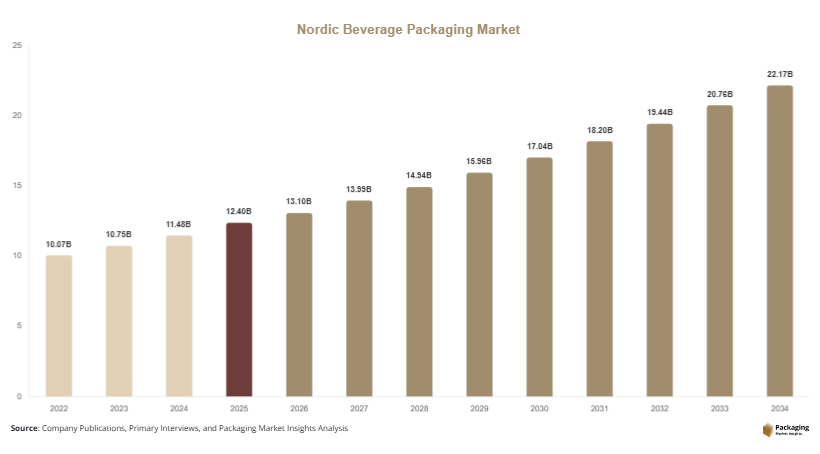
The global nordic beverage packaging market size is estimated at approximately USD 12.4 billion in 2025, reflecting strong adoption of recyclable and lightweight packaging formats across Sweden, Denmark, Norway, Finland, and Iceland. By 2026, the market is projected to reach around USD 13.1 billion, supported by rising investments in circular economy initiatives and eco-friendly material innovation. Looking ahead, the market is expected to attain a value of USD 22.8 billion by 2034, registering a CAGR of 6.8% from 2025 to 2034. The nordic beverage packaging market is witnessing steady expansion driven by increasing demand for sustainable packaging solutions, evolving beverage consumption patterns, and strict environmental regulations across Nordic countries.
Key growth is driven by three major factors: increasing regulatory pressure to reduce plastic waste, rapid expansion of ready-to-drink beverage consumption, and technological advancements in barrier packaging materials. Beverage manufacturers are increasingly shifting toward paper-based cartons, PET bottles with higher recycled content, and bio-based packaging alternatives. Additionally, consumer preference for sustainable and convenient packaging formats continues to reshape product design strategies across the region.
Key Highlights:
- Asia Pacific dominated the market with a 37.4% share in 2025.
- Latin America is projected to grow at the fastest CAGR of 6.2%.
- HDPE containers led the material segment with a 42.6% share in 2025.
- Bottles & jerry cans dominated with a 48.1% share in 2025.
- Crop protection applications led with a 51.3% share in 2025.
- The US remained the dominant country with a market size of USD 132.6 million in 2025 and USD 141.2 million in 2026.
Explore more data points, trends and opportunities Download Free Sample Report
Market Trends
Shift Toward Circular Economy Packaging Systems
The nordic beverage packaging market is strongly influenced by the transition toward circular economy models, where packaging materials are designed for reuse, recycling, and reduced environmental impact. Governments in the region are enforcing strict extended producer responsibility (EPR) policies, pushing beverage companies to redesign packaging formats. This trend is leading to increased adoption of refillable bottles, recycled PET (rPET), and fiber-based cartons. Beverage brands are also investing in closed-loop recycling systems to ensure materials re-enter production cycles. The integration of eco-labeling and sustainability certifications is further enhancing consumer awareness, encouraging manufacturers to adopt greener packaging alternatives across all beverage categories.
Growth of Smart and Functional Beverage Packaging
Another major trend is the rise of smart and functional packaging solutions in the nordic beverage packaging market. Companies are integrating QR codes, freshness indicators, and temperature-sensitive labels to enhance consumer engagement and product safety. This trend is particularly visible in premium beverage segments such as energy drinks, craft beverages, and functional health drinks. Smart packaging not only improves traceability but also supports brand differentiation in a competitive market. Additionally, advancements in barrier coatings and oxygen-resistant materials are extending shelf life, reducing food waste, and improving logistics efficiency across the Nordic supply chain.
Market Drivers
Strong Environmental Regulations and Sustainability Mandates
One of the primary drivers of the nordic beverage packaging market is the region’s stringent environmental regulations. Governments across Nordic countries have implemented aggressive sustainability targets aimed at reducing single-use plastics and carbon emissions. These policies are compelling beverage manufacturers to adopt recyclable, biodegradable, and compostable packaging materials. Regulatory frameworks such as deposit return systems and plastic taxes are further accelerating the transition toward eco-friendly packaging solutions. As a result, companies are investing heavily in material innovation and sustainable production technologies to comply with evolving standards and maintain market competitiveness.
Rising Consumption of Packaged and Ready-to-Drink Beverages
The increasing demand for packaged and ready-to-drink beverages is significantly driving market growth. Urbanization, busy lifestyles, and changing dietary habits are encouraging consumers to prefer convenient beverage packaging formats such as bottles, cartons, and cans. This trend is particularly strong in segments like bottled water, functional drinks, dairy beverages, and alcoholic beverages. Beverage companies are expanding product portfolios and introducing innovative packaging designs to enhance portability and shelf appeal. The growing retail and e-commerce distribution channels further strengthen demand for durable and lightweight packaging solutions across the Nordic region.
Market Restraint
High Cost of Sustainable Packaging Materials and Production
A key restraint affecting the nordic beverage packaging market is the relatively high cost associated with sustainable packaging materials and advanced production technologies. While demand for eco-friendly packaging is increasing, materials such as bio-based plastics, advanced paper composites, and high-grade recycled polymers often come at a premium cost compared to conventional plastic solutions. Additionally, upgrading manufacturing facilities to accommodate sustainable production processes requires significant capital investment. Small and mid-sized beverage companies face challenges in adopting these solutions due to limited budgets and higher operational costs. This cost barrier can slow down large-scale adoption, especially in price-sensitive product segments. Furthermore, fluctuations in raw material supply chains and limited availability of high-quality recycled inputs add further complexity, impacting production scalability and pricing stability across the region.
Market Opportunities
Expansion of Bio-Based and Compostable Packaging Materials
The nordic beverage packaging market presents significant opportunities in the development and adoption of bio-based and compostable packaging materials. Increasing environmental awareness among consumers and strict regulatory frameworks are driving demand for sustainable alternatives to traditional plastics. Companies are investing in plant-based polymers, biodegradable films, and fiber-based packaging solutions to reduce environmental impact. This shift opens new avenues for material innovation and product differentiation. Beverage manufacturers that adopt compostable packaging can strengthen brand positioning and improve compliance with sustainability targets, creating long-term growth potential in both premium and mass-market beverage segments.
Growth of Digitalization and Smart Packaging Integration
Digital transformation offers another major opportunity for the nordic beverage packaging market. Smart packaging technologies such as NFC tags, QR codes, and IoT-enabled tracking systems are gaining traction across beverage supply chains. These innovations improve traceability, enhance consumer engagement, and provide real-time product information. Beverage companies can leverage digital packaging to offer personalized marketing experiences and improve transparency regarding product sourcing and sustainability. The integration of digital solutions also supports inventory management and reduces supply chain inefficiencies, creating value for manufacturers, retailers, and end consumers alike.
Report Scope
| Report Metric | Details |
|---|---|
| Market Size in 2025 | USD 12.4 Billion |
| Market Size in 2026 | USD 13.1 Billion |
| Market Size in 2034 | USD 22.8 Billion |
| CAGR | 6.8% (2026-2034) |
| Base Year for Estimation | 2025 |
| Historical Data | 2022-2024 |
| Forecast Period | 2026-2034 |
| Report Coverage | Revenue Forecast, Competitive Landscape, Supply Chain Disruption, Growth Factors, Environment & Regulatory Landscape and Trends |
| Geographies Covered | North America, Europe, APAC, Middle East and Africa, LATAM |
| Countries Covered | U.S., Canada, U.K., Germany, France, Spain, Italy, Russia, Nordic, Benelux, Rest of Europe, China, South Korea, Japan, India, Australia, Singapore, Taiwan, South East Asia, Rest of Asia-Pacific, UAE, Turky, Saudi Arabia, South Africa, Egypt, Nigeria, Rest of MEA, Brazil, Mexico, Argentina, Chile, Colombia, Rest of LATAM |
Explore more data points, trends and opportunities Download Free Sample Report
Segmental Analysis
By Material Type
The material type segment plays a critical role in shaping the nordic beverage packaging market, with plastic-based packaging currently dominating the landscape. In 2024, plastic materials accounted for approximately 42% market share, primarily driven by the widespread use of PET bottles in bottled water, soft drinks, and dairy beverages. PET remains the preferred material due to its lightweight nature, cost efficiency, and strong recyclability infrastructure across Nordic countries. Additionally, glass packaging maintains a stable presence in premium beverage categories, particularly alcoholic beverages and specialty drinks, where product preservation and premium positioning are key factors.
Metal packaging, especially aluminum cans, also holds a significant share due to its high recyclability and growing adoption in carbonated beverages and energy drinks. Paper and paperboard packaging, particularly in carton formats, is gaining momentum as beverage companies shift toward renewable and fiber-based alternatives. The Nordic region’s strong recycling ecosystem ensures efficient recovery of these materials, reinforcing their adoption across supply chains.
The fastest-growing subsegment within material type is bio-based materials, projected to register a CAGR of 8.2% through 2034. This growth is driven by increasing regulatory pressure to reduce fossil-based plastic usage and rising consumer demand for environmentally friendly packaging solutions. Bio-based polymers, plant-derived plastics, and compostable materials are being widely tested and commercialized. Beverage manufacturers are also investing in material innovation to improve barrier performance and durability while maintaining sustainability objectives. This transition is expected to significantly reshape material sourcing strategies in the nordic beverage packaging market over the forecast period.
By Packaging Type
The packaging type segment is dominated by bottles, which accounted for approximately 45% market share in 2024. Bottles remain the most widely used packaging format due to their versatility, convenience, and compatibility with a wide range of beverages including bottled water, juices, soft drinks, and dairy products. PET bottles, in particular, are highly preferred due to their lightweight structure and recyclability. Glass bottles continue to be used in premium alcoholic beverages, maintaining strong demand in niche segments.
Cans also represent a significant portion of the market, especially in carbonated soft drinks, beer, and energy drinks. Their durability, portability, and high recycling rates make them an attractive packaging option in the nordic beverage packaging market. Cartons are gaining popularity due to their sustainable profile and increasing use in aseptic packaging for juices and dairy beverages.
The fastest-growing subsegment is cartons, projected to grow at a CAGR of 7.9% through 2034. Growth is driven by rising demand for sustainable and renewable packaging formats, particularly those made from paper-based materials. Innovations in barrier coatings and aseptic technology are enhancing product shelf life without compromising recyclability. Beverage companies are increasingly adopting carton packaging to align with sustainability goals and reduce environmental impact, especially in the Nordic region where eco-conscious consumer behavior is highly influential.
By Beverage Type
The beverage type segment is led by non-alcoholic beverages, which accounted for approximately 60% market share in 2024. This dominance is driven by high consumption of bottled water, soft drinks, and dairy-based beverages across Nordic countries. Strong retail distribution networks and consumer preference for convenient packaging formats further support growth in this segment. Packaging innovation in this category focuses on lightweight materials and improved recyclability.
Alcoholic beverages, while smaller in volume share, represent a stable segment with consistent demand for glass bottles, cans, and premium packaging formats. Functional beverages are emerging as a high-growth category due to increasing health consciousness and demand for energy drinks, sports drinks, and wellness beverages.
The fastest-growing subsegment is functional beverages, expected to grow at a CAGR of 8.5% through 2034. This growth is driven by shifting consumer preferences toward health-oriented drinks enriched with vitamins, minerals, and natural ingredients. Packaging innovation in this segment focuses on portability, shelf appeal, and smart labeling features that provide nutritional transparency and product differentiation.
Nordic Beverage Packaging Market Segmentations
By Material Type
- Plastic
- Glass
- Metal
- Paper & Paperboard
- Bio-based Materials
By Packaging Type
- Bottles
- Cans
- Cartons
- Pouches
- Others
By Beverage Type
- Non-alcoholic Beverages
- Alcoholic Beverages
- Functional Beverages
- Dairy-based Beverages
Regional Analysis
North America
North America holds an indirect but strategically influential position in the nordic beverage packaging market, accounting for approximately 22% share in 2025, with a projected CAGR of 6.4% through 2034. While the Nordic region is the core production and innovation hub, North America plays a key role in technology adoption, packaging machinery imports, and sustainability benchmarking. Many global packaging firms operating in Nordic countries also maintain strong supply chain and R&D linkages with the United States and Canada, creating cross-regional synergy in packaging innovation.
The market influence of North America is particularly visible in the adoption of advanced beverage packaging technologies such as lightweight aluminum cans, high-barrier PET bottles, and smart labeling systems. Nordic manufacturers often align with North American sustainability standards when exporting packaged beverages or collaborating with multinational beverage brands. Increasing consumer awareness regarding plastic pollution in the U.S. has also encouraged Nordic-inspired circular packaging models, especially in premium beverage categories.
The United States dominates the region due to its large-scale beverage industry and strong presence of multinational corporations. A key growth factor is the increasing adoption of deposit return schemes (DRS) in several states, inspired by Nordic regulatory frameworks. Canada also contributes significantly, driven by strict environmental policies and rising demand for recyclable beverage packaging solutions.
Europe
Europe is the dominant region in the nordic beverage packaging market, accounting for approximately 38% share in 2025, with a strong projected CAGR of 7.0% through 2034. The Nordic countries—Sweden, Denmark, Norway, Finland, and Iceland—form the innovation core of this regional market due to their highly advanced recycling infrastructure, strong environmental governance, and consumer preference for sustainable packaging formats. Europe as a whole benefits from harmonized sustainability regulations under EU packaging directives, which further accelerate adoption of eco-friendly beverage packaging systems.
The region is characterized by widespread implementation of circular economy practices, including deposit return systems, extended producer responsibility (EPR), and mandatory recycled content targets. Beverage companies across Europe are increasingly transitioning toward paper-based cartons, aluminum cans with high recycled content, and reusable bottle systems. The Nordic region plays a leadership role in setting packaging benchmarks that are later adopted across Germany, France, and the UK.
Germany is the leading country in this region due to its advanced manufacturing ecosystem and strong recycling infrastructure. A key growth driver is the expansion of high-efficiency waste sorting systems and increasing collaboration between beverage producers and packaging recyclers. Additionally, consumer demand for environmentally responsible packaging is significantly higher in Germany, reinforcing the shift toward sustainable beverage packaging formats.
Asia Pacific
Asia Pacific accounts for approximately 20% share in 2025, with the fastest regional CAGR of 7.5% through 2034 in the nordic beverage packaging market ecosystem. Although geographically distant, Asia Pacific is strongly influenced by Nordic packaging technologies through exports, licensing agreements, and sustainability partnerships. The region’s rapid urbanization and rising disposable incomes are driving significant demand for packaged beverages, creating opportunities for Nordic packaging solution providers.
Countries such as China, India, Japan, and South Korea are increasingly adopting sustainable packaging practices inspired by Nordic environmental frameworks. Beverage manufacturers in Asia Pacific are investing in lightweight packaging formats, recyclable plastics, and smart labeling technologies to enhance supply chain efficiency and meet global sustainability expectations. Nordic companies are expanding their presence in the region through joint ventures and technology transfers.
China dominates the Asia Pacific market due to its massive beverage production scale and rapidly evolving packaging industry. A key growth factor is the government-led push toward green packaging and carbon neutrality goals, which aligns closely with Nordic packaging principles. Japan also contributes significantly, with strong demand for premium beverage packaging and high-quality recyclable materials.
Middle East & Africa
The Middle East & Africa region holds approximately 10% share in 2025, with a projected CAGR of 6.1% through 2034 in the nordic beverage packaging market landscape. Growth in this region is primarily driven by expanding beverage consumption, rising urban populations, and increasing penetration of retail and hospitality sectors. Although sustainability regulations are less stringent compared to Europe, awareness regarding environmental impact is steadily increasing.
Nordic packaging companies are gradually expanding their presence in this region by introducing cost-effective recyclable packaging solutions tailored to local market conditions. Beverage imports, particularly bottled water, juices, and energy drinks, are rising, which is supporting demand for durable and lightweight packaging formats. Infrastructure development in retail and logistics is also improving packaging distribution efficiency.
The United Arab Emirates leads the region due to its strong retail infrastructure and high consumption of imported beverages. A key growth factor is the increasing adoption of premium packaging formats in hospitality and tourism sectors. Saudi Arabia is also emerging as a key market due to ongoing economic diversification and sustainability initiatives aligned with Vision 2030.
Latin America
Latin America represents approximately 10% share in 2025, with a CAGR of 6.3% through 2034 in the nordic beverage packaging market. The region is experiencing steady growth in beverage consumption, particularly in countries such as Brazil, Mexico, and Argentina. Increasing urbanization and retail modernization are driving demand for efficient and recyclable packaging systems.
Nordic packaging technologies are gradually being introduced in Latin America through partnerships and technology transfer initiatives. Beverage manufacturers are increasingly adopting PET recycling systems, aluminum can usage, and lightweight packaging formats to reduce costs and improve sustainability performance. Regulatory frameworks are also slowly evolving to encourage recycling and waste reduction.
Brazil dominates the region due to its large beverage production base and strong domestic consumption. A key growth factor is the expansion of municipal recycling programs and increasing consumer awareness regarding environmental sustainability. Mexico also plays a significant role, supported by strong beverage export activity and growing adoption of modern packaging technologies.
Competitive Landscape
The nordic beverage packaging market is moderately consolidated, with leading players focusing on sustainability, innovation, and material efficiency. Key companies include Tetra Pak, Ball Corporation, Stora Enso, Amcor, and DS Smith. These companies are investing heavily in recyclable materials, lightweight packaging, and digital integration technologies.
Tetra Pak remains a leading player due to its strong presence in carton-based beverage packaging and continuous innovation in renewable materials. Recently, the company expanded its fiber-based barrier technology to improve recyclability and reduce carbon footprint across Nordic operations. Competition is intensifying as companies focus on reducing environmental impact while maintaining cost efficiency and packaging performance.
Key Players List
- Amcor plc
- Mondi Group
- Tetra Pak International S.A.
- Ball Corporation
- Stora Enso Oyj
- DS Smith Plc
- Huhtamaki Oyj
- Berry Global Inc.
- Crown Holdings Inc.
- Ardagh Group S.A.
- Smurfit Kappa Group
- Sealed Air Corporation
- Graphic Packaging International
- Elopak AS
- Billerud AB