Specialty Label Packaging Market Size and Growth
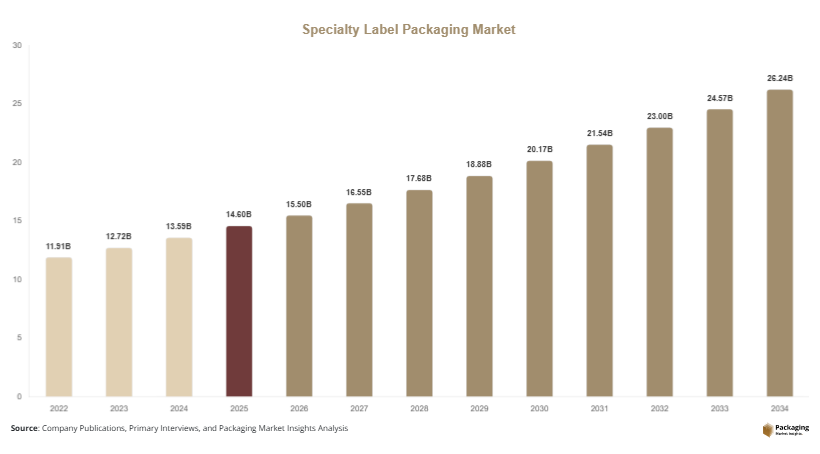
The global specialty label packaging market size was valued at approximately USD 14.6 billion in 2025 and is projected to reach USD 15.5 billion in 2026. By 2034, the market is expected to expand to nearly USD 26.9 billion, registering a CAGR of 6.8% during 2025–2034. The specialty label packaging market is experiencing steady growth due to increasing demand for advanced labeling solutions across industries such as food & beverages, pharmaceuticals, personal care, chemicals, logistics, and consumer electronics. Specialty labels are designed to provide enhanced functionality, branding, security, and product information while improving product identification and traceability. These labels include pressure-sensitive labels, shrink sleeve labels, RFID labels, security labels, and in-mold labels that cater to evolving packaging and compliance requirements.
One of the key growth factors supporting the specialty label packaging market is the rising demand for product traceability and anti-counterfeit packaging solutions. Industries such as pharmaceuticals and food processing are increasingly adopting RFID-enabled and tamper-evident labels to improve supply chain transparency and regulatory compliance. Another major factor is the rapid expansion of e-commerce and organized retail sectors, which require durable and informative labels for efficient logistics and inventory management. The growth of premium product packaging is also contributing to market expansion, as manufacturers increasingly use decorative and customized labels to enhance brand visibility and consumer engagement.
Key Highlights
- Asia Pacific dominated the market with a 38.7% share in 2025.
- Latin America is projected to grow at the fastest CAGR of 7.2%.
- Pressure-sensitive labels led the type segment with a 34.9% share.
- Plastic-based label materials dominated with a 46.3% share.
- Food & beverage applications led the segment with 37.5% share.
- The US remained the dominant country with a market size of USD 3.2 billion in 2025 and USD 3.4 billion in 2026.
Explore more data points, trends and opportunities Download Free Sample Report
Market Trends
Increasing Adoption of Smart and RFID Labels
The adoption of smart labeling technologies is becoming a major trend in the specialty label packaging market. RFID labels, QR-coded labels, and NFC-enabled packaging solutions are increasingly being used to improve product traceability, inventory management, and customer interaction. Food, pharmaceutical, and logistics companies are integrating digital labels into supply chain systems to enhance operational visibility and reduce counterfeit risks. Smart labels also support real-time product tracking and automated inventory control, improving efficiency across distribution networks. In addition, brands are using interactive labels to provide consumers with product authentication, sustainability information, and promotional content. As digital transformation accelerates across industries, demand for connected and intelligent labeling solutions is expected to increase steadily.
Rising Demand for Sustainable and Linerless Labels
Sustainability-focused innovations are strongly influencing the specialty label packaging market. Manufacturers are increasingly developing recyclable label materials, biodegradable adhesives, and linerless labeling formats to reduce packaging waste. Linerless labels help lower material consumption and improve operational efficiency because they eliminate backing liners that often contribute to industrial waste. Companies are also adopting water-based inks and recyclable paper substrates to align with environmental regulations and consumer preferences. Food and beverage companies are particularly investing in eco-friendly labeling solutions as sustainability becomes an important factor in purchasing decisions. This trend is expected to encourage further innovation in renewable materials and environmentally responsible printing technologies.
Market Drivers
Growth in Packaged Food and Beverage Consumption
The increasing consumption of packaged food and beverage products is a major driver of the specialty label packaging market. Food manufacturers require high-quality labels for branding, nutritional information, regulatory compliance, and product traceability. Specialty labels such as shrink sleeves and pressure-sensitive labels help improve shelf visibility and enhance packaging aesthetics. The expansion of ready-to-eat meals, bottled beverages, and frozen food products is contributing to higher demand for durable and moisture-resistant labeling solutions. In addition, changing consumer lifestyles and rapid urbanization are increasing reliance on packaged food products globally. As retail shelves become more competitive, manufacturers are investing in premium labeling designs to improve product differentiation and customer engagement.
Increasing Regulatory Requirements for Product Identification
Strict regulations regarding product labeling and traceability are significantly driving the specialty label packaging market. Industries such as pharmaceuticals, chemicals, and healthcare must comply with detailed labeling requirements related to safety instructions, batch tracking, expiration dates, and authentication codes. Governments are increasingly mandating serialization and anti-counterfeit labeling systems to improve supply chain security and consumer safety. Specialty labels equipped with tamper-evident features and RFID technology help companies meet these regulatory requirements efficiently. Additionally, global trade expansion has increased the need for multilingual and standardized labeling formats. The growing emphasis on product transparency and regulatory compliance is expected to support long-term market growth.
Market Restraint
Fluctuating Raw Material Costs and Printing Expenses
One of the primary restraints affecting the specialty label packaging market is the fluctuation in raw material costs and printing expenses. Specialty labels often require advanced substrates, adhesives, coatings, and printing technologies, which can increase overall production costs. Variations in prices of paper, plastic films, inks, and adhesive materials can significantly impact manufacturer profit margins. Smaller packaging companies may face challenges in adopting advanced digital printing and smart labeling technologies because of high capital investment requirements. For example, RFID-enabled labels involve additional electronic components and software integration, making them more expensive than conventional labels. In addition, rising energy and transportation costs can increase operational expenses across the labeling supply chain. These factors may limit adoption among cost-sensitive industries and smaller businesses, particularly in developing markets where packaging budgets are more constrained. Manufacturers must continuously balance performance, sustainability, and affordability to remain competitive in the evolving specialty labeling industry.
Market Opportunities
Expansion of Smart Packaging and Digital Printing
The increasing adoption of smart packaging technologies presents significant opportunities for the specialty label packaging market. Companies are integrating RFID tags, QR codes, and interactive digital elements into labels to improve consumer engagement and supply chain visibility. Smart labels allow brands to provide product authentication, promotional campaigns, and sustainability information directly through mobile devices. In addition, digital printing technologies are enabling cost-effective short-run production and personalized packaging designs. The growing demand for customized labels across cosmetics, beverages, and healthcare industries is encouraging investment in advanced printing systems. As industries continue embracing digital transformation, the demand for technologically advanced specialty labels is expected to rise considerably.
Growth in Sustainable Packaging Solutions
The rising focus on environmentally responsible packaging is creating strong opportunities for sustainable specialty labels. Manufacturers are developing recyclable paper labels, compostable adhesives, and linerless labeling technologies to reduce environmental impact. Consumer goods companies are increasingly seeking eco-friendly labeling solutions to support sustainability commitments and improve brand perception. Regulatory pressures regarding plastic waste reduction are also encouraging adoption of renewable materials in packaging applications. Innovations in biodegradable substrates and water-based inks are improving the durability and visual quality of sustainable labels. As sustainability becomes a central packaging strategy across industries, demand for environmentally friendly specialty label solutions is expected to expand steadily.
Report Scope
| Report Metric | Details |
|---|---|
| Market Size in 2025 | USD 14.6 Billion |
| Market Size in 2026 | USD 15.5 Billion |
| Market Size in 2034 | USD 26.9 Billion |
| CAGR | 6.8% (2026-2034) |
| Base Year for Estimation | 2025 |
| Historical Data | 2022-2024 |
| Forecast Period | 2026-2034 |
| Report Coverage | Revenue Forecast, Competitive Landscape, Supply Chain Disruption, Growth Factors, Environment & Regulatory Landscape and Trends |
| Geographies Covered | North America, Europe, APAC, Middle East and Africa, LATAM |
| Countries Covered | U.S., Canada, U.K., Germany, France, Spain, Italy, Russia, Nordic, Benelux, Rest of Europe, China, South Korea, Japan, India, Australia, Singapore, Taiwan, South East Asia, Rest of Asia-Pacific, UAE, Turky, Saudi Arabia, South Africa, Egypt, Nigeria, Rest of MEA, Brazil, Mexico, Argentina, Chile, Colombia, Rest of LATAM |
Explore more data points, trends and opportunities Download Free Sample Report
Segmental Analysis
By Type
Pressure-sensitive labels dominated the specialty label packaging market in 2024, accounting for approximately 34.9% of total market revenue. These labels are widely preferred because they offer easy application, high print quality, and compatibility with different packaging surfaces. Pressure-sensitive labels are extensively used across food packaging, personal care products, pharmaceuticals, and logistics applications due to their flexibility and durability. Manufacturers are increasingly using advanced adhesive technologies and premium printing techniques to improve product visibility and labeling performance. The rise of retail-ready packaging and consumer-focused branding strategies is further supporting demand for pressure-sensitive labeling solutions across global packaging industries.
RFID labels are projected to be the fastest-growing subsegment, registering a CAGR of 7.8% during the forecast period. These labels provide advanced tracking and inventory management capabilities, making them increasingly valuable for retail, healthcare, and logistics applications. RFID technology improves supply chain visibility and reduces operational errors by enabling automated data collection and real-time product monitoring. Retailers and pharmaceutical companies are rapidly adopting RFID labels to improve inventory control and combat counterfeit products. The growth of smart packaging and connected supply chains is expected to significantly support expansion of RFID-based specialty labeling solutions over the coming years.
By Material
Plastic-based label materials held the dominant share of the specialty label packaging market in 2024, accounting for approximately 46.3% of total revenue. Plastic films such as polypropylene, polyethylene, and polyester are widely used because they provide moisture resistance, durability, and compatibility with high-quality printing applications. These materials are suitable for beverage, cosmetics, and chemical packaging where labels must withstand harsh storage and transportation conditions. Manufacturers continue to invest in advanced coatings and adhesives to improve label durability and visual appeal. Plastic-based specialty labels also support shrink sleeve and wrap-around applications commonly used in consumer goods packaging.
Paper-based sustainable labels are expected to grow at the fastest CAGR of 7.4% through 2034. Increasing environmental awareness and regulatory pressure regarding plastic waste reduction are encouraging adoption of recyclable and biodegradable paper labels. Food and beverage companies are increasingly shifting toward renewable packaging materials to improve sustainability performance and meet consumer expectations. Advances in water-resistant paper coatings and eco-friendly adhesives are improving the functionality and durability of paper-based labels. Packaging companies are also introducing FSC-certified and compostable labeling solutions to strengthen sustainability initiatives across consumer product industries.
By End-Use Industry
The food & beverage segment dominated the specialty label packaging market in 2024 with a revenue share of approximately 37.5%. Labels play a critical role in food packaging by providing nutritional information, branding, regulatory compliance, and traceability features. Increasing demand for packaged foods, bottled beverages, and convenience products is driving strong demand for specialty labeling solutions. Food manufacturers are adopting decorative and tamper-evident labels to improve product safety and shelf visibility. The rise of organized retail and online grocery platforms is further supporting market growth because labels help improve logistics tracking and consumer communication.
Pharmaceutical labeling is anticipated to grow at the fastest CAGR of 7.6% during the forecast period. Increasing regulations regarding drug traceability, serialization, and patient safety are encouraging pharmaceutical companies to adopt advanced specialty labels. RFID-enabled and tamper-proof labels are becoming increasingly important for preventing counterfeit medicines and improving supply chain security. The growing production of biologics, vaccines, and specialty medicines is also supporting demand for durable and information-rich labels. In addition, healthcare providers and regulatory agencies are emphasizing accurate labeling and digital tracking systems to improve patient safety and operational efficiency.
Specialty Label Packaging Market Segmentations
By Type
- Pressure-Sensitive Labels
- Shrink Sleeve Labels
- RFID Labels
- In-Mold Labels
By Material
- Plastic-Based Labels
- Paper-Based Labels
- Metalized Labels
- Sustainable Labels
By End-Use Industry
- Food & Beverage
- Pharmaceuticals
- Personal Care & Cosmetics
- Chemicals
- Consumer Electronics
By Distribution Channel
- Direct Sales
- Packaging Distributors
- Online Packaging Suppliers
- Retail Packaging Vendors
Regional Analysis
North America
North America accounted for approximately 29.1% of the global specialty label packaging market share in 2025 and is expected to grow at a CAGR of 6.1% during the forecast period. The region benefits from advanced packaging infrastructure and strong demand from food, healthcare, and logistics industries. Increasing adoption of RFID-enabled labels and digital printing technologies is supporting market growth. Sustainability regulations and growing demand for premium packaging are also encouraging investment in recyclable labeling materials and linerless label technologies.
The United States dominates the North American market because of its large consumer goods and pharmaceutical industries. One unique growth factor is the rapid expansion of e-commerce logistics operations that require advanced tracking and inventory labeling systems. Companies are increasingly using smart labels and automated barcode solutions to improve warehouse management and delivery efficiency across retail supply chains.
Europe
Europe held around 23.5% of the specialty label packaging market share in 2025 and is projected to grow at a CAGR of 5.9% through 2034. Strong environmental regulations and increasing demand for sustainable packaging solutions are major factors driving regional growth. Food safety requirements and pharmaceutical serialization mandates are also encouraging adoption of advanced specialty labels. European manufacturers are investing in recyclable materials and energy-efficient printing technologies to improve environmental compliance.
Germany remains the dominant country in the European market due to its strong industrial manufacturing and packaging sectors. One unique growth factor is the increasing use of specialty labels in premium beverage packaging. Beverage producers are adopting decorative shrink sleeves and smart labels to improve product branding, traceability, and consumer interaction across competitive retail markets.
Asia Pacific
Asia Pacific dominated the specialty label packaging market with a 38.7% share in 2025 and is expected to grow at a CAGR of 7.3% during the forecast period. Rising urbanization, expanding retail sectors, and increasing packaged goods consumption are major growth drivers in the region. Food processing, healthcare, and e-commerce industries are creating strong demand for durable and cost-effective labeling solutions. Rapid industrialization and manufacturing expansion are also supporting regional market development.
China is the leading country in the Asia Pacific market because of its extensive manufacturing base and growing packaging industry. One unique growth factor is the rapid expansion of domestic e-commerce platforms that require high-volume logistics and barcode labeling solutions. Packaging companies are increasingly investing in automated label printing and smart packaging systems to meet rising distribution and retail requirements.
Middle East & Africa
The Middle East & Africa region accounted for approximately 4.8% of the global market share in 2025 and is projected to grow at a CAGR of 6.0% during the forecast period. Growth is supported by increasing demand for packaged consumer products, pharmaceutical imports, and retail expansion. Governments are also investing in food security and healthcare infrastructure, creating opportunities for specialty labeling solutions. Packaging modernization initiatives are gradually improving regional manufacturing capabilities.
Saudi Arabia dominates the regional market due to expanding retail distribution and pharmaceutical sectors. One unique growth factor is the growing adoption of multilingual product labeling for imported goods and healthcare products. Companies are increasingly investing in high-quality specialty labels to comply with product traceability and packaging regulations across commercial and healthcare supply chains.
Latin America
Latin America represented nearly 3.9% of the specialty label packaging market share in 2025 and is projected to grow at the fastest CAGR of 7.2% during the forecast period. Rising packaged food consumption and expansion of organized retail channels are driving market growth. Increasing industrial production and improving logistics infrastructure are also supporting higher demand for labeling solutions across consumer goods industries. Packaging manufacturers are introducing cost-efficient and durable labels for regional markets.
Brazil leads the Latin American market due to its strong food processing and beverage industries. One unique growth factor is the increasing demand for decorative labels in beverage and personal care packaging. Brands are focusing on visually appealing labeling formats and moisture-resistant materials to strengthen product differentiation and improve retail shelf visibility.
Competitive Landscape
The specialty label packaging market is moderately competitive, with global and regional players focusing on innovation, sustainability, and digital printing technologies. Companies are investing in smart labels, RFID solutions, and recyclable materials to strengthen market position and address changing customer requirements. Strategic acquisitions, product launches, and manufacturing expansions remain common competitive strategies across the industry.
CCL Industries Inc. is one of the leading companies in the market due to its extensive specialty labeling portfolio and strong global presence. In 2024, the company launched recyclable pressure-sensitive labels designed for food and beverage packaging applications. Other key market participants include Avery Dennison Corporation, Multi-Color Corporation, UPM Raflatac, and 3M Company. These companies are actively investing in sustainable adhesives, smart labeling technologies, and digital printing capabilities to support growing demand across pharmaceuticals, logistics, and consumer goods industries.
Key Players List
- CCL Industries Inc.
- Avery Dennison Corporation
- Multi-Color Corporation
- UPM Raflatac
- 3M Company
- Fuji Seal International, Inc.
- Coveris Holdings S.A.
- Huhtamaki Oyj
- Brady Corporation
- SATO Holdings Corporation
- Constantia Flexibles
- Inland Packaging
- Resource Label Group
- LINTEC Corporation
- WS Packaging Group