Wet Glue Labels Market Size and Growth
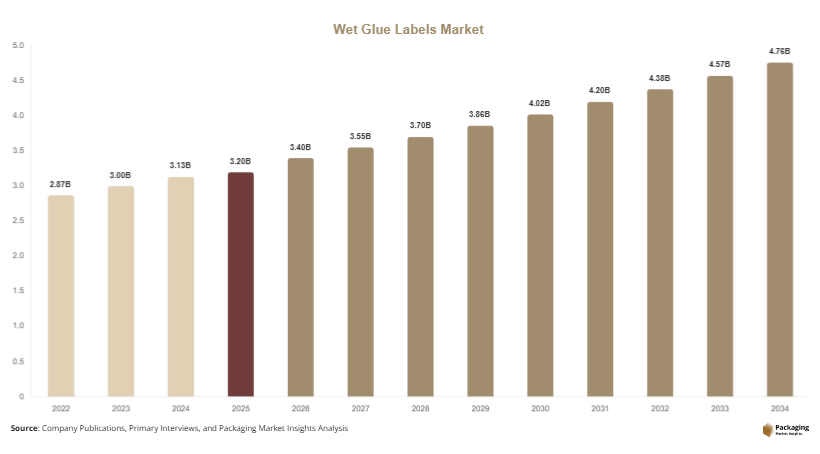
The wet glue labels market is projected to grow from USD 3.2 billion in 2025 to USD 4.7 billion by 2034, registering a CAGR of 4.3% during 2025–2034. In 2026, the market size is estimated at USD 3.4 billion, reflecting consistent demand from beverage and FMCG industries.
Growth is driven by multiple structural factors. The first major factor is the expansion of the global beverage industry, particularly bottled water, beer, and carbonated soft drinks, which require high-speed labeling solutions. Second, the increasing penetration of automated production lines in Asia Pacific and Latin America is boosting demand for wet glue labeling systems capable of handling mass production. Third, the rise of organized retail and private-label FMCG brands is increasing competition, leading to greater investment in visually appealing and cost-efficient labeling systems.
Key Highlights
- Asia Pacific dominated the market with a 37.4% share in 2025.
- Latin America is projected to grow at the fastest CAGR of 6.2%.
- Paper-based packaging led with a 58.1% share.
- Beverage applications accounted for 46.7% share.
- FMCG packaging dominated with 41.2% share.
- The US remained the dominant country with a market size of USD 11.2 billion in 2025 and USD 11.9 billion in 2026.
Explore more data points, trends and opportunities Download Free Sample Report
Market Trends
Expansion of Sustainable Paper-Based Label Systems
A major trend in the wet glue labels market is the transition toward sustainable and recyclable paper-based labeling materials. Manufacturers are increasingly replacing plastic-coated labels with eco-friendly paper solutions to comply with environmental regulations and corporate sustainability targets. Beverage companies in Europe and North America are leading this transition by adopting fully recyclable glass bottle packaging systems where labels can be easily removed during recycling. For example, several global breweries have shifted to paper wet glue labels to reduce plastic waste footprint. This trend is reinforced by increasing consumer preference for environmentally responsible packaging. In the future, stricter environmental laws and circular economy frameworks will further accelerate adoption of sustainable labeling materials across FMCG industries.
Automation and High-Speed Labeling System Integration
Another key trend is the rising adoption of fully automated, high-speed wet glue labeling systems in industrial production lines. These systems are capable of labeling thousands of containers per hour with high precision and minimal downtime. Beverage manufacturers in Asia Pacific are deploying rotary wet glue labeling machines integrated with servo motors and digital monitoring systems to improve efficiency. For instance, large-scale soft drink bottling plants in China and India are upgrading production lines to reduce manual intervention and increase throughput. In the future, integration with IoT-based monitoring, predictive maintenance systems, and AI-driven quality control is expected to further optimize labeling operations and reduce production disruptions.
Market Drivers
Rising Demand from Beverage and FMCG Industries
The growth of the global beverage and FMCG industries is a primary driver of the wet glue labels market. Products such as bottled water, beer, soft drinks, dairy products, sauces, and packaged foods require high-speed labeling solutions capable of handling large production volumes. For example, expanding beer production in Latin America and Asia Pacific has significantly increased demand for wet glue labeling systems due to their cost efficiency and ability to operate at high speed. As urbanization and disposable income levels rise globally, consumption of packaged goods continues to expand, directly increasing demand for labeling solutions.
Expansion of Organized Retail and Brand Differentiation Needs
Another major driver is the increasing competition in organized retail, which is pushing companies to enhance packaging aesthetics and product differentiation. Wet glue labels allow large surface-area printing, making them suitable for branding and promotional content. For example, FMCG companies in North America and Europe use visually rich wet glue labels on glass jars, beverage bottles, and food containers to attract consumer attention. The need for shelf visibility and brand recognition in crowded retail environments continues to support market growth.
Market Restraint
A key restraint in the wet glue labels market is its dependence on high-maintenance machinery and operational complexity. Wet glue labeling systems require precise calibration, continuous cleaning, and consistent adhesive quality to maintain efficiency. Any variation in adhesive viscosity or machine alignment can lead to labeling errors and production downtime.
Additionally, wet glue systems are less flexible compared to digital or pressure-sensitive labeling technologies when it comes to short production runs or frequent design changes. For example, small craft beverage producers often prefer digital labeling solutions due to lower setup time and flexibility. This reduces adoption of wet glue labeling in niche and customized production environments.
Market Opportunities
Expansion in Emerging Industrial Economies
Emerging economies present strong growth opportunities for the wet glue labels market due to rapid industrialization and expansion of packaged goods manufacturing. Countries such as India, Vietnam, Indonesia, and Brazil are experiencing rapid growth in beverage production and FMCG consumption. For example, India’s dairy and bottled water industries are expanding rapidly, increasing demand for high-speed labeling systems. As manufacturing infrastructure improves, wet glue labeling adoption is expected to rise significantly across mass production sectors.
Hybrid Labeling and Smart Packaging Integration
The development of hybrid labeling systems combining wet glue and digital printing technologies presents a major opportunity. These systems allow manufacturers to maintain cost efficiency while enabling customization and variable data printing. For instance, beverage companies are increasingly using hybrid labeling for seasonal product launches and limited-edition packaging. In the future, integration of QR codes, NFC tags, and smart tracking features will enhance product traceability and consumer engagement, opening new revenue streams for labeling manufacturers.
Report Scope
| Report Metric | Details |
|---|---|
| Market Size in 2025 | USD 3.2 Billion |
| Market Size in 2026 | USD 3.4 Billion |
| Market Size in 2034 | USD 4.7 Billion |
| CAGR | 4.3% (2026-2034) |
| Base Year for Estimation | 2025 |
| Historical Data | 2022-2024 |
| Forecast Period | 2026-2034 |
| Report Coverage | Revenue Forecast, Competitive Landscape, Supply Chain Disruption, Growth Factors, Environment & Regulatory Landscape and Trends |
| Geographies Covered | North America, Europe, APAC, Middle East and Africa, LATAM |
| Countries Covered | U.S., Canada, U.K., Germany, France, Spain, Italy, Russia, Nordic, Benelux, Rest of Europe, China, South Korea, Japan, India, Australia, Singapore, Taiwan, South East Asia, Rest of Asia-Pacific, UAE, Turky, Saudi Arabia, South Africa, Egypt, Nigeria, Rest of MEA, Brazil, Mexico, Argentina, Chile, Colombia, Rest of LATAM |
Explore more data points, trends and opportunities Download Free Sample Report
Segmental Analysis
Type
The roll-fed wet glue labels segment dominated with a 2024 market share of 56.2%, driven by its high efficiency in large-scale beverage production environments. These labels are widely used in bottling plants for beer, soft drinks, and mineral water due to their compatibility with high-speed rotary labeling machines. The ability to maintain alignment and adhesion at high production speeds makes them essential in industrial operations. For example, global beverage companies rely on roll-fed systems to ensure consistent branding across millions of bottles produced daily. Their cost efficiency and scalability further strengthen dominance in mass production environments.
Cut-stack wet glue labels are also widely used but remain secondary due to lower production speed efficiency. However, they are preferred in premium packaging segments where design flexibility is important.
The fastest-growing segment is cut-stack labels, with a CAGR of 5.1%, driven by increasing demand for customized and premium packaging solutions. Beverage companies producing craft beers and specialty foods are adopting these labels due to their ability to support high-quality printing and variable designs. The future outlook indicates increased adoption in niche FMCG segments where branding differentiation is essential.
Material
Paper-based wet glue labels dominated with a 2024 market share of 58.1%, primarily due to their low cost, recyclability, and compatibility with wet glue application systems. They are widely used in beverage packaging, particularly for glass bottles and jars. For example, breweries and dairy companies prefer paper labels because they can be easily removed during recycling, supporting sustainability goals.
Plastic-based labels are used in moisture-heavy environments but face pressure from sustainability regulations. However, biodegradable materials are gaining traction as environmental awareness increases.
The fastest-growing segment is biodegradable label materials, with a CAGR of 6.4%, driven by environmental regulations and corporate sustainability initiatives. Companies are increasingly investing in compostable label solutions that reduce environmental footprint. Future developments will focus on bio-based adhesives and recyclable composites.
End-Use
The beverage segment dominated with a 2024 share of 46.7%, driven by large-scale production of bottled water, beer, and soft drinks. Wet glue labels are ideal for high-speed beverage production lines due to durability and cost efficiency. For example, global beverage companies rely heavily on wet glue systems for glass bottle labeling.
Food packaging is also significant due to rising demand for packaged sauces, dairy products, and processed foods.
The fastest-growing segment is pharmaceutical packaging, with a CAGR of 5.9%, driven by increasing demand for compliant and durable labeling solutions. Pharmaceutical companies require high-precision labeling for regulatory compliance and product traceability. Future growth will be supported by serialization and smart labeling integration.
Wet Glue Labels Market Segmentations
By Type
- Roll-Fed Wet Glue Labels
- Cut-Stack Wet Glue Labels
By Material
- Paper-Based
- Plastic-Based
- Biodegradable Materials
By End-User
- Beverage Industry
- Food Industry
- Pharmaceutical Packaging
- Household Products
- Industrial Packaging
Regional Analysis
North America
North America accounted for approximately 26.5% share of the wet glue labels market in 2025, with a projected CAGR of 4.1% through 2034. The region benefits from advanced packaging infrastructure, strong FMCG demand, and high beverage consumption patterns. The United States and Canada represent mature but stable markets, supported by large-scale food processing and bottled beverage industries. The demand for wet glue labeling is particularly strong in beer, carbonated drinks, and dairy packaging sectors. Growth is supported by increasing automation in packaging facilities and rising investment in high-speed production systems.
The region also benefits from strong retail penetration and established distribution networks, which require consistent labeling standards across products. Sustainability initiatives are influencing packaging decisions, with companies gradually shifting toward recyclable paper labels. Additionally, contract manufacturing organizations in the U.S. are expanding production capacity, further supporting labeling system demand.
The United States dominates the region due to its large FMCG manufacturing base and beverage consumption volume. A key growth driver is the modernization of bottling plants with automated rotary labeling systems. For example, major beverage companies in the U.S. are upgrading production lines to improve efficiency and reduce operational costs. The integration of smart monitoring systems in labeling equipment is also gaining traction, enabling predictive maintenance and reducing downtime in large-scale production environments.
Europe
Europe held approximately 24.8% market share in 2025, growing at a CAGR of 4.0%. The region is strongly influenced by strict environmental regulations and circular economy initiatives. Countries such as Germany, France, Italy, and the UK are key contributors. The European market is characterized by high demand for sustainable and recyclable packaging materials.
A key growth factor is regulatory pressure promoting eco-friendly packaging solutions. For example, European beverage companies are increasingly adopting paper-based wet glue labels to comply with recycling mandates. Breweries and bottled water manufacturers are leading adopters of recyclable labeling systems. The demand for premium packaging in alcoholic beverages also supports market growth.
Germany dominates the region due to its strong industrial base and advanced packaging machinery manufacturing sector. A unique growth driver is the widespread adoption of high-efficiency labeling machines integrated with Industry 4.0 technologies. For example, German breweries use advanced rotary wet glue labeling systems to achieve high-speed production while maintaining precision and consistency. Automation and sustainability remain central themes in European market development.
Asia Pacific
Asia Pacific dominated with a 37.4% share in 2025, and is projected to grow at a CAGR of 5.2%. Rapid industrialization, urbanization, and rising consumption of packaged goods are key drivers. China, India, Japan, and Southeast Asian countries are major contributors.
The region benefits from large-scale beverage manufacturing, expanding FMCG industries, and growing export-oriented production facilities. Increasing adoption of automated packaging systems is accelerating demand for wet glue labeling machines. The region also experiences strong growth in bottled water and soft drink consumption.
China leads the region due to its massive manufacturing ecosystem and export capabilities. A key growth driver is the expansion of large-scale beverage production facilities equipped with automated high-speed labeling lines. For example, Chinese soft drink manufacturers are investing heavily in production automation to meet rising domestic and international demand. India is also emerging as a strong growth market due to expansion in dairy and packaged water industries.
Middle East & Africa
Middle East & Africa accounted for approximately 6.9% share in 2025, with a CAGR of 4.6%. Growth is driven by increasing packaged food consumption, retail expansion, and beverage industry development. Countries such as UAE, Saudi Arabia, and South Africa are key markets.
A major growth factor is the expansion of modern retail chains and hospitality sectors. For example, increasing tourism in the UAE is driving demand for packaged beverages and food products requiring high-quality labeling. Industrial diversification efforts in Saudi Arabia are also supporting packaging industry growth.
The UAE dominates the region due to its strong retail infrastructure and import-dependent FMCG market. A unique growth driver is the expansion of bottled water and premium beverage consumption supported by tourism and hospitality industries.
Latin America
Latin America held approximately 4.4% share in 2025, and is projected to grow at the fastest CAGR of 6.2%. Brazil and Mexico dominate due to strong beverage production industries and expanding FMCG sectors.
The region is experiencing rapid growth in beer, soft drink, and packaged food consumption. Increasing industrialization and investment in manufacturing infrastructure are also supporting market expansion. Export-oriented beverage production is further strengthening demand for wet glue labeling systems.
Brazil dominates the region due to its large beverage manufacturing industry. A key growth driver is the expansion of brewery production capacity. For example, Brazilian beverage companies are investing in automated labeling systems to support high-volume production and export demand. Mexico is also growing due to strong packaged food manufacturing and cross-border trade with North America.
Competitive Landscape
The wet glue labels market is moderately consolidated with leading companies focusing on automation, sustainability, and global expansion. Major players include CCL Industries, Avery Dennison, Krones AG, Sidel Group, and Fuji Seal International. Among these, CCL Industries leads due to its diversified product portfolio, global manufacturing presence, and strong partnerships with FMCG companies.
Companies are investing in recyclable materials, smart labeling systems, and high-speed automation technologies. Strategic partnerships with beverage manufacturers are also increasing to enhance production efficiency and reduce operational costs. Expansion into emerging markets remains a key strategy.
Key Players List
- CCL Industries Inc.
- Avery Dennison Corporation
- Krones AG
- Sidel Group
- Fuji Seal International
- UPM Raflatac
- HERMA GmbH
- Constantia Flexibles
- MPI Label Systems
- Huhtamaki
- Bizerba SE & Co. KG
- Torraspapel Adestor
- Label Technology Inc.
- Inland Label and Marketing Services
- Fuji Seal Europe