Pressure Sensitive Labels Market Size and Growth
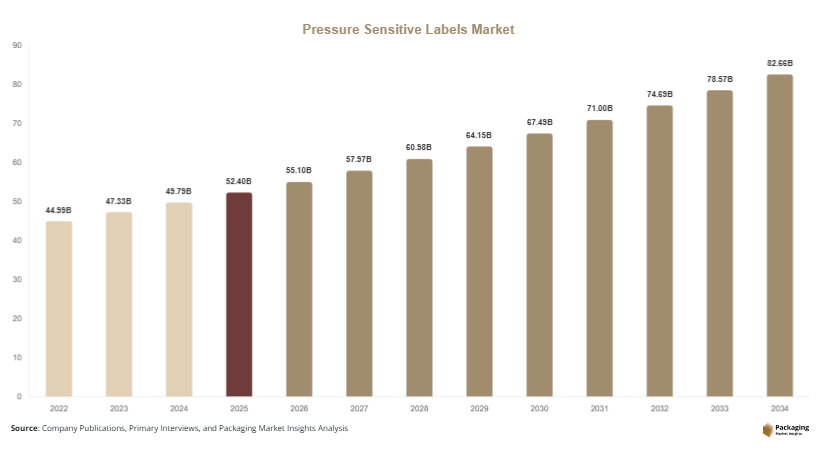
The global pressure sensitive labels market size was valued at USD 52.4 billion in 2025 and is expected to reach USD 55.1 billion in 2026. With continuous innovation in adhesive technologies and expanding applications across multiple industries, the market is projected to reach approximately USD 82.7 billion by 2034, growing at a CAGR of 5.2% during the forecast period from 2025 to 2034. The pressure sensitive labels market is witnessing stable growth driven by increasing demand for efficient labeling solutions across packaging, logistics, and consumer goods industries.
One of the key growth factors is the rising demand for packaged goods, particularly in the food and beverage sector, where labeling plays a crucial role in product identification, branding, and compliance with regulations. Pressure sensitive labels offer advantages such as easy application, high-quality printing, and versatility across various surfaces, making them widely adopted. Another important factor is the expansion of e-commerce and logistics industries, which require durable and efficient labeling solutions for tracking and inventory management.
Key Highlights:
- Asia Pacific dominated the market with a 39.1% share in 2025, while Latin America is projected to grow at the fastest CAGR of 6.4%.
- Release liner labels led the type segment with a 34.7% share, while linerless labels are expected to grow at a CAGR of 6.8%.
- Plastic-based labels dominated with a 56.2% share, while paper-based labels are forecasted to grow at a CAGR of 5.6%.
- Food & beverage applications led the segment with 41.8% share, while healthcare labeling is expected to grow at a CAGR of 6.1%.
- China remained the dominant country with a market size of USD 9.6 billion in 2025 and USD 10.2 billion in 2026.
Explore more data points, trends and opportunities Download Free Sample Report
Market Trends
Growing Adoption of Sustainable Labeling Solutions
Sustainability is becoming a central focus in the pressure sensitive labels market as regulatory pressures and consumer awareness continue to rise. Manufacturers are increasingly developing eco-friendly label materials, including recyclable adhesives and biodegradable substrates. This shift is also encouraging the adoption of linerless labels, which reduce material waste and improve operational efficiency. Companies are investing in research and development to create solutions that maintain performance while minimizing environmental impact. The trend is particularly strong in regions with strict environmental regulations, where businesses are required to comply with sustainability standards. This transformation is influencing product innovation and supply chain strategies across the industry.
Advancements in Digital Printing Technologies
Technological advancements in digital printing are significantly shaping the pressure sensitive labels market. Digital printing enables high-quality graphics, faster production times, and cost-effective short-run printing, making it ideal for customized labeling solutions. This technology allows brands to create personalized labels, enhance product differentiation, and respond quickly to market trends. Additionally, digital printing reduces setup time and material waste compared to traditional printing methods. The increasing demand for variable data printing, particularly in sectors such as pharmaceuticals and logistics, is further driving adoption. As digital printing technology continues to evolve, it is expected to play a critical role in market growth.
Market Drivers
Expansion of Packaged Goods Industry
The growth of the packaged goods industry is a major factor driving the pressure sensitive labels market. Increasing consumption of packaged food, beverages, and personal care products is creating strong demand for labeling solutions. Pressure sensitive labels are widely used due to their ease of application and ability to provide high-quality branding and information. Regulatory requirements for product labeling, including nutritional information and safety warnings, further support demand. As urbanization and changing lifestyles continue to drive consumption of packaged products, the demand for pressure sensitive labels is expected to increase steadily.
Rising Demand from E-commerce and Logistics
The rapid growth of e-commerce and logistics sectors is significantly boosting demand for pressure sensitive labels. These industries require efficient labeling solutions for inventory management, tracking, and shipping. Pressure sensitive labels offer durability and strong adhesion, ensuring that labels remain intact during transportation. The increasing adoption of automated labeling systems is also supporting market growth. Additionally, the need for barcodes, QR codes, and other tracking technologies is driving demand for advanced labeling solutions. This trend is expected to continue as global trade and online retail expand.
Market Restraint
Volatility in Raw Material Prices
Fluctuations in raw material prices pose a challenge for the pressure sensitive labels market. Key materials such as adhesives, films, and paper are subject to price volatility due to changes in supply and demand, as well as external factors such as geopolitical events and environmental regulations. This volatility can impact production costs and profit margins for manufacturers. For example, increases in the cost of petroleum-based materials can lead to higher prices for plastic labels. Smaller manufacturers may face difficulties in managing these cost fluctuations, which can limit their ability to compete in the market. This restraint highlights the importance of developing cost-effective and sustainable material alternatives.
Market Opportunities
Growth in Emerging Economies
Emerging economies present significant growth opportunities for the pressure sensitive labels market. Rapid industrialization, urbanization, and increasing consumer spending are driving demand for packaged goods in these regions. As a result, the need for efficient labeling solutions is rising. Local manufacturers are expanding their production capabilities, while international companies are entering these markets to capture new opportunities. Government initiatives supporting manufacturing and packaging industries further contribute to market growth. This trend is expected to create substantial opportunities for market players over the forecast period.
Increasing Adoption in Healthcare Sector
The healthcare sector offers promising opportunities for the pressure sensitive labels market. Strict regulations regarding labeling of pharmaceutical products and medical devices are driving demand for high-quality labeling solutions. Pressure sensitive labels are widely used for their durability and ability to provide clear and accurate information. The growing focus on patient safety and traceability is further supporting demand. In addition, advancements in labeling technologies, such as tamper-evident and anti-counterfeiting features, are enhancing product security. As the healthcare industry continues to expand, the demand for pressure sensitive labels is expected to grow.
Report Scope
| Report Metric | Details |
|---|---|
| Market Size in 2025 | USD 52.4 Billion |
| Market Size in 2026 | USD 55.1 Billion |
| Market Size in 2034 | USD 82.7 Billion |
| CAGR | 5.2% (2026-2034) |
| Base Year for Estimation | 2025 |
| Historical Data | 2022-2024 |
| Forecast Period | 2026-2034 |
| Report Coverage | Revenue Forecast, Competitive Landscape, Supply Chain Disruption, Growth Factors, Environment & Regulatory Landscape and Trends |
| Geographies Covered | North America, Europe, APAC, Middle East and Africa, LATAM |
| Countries Covered | U.S., Canada, U.K., Germany, France, Spain, Italy, Russia, Nordic, Benelux, Rest of Europe, China, South Korea, Japan, India, Australia, Singapore, Taiwan, South East Asia, Rest of Asia-Pacific, UAE, Turky, Saudi Arabia, South Africa, Egypt, Nigeria, Rest of MEA, Brazil, Mexico, Argentina, Chile, Colombia, Rest of LATAM |
Explore more data points, trends and opportunities Download Free Sample Report
Segmental Analysis
By Type
Release liner labels dominated the market in 2024, accounting for approximately 34.7% of the total share. These labels are widely used due to their ease of application and compatibility with automated labeling systems. They provide strong adhesion and are suitable for various surfaces, making them ideal for multiple industries. Continuous improvements in adhesive technologies are enhancing performance and reliability.
Linerless labels are expected to be the fastest-growing segment, with a CAGR of 6.8% during the forecast period. These labels reduce material waste and improve operational efficiency by eliminating the need for a release liner. Their environmental benefits and cost savings are driving adoption across industries.
By Material
Plastic-based labels dominated the market in 2024, accounting for 56.2% of the total share. These labels offer durability, flexibility, and resistance to moisture and chemicals, making them suitable for a wide range of applications. They are widely used in industries such as food and beverage and healthcare.
Paper-based labels are projected to grow at the fastest CAGR of 5.6%. These labels are gaining popularity due to their sustainability and recyclability. Advances in coating technologies are improving their performance, making them suitable for more applications.
By Application
Food and beverage applications dominated the market in 2024, accounting for 41.8% of the total share. Pressure sensitive labels are widely used in this sector for branding, product information, and regulatory compliance. The increasing demand for packaged food products is driving growth in this segment.
Healthcare applications are expected to grow at the fastest CAGR of 6.1% during the forecast period. The need for accurate labeling and traceability in pharmaceutical products is driving demand. Advances in labeling technologies are further supporting growth in this segment.
Pressure Sensitive Labels Market Segmentations
By Product Type
- Release Liner Labels
- Linerless Labels
- Specialty Labels
By Application
- Food & Beverage
- Healthcare
- Consumer Goods
- Logistics
By Material
- Plastic
- Paper
- Metalized
Regional Analysis
North America
North America accounted for approximately 23.4% of the pressure sensitive labels market share in 2025 and is projected to grow at a CAGR of 4.8% during the forecast period. The region benefits from advanced packaging technologies and strong demand from industries such as food and beverage, healthcare, and logistics. High consumer awareness and regulatory requirements further support market growth.
The United States dominates the regional market due to its large industrial base and well-established supply chains. A key growth factor is the increasing adoption of automation in labeling processes, which improves efficiency and reduces labor costs. This trend is driving demand for advanced pressure sensitive labeling solutions.
Europe
Europe held a 21.7% market share in 2025 and is expected to grow at a CAGR of 4.6%. The region is characterized by strict environmental regulations and a strong focus on sustainability. These factors are driving the adoption of eco-friendly labeling solutions and influencing product development.
Germany leads the European market, supported by its strong manufacturing sector and focus on innovation. A unique growth factor is the increasing demand for recyclable labeling materials, driven by circular economy initiatives. This trend is encouraging manufacturers to develop sustainable solutions.
Asia Pacific
Asia Pacific dominated the market with a 39.1% share in 2025 and is projected to grow at a CAGR of 5.9%. Rapid industrialization, urbanization, and increasing consumption of packaged goods are key factors driving growth in the region. The expansion of e-commerce and retail sectors further supports market development.
China is the dominant country in the region, driven by its large manufacturing base and growing consumer market. A significant growth factor is the increasing demand for cost-effective labeling solutions in mass production industries. Manufacturers are investing in advanced technologies to meet rising demand.
Middle East & Africa
The Middle East & Africa region accounted for 7.8% of the market share in 2025 and is expected to grow at a CAGR of 5.5%. The region is witnessing increased demand for packaged goods due to rising urbanization and improving economic conditions. Flexible labeling solutions are gaining popularity for their cost-effectiveness.
The United Arab Emirates is a key market, supported by its growing logistics and retail sectors. A unique growth factor is the increasing adoption of advanced labeling technologies in supply chain management. This trend is driving demand for pressure sensitive labels.
Latin America
Latin America held a 7.9% market share in 2025 and is projected to grow at the fastest CAGR of 6.4%. The region is experiencing steady growth in the packaging industry, supported by increasing consumer demand and economic development. Pressure sensitive labels are widely used due to their affordability and versatility.
Brazil dominates the regional market due to its large population and strong demand for packaged goods. A key growth factor is the increasing adoption of modern retail formats, which require efficient labeling solutions. This trend is supporting market growth.
Competitive Landscape
The pressure sensitive labels market is moderately fragmented, with several global and regional players competing based on innovation, product quality, and pricing strategies. Companies are focusing on developing sustainable and cost-effective labeling solutions to meet evolving market demands. Strategic collaborations and product launches are common strategies used to strengthen market position.
CCL Industries Inc. is a leading player in the market, known for its extensive product portfolio and global presence. The company has recently expanded its production capacity and introduced eco-friendly labeling solutions, reinforcing its position in the market. Other key players are also investing in research and development to enhance product performance and sustainability.
Key Players List
- CCL Industries Inc.
- Avery Dennison Corporation
- 3M Company
- UPM Raflatac
- Multi-Color Corporation
- Fuji Seal International Inc.
- Henkel AG & Co. KGaA
- Sato Holdings Corporation
- LINTEC Corporation
- Constantia Flexibles
- Coveris Holdings S.A.
- Flexcon Company Inc.
- Huhtamaki Oyj
- Cenveo Corporation
- Brady Corporation