3D Printed Stickers And Labels Market Size and Growth
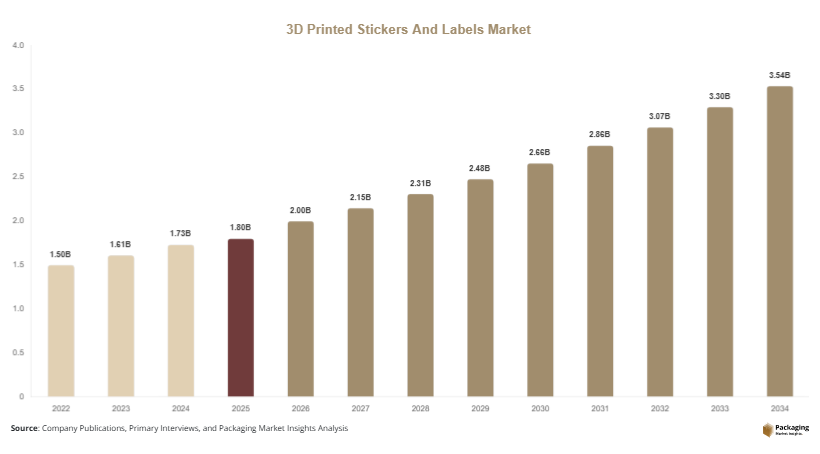
The global 3D printed stickers and labels market size is estimated at USD 1.8 billion in 2025 and is projected to reach USD 2.0 billion in 2026. Over the forecast period from 2025 to 2034, the market is expected to expand at a CAGR of 7.4%, reaching approximately USD 3.8 billion by 2034. This growth reflects the rising demand for visually appealing, tactile, and customizable labeling solutions across industries such as food and beverage, cosmetics, pharmaceuticals, and consumer goods. The 3D printed stickers and labels market is gaining momentum as brands increasingly adopt advanced printing technologies to enhance product differentiation and consumer engagement.
One of the primary growth factors is the increasing demand for product differentiation in competitive markets. Brands are leveraging 3D printed stickers and labels to create unique packaging designs that stand out on retail shelves. These labels offer enhanced visual depth, texture, and interactivity, which can influence consumer purchasing decisions. As packaging becomes a critical marketing tool, the adoption of innovative labeling solutions is expected to increase.
Key Highlights
- Asia Pacific dominated the market with a 37.6% share in 2025, while Latin America is projected to grow at the fastest CAGR of 7.8%.
- Embossed labels led the type segment with a 33.9% share, while textured labels are expected to grow at a CAGR of 7.9%.
- Plastic materials dominated with a 49.8% share, while paper-based materials are forecasted to grow at a CAGR of 7.5%.
- Food & beverage applications led the segment with 42.3% share, while cosmetics applications are expected to grow at a CAGR of 7.7%.
- China remained the dominant country with a market size of USD 0.6 billion in 2025 and USD 0.7 billion in 2026.
Explore more data points, trends and opportunities Download Free Sample Report
Market Trends
Increasing integration of tactile and interactive packaging elements
The 3D printed stickers and labels market is evolving with the growing use of tactile and interactive packaging features. Brands are incorporating raised textures, embossed patterns, and multi-dimensional designs to create a more engaging consumer experience. These features not only enhance visual appeal but also provide a sensory experience that can strengthen brand recognition. Interactive elements such as QR codes embedded within 3D labels are also gaining traction, enabling consumers to access digital content directly from packaging. This trend is particularly evident in premium product segments, where packaging plays a key role in influencing purchasing decisions. As consumer expectations continue to evolve, the demand for innovative and interactive labeling solutions is expected to grow.
Growing adoption of digital and additive manufacturing technologies
Another key trend in the 3D printed stickers and labels market is the increasing adoption of digital and additive manufacturing technologies. 3D printing enables precise control over design and production, allowing manufacturers to create complex label structures that are not possible with traditional printing methods. This technology also supports on-demand production, reducing inventory costs and enabling faster turnaround times. The integration of digital workflows is improving efficiency and enabling greater customization. As industries continue to embrace digital transformation, the adoption of 3D printing technologies in labeling applications is expected to increase, driving market growth.
Market Drivers
Rising demand for innovative branding and product differentiation
The need for effective branding and product differentiation is a major factor driving the 3D printed stickers and labels market. In highly competitive markets, companies are seeking new ways to capture consumer attention and enhance brand identity. 3D printed labels offer a unique combination of visual and tactile features that can set products apart from competitors. These labels are particularly effective in premium and luxury segments, where packaging quality plays a significant role in consumer perception. The ability to create customized designs and limited-edition packaging further enhances their appeal. As brands continue to invest in innovative packaging strategies, the demand for 3D printed stickers and labels is expected to increase.
Expansion of e-commerce and premium packaging demand
The rapid growth of e-commerce is contributing to the expansion of the 3D printed stickers and labels market. Online retail platforms require packaging that not only protects products but also enhances the unboxing experience. High-quality labels with unique designs can improve customer satisfaction and strengthen brand loyalty. Premium packaging is becoming increasingly important as consumers associate it with product quality and value. 3D printed labels provide an opportunity for brands to create distinctive packaging that stands out in a crowded market. As e-commerce continues to grow, the demand for advanced labeling solutions is expected to rise.
Market Restraint
High production costs and scalability challenges
The 3D printed stickers and labels market faces challenges related to high production costs and scalability. While 3D printing offers significant design flexibility, it can be more expensive than traditional printing methods, particularly for large-scale production. The cost of raw materials, equipment, and maintenance can be a barrier for small and medium-sized enterprises. Additionally, scaling production to meet high-volume demand can be challenging due to slower printing speeds compared to conventional techniques. For example, a beverage company producing millions of units may find it difficult to adopt 3D printed labels for all products due to cost constraints. These challenges can limit market adoption, especially in price-sensitive segments. However, ongoing advancements in technology are expected to address these issues over time.
Market Opportunities
Increasing demand for personalized and limited-edition packaging
The growing preference for personalized products presents a significant opportunity for the 3D printed stickers and labels market. Consumers are increasingly seeking unique and customized experiences, and packaging plays a key role in meeting these expectations. 3D printing enables the production of customized labels with specific designs, colors, and textures, allowing brands to offer personalized products at scale. This is particularly relevant in industries such as cosmetics, beverages, and consumer goods, where limited-edition packaging is used to attract customers. As personalization becomes a key trend, the demand for 3D printed labels is expected to increase.
Advancements in sustainable materials and eco-friendly solutions
Sustainability is creating new opportunities for innovation in the 3D printed stickers and labels market. Manufacturers are exploring eco-friendly materials, including biodegradable polymers and recyclable substrates, to reduce environmental impact. Advances in material science are enabling the development of sustainable labeling solutions that maintain performance and durability. Companies are also adopting energy-efficient production processes to minimize their carbon footprint. As regulatory requirements and consumer awareness regarding sustainability increase, the demand for environmentally friendly 3D printed labels is expected to grow, providing new avenues for market expansion.
Report Scope
| Report Metric | Details |
|---|---|
| Market Size in 2025 | USD 1.8 Billion |
| Market Size in 2026 | USD 2.0 Billion |
| Market Size in 2034 | USD 3.8 Billion |
| CAGR | 7.4% (2026-2034) |
| Base Year for Estimation | 2025 |
| Historical Data | 2022-2024 |
| Forecast Period | 2026-2034 |
| Report Coverage | Revenue Forecast, Competitive Landscape, Supply Chain Disruption, Growth Factors, Environment & Regulatory Landscape and Trends |
| Geographies Covered | North America, Europe, APAC, Middle East and Africa, LATAM |
| Countries Covered | U.S., Canada, U.K., Germany, France, Spain, Italy, Russia, Nordic, Benelux, Rest of Europe, China, South Korea, Japan, India, Australia, Singapore, Taiwan, South East Asia, Rest of Asia-Pacific, UAE, Turky, Saudi Arabia, South Africa, Egypt, Nigeria, Rest of MEA, Brazil, Mexico, Argentina, Chile, Colombia, Rest of LATAM |
Explore more data points, trends and opportunities Download Free Sample Report
Segmental Analysis
By Type
Embossed labels dominated the 3D printed stickers and labels market in 2024, accounting for approximately 33.9% of the total share. These labels are widely used due to their ability to create raised designs that enhance visual and tactile appeal. They are particularly popular in premium packaging applications.
Textured labels are expected to grow at a CAGR of 7.9% during the forecast period. These labels offer unique surface finishes that enhance product differentiation. Their ability to provide a distinctive look and feel is driving their adoption across various industries.
By Material
Plastic materials dominated the market in 2024, accounting for 49.8% of the total share. These materials are preferred for their durability and versatility. They are widely used in applications that require strong and long-lasting labels.
Paper-based materials are expected to grow at a CAGR of 7.5%. The increasing demand for sustainable packaging solutions is driving the adoption of paper materials. Advances in coating technologies are improving their performance and expanding their application scope.
By Application
Food and beverage applications held the largest share of the 3D printed stickers and labels market in 2024, accounting for 42.3% of the total market. The need for attractive and informative packaging is driving demand in this segment.
Cosmetics applications are expected to grow at a CAGR of 7.7% during the forecast period. The demand for premium and visually appealing packaging is driving the adoption of 3D printed labels in this segment.
3D Printed Stickers And Labels Market Segmentations
By Product Type
- Embossed Labels
- Textured Labels
- Raised Ink Labels
By Application
- Food & Beverage
- Cosmetics
- Pharmaceuticals
- Consumer Goods
By Material
- Plastic
- Paper
- Others
Regional Analysis
North America
North America accounted for approximately 24.5% of the 3D printed stickers and labels market share in 2025 and is projected to grow at a CAGR of 6.8% during the forecast period. The region benefits from advanced printing technologies and a strong focus on innovation in packaging. The presence of established consumer goods and cosmetics industries supports market growth.
The United States dominates the regional market due to its large consumer base and high adoption of advanced technologies. A unique growth factor is the increasing demand for premium and personalized packaging solutions, which is driving the adoption of 3D printed labels.
Europe
Europe held a 21.3% share of the 3D printed stickers and labels market in 2025 and is expected to grow at a CAGR of 7.0%. The region is characterized by strong regulatory frameworks and a focus on sustainability. These factors are encouraging the adoption of eco-friendly labeling solutions.
Germany leads the European market, supported by its advanced manufacturing capabilities. A unique growth factor is the emphasis on high-quality packaging in the luxury goods sector, which is driving demand for innovative labeling solutions.
Asia Pacific
Asia Pacific dominated the 3D printed stickers and labels market with a 37.6% share in 2025 and is projected to grow at a CAGR of 7.8%. The region’s growth is driven by rapid industrialization and increasing consumer demand for packaged goods. The expansion of e-commerce further supports market growth.
China remains the dominant country in this region due to its large manufacturing base. A unique growth factor is the increasing adoption of digital printing technologies, which is driving the development of advanced labeling solutions.
Middle East & Africa
The Middle East & Africa region accounted for 8.1% of the 3D printed stickers and labels market share in 2025 and is expected to grow at a CAGR of 7.2%. Growth is supported by increasing demand for consumer goods and expanding retail sectors.
Saudi Arabia leads the regional market due to its growing economy. A unique growth factor is the rising demand for premium packaging in luxury goods, which is driving the adoption of innovative labeling solutions.
Latin America
Latin America held an 8.5% share of the 3D printed stickers and labels market in 2025 and is projected to grow at the fastest CAGR of 7.8%. The region’s growth is driven by increasing consumer awareness and demand for high-quality packaging.
Brazil dominates the regional market due to its large population and growing consumer goods industry. A unique growth factor is the increasing adoption of modern printing technologies, which is driving demand for 3D printed labels.
Competitive Landscape
The 3D printed stickers and labels market is moderately competitive, with several global players focusing on innovation and product development. Companies are investing in advanced printing technologies and sustainable materials to enhance their product offerings. Strategic partnerships and collaborations are common as firms aim to expand their market presence.
Avery Dennison Corporation is recognized as a leading player in the market, known for its innovative labeling solutions. The company recently introduced advanced 3D printed label technologies designed to enhance product differentiation. Other companies are also focusing on customization and expanding their product portfolios to meet diverse industry needs.
Key Players List
- Avery Dennison Corporation
- 3M Company
- CCL Industries Inc.
- Multi-Color Corporation
- UPM Raflatac
- Henkel AG & Co. KGaA
- Brady Corporation
- SATO Holdings Corporation
- Toppan Printing Co., Ltd.
- Fuji Seal International, Inc.
- LINTEC Corporation
- Coveris Holdings S.A.
- Resource Label Group
- WS Packaging Group
- Constantia Flexibles