Multilingual Packaging Market Size and Growth
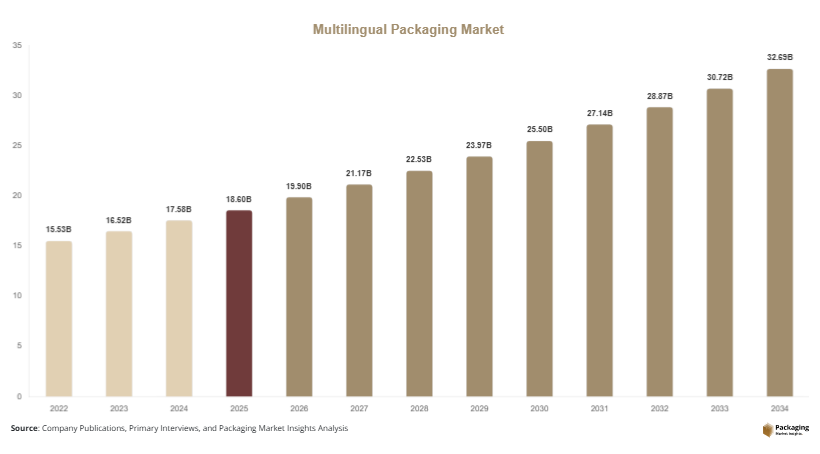
The global multilingual packaging market size was valued at USD 18.6 billion in 2025 and is projected to reach USD 19.9 billion in 2026. Over the forecast period, the market is expected to reach approximately USD 34.7 billion by 2034, growing at a CAGR of 6.4% from 2025 to 2034. Multilingual packaging involves the use of multiple languages on product packaging to meet regulatory compliance and enhance consumer communication across diverse markets. The multilingual packaging market is expanding steadily as global trade, cross-border e-commerce, and regulatory requirements continue to reshape packaging strategies.
One of the key growth factors is the rapid globalization of brands and supply chains. Companies are expanding their presence across multiple regions, requiring packaging that can communicate effectively with diverse consumer bases. Multilingual labeling ensures compliance with regional regulations while improving accessibility and brand perception among international customers.
Key Highlights:
- Asia Pacific dominated the market with a 36.8% share in 2025, while Latin America is projected to grow at the fastest CAGR of 6.9%.
- Pressure-sensitive labels led the type segment with a 41.5% share, while flexible printed packaging is expected to grow at a CAGR of 6.7%.
- Plastic packaging dominated with a 50.7% share, while paper-based packaging is forecasted to grow at a CAGR of 6.5%.
- Food & beverage applications led the segment with 44.2% share, while healthcare packaging is expected to grow at a CAGR of 6.6%.
- China remained the dominant country with a market size of USD 5.4 billion in 2025 and USD 5.8 billion in 2026.
Explore more data points, trends and opportunities Download Free Sample Report
Market Trends
Increasing Adoption of Smart and Digital Labeling Technologies
The multilingual packaging market is experiencing a shift toward smart and digital labeling solutions that allow brands to deliver multilingual content without increasing packaging size. QR codes, NFC tags, and augmented reality features enable consumers to access product information in multiple languages through digital interfaces. This approach reduces the need for extensive on-pack text while maintaining compliance with regulatory requirements. Companies are also leveraging digital printing technologies to produce customized packaging for different regions in shorter production cycles. These innovations improve efficiency and enable brands to respond quickly to market demands. As digital infrastructure continues to expand globally, the integration of smart labeling technologies is expected to play a significant role in market growth.
Growing Focus on Minimalist and Space-Efficient Packaging Design
Manufacturers are increasingly adopting minimalist packaging designs that optimize space while accommodating multilingual information. This trend is driven by the need to balance regulatory compliance with aesthetic appeal and sustainability goals. Techniques such as fold-out labels, peel-back labels, and multi-layered packaging are being used to include detailed information in multiple languages without overcrowding the packaging surface. Additionally, brands are focusing on clear and concise messaging to improve readability and user experience. This trend is particularly evident in the pharmaceutical and food industries, where accurate and accessible information is critical. The emphasis on efficient design is expected to drive innovation in multilingual packaging solutions.
Market Drivers
Expansion of Global Trade and Cross-Border E-commerce
The growth of global trade and cross-border e-commerce is a major driver of the multilingual packaging market. Companies are increasingly selling products in multiple countries, requiring packaging that meets diverse language and regulatory requirements. Multilingual packaging helps ensure compliance while enhancing consumer understanding and trust. The rise of online retail platforms has further increased the need for standardized packaging solutions that can cater to international markets. As cross-border trade continues to expand, the demand for multilingual packaging is expected to increase significantly.
Increasing Regulatory Requirements for Product Labeling
Regulatory frameworks across various regions are becoming more stringent, particularly in industries such as food, pharmaceuticals, and cosmetics. Governments require product information to be provided in multiple languages to ensure consumer safety and transparency. This includes ingredient lists, usage instructions, and safety warnings. Compliance with these regulations is essential for market entry and brand credibility. As regulations continue to evolve, companies are investing in advanced packaging solutions that can accommodate multilingual content while maintaining design integrity. This trend is driving growth in the market.
Market Restraint
Complexity in Design and Higher Production Costs
The multilingual packaging market faces challenges related to design complexity and increased production costs. Incorporating multiple languages into packaging requires careful planning to ensure readability and compliance with regulatory standards. This often involves the use of advanced printing technologies and specialized materials, which can increase production costs. Additionally, managing multiple language versions of packaging can complicate supply chain operations. For example, companies may need to produce different packaging variants for different regions, leading to higher inventory and logistics costs. These challenges can limit adoption, particularly among small and medium-sized enterprises.
Market Opportunities
Integration of Digital Content and Interactive Packaging
The integration of digital content into packaging presents significant opportunities for the multilingual packaging market. Technologies such as QR codes and augmented reality enable brands to provide detailed product information in multiple languages without increasing packaging size. This approach enhances consumer engagement and allows for real-time updates to content. Companies can also use digital platforms to provide additional information, such as tutorials and promotional content, in various languages. This trend is expected to create new growth opportunities in the market.
Growth in Emerging Markets and Localization Strategies
Emerging markets present significant opportunities for multilingual packaging as companies expand their presence in regions with diverse linguistic landscapes. Localization strategies are becoming increasingly important, with brands tailoring packaging to meet the cultural and linguistic preferences of specific markets. This approach improves consumer engagement and brand loyalty. The growing middle-class population and increasing consumer spending in emerging economies are driving demand for localized packaging solutions. As companies continue to expand globally, the need for multilingual packaging is expected to increase.
Report Scope
| Report Metric | Details |
|---|---|
| Market Size in 2025 | USD 18.6 Billion |
| Market Size in 2026 | USD 19.9 Billion |
| Market Size in 2034 | USD 34.7 Billion |
| CAGR | 6.4% (2026-2034) |
| Base Year for Estimation | 2025 |
| Historical Data | 2022-2024 |
| Forecast Period | 2026-2034 |
| Report Coverage | Revenue Forecast, Competitive Landscape, Supply Chain Disruption, Growth Factors, Environment & Regulatory Landscape and Trends |
| Geographies Covered | North America, Europe, APAC, Middle East and Africa, LATAM |
| Countries Covered | U.S., Canada, U.K., Germany, France, Spain, Italy, Russia, Nordic, Benelux, Rest of Europe, China, South Korea, Japan, India, Australia, Singapore, Taiwan, South East Asia, Rest of Asia-Pacific, UAE, Turky, Saudi Arabia, South Africa, Egypt, Nigeria, Rest of MEA, Brazil, Mexico, Argentina, Chile, Colombia, Rest of LATAM |
Explore more data points, trends and opportunities Download Free Sample Report
Segmental Analysis
By Type
Pressure-sensitive labels accounted for the largest share of 41.5% in 2024, driven by their flexibility and ease of application. These labels are widely used in multilingual packaging due to their ability to accommodate detailed information in multiple languages. They offer high-quality printing and can be easily customized for different markets. Additionally, pressure-sensitive labels support advanced features such as peel-back and multi-layer designs, which allow for the inclusion of extensive text without compromising readability.
Flexible printed packaging is expected to grow at a CAGR of 6.7%, driven by increasing demand for lightweight and cost-efficient packaging solutions. This type of packaging allows for high-quality printing and can accommodate multilingual content effectively. The use of advanced printing technologies enables manufacturers to produce customized packaging for different regions. As demand for flexible packaging continues to grow, this segment is expected to expand significantly.
By Material
Plastic packaging dominated the market with a share of 50.7% in 2024 due to its durability and versatility. Plastics are widely used in multilingual packaging because they support high-quality printing and can be easily molded into various shapes. They also provide protection and extend product shelf life, making them suitable for a wide range of applications. The availability of different plastic materials allows manufacturers to tailor packaging solutions to specific requirements.
Paper-based packaging is projected to grow at a CAGR of 6.5%, driven by increasing demand for sustainable packaging solutions. These materials are biodegradable and recyclable, making them an attractive alternative to plastics. Advances in printing technologies are enabling high-quality multilingual printing on paper-based materials. As sustainability becomes a key focus, the demand for paper-based multilingual packaging is expected to increase.
By Application
Food & beverage applications accounted for the largest share of 44.2% in 2024, driven by high demand for packaged food products and strict labeling requirements. Multilingual packaging is essential in this segment to provide ingredient information, nutritional details, and usage instructions in multiple languages. This ensures compliance with regulations and improves consumer understanding. The growing demand for convenience foods and global food trade is supporting segment growth.
Healthcare applications are expected to grow at a CAGR of 6.6%, driven by the need for accurate and accessible product information. Multilingual packaging is critical in this segment to ensure patient safety and compliance with regulatory standards. Packaging must include detailed instructions, warnings, and dosage information in multiple languages. The increasing demand for pharmaceutical products and medical devices is driving growth in this segment.
Multilingual Packaging Market Segmentations
By Product Type
- Pressure-Sensitive Labels
- Flexible Printed Packaging
- Multi-Layer Labels
- Fold-Out and Peel-Back Labels
By Application
- Food & Beverage
- Healthcare
- Personal Care & Cosmetics
- Industrial Products
By Distribution Channel
- Online Retail
- Supermarkets & Hypermarkets
- Pharmacies & Drug Stores
- Specialty Stores
- Direct Sales (B2B)
Regional Analysis
North America
North America held a 27.6% share of the multilingual packaging market in 2025 and is projected to grow at a CAGR of 6.1% during the forecast period. The region benefits from advanced packaging technologies and strong regulatory frameworks that require clear and accessible product information. The presence of major consumer goods and pharmaceutical companies is driving demand for multilingual packaging solutions. Additionally, increasing cross-border trade within the region is contributing to market growth.
The United States dominates the regional market due to its large consumer base and diverse population. A key growth factor is the high demand for bilingual packaging, particularly in English and Spanish, to cater to a multicultural audience. This trend is driving innovation in packaging design and labeling solutions.
Europe
Europe accounted for a 25.2% share in 2025 and is expected to grow at a CAGR of 6.3%. The region is characterized by strict regulatory requirements that mandate multilingual labeling for various products. This has created a strong demand for advanced packaging solutions that can accommodate multiple languages while maintaining clarity and compliance. The presence of established packaging manufacturers also supports market growth.
Germany is the leading country in the European market, driven by its strong industrial base and focus on regulatory compliance. A unique growth factor is the requirement for multilingual labeling across European Union member states, which is driving demand for standardized packaging solutions.
Asia Pacific
Asia Pacific dominated the market with a 36.8% share in 2025 and is projected to grow at a CAGR of 7.0%. The region’s growth is driven by rapid industrialization, urbanization, and increasing consumer demand. Countries such as China, India, and Japan have diverse linguistic populations, which increases the need for multilingual packaging solutions. The expansion of manufacturing and retail sectors is also contributing to market growth.
China is the dominant country in the region, supported by its large manufacturing base and growing consumer market. A key growth factor is the increasing export of consumer goods, which requires packaging that meets international language and regulatory standards.
Middle East & Africa
The Middle East & Africa region accounted for 5.1% of the market share in 2025 and is expected to grow at a CAGR of 6.5%. The region is experiencing growth in trade and consumer markets, which is driving demand for multilingual packaging solutions. Governments are also implementing regulations to ensure product information is accessible to diverse populations.
The United Arab Emirates is a key market in the region due to its role as a global trade hub. A unique growth factor is the presence of a multicultural population, which requires packaging in multiple languages to ensure effective communication.
Latin America
Latin America held a 5.3% share in 2025 and is projected to grow at a CAGR of 6.9%. The region’s growth is driven by increasing consumer demand and expanding retail sectors. The rise of e-commerce and improving logistics infrastructure are also contributing to market expansion. Companies are focusing on cost-effective multilingual packaging solutions to meet market demands.
Brazil dominates the regional market, supported by its large population and growing economy. A key growth factor is the increasing adoption of bilingual packaging in Portuguese and Spanish to cater to regional markets. This trend is expected to drive market growth.
Competitive Landscape
The multilingual packaging market is moderately competitive, with several global players focusing on innovation and regulatory compliance. Companies are investing in advanced printing technologies and digital solutions to enhance their product offerings. Strategic partnerships and acquisitions are common strategies used to expand market presence and improve capabilities.
Amcor plc is recognized as a leading player in the market, offering a wide range of packaging solutions tailored to multilingual requirements. The company recently introduced advanced digital printing solutions that enable efficient production of customized packaging for different regions. Other major players are also focusing on expanding their product portfolios and enhancing their technological capabilities to remain competitive.
Key Players List
- Amcor plc
- Berry Global Group Inc.
- Mondi Group
- Sealed Air Corporation
- Smurfit Kappa Group
- DS Smith Plc
- Huhtamaki Oyj
- Sonoco Products Company
- WestRock Company
- International Paper Company
- UFlex Ltd.
- Coveris Holdings S.A.
- Constantia Flexibles
- Winpak Ltd.
- Graphic Packaging Holding Company