Shrink Wrap Sleeve Labels Market Size
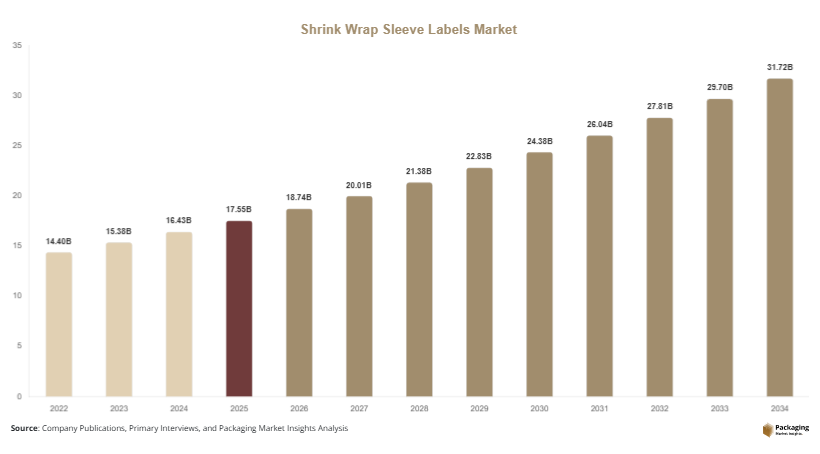
The of shrink wrap sleeve labels' market size is projected at USD 18.74 billion in 2026 and is expected to hit USD 31.68 billion by 2034 with a CAGR of 6.8%. The market assessment evaluates revenue performance, production capacity, raw material utilization, pricing trends, distribution networks, and competitive positioning across major economies. The report also analyzes detailed segmentation, manufacturing developments, regulatory frameworks, and strategic initiatives adopted by leading manufacturers to provide a comprehensive view of the industry landscape.
Shrink wrap sleeve labels are heat-shrinkable labeling solutions that conform tightly around containers, bottles, cans, and jars to provide complete 360-degree branding, product identification, and tamper evidence. Global production exceeded 145 billion sleeve labels in 2025, with packaging converters operating at utilization rates above 79%, while food and beverage applications represented nearly 48% of total consumption. PETG-based products accounted for approximately 44% of production, PVC represented 37%, and OPS contributed 19%, supported by increasing demand for premium packaging, sustainability initiatives, and automated labeling systems.
Explore more data points, trends and opportunities Download Free Sample Report
Shrink Wrap Sleeve Labels Market Trends
Rising Adoption of Sustainable Sleeve Label Technologies
Packaging manufacturers are increasingly replacing conventional materials with recyclable and lightweight shrink sleeve solutions to improve circular economy performance. More than 63% of newly commissioned labeling lines now support recyclable sleeve applications, while global production surpassed 150 billion units annually. Digital printing adoption has increased by 31% over the past three years, enabling shorter production runs, faster customization, and improved printing quality. Sustainability certifications and reduced material thickness continue to influence procurement decisions across consumer goods industries.
Automation continues to reshape label manufacturing as AI-enabled inspection systems, laser perforation, and high-speed shrink tunnels improve operational efficiency. Production efficiency has improved by nearly 18%, while waste generation has declined by approximately 14% across modern facilities. Smart packaging integration, QR-enabled traceability, and serialization technologies have achieved adoption rates above 36% in premium consumer products, reinforcing the importance of advanced shrink sleeve solutions.
Shrink Wrap Sleeve Labels Market Drivers
"Growing Demand for Premium Consumer Packaging"
Increasing consumption of packaged food, beverages, cosmetics, and healthcare products continues to support label demand worldwide. More than 72% of beverage manufacturers now utilize full-body sleeve labeling for enhanced shelf visibility, while premium packaged goods shipments increased by 11% during 2025. Annual container production exceeded 680 billion units, creating substantial opportunities for advanced labeling technologies and supporting continuous expansion of global packaging infrastructure.
Shrink Wrap Sleeve Labels Market Restraints
"Volatility in Polymer Raw Material Prices"
Fluctuating prices of PET resins, PVC compounds, specialty inks, and adhesives continue to pressure manufacturing margins. Raw material expenses account for approximately 58% of total production costs, while polymer price fluctuations reached nearly 17% during recent supply chain disruptions. Rising energy costs and environmental compliance requirements also increase production expenditures, affecting profitability across small and medium-scale manufacturers.
Shrink Wrap Sleeve Labels Market Opportunities
"Expansion of Smart Packaging Applications"
Growing demand for digital authentication, anti-counterfeiting technologies, and interactive packaging is creating new opportunities for sleeve label manufacturers. Smart packaging penetration has exceeded 29% in premium consumer products, while QR-enabled packaging volumes increased by more than 21 billion units globally. Investments in digital printing, recyclable materials, and intelligent packaging platforms continue to create favorable opportunities across multiple industries.
Challenges in Shrink Wrap Sleeve Labels Market
"Recycling Compatibility and Regulatory Compliance"
Despite technological advancements, recycling compatibility remains a major challenge due to mixed-material packaging structures. Nearly 34% of packaging waste still requires additional separation processes before recycling, while compliance costs have increased by approximately 12% following stricter environmental regulations. Manufacturers continue investing in mono-material innovations and recyclable shrink films to overcome these operational challenges.
Report Scope
| Report Metric | Details |
|---|---|
| Market Size in 2025 | USD 17.55 Billion |
| Market Size in 2026 | USD 18.74 Billion |
| Market Size in 2034 | USD 31.68 Billion |
| CAGR | 6.8% (2026-2034) |
| Base Year for Estimation | 2025 |
| Historical Data | 2022-2024 |
| Forecast Period | 2026-2034 |
| Report Coverage | Revenue Forecast, Competitive Landscape, Supply Chain Disruption, Growth Factors, Environment & Regulatory Landscape and Trends |
| Geographies Covered | North America, Europe, APAC, Middle East and Africa, LATAM |
| Countries Covered | U.S., Canada, U.K., Germany, France, Spain, Italy, Russia, Nordic, Benelux, Rest of Europe, China, South Korea, Japan, India, Australia, Singapore, Taiwan, South East Asia, Rest of Asia-Pacific, UAE, Turky, Saudi Arabia, South Africa, Egypt, Nigeria, Rest of MEA, Brazil, Mexico, Argentina, Chile, Colombia, Rest of LATAM |
Explore more data points, trends and opportunities Download Free Sample Report
Shrink Wrap Sleeve Labels Market Segmentation
The market is segmented according to material and end-use industry. PETG-based products account for approximately 44% of global consumption, while the food and beverage sector contributes nearly 48% of total market demand due to high packaging volumes and branding requirements.
By Material
PVC sleeve labels remain widely used because of their cost-effectiveness, strong shrink performance, and excellent print quality. The segment represents nearly 37% of production with annual output exceeding 53 billion units. Applications include beverage bottles, household products, and promotional packaging requiring high shrink ratios and attractive graphics.
PETG leads premium applications with approximately 44% market participation and production exceeding 64 billion units annually. Superior clarity, high shrink capability exceeding 75%, improved recyclability initiatives, and compatibility with digital printing support strong demand across beverages, cosmetics, and healthcare packaging.
OPS materials contribute around 19% of total production with annual manufacturing surpassing 28 billion units. Their lightweight properties, reduced environmental impact, and consistent shrink performance make them suitable for food containers, personal care packaging, and specialty consumer goods.
By End-use Industry
Accounting for nearly 48% of global consumption, this segment uses more than 70 billion sleeve labels annually. High-speed filling lines, enhanced branding, tamper evidence, and moisture resistance support widespread adoption across bottled water, dairy, soft drinks, and ready-to-eat food packaging.
Pharmaceutical packaging contributes approximately 22% of market demand, supported by serialization, anti-counterfeiting requirements, and regulatory labeling standards. Production exceeded 32 billion pharmaceutical containers utilizing shrink sleeve technologies, with adoption rates approaching 46% in premium healthcare products.
Representing roughly 18% of total demand, this segment utilizes advanced graphics, metallic finishes, and full-body branding. Annual consumption surpassed 26 billion units, while premium cosmetic packaging adoption increased by approximately 13% due to growing consumer preference for visually distinctive packaging.
Shrink Wrap Sleeve Labels Market Segmentations
By Material
- PVC
- PETG
- OPS
By End-use Industry
- Food & Beverage
- Pharmaceuticals
- Personal Care & Cosmetics
Shrink Wrap Sleeve Labels Market Regional Outlook
North America
North America accounts for approximately 29% of global revenue, supported by advanced packaging automation and strong beverage production. The United States contributes nearly 82% of regional demand, while Canada continues expanding sustainable packaging investments. Annual sleeve label production exceeds 41 billion units, supported by high consumer goods consumption.
Europe
Europe represents nearly 27% of the market, with Germany, France, Italy, and the United Kingdom leading regional production. Sustainability regulations have increased recyclable sleeve adoption to approximately 58% of newly installed packaging systems. Production exceeds 38 billion units annually across food, pharmaceutical, and personal care industries.
Asia-Pacific
Asia-Pacific remains the largest manufacturing region with around 35% market participation. China, India, Japan, and South Korea collectively account for over 76% of regional production. Manufacturing output exceeds 52 billion sleeve labels annually, supported by expanding packaged food industries, beverage consumption, and rapid industrialization.
Latin America
Latin America contributes approximately 5% of global revenue, with Brazil and Mexico representing the largest production hubs. Rising investments in food processing and beverage manufacturing continue supporting steady packaging demand, while annual production exceeds 7 billion units.
Middle East & Africa
The Middle East & Africa accounts for roughly 4% of the market. Increasing packaged food consumption, pharmaceutical manufacturing, and retail modernization continue driving investments in labeling technologies. Production has exceeded 5 billion units annually, supported by expanding packaging infrastructure.
Top players in the shrink wrap sleeve labels market
- CCL Industries
- Fuji Seal International
- Multi-Color Corporation
- Berry Global
- Huhtamaki
- Fort Dearborn Company
- Klockner Pentaplast
- Avery Dennison
- Coveris
- Constantia Flexibles
- Allen Plastic Industries
- Macfarlane Group
- Hammer Packaging
- Interpack Group
- Hammer Packaging Corp.
CCL Industries
- Estimated market presence exceeds 14% globally with strong manufacturing operations across North America, Europe, and Asia-Pacific.
- Operates numerous production facilities with extensive investments in recyclable sleeve technologies, digital printing, sustainable materials, and premium consumer packaging. The company focuses on continuous innovation, strategic acquisitions, automation, and customized labeling solutions for beverage, pharmaceutical, food, and personal care industries while strengthening global distribution capabilities and manufacturing efficiency.
Fuji Seal International
- Holds an estimated 11% global market participation with leadership in shrink sleeve labeling technology.
- The company emphasizes high-speed application systems, environmentally responsible materials, intelligent packaging solutions, and advanced printing technologies. Strong partnerships with multinational beverage manufacturers, continuous R&D investments, and expanding manufacturing capacity enable Fuji Seal International to maintain competitive positioning across premium packaging applications and global consumer goods markets.