Ethical Label Market Size and Growth
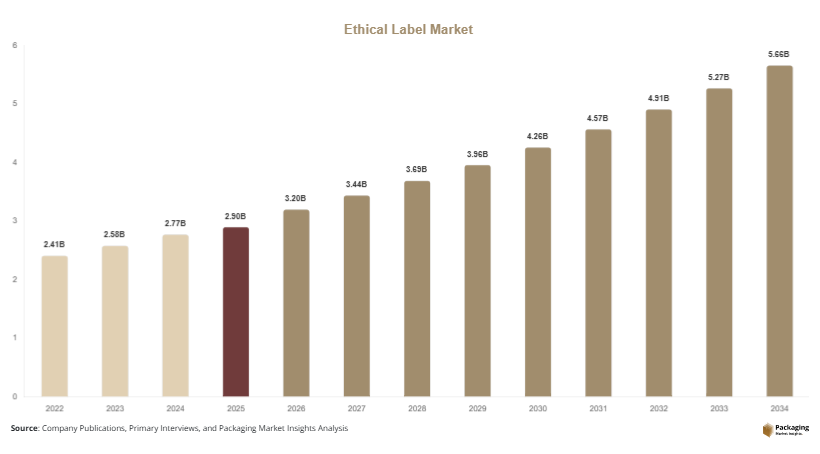
The global ethical label market size was valued at approximately USD 2.9 billion in 2025 and is expected to reach USD 3.2 billion in 2026. With growing awareness of environmental and social issues, the market is projected to expand to USD 6.1 billion by 2034, registering a CAGR of 7.4% during the forecast period (2025–2034). The ethical label market is experiencing steady growth as consumers increasingly prioritize transparency, sustainability, and social responsibility in their purchasing decisions. Ethical labels, which include certifications such as fair trade, organic, cruelty-free, and carbon-neutral labels, serve as indicators of responsible sourcing and production practices.
One of the primary growth factors is the increasing consumer demand for ethically sourced and environmentally friendly products. Consumers are actively seeking products that align with their values, particularly in sectors such as food and beverages, apparel, and personal care. This shift is encouraging companies to adopt ethical labeling as a strategy to build trust and differentiate their products in competitive markets.
Key Highlights:
- Europe dominated the market with a 34.6% share in 2025.
- Asia Pacific is projected to grow at the fastest CAGR of 8.1%.
- Fair trade labels led the type segment with a 31.2% share.
- Paper-based labels dominated with a 56.7% share.
- Food & beverage applications led the segment with 42.9% share.
- Germany remained the dominant country with a market size of USD 0.48 billion in 2025 and USD 0.52 billion in 2026.
Explore more data points, trends and opportunities Download Free Sample Report
Market Trends
Rising Demand for Transparency and Traceability
The increasing emphasis on transparency and traceability is a key trend shaping the ethical label market. Consumers are demanding clear and verifiable information about product origins, manufacturing processes, and environmental impact. Ethical labels serve as a tool to provide this information, enabling consumers to make informed purchasing decisions.
For example, food manufacturers are using QR code-enabled labels that allow consumers to trace the journey of products from farm to shelf. This level of transparency builds trust and enhances brand credibility. In the apparel industry, brands are adopting blockchain-based labeling systems to verify ethical sourcing and labor practices.
In the future, this trend is expected to intensify as digital technologies become more integrated into labeling solutions. Companies will invest in advanced traceability systems to meet consumer expectations and regulatory requirements, driving further growth in the ethical label market.
Expansion of Multi-Certification Labels
Another notable trend is the growing adoption of multi-certification labels that combine several ethical attributes into a single label. Instead of using multiple certifications, companies are opting for integrated labels that cover aspects such as sustainability, fair trade, and carbon footprint.
For instance, a single label on a food product may indicate that it is organic, fair trade certified, and environmentally sustainable. This simplifies the decision-making process for consumers and enhances product appeal. Retailers are also supporting this trend by promoting products with comprehensive certifications.
Looking ahead, multi-certification labels are expected to become more standardized, improving clarity and reducing confusion among consumers. This will encourage broader adoption across industries and support market expansion.
Market Drivers
Increasing Consumer Awareness and Ethical Consumption
The growing awareness of environmental and social issues is a major driver of the ethical label market. Consumers are becoming more conscious of the impact of their purchasing decisions and are actively seeking products that align with their values.
This shift in consumer behavior is particularly evident in developed markets, where demand for ethically labeled products is rising across various sectors. For example, organic and fair trade food products have seen increased sales as consumers prioritize health and sustainability.
The cause-and-effect relationship is clear: as awareness increases, demand for ethical labels rises, prompting companies to adopt certification practices. This trend is expected to continue, supported by educational campaigns and media coverage on sustainability issues.
Corporate Sustainability Initiatives and Brand Differentiation
Companies are increasingly adopting ethical labeling as part of their sustainability strategies. Ethical labels help businesses communicate their commitment to responsible practices and differentiate their products in competitive markets.
For example, personal care brands are using cruelty-free and vegan labels to attract environmentally conscious consumers. Similarly, apparel companies are adopting fair trade and eco-friendly certifications to enhance brand image.
This driver is further reinforced by investor pressure and corporate social responsibility goals. Companies that demonstrate ethical practices are more likely to attract investment and customer loyalty. As a result, the adoption of ethical labels is expected to grow significantly.
Market Restraint
Lack of Standardization and Consumer Confusion
One of the key challenges in the ethical label market is the lack of standardization across certification systems. The presence of multiple labels with varying criteria can create confusion among consumers, making it difficult to interpret and compare products.
For instance, different certifications for organic or sustainable products may have different standards, leading to inconsistencies. This can reduce consumer trust and limit the effectiveness of ethical labels.
The impact of this restraint is significant, as it can hinder market growth and reduce the perceived value of certifications. Companies may also face challenges in choosing the right certifications and managing compliance costs.
Efforts are being made to address this issue through the development of unified standards and regulatory frameworks. However, until greater standardization is achieved, this challenge is expected to persist.
Market Opportunities
Growth in Emerging Markets
Emerging markets present significant opportunities for the ethical label market. As awareness of sustainability issues increases in regions such as Asia Pacific and Latin America, demand for ethically labeled products is expected to rise.
For example, urban consumers in countries like India and Brazil are showing increased interest in organic and fair trade products. This trend is supported by rising disposable incomes and exposure to global sustainability practices.
Companies can capitalize on this opportunity by expanding their presence in these markets and offering products with relevant certifications. This will drive market growth and create new revenue streams.Integration of Digital Technologies in Labeling
The integration of digital technologies such as QR codes, NFC, and blockchain presents a major opportunity for the ethical label market. These technologies enhance transparency, traceability, and consumer engagement.
For instance, QR codes on product labels can provide detailed information about sourcing, production, and sustainability practices. Blockchain technology can ensure the authenticity of certifications and prevent fraud.As technology adoption increases, digital labeling solutions are expected to become more widespread. This will improve consumer trust and support the growth of the ethical label market.
Report Scope
| Report Metric | Details |
|---|---|
| Market Size in 2025 | USD 2.9 Billion |
| Market Size in 2026 | USD 3.2 Billion |
| Market Size in 2034 | USD 6.1 Billion |
| CAGR | 7.4% (2026-2034) |
| Base Year for Estimation | 2025 |
| Historical Data | 2022-2024 |
| Forecast Period | 2026-2034 |
| Report Coverage | Revenue Forecast, Competitive Landscape, Supply Chain Disruption, Growth Factors, Environment & Regulatory Landscape and Trends |
| Geographies Covered | North America, Europe, APAC, Middle East and Africa, LATAM |
| Countries Covered | U.S., Canada, U.K., Germany, France, Spain, Italy, Russia, Nordic, Benelux, Rest of Europe, China, South Korea, Japan, India, Australia, Singapore, Taiwan, South East Asia, Rest of Asia-Pacific, UAE, Turky, Saudi Arabia, South Africa, Egypt, Nigeria, Rest of MEA, Brazil, Mexico, Argentina, Chile, Colombia, Rest of LATAM |
Explore more data points, trends and opportunities Download Free Sample Report
Segmental Analysis
By Type
Fair trade labels dominated the market in 2024, accounting for approximately 31.2% of the total share. This dominance is attributed to their widespread adoption in the food and beverage and apparel industries. Fair trade certifications ensure that producers receive fair compensation and adhere to ethical labor practices. For example, coffee and cocoa products often carry fair trade labels, which appeal to socially conscious consumers. The increasing demand for ethically sourced products is driving the adoption of fair trade labels across industries.
Carbon-neutral labels are the fastest-growing segment, with a projected CAGR of 8.5%. This growth is driven by increasing focus on reducing carbon emissions and combating climate change. Companies are adopting carbon-neutral certifications to demonstrate their commitment to sustainability. For instance, several brands are offsetting their carbon emissions and using labels to communicate their efforts. As environmental concerns continue to rise, the demand for carbon-neutral labels is expected to grow significantly.
By Material
Paper-based labels dominated the market in 2024 with a share of 56.7%, owing to their cost-effectiveness and recyclability. Paper labels are widely used across industries due to their versatility and compatibility with various printing technologies. For example, food and beverage products commonly use paper labels for branding and certification purposes. The growing emphasis on sustainability is further supporting the adoption of paper-based labels.
Biodegradable materials are the fastest-growing segment, with a CAGR of 8.0%. This growth is driven by increasing demand for environmentally friendly packaging solutions. Biodegradable labels reduce environmental impact and align with sustainability goals. For instance, companies are using compostable materials for labeling to minimize waste. As regulatory pressure increases, the adoption of biodegradable materials is expected to rise.
By End-Use
Food & beverage applications dominated the market in 2024, accounting for 42.9% of the total share. This dominance is due to the high demand for transparency and certification in food products. Ethical labels such as organic and fair trade are widely used to ensure product quality and safety. For example, organic food products often carry certification labels that indicate compliance with standards. The growing demand for healthy and sustainable food options is driving this segment.
Personal care products are the fastest-growing segment, with a CAGR of 7.9%. The increasing demand for cruelty-free and vegan products is driving the adoption of ethical labels in this sector. For instance, skincare and cosmetics brands are using ethical certifications to attract environmentally conscious consumers. As awareness of ethical consumption increases, this segment is expected to grow significantly.
Ethical Label Market Segmentations
By Type
- Fair Trade Labels
- Organic Labels
- Carbon-Neutral Labels
- Cruelty-Free Labels
By Material
- Paper
- Plastic
- Biodegradable Materials
By End-User
- Food & Beverage
- Apparel
- Personal Care
- Consumer Goods
Regional Analysis
North America
North America accounted for approximately 27.3% of the ethical label market share in 2025 and is projected to grow at a CAGR of 7.1% during the forecast period. The region benefits from high consumer awareness, well-established certification systems, and strong regulatory frameworks supporting sustainable practices. Demand for ethical labels is particularly strong in the food and beverage and personal care sectors. Retailers are increasingly prioritizing products with ethical certifications, which drives adoption among manufacturers. The presence of advanced supply chain infrastructure also supports traceability and transparency initiatives, further strengthening the market.
The United States dominates the regional market, driven by increasing demand for organic and fair trade products. A unique growth driver is the expansion of private-label ethical products by major retailers. For example, supermarket chains are introducing their own ethically certified product lines to cater to consumer demand. This trend is boosting the adoption of ethical labels and encouraging competition among brands.
Europe
Europe held a market share of 34.6% in 2025 and is expected to grow at a CAGR of 7.0%. The region has a strong regulatory environment that promotes sustainability and ethical practices. Consumers in Europe are highly aware of environmental and social issues, which drives demand for ethically labeled products. The food and beverage industry is a major contributor to market growth, with widespread adoption of organic and fair trade certifications.
Germany is the dominant country in the region, supported by its strong retail sector and consumer preference for sustainable products. A key growth driver is the implementation of stringent labeling regulations that require transparency in sourcing and production. For example, German retailers are promoting products with verified ethical certifications, which increases consumer trust and market growth.
Asia Pacific
Asia Pacific emerged as the fastest-growing region, with a market share of 23.8% in 2025 and a projected CAGR of 8.1%. Rapid urbanization, rising disposable incomes, and increasing awareness of sustainability issues are driving demand for ethical labels in the region. The expansion of e-commerce platforms is also contributing to market growth by providing access to certified products.
China dominates the regional market, driven by its large consumer base and growing interest in sustainable products. A unique growth driver is the increasing demand for imported goods with ethical certifications. For example, consumers in urban areas are seeking organic and environmentally friendly products, which boosts the adoption of ethical labels.
Middle East & Africa
The Middle East & Africa region accounted for 6.1% of the market share in 2025 and is expected to grow at a CAGR of 6.5%. The market is influenced by increasing awareness of sustainability and the growth of the retail sector. Demand for ethical labels is primarily driven by imported products and premium segments.
South Africa is the leading country in the region, supported by its growing retail industry and export-oriented sectors. A key growth driver is the increasing adoption of fair trade certifications in agricultural exports. For example, producers are using ethical labels to enhance product value and access international markets.
Latin America
Latin America held a market share of 8.2% in 2025 and is projected to grow at a CAGR of 7.8%. The region is experiencing steady growth in demand for ethically labeled products, particularly in the food and beverage sector. Increasing awareness of sustainability and government initiatives are supporting market expansion.
Brazil is the dominant country in the region, driven by its large consumer base and growing interest in organic products. A unique growth driver is the expansion of local certification programs that promote sustainable practices. For instance, Brazilian producers are adopting ethical labels to differentiate their products and attract consumers.
Competitive Landscape
The ethical label market is moderately fragmented, with several global and regional players offering certification and labeling solutions. Companies compete based on credibility, recognition, and compliance with international standards.
Fairtrade International is identified as a leading player in the market, known for its widely recognized certification system. The organization focuses on promoting fair trade practices and supporting producers in developing countries.
Other key players are adopting strategies such as partnerships, digital innovation, and expansion of certification programs. For example, companies are integrating blockchain technology to enhance transparency and prevent fraud. Investments in awareness campaigns and collaborations with retailers are also common strategies.
Recent developments include the introduction of multi-certification labels and digital platforms for verification. These initiatives aim to improve consumer trust and streamline certification processes. As competition intensifies, companies are focusing on innovation and global expansion to strengthen their market position.
Key Players
- Fairtrade International
- Rainforest Alliance
- USDA Organic
- EU Organic Certification
- B Corp Certification
- Carbon Trust
- Soil Association Certification
- Ecocert
- Control Union Certifications
- SGS SA
- Bureau Veritas
- Intertek Group Plc
- UL Solutions
- NSF International
- TÜV SÜD