Personalized Stickers Market Size and Growth
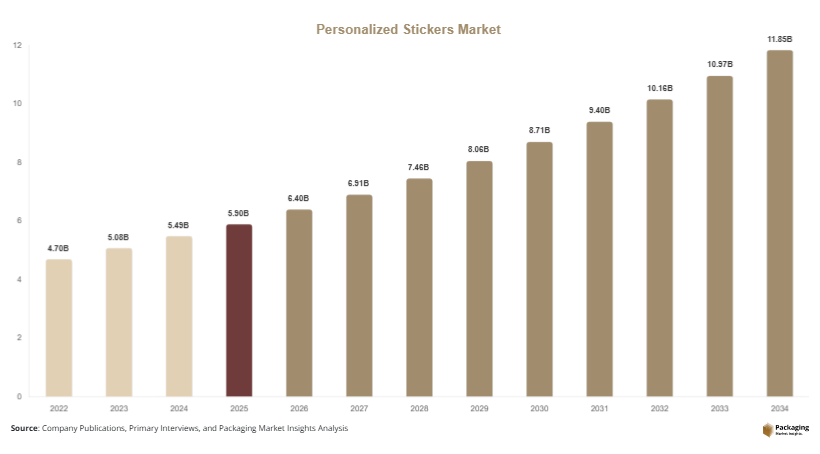
The global personalized stickers market size was valued at approximately USD 5.9 billion in 2025 and is projected to reach around USD 6.4 billion in 2026. By 2034, the market is expected to attain nearly USD 12.8 billion, growing at a CAGR of 8.0% during 2025–2034. Increasing consumer preference for visually distinctive packaging and personalized products is contributing to long-term market expansion. Small businesses, social media sellers, and independent creators are increasingly using personalized stickers for branding and customer engagement.
One of the major growth factors is the rapid expansion of e-commerce and direct-to-consumer brands that require customized packaging materials for product differentiation. Another important factor is the increasing adoption of digital printing technologies, enabling low-cost short-run sticker production with high design flexibility. In addition, rising popularity of DIY crafts, event decorations, and personalized gifting solutions is creating strong demand across residential and commercial applications.
Key Highlights:
- North America dominated the market with a 34.8% share in 2025.
- Asia Pacific is projected to grow at the fastest CAGR of 8.9%.
- Vinyl stickers led the type segment with a 39.6% share.
- Plastic-based materials dominated with a 49.3% share.
- Commercial branding applications led the end-use segment with 45.2% share.
- The US remained the dominant country with a market size of USD 1.6 billion in 2025 and USD 1.8 billion in 2026.
Explore more data points, trends and opportunities Download Free Sample Report
Market Trends
Growing Adoption of Eco-Friendly Personalized Stickers
The personalized stickers market is witnessing rising demand for sustainable and eco-friendly sticker solutions as businesses and consumers increasingly prioritize environmentally responsible products. Manufacturers are introducing biodegradable adhesives, recyclable paper substrates, soy-based inks, and compostable sticker materials to align with sustainability goals. For example, small packaging brands and handmade product sellers are increasingly using recyclable kraft-paper stickers for product labeling and branding. This trend is especially prominent in food packaging, cosmetics, and eco-conscious retail segments where sustainable packaging influences purchasing decisions. Future growth is expected to be supported by advancements in water-based adhesives and low-emission printing technologies. As environmental regulations tighten globally, sustainable personalized stickers are likely to become a standard offering across commercial and consumer applications.
Expansion of Digital and Short-Run Printing Technologies
Digital printing innovation is significantly transforming the personalized stickers market by enabling high-quality short-run production and rapid customization capabilities. Businesses and individual consumers can now order low-volume personalized stickers with customized graphics, colors, and finishes at affordable costs. For example, online print-on-demand platforms allow creators and small businesses to design personalized stickers for laptops, packaging, promotional merchandise, and social media branding. The flexibility of digital printing supports seasonal marketing campaigns and customized event branding with minimal production delays. Future developments in UV printing, holographic finishes, and variable data printing are expected to enhance product quality and design versatility. This trend is helping smaller businesses compete effectively in highly personalized branding markets.
Market Drivers
Expansion of E-commerce and Small Business Branding
The rapid growth of e-commerce and direct-to-consumer brands is a major driver for the personalized stickers market. Online sellers increasingly rely on customized stickers to strengthen packaging aesthetics, improve customer engagement, and enhance brand visibility. Personalized stickers are widely used on shipping boxes, thank-you cards, product labels, and promotional inserts. For example, small businesses operating through social commerce platforms use customized logo stickers to create professional packaging experiences at low cost. This trend is particularly strong among cosmetics, handmade crafts, food delivery, and apparel brands. As e-commerce competition intensifies, businesses are increasingly investing in personalized packaging elements to improve customer retention and social media visibility, driving long-term demand for personalized stickers globally.
Rising Popularity of Personalized Merchandise and Décor
The increasing popularity of customized merchandise and decorative products is another major factor driving market growth. Consumers are increasingly purchasing personalized stickers for laptops, mobile accessories, notebooks, planners, automobiles, and home décor applications. Social media culture and online creator communities are significantly influencing personalized merchandise demand. For instance, influencers and artists frequently launch custom sticker collections as part of branded merchandise strategies. Educational institutions and event organizers are also using personalized stickers for branding and engagement activities. Future demand is expected to rise further as younger consumers continue prioritizing individuality and personalized design aesthetics across lifestyle products and accessories.
Market Restraint
One of the major restraints in the personalized stickers market is the fluctuating cost of raw materials and printing supplies. Sticker production depends heavily on materials such as vinyl films, specialty papers, adhesives, laminates, and printing inks, which are affected by supply chain volatility and petroleum-based pricing fluctuations. Rising logistics costs and shortages of specialty printing materials can significantly increase production expenses for manufacturers and online print providers. For example, small-scale printing businesses often face margin pressure during periods of adhesive or vinyl price inflation. In addition, increasing environmental regulations regarding plastic-based sticker materials are creating compliance challenges for manufacturers. Counterfeit design duplication and intellectual property concerns also affect independent creators and customized merchandise businesses operating through online platforms.
Market Opportunities
Growth of Smart and Interactive Sticker Technologies
Smart and interactive sticker technologies present a major growth opportunity for the personalized stickers market. Businesses are increasingly integrating QR codes, NFC chips, and augmented reality features into customized stickers to improve customer interaction and digital engagement. For example, cosmetic brands and food companies are using QR-enabled stickers that direct consumers to promotional content, product information, or loyalty programs. Interactive stickers also support product authentication and digital storytelling applications. Future developments may include AI-enabled promotional stickers and mobile-responsive augmented reality experiences. As brands continue prioritizing digital consumer engagement, demand for technologically enhanced personalized stickers is expected to increase significantly across commercial packaging and promotional markets.
Expansion of Personalized Event and Gifting Applications
The growing popularity of customized gifting and event decoration is creating substantial opportunities in the personalized stickers market. Personalized stickers are increasingly used for weddings, birthdays, corporate events, product launches, and seasonal celebrations. Consumers are seeking affordable customization solutions that improve visual appeal and create unique experiences. For instance, event planners and gift packaging businesses are increasingly offering personalized sticker bundles for party favors, invitation packaging, and decorative labeling. Future demand is expected to rise due to increasing consumer spending on customized celebrations and experiential gifting trends. The growth of online craft marketplaces and DIY customization platforms is also expected to support market expansion.
Report Scope
| Report Metric | Details |
|---|---|
| Market Size in 2025 | USD 5.9 Billion |
| Market Size in 2026 | USD 6.4 Billion |
| Market Size in 2034 | USD 12.8 Billion |
| CAGR | 8.0% (2026-2034) |
| Base Year for Estimation | 2025 |
| Historical Data | 2022-2024 |
| Forecast Period | 2026-2034 |
| Report Coverage | Revenue Forecast, Competitive Landscape, Supply Chain Disruption, Growth Factors, Environment & Regulatory Landscape and Trends |
| Geographies Covered | North America, Europe, APAC, Middle East and Africa, LATAM |
| Countries Covered | U.S., Canada, U.K., Germany, France, Spain, Italy, Russia, Nordic, Benelux, Rest of Europe, China, South Korea, Japan, India, Australia, Singapore, Taiwan, South East Asia, Rest of Asia-Pacific, UAE, Turky, Saudi Arabia, South Africa, Egypt, Nigeria, Rest of MEA, Brazil, Mexico, Argentina, Chile, Colombia, Rest of LATAM |
Explore more data points, trends and opportunities Download Free Sample Report
Segmental Analysis
Type
Vinyl stickers dominated the type segment with approximately 39.6% market share in 2024. Vinyl materials remain highly preferred because of their durability, waterproof properties, flexibility, and long-lasting print quality. Businesses and consumers use vinyl stickers extensively for outdoor branding, automotive decals, laptop customization, packaging labels, and promotional merchandise. For example, food delivery companies and beverage brands frequently use weather-resistant vinyl stickers for product labeling and promotional packaging applications. The dominance of this segment is also supported by compatibility with advanced digital printing technologies and holographic finishes. Vinyl stickers provide strong adhesive performance and vibrant color reproduction, making them suitable for both commercial and decorative applications. Increasing demand for customized business branding and durable promotional materials continues supporting segment growth globally.
Holographic stickers are expected to emerge as the fastest-growing subsegment with a CAGR of 9.4% during 2025–2034. Growth is driven by increasing demand for visually distinctive branding materials and premium decorative products. Holographic finishes improve product aesthetics and enhance visual engagement, particularly in cosmetics packaging, influencer merchandise, and promotional campaigns. For example, online creators and beauty brands are increasingly using holographic personalized stickers to improve packaging appeal and social media visibility. Future growth is expected to be supported by advancements in reflective printing technologies and specialty laminates. Rising consumer preference for premium visual effects and limited-edition packaging is likely to accelerate demand for holographic personalized stickers across retail and commercial sectors.
Material
Plastic-based materials accounted for the dominant material segment with approximately 49.3% share in 2024. Plastic substrates such as vinyl and polyester are widely used because they provide durability, water resistance, flexibility, and compatibility with various printing techniques. These materials are extensively utilized in outdoor stickers, product labels, promotional decals, and decorative applications. For example, e-commerce packaging companies frequently use plastic-based stickers because they maintain adhesive quality during transportation and storage. The dominance of this segment is also linked to its ability to support advanced finishes such as gloss laminates, UV coatings, and holographic effects. Businesses prefer plastic-based sticker materials for high-volume branding applications due to cost efficiency and long-lasting performance.
Recyclable paper materials are projected to be the fastest-growing subsegment with a CAGR of 8.7% during the forecast period. Growth is driven by increasing sustainability awareness and regulatory pressure regarding plastic waste reduction. Brands operating in food packaging, cosmetics, and handmade crafts are increasingly adopting paper-based personalized stickers to align with eco-friendly branding strategies. For instance, organic product companies are using recyclable kraft-paper stickers with biodegradable adhesives for packaging applications. Future demand is expected to increase due to advancements in water-resistant paper coatings and sustainable printing technologies. Eco-conscious consumer purchasing behavior is likely to further accelerate adoption of recyclable sticker materials across global markets.
End-Use
Commercial branding applications dominated the end-use segment with approximately 45.2% market share in 2024. Businesses across retail, food delivery, logistics, cosmetics, and apparel sectors heavily rely on personalized stickers for branding, packaging, and promotional marketing purposes. Customized stickers are widely used on shipping boxes, bottles, takeaway packaging, and promotional merchandise to improve brand recognition and customer interaction. For example, online retail brands frequently include logo stickers and branded packaging labels in subscription deliveries and seasonal campaigns. The dominance of this segment is also supported by rising competition in digital commerce and increasing importance of customized customer experiences. Growing demand for affordable branding tools among startups and small businesses continues supporting strong market demand globally.
Personalized gifting applications are projected to register the fastest CAGR of 9.1% through 2034. Growth is driven by rising consumer spending on customized celebrations, DIY crafts, and event decoration products. Personalized stickers are increasingly used in wedding favors, birthday decorations, greeting packages, and festive gift wrapping applications. For example, online marketplaces now offer customized sticker bundles designed for personal gifting and creative decoration purposes. Future market expansion is expected to be supported by increasing demand for experiential gifting and handmade customization trends. The integration of augmented reality effects and interactive digital elements into personalized gift stickers may further strengthen long-term market opportunities.
Personalized Stickers Market Segmentations
By Type
- Vinyl Stickers
- Paper Stickers
- Holographic Stickers
- Transparent Stickers
- Die-Cut Stickers
By Material
- Plastic-Based Materials
- Recyclable Paper Materials
- Polyester Materials
- Vinyl Materials
- Biodegradable Materials
By End-User
- Commercial Branding
- Personalized Gifting
- Packaging & Labeling
- Decorative Applications
- Promotional Marketing
Regional Analysis
North America
North America accounted for approximately 34.8% share of the personalized stickers market in 2025 and is expected to grow at a CAGR of 7.6% during 2025–2034. The region benefits from strong e-commerce penetration, advanced digital printing infrastructure, and rising demand for customized branding solutions. Businesses across food delivery, retail packaging, and lifestyle merchandise segments are increasingly using personalized stickers to strengthen brand identity and improve customer engagement. Growth is also supported by the popularity of online print-on-demand services and social media-driven merchandising trends. Consumers in the region are increasingly purchasing decorative stickers for laptops, planners, automobiles, and mobile accessories, further supporting retail market expansion.
The United States dominates the regional market due to its large customized merchandise ecosystem and high online retail activity. A unique growth driver is the increasing adoption of personalized packaging among small businesses and influencer-led brands. For example, independent cosmetic and apparel brands frequently use custom logo stickers for subscription packaging and promotional campaigns. Canada is also experiencing rising demand for eco-friendly sticker products made from recyclable materials and water-based inks. Future regional growth is expected to be supported by increasing investments in sustainable printing technologies and advanced digital design platforms.
Europe
Europe represented nearly 24.2% market share in 2025 and is projected to grow at a CAGR of 7.8% during the forecast period. The region is characterized by rising demand for sustainable packaging, premium branding materials, and customized retail labeling solutions. European businesses are increasingly adopting recyclable sticker substrates and environmentally friendly adhesives to comply with strict packaging regulations. The market is also benefiting from strong demand for personalized décor products and event customization services. Growth in boutique retail, artisanal food packaging, and handmade product branding is supporting personalized sticker consumption across multiple industries.
Germany leads the European market due to its advanced printing industry and strong demand for premium customized packaging. A key growth driver is the increasing adoption of sustainable personalized stickers in retail and food packaging applications. For example, German organic food brands are using recyclable kraft-paper stickers with water-based adhesives for product labeling and packaging personalization. France and the United Kingdom are also major contributors due to rising demand for designer merchandise and event-based customization products. Future market growth is expected to be supported by eco-friendly printing innovations and rising demand for luxury personalized packaging.
Asia Pacific
Asia Pacific is projected to register the fastest CAGR of 8.9% during 2025–2034 and accounted for approximately 27.5% share in 2025. Rapid e-commerce growth, increasing smartphone usage, and expanding small business ecosystems are driving strong demand for personalized stickers across the region. Countries such as China, Japan, South Korea, and India are experiencing rising adoption of customized packaging and digital printing technologies. Growing youth populations and increasing social media engagement are also contributing to higher consumption of decorative and branded sticker products. The region benefits from cost-effective manufacturing capabilities and strong growth in online customization platforms.
China dominates the regional market due to its extensive digital printing infrastructure and large e-commerce packaging industry. A unique growth driver is the rapid expansion of social commerce and influencer-driven merchandise sales. For example, Chinese online sellers frequently use personalized stickers for livestream retail packaging and promotional branding campaigns. South Korea is also a significant contributor because of rising demand for aesthetic lifestyle products and decorative stationery items. India is emerging rapidly with growing adoption of personalized event stickers and customized business branding materials among small enterprises and startup brands.
Middle East & Africa
The Middle East & Africa region accounted for approximately 6.5% market share in 2025 and is expected to grow at a CAGR of 7.1% during the forecast period. Market growth is supported by increasing retail modernization, rising event management activities, and growing adoption of customized packaging solutions across urban markets. Personalized stickers are increasingly used in promotional marketing, hospitality branding, and retail packaging applications. The expansion of small businesses and food delivery platforms is also contributing to rising demand for customized labels and decorative stickers.
Saudi Arabia dominates the regional market due to growing investments in retail branding and event management industries. A key growth driver is the increasing use of personalized stickers in luxury retail packaging and corporate promotional activities. For example, premium retail brands in Riyadh and Dubai are increasingly incorporating customized holographic stickers into gift packaging and product branding. South Africa is also experiencing steady demand growth due to increasing use of personalized stickers in local crafts, handmade products, and small business branding. Future regional expansion is expected to be supported by digital printing adoption and rising entrepreneurial activity.
Latin America
Latin America held approximately 7.0% market share in 2025 and is projected to grow at a CAGR of 8.3% through 2034. The market is benefiting from increasing online retail activity, growing personalized gifting culture, and rising adoption of custom packaging solutions among small businesses. Personalized stickers are widely used in event decoration, bakery packaging, cosmetics branding, and promotional marketing campaigns. The growing popularity of independent creators and local online businesses is supporting strong market demand across urban centers.
Brazil dominates the Latin American market due to its large consumer goods industry and expanding online craft marketplace ecosystem. A major growth driver is the increasing demand for personalized decorative products and customized retail packaging. For example, Brazilian handmade product sellers frequently use colorful personalized stickers for packaging differentiation and seasonal promotional campaigns. Mexico is also witnessing rising demand for personalized event stickers and food packaging labels. Future market growth is expected to be supported by increasing smartphone penetration and expansion of social commerce platforms across the region.
Competitive Landscape
The personalized stickers market is moderately fragmented, with companies competing through digital printing innovation, customization capabilities, and sustainable material development. Major market participants are investing in print-on-demand platforms, advanced adhesive technologies, and eco-friendly sticker materials to strengthen their market positions. The competitive landscape includes large printing companies, specialty sticker manufacturers, and online customization providers.
Sticker Mule remains one of the leading players due to its strong online customization platform, rapid production capabilities, and broad product portfolio. The company continues expanding its short-run digital printing services and premium sticker finish options for commercial and consumer applications. Avery Products Corporation is focusing on printable label technologies and customized business branding solutions for retail and packaging sectors. Vistaprint is expanding personalized promotional product offerings integrated with sticker customization services.
Other companies are emphasizing sustainable sticker materials, holographic finishes, and interactive digital sticker technologies. Strategic partnerships with e-commerce sellers, independent creators, and packaging companies are increasing across the market. Future competition is expected to intensify as businesses continue prioritizing personalized branding and sustainable packaging solutions.
Key Players List
- Sticker Mule
- Avery Products Corporation
- Vistaprint
- Moo Print Ltd.
- StickerApp
- UPrinting
- PrintRunner
- Online Labels LLC
- Redbubble Ltd.
- Zazzle Inc.
- StickerYou Inc.
- GotPrint
- PsPrint
- Canva Pty Ltd.
- Sticker Giant