Shrink Sleeve Labels Market Size
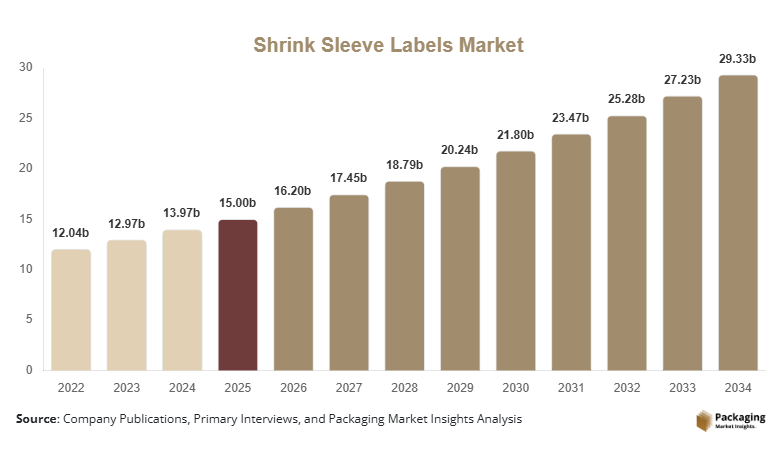
Shrink Sleeve Labels market size is projected at USD 16.2 billion in 2026 and is expected to hit USD 29.4 billion by 2034 with a CAGR of 7.7%.” The market expansion is driven by increasing demand for attractive packaging designs, rising adoption of tamper-evident solutions, and growing use of 360-degree labeling technologies across consumer goods industries. The report provides comprehensive segmentation analysis, competitive landscape evaluation, production trends, technological advancements, and regional insights covering historical years 2022–2024 and forecast period 2026–2034.
Shrink Sleeve Labels Market includes heat-shrinkable labeling solutions manufactured from polymer films that conform tightly to product containers through thermal processing. Global shrink sleeve label production exceeded 95 billion units in 2025, with beverage packaging accounting for nearly 45% of total consumption. PETG-based shrink sleeves represent approximately 40% of demand due to their superior clarity, print quality, and recyclability advantages. Adoption has increased among FMCG companies, with more than 60% of beverage and personal care brands using shrink sleeve labels for product differentiation. Growing demand for premium packaging and flexible branding solutions continues to strengthen Shrink Sleeve Labels Market Growth.
Explore more data points, trends and opportunities Download Free Sample Report
Shrink Sleeve Labels Market Trends
Increasing Adoption of Sustainable and Recyclable Sleeve Materials
The shift toward sustainable packaging solutions is accelerating innovation in shrink sleeve label materials. In 2025, global consumption of recyclable shrink sleeve films exceeded 35 billion units, supported by increasing environmental regulations and brand sustainability targets. Approximately 55% of packaging manufacturers are investing in recyclable PETG and low-density sleeve materials. Advanced film technologies are reducing material thickness by 15–25% while maintaining durability, supporting Shrink Sleeve Labels Market Trend development.
Rising Demand for Premium Packaging and Digital Printing Solutions
Premiumization across beverages, cosmetics, and healthcare products is increasing demand for high-quality shrink sleeve labels. More than 40 billion units of digitally printed shrink sleeve labels were produced globally in 2025, enabling customized packaging designs and shorter production runs. Around 50% of premium FMCG brands are adopting advanced printing technologies, including digital and rotogravure printing, to improve shelf visibility and consumer engagement. These innovations are supporting Shrink Sleeve Labels Market Demand.
Shrink Sleeve Labels Drivers
Growing Demand for Attractive and Functional Packaging Solutions
Increasing competition among consumer brands is driving adoption of shrink sleeve labels for enhanced product appearance and protection. More than 70% of beverage manufacturers use sleeve labeling solutions for bottles and containers, while demand from food and personal care sectors has increased by approximately 25% since 2022. Shrink sleeves provide 360-degree graphics, tamper evidence, and improved branding opportunities, making them highly suitable for premium packaging applications and accelerating Shrink Sleeve Labels Market Growth.
Shrink Sleeve Labels Restraints
High Material Costs and Recycling Challenges
The market faces limitations due to higher production costs and recycling complexities associated with certain plastic films. Raw materials account for approximately 60–65% of total shrink sleeve production costs, while polymer price fluctuations of 10–20% annually impact manufacturer margins. Additionally, compatibility issues between sleeve materials and containers create recycling challenges. These factors influence adoption rates among cost-sensitive packaging manufacturers and affect Shrink Sleeve Labels Market expansion.
Shrink Sleeve Labels Opportunities
Expansion of Sustainable Packaging and Smart Labeling Technologies
Increasing investments in sustainable and intelligent packaging solutions create new opportunities for shrink sleeve label manufacturers. More than 65% of global brands are focusing on recyclable packaging formats, while smart labeling applications such as QR codes and anti-counterfeit features are growing by over 20% annually. Development of bio-based films, lightweight structures, and digital printing technologies is expected to create significant opportunities for Shrink Sleeve Labels Market Opportunities.
Challenges in Shrink Sleeve Labels
Competition from Alternative Labeling Technologies
Shrink sleeve labels face competition from pressure-sensitive labels, in-mold labels, and direct printing technologies. Approximately 30% of packaging converters continue evaluating alternative labeling formats due to cost and recycling considerations. Additionally, specialized equipment requirements increase initial investment costs by 15–30% compared with conventional labeling systems. Manufacturers are focusing on material innovation and production efficiency to overcome challenges affecting Shrink Sleeve Labels Market Insights.
Report Scope
| Report Metric | Details |
|---|---|
| Market Size in 2025 | USD 15.0 billion |
| Market Size in 2026 | USD 16.2 billion |
| Market Size in 2034 | USD 29.4 billion |
| CAGR | 7.7% (2026-2034) |
| Base Year for Estimation | 2025 |
| Historical Data | 2022-2024 |
| Forecast Period | 2026-2034 |
| Report Coverage | Revenue Forecast, Competitive Landscape, Supply Chain Disruption, Growth Factors, Environment & Regulatory Landscape and Trends |
| Geographies Covered | North America, Europe, APAC, Middle East and Africa, LATAM |
| Countries Covered | U.S., Canada, U.K., Germany, France, Spain, Italy, Russia, Nordic, Benelux, Rest of Europe, China, South Korea, Japan, India, Australia, Singapore, Taiwan, South East Asia, Rest of Asia-Pacific, UAE, Turky, Saudi Arabia, South Africa, Egypt, Nigeria, Rest of MEA, Brazil, Mexico, Argentina, Chile, Colombia, Rest of LATAM |
Explore more data points, trends and opportunities Download Free Sample Report
Shrink Sleeve Labels Market Segmentation
Shrink Sleeve Labels Market segmentation is based on type and application. PETG shrink sleeve labels dominate the type segment with nearly 40% market share due to high shrink performance and visual quality, while food and beverage packaging accounts for approximately 45% of total application demand. Increasing adoption across FMCG, healthcare, and personal care industries continues expanding market penetration.
By Type
PVC Shrink Sleeve Labels
PVC shrink sleeve labels account for approximately 35% market share due to their cost-effectiveness and wide adoption in consumer packaging. Global production exceeded 30 billion units in 2025. These labels provide shrink ratios of 45–65% and are widely used for beverage bottles, household products, and promotional packaging applications.
PETG Shrink Sleeve Labels
PETG shrink sleeve labels represent the largest segment with nearly 40% share. More than 38 billion units were produced in 2025 due to excellent transparency, printability, and compatibility with premium packaging. PETG sleeves provide shrink ratios above 70% and are increasingly preferred by beverage, cosmetic, and healthcare manufacturers.
OPS Shrink Sleeve Labels
OPS shrink sleeve labels contribute approximately 25% market share and are mainly used for lightweight packaging applications. Production reached nearly 25 billion units in 2025. These labels provide high shrink performance, low density, and improved environmental advantages for food and beverage packaging.
By Application
Food & Beverage Packaging
Food and beverage packaging dominates the application segment with nearly 45% share. More than 42 billion shrink sleeve labels were consumed in this segment during 2025. Beverage bottles, dairy products, sauces, and ready-to-drink products are major users. Adoption penetration exceeds 70% among beverage companies due to branding flexibility and tamper protection.
Personal Care Packaging
Personal care packaging accounts for approximately 30% market share. More than 28 billion units were used in cosmetics, skincare, and hygiene products in 2025. Shrink sleeves enable premium appearance, full-container graphics, and brand differentiation, supporting increasing adoption among cosmetic manufacturers.
Pharmaceutical Packaging
Pharmaceutical packaging contributes nearly 15% share, supported by demand for authentication and tamper-evident labeling. Around 14 billion units were consumed in 2025 for medicine bottles and healthcare products. Shrink sleeve labels improve product security and regulatory compliance.
Shrink Sleeve Labels Market Segmentations
Type
- PVC Shrink Sleeve Labels
- PETG Shrink Sleeve Labels
- OPS Shrink Sleeve Labels
- PLA & Bio-Based Shrink Sleeve Labels
Application
- Food & Beverage Packaging
- Personal Care & Cosmetics Packaging
- Pharmaceutical Packaging
- Household & Industrial Products
Printing Technology
- Flexographic Printing
- Rotogravure Printing
- Digital Printing
- Offset Printing
Shrink Sleeve Labels Regional Outlook
North America
North America holds approximately 30% of the global Shrink Sleeve Labels Market Share. The region consumed more than 28 billion units in 2025, driven by beverage, healthcare, and personal care industries. The United States contributes nearly 75% of regional demand due to advanced packaging infrastructure and strong adoption of premium labels.
Europe
Europe accounts for around 28% market share, supported by sustainability regulations and advanced packaging technologies. Germany, France, Italy, and the United Kingdom represent major markets, collectively contributing more than 70% of regional consumption. Food, beverage, and cosmetic packaging represent over 75% of applications.
Asia-Pacific
Asia-Pacific is the fastest-growing region with approximately 32% market share. China, India, Japan, and South Korea are major contributors, accounting for more than 80% of regional demand. The region produced over 30 billion shrink sleeve labels in 2025 due to expanding FMCG and beverage industries.
Latin America and Middle East & Africa
These regions collectively contribute nearly 10% market share. Growing packaged food consumption, urbanization, and retail expansion are increasing adoption. Brazil, Mexico, UAE, and South Africa represent key growth markets.
Top players in Shrink Sleeve Labels Market
- CCL Industries Inc.
- Avery Dennison Corporation
- Fuji Seal International Inc.
- Berry Global Inc.
- Multi-Color Corporation
- Huhtamaki Oyj
- Amcor plc
- Coveris Holdings S.A.
- Clondalkin Group Holdings
- Fort Dearborn Company
- Hammer Packaging Corporation
- Traco Manufacturing Inc.
CCL Industries Inc.
-
Holds a leading position with approximately 10–12% presence in global labeling solutions.
-
Provides shrink sleeve labels for beverage, healthcare, and consumer goods applications.
-
Operates multiple manufacturing facilities across North America, Europe, and Asia.
-
Focuses on sustainable materials, digital printing, and smart labeling technologies.
-
Invests in advanced production capabilities to support premium packaging demand.
Avery Dennison Corporation
-
Maintains approximately 8–10% market positioning in global labeling technologies.
-
Offers innovative shrink sleeve solutions for food, beverage, and personal care industries.
-
Focuses on recyclable label materials and sustainable packaging systems.
-
Develops intelligent labeling solutions incorporating tracking and authentication features.
-
Supports global brands with advanced adhesive and labeling technologies.