Shrink Sleeve Label Applicator Market Size and Growth
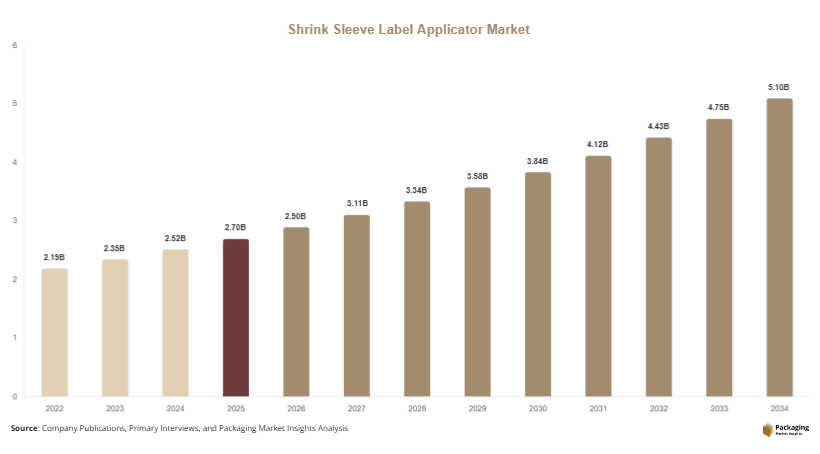
The global shrink sleeve label applicator market size was valued at approximately USD 2.7 billion in 2025 and is projected to reach USD 2.9 billion in 2026. By 2034, the market is forecast to reach nearly USD 5.1 billion, expanding at a CAGR of 7.3% during 2025–2034. The shrink sleeve label applicator market is experiencing consistent growth due to increasing demand for advanced labeling technologies across food & beverage, pharmaceuticals, cosmetics, household products, and industrial packaging sectors. Shrink sleeve label applicators are specialized machines designed to apply shrink sleeve labels accurately around containers and packaging products. These systems improve branding, product visibility, tamper evidence, and packaging efficiency while supporting high-speed manufacturing operations.
One of the primary growth factors supporting the shrink sleeve label applicator market is the rapid expansion of packaged consumer goods industries. Beverage manufacturers, food processors, and personal care brands increasingly use shrink sleeve labels because they provide full-body graphics, 360-degree branding, and strong shelf appeal. Another significant growth factor is the rising adoption of automated packaging systems across industrial production facilities. Manufacturers are investing in high-speed applicators to improve labeling precision, reduce operational downtime, and support mass production requirements. In addition, increasing demand for tamper-evident packaging solutions is contributing to wider adoption of shrink sleeve technologies in pharmaceutical and healthcare applications.
Key Highlights
- Asia Pacific dominated the market with a 39.8% share in 2025.
- Latin America is projected to grow at the fastest CAGR of 7.7%.
- Automatic shrink sleeve applicators led the type segment with a 41.2% share.
- Food & beverage applications dominated with a 44.6% share.
- High-speed production lines led the end-use segment with 36.4% share.
- The US remained the dominant country with a market size of USD 620 million in 2025 and USD 665 million in 2026.
Explore more data points, trends and opportunities Download Free Sample Report
Market Trends
Integration of Automation and Smart Control Systems
Automation and digital monitoring technologies are becoming major trends in the shrink sleeve label applicator market. Manufacturers are increasingly integrating servo motors, programmable logic controllers, automated sensors, and touchscreen interfaces into applicator systems to improve operational accuracy and production speed. Smart control systems help packaging facilities reduce material waste, improve label alignment, and minimize downtime during high-volume production. In addition, automated inspection technologies are being used to identify labeling defects and improve quality control efficiency. Beverage and pharmaceutical manufacturers are particularly adopting intelligent shrink sleeve systems to support continuous production operations. As industrial automation expands globally, demand for advanced and digitally connected labeling equipment is expected to increase steadily.
Rising Adoption of Sustainable Shrink Sleeve Technologies
Sustainability-focused packaging solutions are significantly influencing the shrink sleeve label applicator market. Packaging manufacturers are increasingly adopting recyclable shrink films, low-energy steam tunnels, and lightweight labeling materials to reduce environmental impact. Equipment manufacturers are developing applicators compatible with eco-friendly sleeve materials and reduced-energy operating systems. Brands in food, beverage, and personal care industries are actively seeking sustainable labeling technologies to support environmental commitments and improve packaging recyclability. In addition, water-based inks and washable adhesive technologies are improving the recycling compatibility of shrink sleeve labels. The transition toward sustainable packaging practices is expected to create continuous innovation opportunities across the shrink sleeve applicator industry.
Market Drivers
Growing Demand for Premium and Visually Attractive Packaging
The increasing demand for premium packaging solutions is a major driver of the shrink sleeve label applicator market. Shrink sleeve labels provide 360-degree graphics, vibrant printing quality, and flexibility for complex container shapes, making them highly attractive for branding purposes. Beverage, cosmetics, and personal care companies are increasingly adopting shrink sleeve packaging to improve shelf visibility and strengthen consumer engagement. The ability to create visually appealing product designs is especially important in competitive retail environments where packaging plays a critical role in purchasing decisions. Furthermore, manufacturers are using shrink sleeve labels to launch limited-edition and customized packaging campaigns that support brand differentiation and marketing strategies.
Expansion of Automated Packaging and Manufacturing Operations
The increasing automation of packaging lines across industrial sectors is another key factor driving the shrink sleeve label applicator market. High-speed production facilities require accurate and reliable labeling systems capable of handling large packaging volumes with minimal operational interruptions. Automatic shrink sleeve applicators improve production efficiency by reducing manual labor requirements and increasing labeling consistency. Food processing, pharmaceutical manufacturing, and beverage bottling industries are increasingly investing in automated applicator technologies to support operational scalability. In addition, manufacturers are integrating applicator systems with conveyor lines and robotic packaging equipment to optimize production workflows and reduce packaging errors.
Market Restraint
High Equipment Costs and Complex Maintenance Requirements
One of the primary restraints affecting the shrink sleeve label applicator market is the high initial investment required for advanced applicator systems and associated maintenance infrastructure. Automatic and servo-driven shrink sleeve applicators involve sophisticated mechanical components, digital control systems, and high-speed operational capabilities that significantly increase equipment costs. Small and medium-sized packaging companies may face financial challenges when upgrading from conventional labeling technologies to automated shrink sleeve systems. In addition, maintenance requirements for steam tunnels, cutting systems, conveyors, and digital controls can increase operational expenses over time. For example, production facilities operating high-speed shrink sleeve applicators may require specialized technical personnel and regular calibration procedures to maintain labeling accuracy and machine performance. Equipment downtime caused by maintenance or mechanical issues can also affect production schedules and increase operational inefficiencies. These cost-related challenges may limit adoption among budget-sensitive manufacturers, particularly in developing regions where packaging automation investments remain relatively constrained.
Market Opportunities
Expansion of Smart Packaging and Digital Labeling Solutions
The growing adoption of smart packaging technologies presents strong opportunities for the shrink sleeve label applicator market. Companies are increasingly integrating QR codes, NFC-enabled labels, and digital authentication features into shrink sleeve packaging to improve product traceability and consumer engagement. Shrink sleeve applicators compatible with advanced digital printing systems can support variable data printing and customized product identification. Beverage and pharmaceutical companies are adopting smart labeling solutions to strengthen supply chain transparency and anti-counterfeit measures. In addition, brands are using interactive shrink sleeve labels for promotional campaigns and customer communication. These developments are expected to create sustained demand for technologically advanced shrink sleeve applicator systems.
Rising Demand from Emerging Consumer Goods Markets
Emerging economies are creating substantial opportunities for the shrink sleeve label applicator market due to increasing packaged goods consumption and industrial expansion. Countries in Asia Pacific, Latin America, and the Middle East are experiencing rising demand for beverages, personal care products, pharmaceuticals, and processed foods. Manufacturers operating in these regions are investing in automated packaging systems to improve production efficiency and packaging quality. The growth of organized retail and export-oriented manufacturing is also encouraging adoption of advanced labeling equipment. As consumer preferences shift toward visually attractive and branded packaging, shrink sleeve applicator suppliers are expected to expand their presence across developing regional markets.
Report Scope
| Report Metric | Details |
|---|---|
| Market Size in 2025 | USD 2.7 Billion |
| Market Size in 2026 | USD 2.9 Billion |
| Market Size in 2034 | USD 5.1 Billion |
| CAGR | 7.3% (2026-2034) |
| Base Year for Estimation | 2025 |
| Historical Data | 2022-2024 |
| Forecast Period | 2026-2034 |
| Report Coverage | Revenue Forecast, Competitive Landscape, Supply Chain Disruption, Growth Factors, Environment & Regulatory Landscape and Trends |
| Geographies Covered | North America, Europe, APAC, Middle East and Africa, LATAM |
| Countries Covered | U.S., Canada, U.K., Germany, France, Spain, Italy, Russia, Nordic, Benelux, Rest of Europe, China, South Korea, Japan, India, Australia, Singapore, Taiwan, South East Asia, Rest of Asia-Pacific, UAE, Turky, Saudi Arabia, South Africa, Egypt, Nigeria, Rest of MEA, Brazil, Mexico, Argentina, Chile, Colombia, Rest of LATAM |
Explore more data points, trends and opportunities Download Free Sample Report
Segmental Analysis
By Type
Automatic shrink sleeve applicators dominated the shrink sleeve label applicator market in 2024, accounting for approximately 41.2% of total market revenue. These applicators are widely preferred because they support high-speed production operations, improve labeling precision, and reduce manual labor requirements. Automatic systems are extensively used in beverage bottling plants, pharmaceutical packaging facilities, and large-scale food processing operations where operational efficiency is essential. Manufacturers are increasingly integrating advanced sensors, digital controls, and automated inspection technologies into these machines to improve labeling accuracy and minimize material waste. The growth of industrial automation and increasing demand for continuous production processes continue to support strong adoption of automatic shrink sleeve labeling systems across global manufacturing industries.
Servo-driven shrink sleeve applicators are expected to witness the fastest growth, registering a CAGR of 8.0% during the forecast period. These systems provide enhanced operational precision, flexible speed control, and compatibility with complex packaging formats. Servo-driven technologies are increasingly being adopted by premium packaging manufacturers because they improve sleeve positioning and reduce production errors during high-speed operations. Companies in pharmaceutical and personal care industries are particularly investing in servo-driven applicators to support customized packaging requirements and strict quality standards. In addition, advancements in digital automation and machine connectivity are improving system reliability and operational efficiency. The increasing demand for flexible and intelligent packaging equipment is expected to support continued growth within this subsegment.
By Application
Food & beverage applications dominated the shrink sleeve label applicator market in 2024 with a revenue share of approximately 44.6%. Beverage manufacturers extensively use shrink sleeve labels because they provide full-container branding, tamper evidence, and compatibility with various bottle shapes and materials. Food companies are also increasingly adopting shrink sleeve technologies for promotional packaging and enhanced shelf visibility. The growth of bottled water, carbonated beverages, energy drinks, and packaged food products continues to support strong demand for shrink sleeve applicators. Furthermore, manufacturers are investing in high-speed application systems capable of supporting continuous production environments and rapid packaging line operations across food and beverage industries.
Pharmaceutical applications are projected to grow at the fastest CAGR of 7.9% through 2034. Pharmaceutical companies increasingly require tamper-evident packaging and accurate labeling systems to comply with product safety and regulatory requirements. Shrink sleeve labels provide secure sealing and detailed product information while supporting serialization and anti-counterfeit measures. The growing production of medicines, healthcare products, and biologics is encouraging pharmaceutical manufacturers to adopt advanced automated labeling technologies. In addition, shrink sleeve applicators are being integrated with inspection and tracking systems to improve packaging reliability and operational efficiency. Rising global healthcare demand is expected to create sustained opportunities within this segment.
By End-Use
High-speed production lines dominated the shrink sleeve label applicator market in 2024, accounting for approximately 36.4% of total revenue. Large manufacturing facilities require high-speed labeling equipment capable of handling substantial production volumes with consistent operational accuracy. Beverage bottling plants, food processing facilities, and consumer goods manufacturers increasingly rely on automated applicator systems to optimize production workflows and reduce downtime. High-speed systems also improve packaging consistency and support integration with conveyor-based manufacturing operations. Technological advancements in automation and digital monitoring are further improving equipment performance and operational reliability across large-scale industrial packaging environments.
Medium-scale packaging facilities are expected to grow at the fastest CAGR of 7.5% during the forecast period. Medium-sized manufacturers are increasingly upgrading from semi-automatic systems to more advanced shrink sleeve applicators to improve productivity and packaging quality. The growing availability of flexible and compact applicator systems is making automation more accessible for regional food, beverage, and personal care manufacturers. Companies are also adopting digital controls and modular labeling equipment to support production scalability and customized packaging requirements. Rising demand for premium packaging and operational efficiency improvements are expected to drive growth among medium-scale packaging operations.
Shrink Sleeve Label Applicator Market Segmentations
By Type
- Automatic Shrink Sleeve Applicators
- Semi-Automatic Shrink Sleeve Applicators
- Servo-Driven Shrink Sleeve Applicators
By Application
- Food & Beverage
- Pharmaceuticals
- Personal Care & Cosmetics
- Household Products
- Industrial Packaging
By End-User
- High-Speed Production Lines
- Medium-Scale Packaging Facilities
- Small Manufacturing Units
By Distribution Channel
- Direct Industrial Sales
- Packaging Equipment Distributors
- Online Machinery Suppliers
- Authorized Dealers
Regional Analysis
North America
North America accounted for approximately 27.8% of the global shrink sleeve label applicator market share in 2025 and is projected to grow at a CAGR of 6.6% during the forecast period. The region benefits from advanced packaging automation infrastructure and strong demand from beverage, pharmaceutical, and personal care industries. Companies are increasingly adopting high-speed labeling systems to improve operational efficiency and support premium product packaging. Sustainability initiatives and smart packaging technologies are also contributing to equipment modernization across manufacturing facilities.
The United States dominates the North American market because of its extensive beverage bottling and consumer goods manufacturing industries. One unique growth factor is the increasing adoption of customized shrink sleeve packaging for limited-edition beverage and retail products. Brands are investing in flexible labeling technologies that support rapid design changes and personalized packaging campaigns for competitive retail markets.
Europe
Europe held around 22.9% of the shrink sleeve label applicator market share in 2025 and is expected to grow at a CAGR of 6.3% through 2034. The region is influenced by strong sustainability regulations and increasing demand for recyclable packaging solutions. Packaging manufacturers are investing in energy-efficient applicator systems and recyclable sleeve materials to improve environmental compliance. Pharmaceutical serialization requirements and growth in premium food packaging are also contributing to rising adoption of shrink sleeve labeling technologies.
Germany remains the dominant country in the European market because of its advanced industrial manufacturing and packaging equipment sectors. One unique growth factor is the increasing use of shrink sleeve labels in premium beverage exports. Beverage manufacturers are adopting high-quality sleeve applicators to improve branding, tamper evidence, and packaging differentiation within international distribution channels.
Asia Pacific
Asia Pacific dominated the shrink sleeve label applicator market with a 39.8% share in 2025 and is projected to grow at a CAGR of 7.8% during the forecast period. Rapid industrialization, increasing packaged food consumption, and expansion of beverage production facilities are major drivers supporting regional growth. Manufacturers are increasingly investing in automated packaging machinery to improve operational efficiency and meet rising consumer demand. The growth of organized retail and e-commerce sectors is also encouraging packaging modernization across the region.
China leads the Asia Pacific market due to its extensive manufacturing infrastructure and growing consumer goods industries. One unique growth factor is the rapid expansion of bottled beverage production requiring high-speed shrink sleeve application systems. Domestic packaging companies are increasingly adopting advanced automation technologies to support large-scale beverage and consumer goods manufacturing operations.
Middle East & Africa
The Middle East & Africa region accounted for approximately 4.6% of the global market share in 2025 and is expected to grow at a CAGR of 6.5% during the forecast period. Growth is supported by increasing investments in food processing, pharmaceutical production, and retail distribution infrastructure. Packaging companies are gradually adopting automated labeling systems to improve operational consistency and packaging quality. Rising urbanization and demand for packaged consumer products are also contributing to market development.
Saudi Arabia dominates the regional market due to expanding beverage manufacturing and retail packaging activities. One unique growth factor is the growing investment in domestic food processing industries supported by regional economic diversification initiatives. Packaging manufacturers are increasingly introducing advanced shrink sleeve applicators designed for high-temperature industrial operating conditions.
Latin America
Latin America represented nearly 4.9% of the shrink sleeve label applicator market share in 2025 and is projected to grow at the fastest CAGR of 7.7% during the forecast period. Expanding beverage consumption, improving retail infrastructure, and rising packaged food demand are major factors supporting market growth. Packaging manufacturers are increasingly investing in automated labeling systems to improve productivity and packaging consistency across industrial operations.
Brazil remains the leading country in the Latin American market because of its large beverage and personal care manufacturing industries. One unique growth factor is the increasing adoption of decorative shrink sleeve packaging for premium beverage products. Companies are focusing on visually attractive packaging solutions to improve product differentiation and strengthen retail shelf visibility across competitive consumer markets.
Competitive Landscape
The shrink sleeve label applicator market is moderately competitive, with major companies focusing on automation technologies, machine precision, and sustainable packaging solutions. Market participants are investing in servo-driven systems, smart controls, and energy-efficient steam tunnel technologies to improve operational performance and packaging flexibility. Strategic collaborations with beverage and pharmaceutical manufacturers are also supporting equipment innovation and regional expansion.
Krones AG remains one of the leading players in the market due to its strong global presence and advanced packaging automation portfolio. In 2024, the company introduced a high-speed shrink sleeve applicator integrated with AI-based inspection systems for beverage packaging operations. Other prominent companies include Fuji Seal International, Accraply Inc., Karlville Development Group, and PDC International Corporation. These companies are increasingly focusing on digital automation, recyclable sleeve compatibility, and flexible machine configurations to address evolving packaging industry requirements.
Key Players List
- Krones AG
- Fuji Seal International, Inc.
- Accraply Inc.
- Karlville Development Group
- PDC International Corporation
- Axon LLC
- Sleever International
- American Film & Machinery
- Tripack Machinery
- BW Integrated Systems
- Pack Leader Machinery Inc.
- Multipack Machinery Company
- Aesus Packaging Systems
- E-Packaging Srl
- Benison & Co., Ltd.