Pallet Labeler Market Size
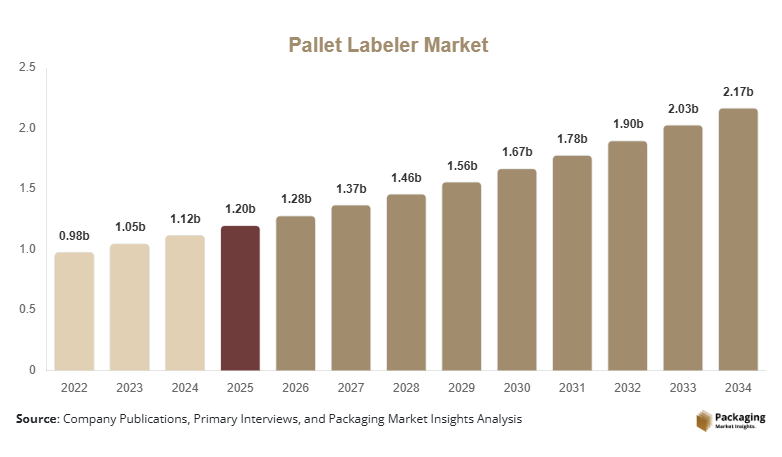
Pallet Labeler market size is projected at USD 1.28 billion in 2026 and is expected to hit USD 2.17 billion by 2034 with a CAGR of 6.8%. Increasing warehouse automation, Industry 4.0 adoption, and demand for traceability are accelerating market expansion. The report analyzes production trends, market segmentation, technological developments, and the competitive landscape across major regions.
Pallet labelers are automated systems designed to print and apply barcode, RFID, and shipping labels to palletized goods for logistics and warehouse operations. Global production exceeded 214,000 units in 2025, while automated warehouse penetration reached approximately 46% among large distribution facilities. Automatic pallet labelers contributed nearly 54% of total installations, robotic systems accounted for 21%, and print-and-apply labelers represented 25%. Food & beverage applications generated approximately 39% of total demand, reinforcing the Pallet Labeler Market.
Explore more data points, trends and opportunities Download Free Sample Report
Pallet Labeler Trends
Rising Adoption of Smart Warehouse Automation
Manufacturers are increasingly integrating pallet labelers with warehouse management systems (WMS), industrial IoT platforms, and AI-enabled inspection technologies. More than 92,000 automated pallet labelers were installed globally during 2025, representing annual installation growth of 10.8%. RFID-enabled labeling solutions recorded adoption rates above 34%, while vision inspection systems improved labeling accuracy to over 99.8%, strengthening the Pallet Labeler Market.
The adoption of robotic pallet labeling systems continues to expand across logistics hubs and manufacturing plants. Investments exceeding USD 320 million in smart labeling equipment were announced between 2023 and 2025. High-speed labeling systems capable of processing 240 pallets per hour experienced demand growth exceeding 14%, while cloud-connected monitoring platforms improved operational efficiency by nearly 17%, supporting the Pallet Labeler Market.
Pallet Labeler Drivers
Growing Demand for Warehouse Automation
The expansion of e-commerce, distribution centers, and automated fulfillment facilities is driving demand for pallet labeling equipment. Warehouse automation investments increased by 15% during 2025, while more than 63% of newly constructed logistics facilities adopted automated labeling systems. Barcode compliance exceeded 96%, and pallet throughput improved by approximately 22% following automation deployment, supporting the Pallet Labeler Market.
Pallet Labeler Restraints
High Initial Equipment and Integration Costs
High capital expenditure and complex integration with existing production lines remain major restraints. Installation costs increased by nearly 11% between 2024 and 2025, while software integration represented approximately 18% of total project expenditure. Small and medium-sized enterprises continue to delay automation investments despite long-term productivity gains, limiting the Pallet Labeler Market.
Pallet Labeler Opportunities
Expansion of RFID and Smart Labeling Technologies
The rapid deployment of RFID-enabled logistics and serialization regulations is creating new opportunities. RFID pallet labeler shipments increased by 18% during 2025, while smart label adoption exceeded 31% across pharmaceutical and food supply chains. More than 48,000 facilities are expected to upgrade labeling infrastructure over the coming years, strengthening the Pallet Labeler Market.
Challenges in Pallet Labeler Market
Maintaining System Compatibility Across Diverse Production Lines
Manufacturers face challenges integrating pallet labelers with different conveyor systems, ERP platforms, and warehouse software. More than 26% of installations require customized engineering, increasing commissioning time by 14%. Maintenance expenses rose by approximately 9%, while skilled automation technicians remain in limited supply, creating operational challenges across the Pallet Labeler Market.
Report Scope
| Report Metric | Details |
|---|---|
| Market Size in 2025 | USD 1.20 billion |
| Market Size in 2026 | USD 1.28 billion |
| Market Size in 2034 | USD 2.17 billion |
| CAGR | 6.8% (2026-2034) |
| Base Year for Estimation | 2025 |
| Historical Data | 2022-2024 |
| Forecast Period | 2026-2034 |
| Report Coverage | Revenue Forecast, Competitive Landscape, Supply Chain Disruption, Growth Factors, Environment & Regulatory Landscape and Trends |
| Geographies Covered | North America, Europe, APAC, Middle East and Africa, LATAM |
| Countries Covered | U.S., Canada, U.K., Germany, France, Spain, Italy, Russia, Nordic, Benelux, Rest of Europe, China, South Korea, Japan, India, Australia, Singapore, Taiwan, South East Asia, Rest of Asia-Pacific, UAE, Turky, Saudi Arabia, South Africa, Egypt, Nigeria, Rest of MEA, Brazil, Mexico, Argentina, Chile, Colombia, Rest of LATAM |
Explore more data points, trends and opportunities Download Free Sample Report
Pallet Labeler Market Segmentation
The market is segmented by type and application. Automatic pallet labelers accounted for approximately 54% of global revenue during 2025, while food & beverage applications represented nearly 39% of total installations owing to strict traceability requirements.
By Type
These systems represented approximately 25% of global demand with production exceeding 53,000 units annually. They offer print resolutions up to 600 dpi, support barcode verification, and are widely deployed in medium-speed packaging operations.
Holding nearly 54% market share, automatic systems exceeded 116,000 units in annual production. They operate at speeds of 180–240 pallets per hour, providing high labeling accuracy and seamless integration with warehouse automation platforms.
Robotic solutions accounted for approximately 21% of global revenue with production surpassing 45,000 units. Six-axis robotic arms, AI-assisted positioning, and multi-side label application improve operational flexibility for high-volume facilities.
By Application
This segment accounted for approximately 39% of total demand, processing over 83,000 installed systems globally. Compliance with food traceability standards and high production throughput support widespread deployment.
Pharmaceutical facilities represented nearly 28% of installations. Serialization regulations, barcode verification, and product authentication requirements have increased automated labeling adoption across manufacturing and distribution operations.
Logistics and warehousing contributed approximately 33% of market demand, supported by rapid e-commerce expansion. High-speed pallet identification, shipment tracking, and automated warehouse operations continue driving adoption.
Pallet Labeler Market Segmentations
Type
- Print and Apply Labelers
- Automatic Pallet Labelers
- Robotic Pallet Labelers
Application
- Food & Beverage
- Pharmaceuticals
- Logistics & Warehousing
Distribution Channel
- Direct Sales
- Industrial Equipment Distributors
- System Integrators
- OEM Partners
- Online Sales
Pallet Labeler Regional Outlook
North America
North America accounted for approximately 36% of global revenue during 2025 with more than 77,000 units installed. The United States contributed nearly 82% of regional demand, supported by warehouse automation, e-commerce fulfillment centers, and advanced logistics infrastructure.
Europe
Europe represented approximately 30% of global demand, producing and installing over 64,000 units annually. Germany, France, Italy, the United Kingdom, and the Netherlands remained leading adopters, with manufacturing automation penetration exceeding 52%.
Asia-Pacific
Asia-Pacific captured nearly 27% of worldwide revenue. China, Japan, South Korea, and India accounted for more than 71% of regional installations. Rapid industrialization, logistics expansion, and smart factory investments continue supporting market development.
Latin America, Middle East & Africa
These regions collectively represented approximately 7% of global demand with installations exceeding 15,000 units annually. Brazil, Mexico, Saudi Arabia, South Africa, and the UAE are expanding warehouse automation to improve supply chain efficiency.
Top players in Pallet Labeler Market
- Novexx Solutions GmbH
- Weber Packaging Solutions
- ID Technology LLC
- Fox IV Technologies Inc.
- Logopak Systeme GmbH & Co. KG
- Domino Printing Sciences PLC
- SATO Holdings Corporation
- Zebra Technologies Corporation
- Markem-Imaje
- HERMA GmbH
- Cab Produkttechnik GmbH & Co. KG
- Label-Aire Inc.
Novexx Solutions GmbH
-
Estimated global market share of approximately 15%.
-
Strong presence across Europe and North America with advanced print-and-apply technologies.
-
Offers integrated barcode verification, RFID compatibility, and Industry 4.0 connectivity.
-
Continues expanding automated pallet labeling solutions for manufacturing, logistics, and food processing industries while investing in intelligent software integration and high-speed labeling technologies.
Weber Packaging Solutions
-
Estimated market share of approximately 12% globally.
-
Extensive product portfolio covering industrial print-and-apply and automated pallet labeling systems.
-
Strong distribution network serving logistics, pharmaceuticals, and consumer goods industries.
-
Focuses on high-performance automation, remote monitoring capabilities, and customized labeling solutions that improve productivity, compliance, and operational efficiency.