Inline OCR Validation for Packaging Lines Market Size
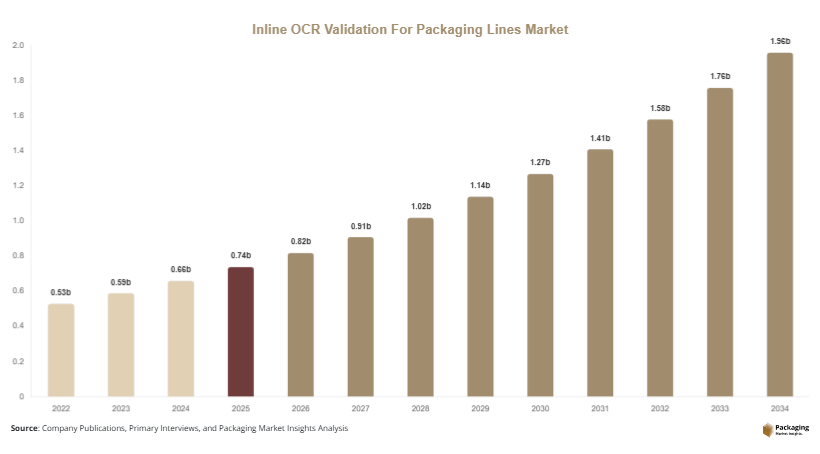
Inline OCR Validation for Packaging Lines market size is projected at USD 0.82 billion in 2026 and is expected to hit USD 1.96 billion by 2034 with a CAGR of 11.5%. The market is expanding as manufacturers increasingly deploy automated machine vision and optical character recognition technologies to improve traceability, serialization, and regulatory compliance across high-speed packaging environments. The report evaluates major industry segments, regional performance, technological developments, and the competitive landscape across the forecast period.
Inline OCR validation for packaging lines refers to automated inspection systems that verify printed information such as batch numbers, expiry dates, serial numbers, barcodes, and variable data directly on production lines. In 2025, more than 165,000 industrial packaging lines globally incorporated some level of automated vision inspection, while nearly 58% included OCR verification capabilities. Pharmaceutical packaging accounted for approximately 38% of deployments, followed by food and beverage at 35% and consumer goods at 19%. Production of industrial OCR inspection modules exceeded 920,000 units during the base year as digital manufacturing adoption continued across developed and emerging economies.
Explore more data points, trends and opportunities Download Free Sample Report
Inline OCR Validation for Packaging Lines Market Trends
Increasing Adoption of AI-Enabled OCR Inspection Systems
Artificial intelligence and deep learning algorithms are improving OCR recognition accuracy above 99.5% while reducing false rejection rates below 0.3% on production lines operating at speeds exceeding 800 packs per minute. More than 61% of newly installed packaging inspection systems now integrate AI-assisted character recognition, while annual shipments of intelligent vision cameras surpassed 2.8 million units globally. Growing implementation of predictive analytics and edge computing continues strengthening Inline OCR Validation for Packaging Lines Market Trends.
Automation suppliers are integrating OCR validation with barcode grading, print quality inspection, and serialization within unified machine vision platforms. Over 47% of newly commissioned pharmaceutical packaging lines now utilize integrated inspection architectures capable of processing over 2,000 images per minute with latency below 40 milliseconds. Investments in Industry 4.0 and smart factories continue accelerating Inline OCR Validation for Packaging Lines Market Trends.
Inline OCR Validation for Packaging Lines Drivers
Growing Regulatory Compliance and Product Traceability Requirements
Governments and regulatory agencies continue strengthening labeling, serialization, and traceability requirements across pharmaceutical and food sectors. More than 72% of pharmaceutical manufacturers upgraded inspection equipment between 2022 and 2025, while over 410 billion serialized packages were processed annually using automated validation technologies. Inspection accuracy exceeding 99%, reduced recall incidents by nearly 28%, and production efficiency improvements of approximately 17% continue supporting market expansion.
Inline OCR Validation for Packaging Lines Restraints
High Capital Investment and Integration Complexity
Complete inline OCR validation installations require investments ranging from USD 45,000 to USD 420,000 depending on production capacity and inspection requirements. Around 36% of small packaging companies delay modernization due to implementation costs, while system integration may require production shutdowns lasting 3 to 10 days. Legacy production equipment compatibility remains limited across nearly 29% of older manufacturing facilities.
Inline OCR Validation for Packaging Lines Opportunities
Expansion of Smart Manufacturing Across Emerging Economies
Industrial automation investments across Asia-Pacific, Latin America, and the Middle East continue generating new opportunities. More than 48,000 packaging lines are expected to undergo digital modernization before 2030, while factory automation expenditure is increasing above 10% annually across several developing manufacturing economies. Cloud-based analytics, remote monitoring, and AI-driven inspection solutions are creating significant commercial opportunities.
Challenges in Inline OCR Validation for Packaging Lines
Managing Complex Variable Data Across High-Speed Production
Manufacturers increasingly process multilingual labels, variable QR codes, dynamic serialization, and promotional packaging simultaneously. High-speed production exceeding 1,200 products per minute requires image processing accuracy above 99.7%, while maintaining less than 20 milliseconds processing delay. Workforce shortages in machine vision engineering and continuous software calibration remain operational challenges.
Report Scope
| Report Metric | Details |
|---|---|
| Market Size in 2025 | USD 0.74 billion |
| Market Size in 2026 | USD 0.82 billion |
| Market Size in 2034 | USD 1.96 billion |
| CAGR | 11.5% (2026-2034) |
| Base Year for Estimation | 2025 |
| Historical Data | 2022-2024 |
| Forecast Period | 2026-2034 |
| Report Coverage | Revenue Forecast, Competitive Landscape, Supply Chain Disruption, Growth Factors, Environment & Regulatory Landscape and Trends |
| Geographies Covered | North America, Europe, APAC, Middle East and Africa, LATAM |
| Countries Covered | U.S., Canada, U.K., Germany, France, Spain, Italy, Russia, Nordic, Benelux, Rest of Europe, China, South Korea, Japan, India, Australia, Singapore, Taiwan, South East Asia, Rest of Asia-Pacific, UAE, Turky, Saudi Arabia, South Africa, Egypt, Nigeria, Rest of MEA, Brazil, Mexico, Argentina, Chile, Colombia, Rest of LATAM |
Explore more data points, trends and opportunities Download Free Sample Report
Inline OCR Validation for Packaging Lines Market Segmentation
The market is segmented by type and application, with integrated vision inspection systems accounting for approximately 44% of installations during 2025, while pharmaceutical packaging contributed nearly 38% of overall industry revenue due to stringent compliance requirements.
By Type
Hardware-Based OCR Validation Systems
Dedicated industrial cameras, lighting modules, processors, and inspection sensors represented nearly 33% of deployments during 2025. More than 310,000 hardware units were installed globally, supporting inspection resolutions exceeding 12 MP and processing speeds above 1,000 products per minute.
Software-Based OCR Validation Platforms
Software platforms accounted for approximately 23% of installations as cloud connectivity, AI-based learning, and centralized monitoring became increasingly important. More than 145,000 licenses were deployed globally, enabling character recognition accuracy exceeding 99% with multilingual support across over 60 languages.
Integrated Vision Inspection Systems
Integrated systems held nearly 44% market share owing to comprehensive inspection capabilities combining OCR, barcode validation, print inspection, and defect detection. More than 405,000 integrated systems operated globally while supporting line speeds between 300 and 1,500 packages per minute.
By Application
Food & Beverage Packaging
Food and beverage manufacturers represented approximately 35% of deployments. More than 58 billion packaged food products underwent OCR validation annually, while inspection systems verified expiry dates, lot codes, allergens, and nutritional labeling across automated packaging facilities.
Pharmaceutical Packaging
Pharmaceutical packaging accounted for around 38% of industry demand due to serialization regulations and patient safety requirements. More than 410 billion serialized medicine packages were validated annually using OCR systems capable of inspecting blister packs, bottles, cartons, and vials with accuracy exceeding 99.8%.
Consumer Goods Packaging
Consumer goods contributed nearly 19% of installations across cosmetics, personal care, electronics, and household products. Production facilities processed over 46 billion labeled packages annually using OCR inspection for promotional codes, manufacturing dates, and traceability information.
Inline OCR Validation For Packaging Lines Market Segmentations
Type
- Hardware-Based OCR Validation Systems
- Software-Based OCR Validation Platforms
- Integrated Vision Inspection Systems
Application
- Food & Beverage Packaging
- Pharmaceutical Packaging
- Consumer Goods Packaging
Inline OCR Validation for Packaging Lines Regional Outlook
North America
North America accounted for approximately 31% of global revenue during 2025, supported by pharmaceutical manufacturing, food safety regulations, and advanced automation. The United States contributed nearly 82% of regional demand, while Canada represented about 11%. More than 36,000 packaging lines utilized OCR validation technologies.
Europe
Europe held nearly 29% market share due to strong pharmaceutical production and strict labeling regulations. Germany, France, Italy, and the United Kingdom generated over 71% of regional installations, while more than 31 billion packaged products underwent OCR validation annually.
Asia-Pacific
Asia-Pacific represented around 30% of the market and recorded the fastest expansion owing to manufacturing investments across China, Japan, India, South Korea, and Southeast Asia. More than 54,000 automated packaging lines incorporated OCR validation systems, with electronics, pharmaceuticals, and food industries driving adoption.
Latin America, Middle East & Africa
These regions collectively contributed approximately 10% of global revenue. Brazil, Mexico, Saudi Arabia, UAE, and South Africa remained leading adopters as packaging automation investments increased by more than 9% annually across regulated manufacturing industries.
Top players in Inline OCR Validation for Packaging Lines
- Cognex Corporation
- Keyence Corporation
- Omron Corporation
- SICK AG
- Teledyne DALSA
- Zebra Technologies
- Mettler-Toledo
- Antares Vision Group
- ISRA Vision
- Datalogic S.p.A.
- Baumer Group
- Hikrobot
- Advantech Co., Ltd.
- Panasonic Industry
- Siemens AG
Cognex Corporation
-
Estimated market presence of approximately 15%–18% within industrial machine vision for packaging inspection.
-
Strong portfolio of AI-powered vision systems, OCR verification software, barcode readers, and smart cameras.
-
Extensive presence across pharmaceutical, food, logistics, and consumer goods manufacturing with continuous investments in deep learning inspection technologies and global channel expansion.
Keyence Corporation
-
Estimated market presence of approximately 11%–14% across industrial vision inspection solutions.
-
Provides integrated OCR validation, high-speed imaging, laser measurement, and automation platforms supporting packaging lines exceeding 1,000 products per minute.
-
Strong direct-sales model, continuous product innovation, and broad manufacturing customer base strengthen its competitive position worldwide.