Augmented Reality In Packaging Market Size and Growth
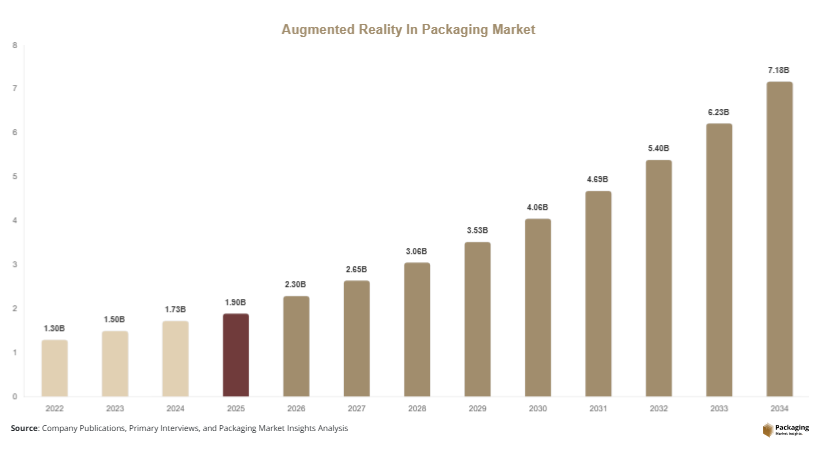
The global augmented reality in packaging market size was valued at approximately USD 1.9 billion in 2025 and is projected to reach USD 2.3 billion in 2026. Over the forecast period, the market is expected to expand significantly, reaching nearly USD 7.2 billion by 2034, registering a compound annual growth rate (CAGR) of 15.3% from 2025 to 2034. This growth reflects the rising integration of digital experiences into traditional packaging formats. The augmented reality in packaging market is gaining traction as brands increasingly adopt immersive technologies to enhance consumer engagement and product differentiation.
One of the primary growth factors is the increasing demand for interactive and personalized consumer experiences. Brands are leveraging augmented reality (AR) to transform packaging into a digital touchpoint, enabling users to access product information, promotional content, and immersive storytelling through smartphones. Another key driver is the growth of e-commerce and digital retail, where AR-enabled packaging helps bridge the gap between physical and online experiences. Additionally, advancements in mobile technology, including improved camera capabilities and AR software platforms, are making it easier for consumers to access AR features.
Key Highlights:
- Asia Pacific dominated the market with a 36.8% share in 2025, while Latin America is projected to grow at the fastest CAGR of 17.1%.
- Marker-based AR led the technology segment with a 41.2% share, while markerless AR is expected to grow at a CAGR of 16.4%.
- Flexible packaging dominated with a 49.6% share, while rigid packaging is forecasted to grow at a CAGR of 15.9%.
- Food & beverage applications led the segment with 44.3% share, while healthcare packaging is expected to grow at a CAGR of 16.2%.
- China remained the dominant country with a market size of USD 420 million in 2025 and USD 510 million in 2026.
Explore more data points, trends and opportunities Download Free Sample Report
Market Trends
Increasing Use of AR for Brand Engagement and Storytelling
The augmented reality in packaging market is witnessing a strong trend toward the use of AR as a storytelling tool. Brands are integrating AR features into packaging to create immersive experiences that connect with consumers on a deeper level. Through AR-enabled labels, customers can scan products to access interactive content such as videos, product origin stories, and usage demonstrations. This approach enhances customer engagement and builds brand loyalty. The trend is particularly prominent in the food & beverage and cosmetics industries, where visual appeal and storytelling play a crucial role in influencing purchasing decisions.
Expansion of Mobile-Based AR Applications
The growing penetration of smartphones and mobile internet is driving the adoption of mobile-based AR applications in packaging. Consumers can easily access AR features without the need for specialized hardware, making the technology more accessible. Companies are developing user-friendly AR platforms that allow seamless interaction with packaging. This trend is supported by advancements in mobile processing power and AR development tools, which enable high-quality digital experiences. As mobile usage continues to increase globally, the integration of AR into packaging is expected to become more widespread.
Market Drivers
Rising Demand for Interactive Consumer Experiences
The increasing demand for interactive and engaging consumer experiences is a key driver of the augmented reality in packaging market. Modern consumers are seeking more than just functional packaging; they expect value-added experiences that enhance their interaction with products. AR technology allows brands to deliver personalized content, promotional offers, and interactive features directly through packaging. This capability not only improves customer satisfaction but also increases brand recall and loyalty, driving market growth.
Growth of Digital Marketing and E-commerce Integration
The rapid growth of digital marketing and e-commerce is significantly influencing the adoption of AR in packaging. Brands are using AR-enabled packaging as a tool to connect offline and online channels, providing a seamless shopping experience. Consumers can scan packaging to access online stores, product reviews, and additional information. This integration enhances the overall customer journey and supports marketing strategies. As e-commerce continues to expand, the demand for AR-enabled packaging solutions is expected to increase.
Market Restraint
High Implementation Costs and Technical Complexity
The adoption of AR in packaging involves significant costs related to technology development, software integration, and content creation. Small and medium-sized enterprises may find it challenging to invest in AR solutions due to budget constraints. Additionally, the implementation of AR requires technical expertise and continuous updates to maintain functionality and compatibility with devices. For example, developing high-quality AR content for a product line can require substantial resources and time. These factors can limit the widespread adoption of AR packaging, particularly in cost-sensitive markets.
Market Opportunities
Integration with Smart Packaging Technologies
The integration of AR with smart packaging technologies presents significant opportunities for market growth. Combining AR with features such as QR codes, NFC tags, and IoT sensors can enhance functionality and provide real-time information to consumers. This integration enables applications such as product authentication, supply chain tracking, and personalized marketing. As smart packaging technologies continue to evolve, the demand for AR-enabled solutions is expected to increase.
Expansion in Emerging Markets
Emerging markets offer substantial growth opportunities for the augmented reality in packaging market. Increasing smartphone penetration and internet connectivity in regions such as Asia Pacific, Latin America, and Africa are enabling wider adoption of AR technologies. Brands are targeting these markets with innovative packaging solutions to attract tech-savvy consumers. The growing middle-class population and rising disposable income are further supporting market expansion in these regions.
Report Scope
| Report Metric | Details |
|---|---|
| Market Size in 2025 | USD 1.9 Billion |
| Market Size in 2026 | USD 2.3 Billion |
| Market Size in 2034 | USD 7.2 Billion |
| CAGR | 15.3% (2026-2034) |
| Base Year for Estimation | 2025 |
| Historical Data | 2022-2024 |
| Forecast Period | 2026-2034 |
| Report Coverage | Revenue Forecast, Competitive Landscape, Supply Chain Disruption, Growth Factors, Environment & Regulatory Landscape and Trends |
| Geographies Covered | North America, Europe, APAC, Middle East and Africa, LATAM |
| Countries Covered | U.S., Canada, U.K., Germany, France, Spain, Italy, Russia, Nordic, Benelux, Rest of Europe, China, South Korea, Japan, India, Australia, Singapore, Taiwan, South East Asia, Rest of Asia-Pacific, UAE, Turky, Saudi Arabia, South Africa, Egypt, Nigeria, Rest of MEA, Brazil, Mexico, Argentina, Chile, Colombia, Rest of LATAM |
Explore more data points, trends and opportunities Download Free Sample Report
Segmental Analysis
By Technology
Marker-based AR dominated the technology segment in 2024, accounting for approximately 41.2% of the market share. This technology relies on visual markers such as QR codes or images printed on packaging, which can be easily scanned using smartphones. Marker-based AR is widely adopted due to its simplicity and cost-effectiveness. It allows brands to deliver interactive content without requiring advanced hardware, making it accessible to a broad consumer base. The technology is particularly popular in industries such as food & beverage and cosmetics, where packaging plays a key role in marketing.
Markerless AR is expected to be the fastest-growing segment, registering a CAGR of 16.4% during the forecast period. This technology does not require predefined markers and uses advanced sensors and algorithms to overlay digital content onto real-world environments. Markerless AR offers greater flexibility and enhanced user experience, making it suitable for more complex applications. The increasing adoption of advanced smartphones and AR development platforms is driving the growth of this segment.
By Packaging Type
Flexible packaging dominated the packaging type segment in 2024, holding a market share of 49.6%. Flexible materials such as pouches and wrappers are widely used due to their cost-effectiveness and versatility. The integration of AR features into flexible packaging allows brands to create interactive experiences without significantly increasing costs. This segment is particularly prominent in the food & beverage industry, where flexible packaging is commonly used.
Rigid packaging is expected to be the fastest-growing segment, with a CAGR of 15.9%. Rigid materials such as bottles and containers provide a larger surface area for AR integration, enabling more detailed and immersive experiences. The increasing demand for premium packaging solutions is driving the adoption of AR-enabled rigid packaging, particularly in sectors such as cosmetics and beverages.
By Application
Food & beverage dominated the application segment in 2024, accounting for 44.3% of the market share. The industry is leveraging AR packaging to enhance consumer engagement and provide product information. Interactive features such as recipes, nutritional details, and promotional content are commonly integrated into packaging. This approach helps brands differentiate their products and improve customer experience.
Healthcare packaging is expected to be the fastest-growing segment, with a CAGR of 16.2%. AR technology is being used to provide detailed product information, usage instructions, and safety guidelines. This enhances patient awareness and improves product transparency. The increasing focus on digital healthcare solutions is driving the adoption of AR-enabled packaging in this segment.
Augmented Reality In Packaging Market Segmentations
By Technology
- Marker-Based Augmented Reality
- Markerless Augmented Reality
By Packaging Type
- Flexible Packaging
- Rigid Packaging
By Application
- Food & Beverage
- Cosmetics & Personal Care
- Healthcare
- Retail & E-commerce
Regional Analysis
North America
North America accounted for approximately 28.4% of the augmented reality in packaging market share in 2025 and is projected to grow at a CAGR of 14.2% during the forecast period. The region’s growth is driven by high adoption of advanced technologies and strong presence of key market players. Companies in North America are actively investing in AR solutions to enhance customer engagement and improve brand visibility. The well-developed digital infrastructure further supports the adoption of AR-enabled packaging.
The United States dominates the North American market due to its advanced retail and e-commerce sectors. A unique growth factor in this region is the integration of AR with digital marketing strategies, enabling brands to create immersive campaigns. This approach is helping companies improve customer interaction and drive sales through innovative packaging solutions.
Europe
Europe held a market share of around 22.7% in 2025 and is expected to grow at a CAGR of 14.8%. The region is characterized by strong consumer demand for innovative and sustainable packaging solutions. Companies are adopting AR technologies to enhance product transparency and provide detailed information to consumers. Regulatory frameworks supporting digital innovation are also contributing to market growth.
Germany is the leading country in the European market, supported by its advanced manufacturing and retail sectors. A key growth factor in Europe is the focus on sustainability and transparency, which is driving the adoption of AR-enabled packaging to provide detailed product information and traceability features.
Asia Pacific
Asia Pacific dominated the augmented reality in packaging market with a 36.8% share in 2025 and is projected to grow at a CAGR of 16.1%. The region’s growth is driven by rapid digitalization, increasing smartphone usage, and expanding retail sectors. Countries such as China, India, and Japan are adopting AR technologies to enhance consumer engagement and improve marketing strategies.
China remains the dominant country in this region due to its large consumer base and advanced digital ecosystem. A unique growth factor is the integration of AR with social media platforms, enabling brands to reach a wider audience and create interactive campaigns. This trend is driving the adoption of AR-enabled packaging solutions.
Middle East & Africa
The Middle East & Africa region accounted for 6.9% of the market share in 2025 and is expected to grow at a CAGR of 15.6%. The region is witnessing increasing adoption of digital technologies and innovative marketing strategies. Companies are exploring AR-enabled packaging to differentiate their products and attract consumers.
The United Arab Emirates leads the market in this region, driven by its advanced retail infrastructure and focus on digital innovation. A unique growth factor is the increasing use of AR in tourism and retail sectors, which is influencing packaging strategies and driving market growth.
Latin America
Latin America held a market share of 5.2% in 2025 and is projected to grow at the fastest CAGR of 17.1%. The region’s growth is driven by increasing smartphone penetration and rising consumer interest in digital experiences. Brands are adopting AR technologies to enhance product appeal and engage consumers.
Brazil dominates the Latin American market due to its large consumer base and growing retail sector. A key growth factor is the increasing adoption of mobile-based AR applications, which is enabling companies to reach consumers more effectively through interactive packaging solutions.
Competitive Landscape
The augmented reality in packaging market is characterized by the presence of technology providers, packaging companies, and software developers. Key players are focusing on innovation and strategic partnerships to enhance their market position. Companies are investing in research and development to create advanced AR solutions that improve user experience and engagement.
Zappar Ltd. is recognized as a leading player in the market, known for its expertise in AR technology and interactive packaging solutions. The company recently launched a new AR platform designed to simplify content creation for brands. Other major players, including Blippar Ltd., Wikitude GmbH, Google LLC, and Apple Inc., are also contributing to market growth through technological advancements and product innovations.
Key Players List
- Zappar Ltd.
- Blippar Ltd.
- Wikitude GmbH
- Google LLC
- Apple Inc.
- Microsoft Corporation
- PTC Inc.
- Vuforia (PTC)
- Augment SAS
- ViewAR GmbH
- CraftAR (Catchoom)
- Banuba Ltd.
- Marxent Labs LLC
- INDE (Interactive Digital Entertainment Ltd.)
- Vertebrae (Snap Inc.)