Chemicals Packaging Coding Equipment Market Size and Growth
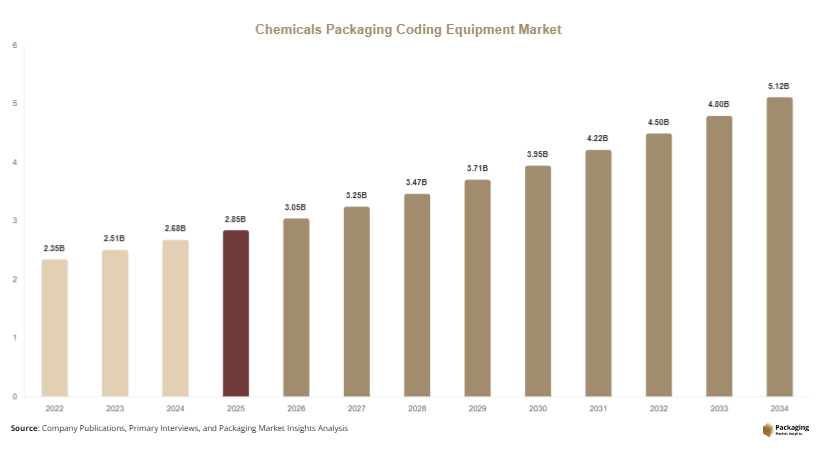
The global chemicals packaging coding equipment market size was valued at USD 2.85 billion in 2025 and is expected to reach USD 3.05 billion in 2026, further expanding to approximately USD 5.12 billion by 2034, registering a CAGR of 6.7% during the forecast period (2025–2034). Coding equipment used in chemical packaging includes technologies such as continuous inkjet printers, laser coders, thermal inkjet systems, and print-and-apply labeling machines, all designed to mark packaging with essential information including batch numbers, manufacturing dates, and safety instructions. The global chemicals packaging coding equipment market is witnessing consistent growth, supported by the rising need for traceability, regulatory compliance, and efficient product identification across chemical packaging applications.
One of the primary growth factors is the increasing enforcement of regulatory requirements related to labeling and traceability in the chemical industry. Governments and international agencies require accurate and durable coding on chemical packaging to ensure safety and compliance, driving demand for advanced coding equipment. Another key factor is the expansion of the global chemical industry, particularly in emerging economies, where production volumes are increasing rapidly. This expansion necessitates efficient and high-speed coding systems to support large-scale operations.
Key Highlights
- Asia Pacific dominated the market with a 39.1% share in 2025, while Latin America is projected to grow at the fastest CAGR of 7.2%.
- Continuous inkjet printers led the type segment with a 31.4% share, while laser coding systems are expected to grow at a CAGR of 7.5%.
- Plastic packaging dominated with a 54.2% share, while metal containers are forecasted to grow at a CAGR of 6.9%.
- Industrial chemicals applications led the segment with 48.6% share, while specialty chemicals are expected to grow at a CAGR of 7.1%.
- China remained the dominant country with a market size of USD 0.68 billion in 2025 and USD 0.74 billion in 2026.
Explore more data points, trends and opportunities Download Free Sample Report
Market Trends
Increasing adoption of laser and non-contact coding technologies
The chemicals packaging coding equipment market is experiencing a shift toward laser-based and non-contact coding technologies. These systems offer high precision, durability, and minimal maintenance compared to traditional ink-based solutions. Laser coders eliminate the need for consumables such as ink and solvents, reducing operational costs and environmental impact. They are particularly suitable for harsh chemical environments where packaging surfaces may be exposed to moisture, heat, or abrasion. Additionally, laser coding provides permanent markings that resist fading or smudging, ensuring compliance with regulatory standards. As manufacturers prioritize efficiency and sustainability, the adoption of laser coding technologies is expected to increase steadily.
Integration of smart and automated coding systems
Automation and smart technologies are transforming coding equipment in the chemical packaging sector. Manufacturers are integrating coding systems with automated production lines to enhance efficiency and reduce human intervention. Smart coding equipment enables real-time monitoring, error detection, and remote operation, improving overall productivity. These systems can also store and manage large volumes of data, supporting traceability and compliance requirements. The adoption of Industry 4.0 practices is further driving the integration of advanced coding solutions. As companies seek to optimize operations and reduce downtime, the demand for automated and intelligent coding equipment is expected to grow significantly.
Market Drivers
Stringent regulatory requirements for chemical labeling and traceability
Regulatory compliance is a major driver of the chemicals packaging coding equipment market. Chemical products require accurate labeling to ensure safety, traceability, and proper handling. Regulations mandate the inclusion of information such as batch numbers, expiration dates, hazard warnings, and manufacturing details. Coding equipment plays a critical role in meeting these requirements by providing clear and durable markings on packaging. Non-compliance can lead to legal penalties, product recalls, and reputational damage. As regulations become more stringent globally, manufacturers are investing in advanced coding solutions to ensure compliance and maintain operational efficiency.
Growth of the global chemical manufacturing industry
The expansion of the chemical manufacturing sector is significantly driving demand for packaging coding equipment. Increasing production of industrial, agricultural, and specialty chemicals is creating a need for efficient coding systems that can handle high volumes. Emerging economies are witnessing rapid industrialization, leading to increased chemical production and packaging activities. Coding equipment ensures accurate identification and traceability of products throughout the supply chain. Additionally, the rise of export-oriented manufacturing requires compliance with international labeling standards, further supporting market growth. As chemical production continues to grow, the demand for reliable coding equipment is expected to increase.
Market Restraint
High initial investment and maintenance costs of advanced coding systems
One of the key challenges in the chemicals packaging coding equipment market is the high cost associated with advanced coding technologies. Systems such as laser coders and automated printing solutions require significant upfront investment, which may be a barrier for small and medium-sized enterprises. Additionally, maintenance and repair costs can add to the overall expenditure, particularly for complex systems that require specialized technical support. For example, laser coding equipment may require periodic calibration and servicing to maintain performance. These cost-related challenges can limit the adoption of advanced coding solutions, especially in price-sensitive markets, affecting overall market growth.
Market Opportunities
Rising demand for eco-friendly and sustainable coding solutions
The increasing focus on sustainability is creating opportunities for eco-friendly coding technologies. Manufacturers are seeking solutions that reduce environmental impact by minimizing the use of consumables and energy. Laser coding systems and water-based inks are gaining popularity as sustainable alternatives to traditional methods. These solutions help reduce waste and improve operational efficiency. Additionally, regulatory pressure to adopt environmentally responsible practices is encouraging companies to invest in sustainable coding equipment. As sustainability becomes a key priority across industries, the demand for eco-friendly coding solutions is expected to grow.
Expansion of chemical exports and global supply chains
The growth of global trade and chemical exports is creating opportunities for the chemicals packaging coding equipment market. Export-oriented manufacturers require advanced coding systems to meet international labeling standards and ensure product traceability. Coding equipment enables accurate marking of packaging with essential information, supporting compliance with export regulations. Additionally, the expansion of global supply chains is increasing the need for efficient tracking and identification of products. As companies expand their presence in international markets, the demand for reliable and high-performance coding equipment is expected to increase.
Report Scope
| Report Metric | Details |
|---|---|
| Market Size in 2025 | USD 2.85 Billion |
| Market Size in 2026 | USD 3.05 Billion |
| Market Size in 2034 | USD 5.12 Billion |
| CAGR | 6.7% (2026-2034) |
| Base Year for Estimation | 2025 |
| Historical Data | 2022-2024 |
| Forecast Period | 2026-2034 |
| Report Coverage | Revenue Forecast, Competitive Landscape, Supply Chain Disruption, Growth Factors, Environment & Regulatory Landscape and Trends |
| Geographies Covered | North America, Europe, APAC, Middle East and Africa, LATAM |
| Countries Covered | U.S., Canada, U.K., Germany, France, Spain, Italy, Russia, Nordic, Benelux, Rest of Europe, China, South Korea, Japan, India, Australia, Singapore, Taiwan, South East Asia, Rest of Asia-Pacific, UAE, Turky, Saudi Arabia, South Africa, Egypt, Nigeria, Rest of MEA, Brazil, Mexico, Argentina, Chile, Colombia, Rest of LATAM |
Explore more data points, trends and opportunities Download Free Sample Report
Segmental Analysis
By Type
Continuous inkjet printers accounted for the largest share in 2024, holding approximately 31.4% of the market. These systems are widely used due to their versatility and ability to print on various surfaces, including plastic, metal, and glass. Continuous inkjet technology is suitable for high-speed production lines, making it ideal for large-scale chemical packaging operations. It provides clear and durable markings, ensuring compliance with regulatory requirements. Additionally, these systems are relatively cost-effective compared to other advanced technologies, contributing to their widespread adoption.
Laser coding systems are expected to be the fastest-growing segment, registering a CAGR of 7.5% during the forecast period. These systems offer high precision and durability, making them suitable for demanding applications. Laser coding eliminates the need for consumables, reducing operational costs and environmental impact. The increasing focus on sustainability and efficiency is driving the adoption of laser coding technologies. Additionally, advancements in laser systems are improving performance and expanding their application scope.
By Packaging Material
Plastic packaging dominated the market in 2024, accounting for approximately 54.2% of the share. Plastic is widely used in chemical packaging due to its durability and resistance to corrosion. Coding equipment is essential for marking plastic containers with product information and safety details. The compatibility of coding technologies with plastic surfaces is driving demand in this segment.
Metal containers are projected to grow at the fastest CAGR of 6.9% during the forecast period. Metal packaging is commonly used for industrial chemicals and hazardous materials due to its strength and protective properties. Coding on metal surfaces requires advanced technologies to ensure durability and readability. The increasing demand for secure and robust packaging solutions is driving growth in this segment.
By Application
Industrial chemicals applications dominated the market in 2024, accounting for approximately 48.6% of the total share. Coding equipment is essential for labeling industrial chemical products with safety and regulatory information. The large-scale production of industrial chemicals is driving demand for high-performance coding systems.
Specialty chemicals are expected to grow at the fastest CAGR of 7.1% during the forecast period. These products require precise labeling due to their specific applications and regulatory requirements. The increasing demand for specialty chemicals in various industries is driving the adoption of advanced coding equipment.
Chemicals Packaging Coding Equipment Market Segmentations
By Type
- Continuous Inkjet Printers
- Laser Coding Systems
- Thermal Inkjet Printers
- Print and Apply Labeling Systems
By Packaging Material
- Plastic
- Metal
- Glass
- Paper
By Application
- Industrial Chemicals
- Specialty Chemicals
- Agricultural Chemicals
- Petrochemicals
Regional Analysis
North America
North America accounted for approximately 23.8% of the chemicals packaging coding equipment market share in 2025 and is projected to grow at a CAGR of 6.1% during the forecast period. The region benefits from a well-established chemical industry and advanced manufacturing infrastructure. Increasing focus on regulatory compliance and product traceability is driving the adoption of coding equipment across various applications.
The United States dominates the regional market due to its large chemical production base and technological advancements. A unique growth factor in this region is the adoption of automation and smart manufacturing practices, which are enhancing the efficiency of coding operations.
Europe
Europe held a 21.9% market share in 2025 and is expected to register a CAGR of 6.3% through 2034. The region’s growth is driven by stringent regulations related to chemical labeling and safety standards. Manufacturers are required to comply with strict guidelines, increasing demand for reliable coding solutions.
Germany leads the European market due to its strong industrial base and focus on innovation. A unique growth factor is the implementation of advanced manufacturing technologies, supporting the adoption of high-performance coding equipment.
Asia Pacific
Asia Pacific dominated the market with a 39.1% share in 2025 and is projected to grow at a CAGR of 7.0% during the forecast period. Rapid industrialization and increasing chemical production are driving market growth in this region.
China remains the dominant country due to its extensive manufacturing capabilities. A unique growth factor is the expansion of export-oriented industries, increasing demand for compliant packaging coding solutions.
Middle East & Africa
The Middle East & Africa region accounted for 7.2% of the market share in 2025 and is expected to grow at a CAGR of 6.5%. The market is supported by increasing investments in the chemical sector and improving industrial infrastructure.
Saudi Arabia leads the regional market due to its strong petrochemical industry. A unique growth factor is the expansion of large-scale chemical production facilities, driving demand for coding equipment.
Latin America
Latin America held a 8.0% share in 2025 and is projected to grow at a CAGR of 7.2% during the forecast period. The region is experiencing growth in chemical manufacturing and exports.
Brazil dominates the regional market due to its industrial base. A unique growth factor is the increasing adoption of advanced packaging technologies to improve product traceability and compliance.
Competitive Landscape
The chemicals packaging coding equipment market is moderately competitive, with several global players focusing on innovation and technological advancements. Companies are investing in research and development to enhance product performance and meet evolving industry requirements. Strategic partnerships and acquisitions are common strategies used to expand market presence.
Domino Printing Sciences is a leading player in the market, known for its advanced coding and marking solutions. The company has recently introduced new laser coding systems designed for high-speed production lines. Other key players such as Videojet Technologies, Markem-Imaje, and Hitachi Industrial Equipment Systems are also focusing on product innovation and expansion strategies.
Key Players List
- Domino Printing Sciences
- Videojet Technologies Inc.
- Markem-Imaje
- Hitachi Industrial Equipment Systems
- Linx Printing Technologies
- Danaher Corporation
- ID Technology LLC
- KBA-Metronic GmbH
- REA Elektronik GmbH
- Matthews International Corporation
- Squid Ink Manufacturing
- Control Print Ltd.
- KGK Jet India Pvt. Ltd.
- Paul Leibinger GmbH & Co. KG
- Koenig & Bauer Coding GmbH