NFC-Enabled Packaging Market Size and Growth
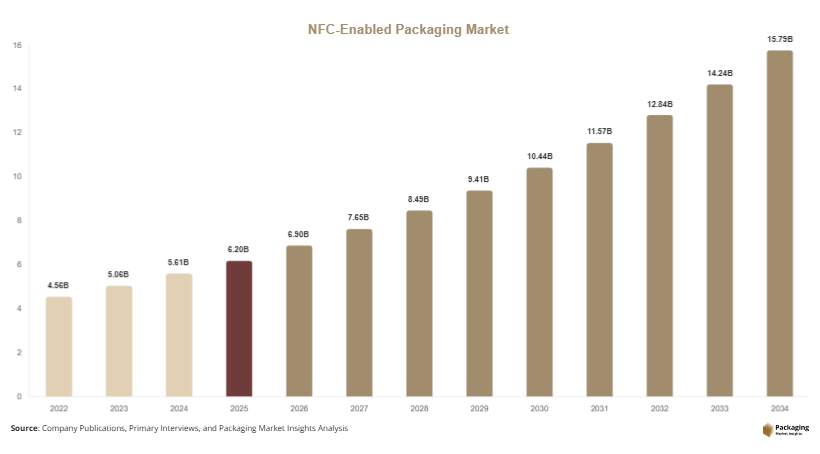
The global market size is estimated at USD 6.2 billion in 2025, and it is projected to reach USD 6.9 billion in 2026. By 2034, the market is expected to reach approximately USD 15.8 billion, expanding at a CAGR of 10.9% during 2025–2034. The NFC-enabled packaging market is emerging as a transformative segment within the smart packaging industry, driven by increasing demand for product authentication, consumer engagement, and supply chain transparency. NFC (Near Field Communication) technology integrated into packaging enables brands to connect physical products with digital experiences, including product verification, traceability, marketing content, and anti-counterfeit protection.
Growth in the market is strongly influenced by the increasing adoption of smart packaging across food & beverage, pharmaceuticals, cosmetics, and luxury goods sectors. Brands are integrating NFC tags into packaging to enable consumers to verify authenticity, access product details, and interact with digital platforms through smartphones. Another major growth factor is the rising concern over counterfeit products, particularly in pharmaceuticals and premium consumer goods. NFC-enabled packaging helps ensure traceability and strengthens brand trust. Additionally, the expansion of e-commerce has accelerated demand for interactive packaging solutions that enhance consumer engagement beyond physical product interaction.
Key Highlights:
- Asia Pacific dominated the market with a 37.4% share in 2025.
- Latin America is projected to grow at the fastest CAGR of 6.2%.
- NFC tags embedded packaging led the type segment with a 29.6% share.
- Plastic-based smart packaging dominated with a 52.3% share.
- Food & beverage applications led the segment with a 43.1% share.
- The US remained the dominant country with a market size of USD 1.5 billion in 2025 and USD 1.7 billion in 2026.
Explore more data points, trends and opportunities Download Free Sample Report
Market Trends
Integration of NFC with Interactive Consumer Engagement Platforms
One of the most significant trends in the NFC-enabled packaging market is the integration of NFC technology with interactive digital engagement platforms. Brands are embedding NFC tags in packaging that allow consumers to scan products using smartphones and access detailed information such as sourcing, usage instructions, promotions, and brand storytelling. For example, beverage companies are using NFC-enabled labels to provide vineyard origin details and tasting notes directly to consumers. This enhances transparency and strengthens brand-consumer relationships. The trend is expected to evolve further with integration into augmented reality (AR) and personalized marketing campaigns, where NFC triggers customized digital experiences based on user profiles.
Expansion of NFC in Anti-Counterfeit and Supply Chain Security Applications
Another major trend is the increasing use of NFC-enabled packaging for anti-counterfeit and supply chain security purposes. Pharmaceuticals and luxury goods manufacturers are embedding NFC tags to verify product authenticity and track distribution channels. For instance, pharmaceutical companies use NFC-enabled blister packs to allow patients and distributors to verify drug legitimacy. This helps reduce counterfeit risks and ensures compliance with regulatory standards. In the future, NFC will be increasingly integrated with blockchain systems to provide immutable product tracking, enhancing transparency across global supply chains.
Market Drivers
Rising Demand for Product Authentication and Anti-Counterfeit Solutions
The growing incidence of counterfeit products across pharmaceuticals, cosmetics, and luxury goods is a major driver of the NFC-enabled packaging market. Counterfeit drugs and fake luxury items pose significant safety and economic risks, prompting companies to adopt advanced authentication technologies. NFC-enabled packaging allows consumers and supply chain stakeholders to verify product authenticity instantly through smartphone scanning. For example, luxury fashion brands use NFC chips embedded in tags to confirm originality and provide ownership details. This increasing need for trust and transparency is significantly accelerating adoption across high-value industries.
Expansion of Smart Retail and Digital Consumer Ecosystems
The rapid growth of smart retail environments and digital-first consumer engagement is another key driver. Retailers are increasingly integrating NFC-enabled packaging into omnichannel strategies to enhance customer experience. Consumers can access product reviews, discounts, and usage tutorials directly through NFC interactions. For instance, FMCG brands are using NFC packaging to offer recipe suggestions and loyalty rewards. This integration of physical packaging with digital ecosystems is transforming packaging from a passive container into an active communication tool, driving widespread adoption.
Market Restraint
High Cost of NFC Integration and Limited Awareness in Emerging Markets
One of the primary restraints in the NFC-enabled packaging market is the relatively high cost of integrating NFC chips into packaging materials. Although chip prices have declined over time, large-scale implementation still adds significant cost, particularly for low-margin consumer goods. Additionally, NFC-enabled packaging requires compatible smartphones and consumer awareness, which is not uniformly available across all regions. In many emerging markets, consumers may not be familiar with NFC technology, limiting its effectiveness. For example, small food manufacturers in developing economies may avoid NFC integration due to cost sensitivity and limited digital adoption infrastructure. This restricts widespread adoption despite strong technological potential.
Market Opportunities
Expansion in Pharmaceutical Serialization and Compliance Systems
The pharmaceutical industry presents a major opportunity for NFC-enabled packaging due to increasing regulatory requirements for serialization and traceability. Governments worldwide are mandating stricter drug authentication systems to prevent counterfeit medicines. NFC technology provides a secure and efficient way to track drug movement across the supply chain while enabling patient-level verification. For example, hospitals and pharmacies can scan NFC-enabled drug packaging to validate authenticity before dispensing. As global healthcare regulations tighten, adoption of NFC packaging in pharmaceuticals is expected to grow significantly.
Growth in Smart Luxury and Premium Consumer Goods Packaging
The luxury goods sector offers strong growth potential for NFC-enabled packaging, as brands increasingly focus on enhancing exclusivity and customer engagement. NFC tags embedded in premium packaging allow customers to access authentication certificates, ownership records, and brand experiences. For instance, luxury watchmakers are using NFC-enabled certificates of authenticity linked to blockchain systems. This enhances product value and reduces counterfeit risks. As luxury consumption grows in Asia Pacific and the Middle East, demand for NFC-integrated packaging in high-end fashion, cosmetics, and jewelry is expected to expand.
Report Scope
| Report Metric | Details |
|---|---|
| Market Size in 2025 | USD 6.2 Billion |
| Market Size in 2026 | USD 6.9 Billion |
| Market Size in 2034 | USD 15.8 Billion |
| CAGR | 10.9% (2026-2034) |
| Base Year for Estimation | 2025 |
| Historical Data | 2022-2024 |
| Forecast Period | 2026-2034 |
| Report Coverage | Revenue Forecast, Competitive Landscape, Supply Chain Disruption, Growth Factors, Environment & Regulatory Landscape and Trends |
| Geographies Covered | North America, Europe, APAC, Middle East and Africa, LATAM |
| Countries Covered | U.S., Canada, U.K., Germany, France, Spain, Italy, Russia, Nordic, Benelux, Rest of Europe, China, South Korea, Japan, India, Australia, Singapore, Taiwan, South East Asia, Rest of Asia-Pacific, UAE, Turky, Saudi Arabia, South Africa, Egypt, Nigeria, Rest of MEA, Brazil, Mexico, Argentina, Chile, Colombia, Rest of LATAM |
Explore more data points, trends and opportunities Download Free Sample Report
Segmental Analysis
By Type
NFC embedded labels dominated the market in 2024 with a 34.5% share, as they are widely used across food, beverage, and pharmaceutical packaging. These labels allow seamless integration without significantly altering packaging structure. Brands use them for authentication, traceability, and consumer engagement. For example, beverage companies embed NFC tags in bottle labels to provide origin and quality information. Their ease of application and cost efficiency support widespread adoption.
Hybrid NFC smart packaging systems are the fastest-growing segment with a CAGR of 11.6%, driven by integration with IoT and blockchain platforms. These systems combine NFC with QR codes and sensors, enhancing functionality and supply chain visibility.
By Material
Plastic-based NFC packaging dominated with a 53.2% share in 2024, due to durability and ease of integration with electronic components. Plastic packaging is widely used in pharmaceuticals and FMCG sectors for embedding NFC chips securely.
Paper-based NFC packaging is the fastest-growing segment with a CAGR of 10.8%, driven by sustainability trends. Brands are developing eco-friendly smart cartons with embedded NFC layers.
By End-Use
Food & beverage led with a 42.6% share in 2024, driven by demand for traceability and consumer engagement. NFC packaging is used for product origin verification and promotional campaigns.
Pharmaceuticals is the fastest-growing segment with a CAGR of 12.0%, driven by anti-counterfeit requirements and regulatory compliance needs.
NFC-Enabled Packaging Market Segmentations
By Product Type
- NFC Embedded Labels
- NFC Smart Tags
- Hybrid NFC Packaging Systems
- NFC Sensor-Integrated Packaging
By Application
- Food & Beverage Packaging
- Pharmaceutical Packaging
- Cosmetics & Personal Care
- Luxury Goods & Fashion
By Technology Integration
- Standalone NFC Packaging
- NFC + QR Code Hybrid Systems
- NFC + IoT-Enabled Smart Packaging
- NFC + Blockchain Traceability Systems
Regional Analysis
North America
North America accounted for approximately 29.1% share in 2025, with a projected CAGR of 10.2% during 2025–2034. The region is a key market for NFC-enabled packaging due to strong adoption of digital retail technologies and advanced pharmaceutical infrastructure. Companies across food, beverage, and healthcare sectors are increasingly investing in smart packaging to improve consumer engagement and product traceability. Regulatory emphasis on drug safety and counterfeit prevention further supports adoption.
The United States dominates the regional market due to high smartphone penetration and strong digital retail ecosystems. A unique growth driver is the widespread adoption of omnichannel retail strategies, where NFC-enabled packaging bridges physical products with online platforms. For example, FMCG brands in the U.S. use NFC tags to offer personalized promotions and loyalty rewards.
Europe
Europe held a 26.4% share in 2025, and is expected to grow at a CAGR of 10.5%. The region benefits from strong regulatory frameworks around product traceability and sustainability. NFC-enabled packaging is widely used in pharmaceuticals, cosmetics, and luxury goods. European consumers also show strong preference for transparency and product authenticity.
Germany leads the regional market due to its advanced manufacturing and pharmaceutical industries. A key growth driver is the integration of NFC packaging in pharmaceutical serialization systems, where drug authentication is mandatory across supply chains.
Asia Pacific
Asia Pacific dominated the market with a 37.4% share in 2025, and is projected to grow at a CAGR of 11.8%. Rapid digital transformation, rising smartphone adoption, and expanding e-commerce platforms are key growth factors. Countries like China, Japan, South Korea, and India are driving strong demand for smart packaging technologies.
China remains the dominant country due to its massive consumer goods and electronics manufacturing base. A unique growth driver is the expansion of mobile payment ecosystems, where NFC technology is already widely accepted, making adoption in packaging seamless.
Middle East & Africa
The Middle East & Africa accounted for a 4.9% share in 2025, with a projected CAGR of 9.8%. Growth is driven by increasing luxury retail expansion and pharmaceutical imports. NFC-enabled packaging is gaining traction in high-value consumer goods and healthcare sectors.
The UAE leads the regional market due to strong luxury retail infrastructure. A key growth driver is the rise of smart tourism retail experiences, where NFC packaging is used for premium gifting and product authentication.
Latin America
Latin America held a 2.2% share in 2025, and is expected to grow at the fastest CAGR of 12.1%. Growth is driven by increasing digital adoption and expanding FMCG sector modernization. Brazil and Mexico are key contributors to regional demand.
Brazil dominates the region due to its growing retail digitization. A unique growth driver is the increasing use of NFC packaging in beverage exports, where brands use smart labels to enhance product storytelling and authenticity.
Competitive Landscape
The NFC-enabled packaging market is moderately fragmented, with technology providers, packaging manufacturers, and smart label developers competing for market share. Key players include Avery Dennison Corporation, Zebra Technologies, Smartrac Technology, Thinfilm Electronics, and Huhtamaki Oyj. Among these, Avery Dennison Corporation is a leading player due to its strong RFID and NFC tag manufacturing capabilities.
Companies are focusing on partnerships with FMCG and pharmaceutical brands to expand NFC adoption. Zebra Technologies is investing in smart label printing systems, while Smartrac focuses on advanced NFC chip integration for high-security applications. Strategic collaborations with blockchain and IoT companies are also increasing to enhance traceability solutions. Recent developments include expansion of NFC manufacturing capacity and introduction of ultra-thin embedded chips for flexible packaging applications.
Key Players List
- Avery Dennison Corporation
- Zebra Technologies Corporation
- Smartrac Technology GmbH
- Thinfilm Electronics ASA
- Huhtamaki Oyj
- CCL Industries Inc.
- Identiv Inc.
- Impinj Inc.
- Confidex Ltd.
- Tageos SAS
- NXP Semiconductors
- Alien Technology LLC
- William Frick & Company
- Checkpoint Systems Inc.
- Tageo Group