Tablet Inspection And Printing System Market Size and Growth
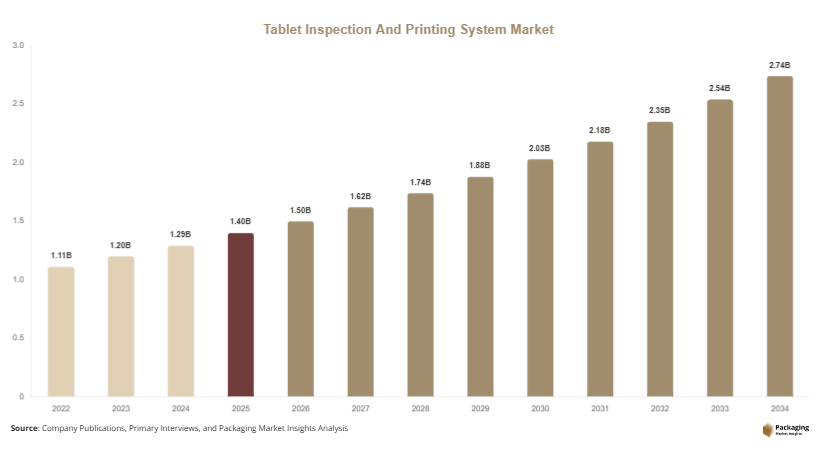
The global tablet inspection and printing system market size is estimated at USD 1.4 billion in 2025 and is projected to reach USD 1.5 billion in 2026. With increasing demand for automation and quality assurance in pharmaceutical manufacturing, the market is expected to grow to approximately USD 2.9 billion by 2034, registering a CAGR of 7.8% from 2025 to 2034. The tablet inspection and printing system market is gaining steady traction as pharmaceutical manufacturers prioritize quality control, regulatory compliance, and product traceability. These systems are used to inspect tablets for defects such as cracks, discoloration, and contamination, while also enabling high-speed printing of identification codes and branding elements.
One of the primary growth factors is the increasing regulatory scrutiny in the pharmaceutical industry. Regulatory bodies require stringent quality control measures, including accurate inspection and traceability of tablets. This has led to increased adoption of automated inspection and printing systems. Another significant factor is the rise in pharmaceutical production, driven by growing demand for generic drugs, over-the-counter medications, and specialty pharmaceuticals. As production volumes increase, manufacturers are investing in advanced systems to maintain consistency and efficiency.
Key Highlights
- Asia Pacific dominated the market with a 36.8% share in 2025, while Latin America is projected to grow at the fastest CAGR of 8.3%.
- Automatic systems led the type segment with a 54.2% share, while semi-automatic systems are expected to grow at a CAGR of 8.1%.
- Integrated inspection and printing systems dominated with a 49.7% share, while standalone printing systems are forecasted to grow at a CAGR of 8.5%.
- Pharmaceutical manufacturing applications led the segment with 61.3% share, while contract manufacturing is expected to grow at a CAGR of 8.4%.
- China remained the dominant country with a market size of USD 0.3 billion in 2025 and USD 0.32 billion in 2026.
Explore more data points, trends and opportunities Download Free Sample Report
Market Trends
Increasing integration of AI and machine vision technologies
The tablet inspection and printing system market is experiencing a significant shift toward the integration of artificial intelligence and advanced machine vision technologies. These systems are capable of detecting minute defects in tablets, such as color variations, cracks, and contamination, with high precision. AI-driven algorithms enhance the ability to analyze large volumes of data in real time, improving inspection accuracy and reducing false rejection rates. This trend is particularly important in pharmaceutical manufacturing, where quality standards are stringent. The adoption of intelligent inspection systems is expected to grow as manufacturers seek to improve efficiency and ensure compliance with regulatory requirements.
Growing demand for serialization and anti-counterfeiting solutions
Serialization and anti-counterfeiting measures are becoming increasingly important in the pharmaceutical industry, driving demand for advanced printing systems. Manufacturers are required to print unique identification codes on tablets to ensure traceability throughout the supply chain. These codes help prevent counterfeit products from entering the market and enhance patient safety. The integration of printing systems with inspection technologies allows for seamless verification of printed codes, ensuring accuracy and compliance. This trend is gaining momentum as regulatory authorities implement stricter guidelines for product traceability and security.
Market Drivers
Rising pharmaceutical production and demand for quality assurance
The increasing production of pharmaceutical products is a key driver of the tablet inspection and printing system market. As demand for medications continues to grow, manufacturers are expanding their production capacities. This increase in production volume requires efficient inspection and printing systems to maintain quality and consistency. Automated systems enable manufacturers to inspect tablets at high speeds while ensuring accuracy. The growing emphasis on quality assurance is driving the adoption of advanced inspection technologies.
Stringent regulatory requirements and compliance standards
Regulatory requirements play a crucial role in driving the adoption of tablet inspection and printing systems. Pharmaceutical companies must comply with strict quality standards to ensure product safety and efficacy. Regulatory bodies require detailed inspection and traceability of tablets, which can be achieved through advanced systems. The need to meet these standards is prompting manufacturers to invest in automated solutions. Compliance with regulations is essential for market entry and maintaining brand reputation, making these systems a critical component of pharmaceutical manufacturing.
Market Restraint
High initial investment and operational costs
The tablet inspection and printing system market faces challenges related to high initial investment and operational costs. Advanced systems equipped with AI and machine vision technologies require significant capital expenditure. Small and medium-sized pharmaceutical companies may find it difficult to afford these systems, limiting their adoption. In addition, maintenance and training costs can add to the overall expense. For example, implementing a fully automated inspection and printing system in a production line can require substantial investment in equipment and infrastructure. These cost-related challenges can hinder market growth, particularly in developing regions.
Market Opportunities
Expansion of pharmaceutical manufacturing in emerging markets
Emerging markets present significant opportunities for the tablet inspection and printing system market. Countries in Asia Pacific, Latin America, and the Middle East are experiencing growth in pharmaceutical manufacturing due to increasing demand for medications and government support. The establishment of new manufacturing facilities is driving the need for advanced inspection and printing systems. Companies that expand their presence in these regions can benefit from growing demand and favorable market conditions.
Advancements in integrated and modular system designs
Technological advancements in integrated and modular system designs are creating new opportunities for market growth. Manufacturers are developing systems that combine inspection and printing functionalities in a single platform, improving efficiency and reducing operational complexity. Modular designs allow companies to customize systems based on their specific requirements, enhancing flexibility. These innovations are enabling manufacturers to optimize their production processes and improve overall performance, driving demand for advanced systems.
Report Scope
| Report Metric | Details |
|---|---|
| Market Size in 2025 | USD 1.4 Billion |
| Market Size in 2026 | USD 1.5 Billion |
| Market Size in 2034 | USD 2.9 Billion |
| CAGR | 7.8% (2026-2034) |
| Base Year for Estimation | 2025 |
| Historical Data | 2022-2024 |
| Forecast Period | 2026-2034 |
| Report Coverage | Revenue Forecast, Competitive Landscape, Supply Chain Disruption, Growth Factors, Environment & Regulatory Landscape and Trends |
| Geographies Covered | North America, Europe, APAC, Middle East and Africa, LATAM |
| Countries Covered | U.S., Canada, U.K., Germany, France, Spain, Italy, Russia, Nordic, Benelux, Rest of Europe, China, South Korea, Japan, India, Australia, Singapore, Taiwan, South East Asia, Rest of Asia-Pacific, UAE, Turky, Saudi Arabia, South Africa, Egypt, Nigeria, Rest of MEA, Brazil, Mexico, Argentina, Chile, Colombia, Rest of LATAM |
Explore more data points, trends and opportunities Download Free Sample Report
Segmental Analysis
By Type
Automatic systems dominated the market in 2024, accounting for approximately 54.2% of the share. These systems are widely used in large-scale pharmaceutical manufacturing due to their high efficiency and accuracy. Automatic systems reduce manual intervention and enable continuous production, making them suitable for high-volume operations.
Semi-automatic systems are expected to grow at the fastest CAGR of 8.1%. These systems are preferred by small and medium-sized manufacturers due to their lower cost and flexibility. The growing demand for cost-effective solutions is driving the growth of this segment.
By Product Type
Integrated inspection and printing systems dominated the market in 2024, accounting for 49.7% of the share. These systems combine inspection and printing functionalities, improving efficiency and reducing operational complexity. The increasing demand for integrated solutions is supporting the growth of this segment.
Standalone printing systems are expected to grow at the fastest CAGR of 8.5%. These systems are used for specialized applications and offer flexibility in production processes. The growing demand for customization is driving the growth of this segment.
By End-Use
Pharmaceutical manufacturing dominated the market in 2024, accounting for 61.3% of the share. These facilities require advanced systems to ensure quality and compliance. The increasing production of pharmaceutical products is driving demand for inspection and printing systems.
Contract manufacturing is expected to grow at the fastest CAGR of 8.4%. The increasing outsourcing of pharmaceutical production is driving demand for advanced systems in contract manufacturing facilities.
Tablet Inspection And Printing System Market Segmentations
By Type
- Automatic Systems
- Semi-Automatic Systems
By Product Type
- Integrated Inspection And Printing Systems
- Standalone Printing Systems
By End-User
- Pharmaceutical Manufacturing
- Contract Manufacturing
Regional Analysis
North America
North America accounted for a market share of 31.2% in 2025 and is expected to grow at a CAGR of 7.2% during the forecast period. The region benefits from a well-established pharmaceutical industry and advanced manufacturing technologies. The demand for high-quality inspection and printing systems is driven by strict regulatory requirements and the need for product traceability.
The United States dominates the regional market due to its large pharmaceutical manufacturing base. A key growth factor is the increasing adoption of automation technologies, which is improving efficiency and driving demand for advanced systems.
Europe
Europe held a market share of 25.8% in 2025 and is projected to grow at a CAGR of 7.0%. The region is characterized by strong regulatory frameworks and a focus on quality assurance. Pharmaceutical companies are investing in advanced inspection systems to comply with regulations and maintain product quality.
Germany leads the European market due to its advanced manufacturing capabilities. A unique growth factor is the increasing adoption of serialization technologies, which is driving demand for printing systems.
Asia Pacific
Asia Pacific dominated the market with a 36.8% share in 2025 and is projected to grow at a CAGR of 8.3%. The region is experiencing rapid growth in pharmaceutical manufacturing, driven by increasing demand for medications and government support.
China is the dominant country in the region due to its large manufacturing base. A key growth factor is the expansion of pharmaceutical production facilities, which is driving demand for inspection and printing systems.
Middle East & Africa
The Middle East and Africa region held a market share of 3.1% in 2025 and is expected to grow at a CAGR of 7.5%. The region is witnessing growth due to increasing investments in healthcare infrastructure and pharmaceutical manufacturing.
Saudi Arabia is a leading market in the region. A unique growth factor is the development of local pharmaceutical manufacturing capabilities, which is driving demand for advanced systems.
Latin America
Latin America accounted for 3.1% of the market share in 2025 and is projected to grow at a CAGR of 8.3%. The region is experiencing growth due to increasing demand for pharmaceutical products and improving healthcare infrastructure.
Brazil dominates the Latin American market. A key growth factor is the expansion of generic drug manufacturing, which is driving demand for inspection and printing systems.
Competitive Landscape
The tablet inspection and printing system market is characterized by moderate competition, with key players focusing on innovation and strategic partnerships. Körber AG is recognized as a leading player due to its advanced technologies and strong market presence. The company continues to invest in research and development to enhance its product offerings.
Other major players include Uhlmann Group, ACG Worldwide, Optel Group, and Marchesini Group. These companies are focusing on product development and expansion strategies to strengthen their market position. A recent development includes the introduction of AI-powered inspection systems that improve accuracy and efficiency. The competitive landscape is driven by technological advancements and a focus on meeting regulatory requirements.
Key Players List
- Körber AG
- Uhlmann Group
- ACG Worldwide
- Optel Group
- Marchesini Group
- Bosch Packaging Technology
- IMA Group
- Sensum d.o.o.
- Scanware Electronic GmbH
- Seidenader Maschinenbau GmbH
- Pharma Technology Inc.
- Antares Vision Group
- Metec Packaging Machinery
- Brevetti CEA
- Global Vision Inc.