Roll-to-Roll Printer Market Size
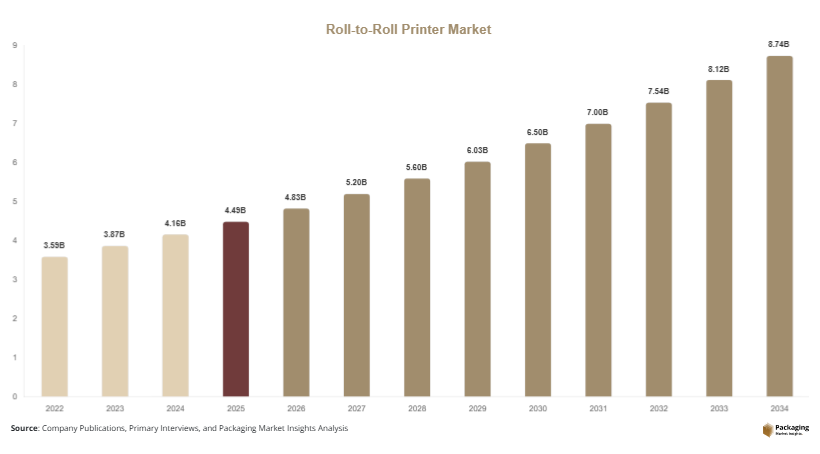
The roll-to-roll printer market size is projected at USD 4.83 billion in 2026 and is expected to hit USD 8.74 billion by 2034 with a CAGR of 7.7%. The report provides detailed quantitative analysis covering production capacity, technological innovations, pricing trends, distribution channels, and competitive benchmarking. It also evaluates segment-level performance, regional manufacturing capabilities, and strategic developments shaping the global industry landscape.
Roll-to-roll printers are high-speed digital printing systems designed to print continuously on flexible media such as vinyl, paper, textile, film, banners, and packaging substrates. Global production exceeded 242,000 units in 2025, while equipment utilization averaged 81% across commercial printing facilities. Advertising and signage applications accounted for nearly 46% of total installations, textile printing contributed 31%, and packaging printing represented approximately 23%. Increasing adoption of industrial automation, digital workflows, and sustainable printing technologies continues to strengthen the roll-to-roll printer market.
Explore more data points, trends and opportunities Download Free Sample Report
Roll-to-Roll Printer Market Trends
Growing Adoption of High-Speed Digital Printing Systems
Demand for high-speed roll-to-roll printers continues to increase as commercial printing companies seek greater production efficiency and shorter turnaround times. More than 67% of newly installed industrial printers now feature automated media handling, while annual production surpassed 255,000 units globally. UV curing technology adoption increased by 28% between 2023 and 2025, enabling improved print durability, faster curing cycles, and lower operating costs. These developments continue to strengthen the roll-to-roll printer market.
Manufacturers are integrating AI-based print monitoring, cloud-enabled workflow management, and precision color calibration into next-generation equipment. Approximately 42% of industrial print facilities have adopted predictive maintenance systems, reducing equipment downtime by nearly 19%. Eco-friendly latex inks and energy-efficient drying technologies are also gaining traction, supporting sustainability initiatives and expanding commercial applications across multiple industries within the roll-to-roll printer market.
Roll-to-Roll Printer Market Drivers
Rising Demand for Large-Format Digital Printing
Growing investments in advertising, retail branding, vehicle graphics, and flexible packaging continue driving equipment demand worldwide. Global large-format print output exceeded 18.5 billion square meters during 2025, while commercial printing facilities expanded production capacity by approximately 14%. More than 73% of outdoor advertising providers utilize roll-to-roll digital printing systems, supporting continuous expansion of the roll-to-roll printer market.
Roll-to-Roll Printer Market Restraints
High Capital Investment and Maintenance Costs
Industrial roll-to-roll printing systems require significant upfront investment, advanced operator training, and regular maintenance. Premium production systems typically account for over 62% of total installation expenses, while annual maintenance costs represent approximately 8%–12% of equipment value. Fluctuating raw material prices and rising energy expenses further impact profitability across small and medium-sized printing companies.
Roll-to-Roll Printer Market Opportunities
Expansion of Digital Textile and Packaging Printing
Rapid growth in customized apparel, flexible packaging, and short-run production creates substantial opportunities for digital printing manufacturers. Digital textile printing volumes exceeded 16 billion square meters, while customized packaging demand increased by 17% in 2025. Automation, variable data printing, and environmentally friendly inks continue creating long-term opportunities across commercial and industrial applications.
Challenges in the Roll-to-Roll Printer Market
Managing Print Quality Across High-Speed Production
Maintaining consistent print resolution, color accuracy, and substrate compatibility remains challenging during continuous high-volume production. Nearly 26% of industrial printing facilities report quality variation during long production cycles, while waste rates average 4.8% due to calibration adjustments. Manufacturers continue investing in automated inspection systems and advanced printhead technologies to improve operational consistency.
Report Scope
| Report Metric | Details |
|---|---|
| Market Size in 2025 | USD 4.49 Billion |
| Market Size in 2026 | USD 4.83 Billion |
| Market Size in 2034 | USD 8.74 Billion |
| CAGR | 7.7% (2026-2034) |
| Base Year for Estimation | 2025 |
| Historical Data | 2022-2024 |
| Forecast Period | 2026-2034 |
| Report Coverage | Revenue Forecast, Competitive Landscape, Supply Chain Disruption, Growth Factors, Environment & Regulatory Landscape and Trends |
| Geographies Covered | North America, Europe, APAC, Middle East and Africa, LATAM |
| Countries Covered | U.S., Canada, U.K., Germany, France, Spain, Italy, Russia, Nordic, Benelux, Rest of Europe, China, South Korea, Japan, India, Australia, Singapore, Taiwan, South East Asia, Rest of Asia-Pacific, UAE, Turky, Saudi Arabia, South Africa, Egypt, Nigeria, Rest of MEA, Brazil, Mexico, Argentina, Chile, Colombia, Rest of LATAM |
Explore more data points, trends and opportunities Download Free Sample Report
Roll-to-Roll Printer Market Segmentation
The market is segmented by printer type and application. Inkjet roll-to-roll printers account for approximately 49% of global installations, while advertising and signage represent nearly 46% of total equipment demand due to increasing commercial display production and promotional printing requirements.
By Printer Type
Inkjet systems account for nearly 49% of global demand with annual production exceeding 118,000 units. These printers support resolutions above 1,200 dpi, variable droplet technology, automated media feeding, and high-speed production for banners, posters, and indoor graphics.
UV printers represent approximately 32% of market demand with production exceeding 77,000 units annually. Instant UV curing, superior scratch resistance, multi-substrate compatibility, and reduced drying time make them suitable for industrial signage, labels, decorative graphics, and packaging applications.
Latex printing systems contribute nearly 19% of installations, and annual production surpasses 47,000 units. Water-based inks, low VOC emissions, flexible substrate compatibility, and enhanced environmental performance support increasing adoption across commercial and interior décor printing.
By Application
Accounting for approximately 46% of market demand, this application utilizes over 112,000 printers worldwide. High-speed banner production, retail displays, exhibition graphics, vehicle wraps, and outdoor advertising continue driving demand with penetration exceeding 71% among commercial print service providers.
Textile printing represents around 31% of total installations, supported by digital garment manufacturing and customized fabric production. Annual digitally printed textile output exceeded 16 billion square meters, while adoption rates surpassed 39% among industrial textile manufacturers.
Packaging printing contributes approximately 23% of market demand, driven by flexible packaging, corrugated displays, and customized labels. Production volumes exceeded 7.2 billion square meters, with digital packaging adoption increasing to nearly 36% among consumer goods manufacturers.
Roll-to-Roll Printer Market Segmentations
Printer Type:
- Inkjet Roll-to-Roll Printers
- UV Roll-to-Roll Printers
- Latex Roll-to-Roll Printers
Application
- Advertising & Signage
- Textile Printing
- Packaging Printing
Roll-to-Roll Printer Market Regional Outlook
North America
North America accounts for approximately 31% of global revenue, supported by advanced commercial printing infrastructure and high digital printing adoption. The United States contributes nearly 84% of regional demand, while annual printer shipments exceed 68,000 units across signage, packaging, and textile applications.
Europe
Europe represents nearly 28% of the global market, led by Germany, Italy, the United Kingdom, France, and Spain. Regional production exceeds 61,000 units annually, while environmentally friendly latex and UV printing systems account for over 54% of newly installed equipment.
Asia-Pacific
Asia-Pacific holds approximately 34% of global demand and remains the fastest-growing regional market. China, Japan, India, and South Korea contribute more than 79% of regional production. Manufacturing output exceeded 82,000 units during 2025, supported by rapid expansion of the textile, packaging, and advertising industries.
Latin America
Latin America contributes approximately 4% of global revenue, with Brazil and Mexico serving as major commercial printing hubs. Regional production surpassed 9,000 units, driven by increasing investments in retail advertising and packaging conversion.
Middle East & Africa
The Middle East & Africa account for nearly 3% of the market. Growing infrastructure development, retail expansion, and commercial branding activities supported production exceeding 6,000 units, with increasing investments in digital printing technologies.
Top Players In The Roll-To-Roll Printer Market
- HP Inc.
- Canon Inc.
- Epson Corporation
- Roland DG Corporation
- Mimaki Engineering Co., Ltd.
- Durst Group AG,
- Agfa-Gevaert Group
- EFI (Electronics For Imaging, Inc.)
- Konica Minolta, Inc.
- Ricoh Company, Ltd.
- Mutoh Holdings Co., Ltd.
- SwissQprint AG
- Brother Industries, Ltd.
- Xerox Holdings Corporation
- Seiko Instruments Inc.