Hang Tag Market Size
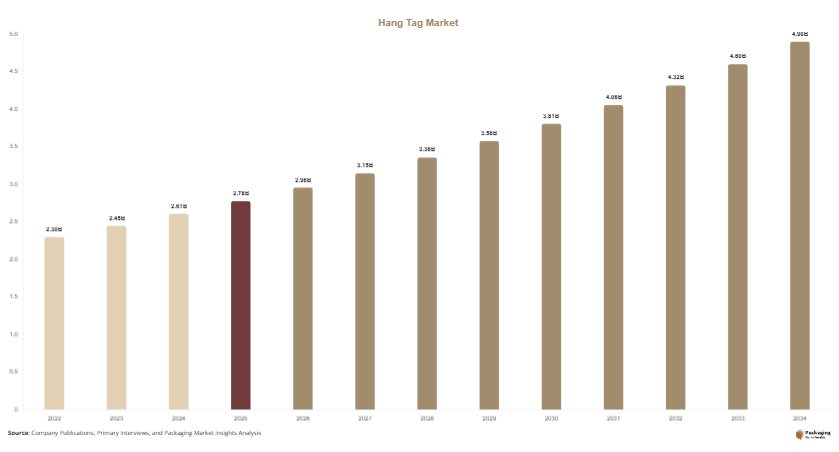
Hang tag market size is projected at USD 2.96 billion in 2026 and is expected to hit USD 4.91 billion by 2034 with a CAGR of 6.5%.
The market is witnessing stable expansion due to increasing retail branding, premium product labeling, and sustainable packaging initiatives across consumer industries. This report provides detailed analysis of market segmentation, production volume, competitive landscape, technological developments, and regional performance within the hang tag market.
Hang tags are product identification and branding labels attached to merchandise to communicate pricing, product information, sustainability credentials, and promotional messaging. Global production exceeded 76 billion hang tags in 2025, while paper-based tags represented approximately 62% of total production. Apparel and footwear applications accounted for nearly 54% of demand, retail and consumer goods contributed 28%, and food & beverage applications represented 18%. Increasing demand for premium branding solutions continues strengthening the hang tag market.
Explore more data points, trends and opportunities Download Free Sample Report
Hang Tag Market Trends
Growing Adoption of Sustainable and Smart Hang Tags
Manufacturers are increasingly producing recyclable, FSC-certified, biodegradable, and seed paper hang tags to meet sustainability goals. More than 48 billion paper hang tags were manufactured globally during 2025, while eco-friendly material adoption increased by 29%. Digital printing utilization exceeded 46%, improving customization and short-run production capabilities across the hang tag market.
Retailers are integrating QR codes, RFID chips, NFC technology, and variable data printing into hang tags to improve product traceability and customer engagement. Smart hang tag adoption exceeded 18% across premium apparel brands, while annual production of digitally enabled tags surpassed 2.3 billion units. Growing omnichannel retailing continues supporting technological innovation within the hang tag market.
Hang Tag Market Drivers
Expansion of Global Fashion and Retail Industries
The rapid growth of apparel manufacturing, organized retail, and premium consumer goods is significantly increasing demand for branded hang tags. Global apparel production exceeded 105 billion garments annually, while organized retail sales expanded by approximately 7% year over year. Nearly 72% of premium apparel brands utilize customized hang tags for product differentiation and brand communication, supporting the hang tag market.
Hang Tag Market Restraints
Volatility in Raw Material Prices and Printing Costs
Fluctuations in paper pulp, specialty inks, plastics, and finishing materials continue affecting manufacturing costs. Paper prices fluctuated by approximately 14%, while specialty printing and embossing increased production expenses by nearly 11%. Small-scale manufacturers continue facing margin pressure due to rising raw material costs, limiting expansion within the hang tag market.
Hang Tag Market Opportunities
Increasing Demand for Sustainable Branding and Product Authentication
Growing consumer preference for eco-friendly packaging and digital product authentication creates significant opportunities. More than 65% of global consumers prefer sustainable packaging materials, while QR-enabled product authentication adoption increased by 23% annually. Investments in recycled paper hang tags and smart labeling technologies continue to create growth opportunities across the hang tag market.
Challenges in Hang Tag Market
Balancing Premium Design with Cost Efficiency
Manufacturers must deliver visually appealing hang tags while maintaining production efficiency and competitive pricing. Approximately 51% of retailers require customized finishing such as foil stamping, embossing, and textured paper. Premium printing increases production costs by nearly 16%, presenting an ongoing challenge for the hang tag market.
Report Scope
| Report Metric | Details |
|---|---|
| Market Size in 2025 | USD 2.78 Billion |
| Market Size in 2026 | USD 2.96 Billion |
| Market Size in 2034 | USD 4.91 Billion |
| CAGR | 6.5% (2026-2034) |
| Base Year for Estimation | 2025 |
| Historical Data | 2022-2024 |
| Forecast Period | 2026-2034 |
| Report Coverage | Revenue Forecast, Competitive Landscape, Supply Chain Disruption, Growth Factors, Environment & Regulatory Landscape and Trends |
| Geographies Covered | North America, Europe, APAC, Middle East and Africa, LATAM |
| Countries Covered | U.S., Canada, U.K., Germany, France, Spain, Italy, Russia, Nordic, Benelux, Rest of Europe, China, South Korea, Japan, India, Australia, Singapore, Taiwan, South East Asia, Rest of Asia-Pacific, UAE, Turkey, Saudi Arabia, South Africa, Egypt, Nigeria, Rest of MEA, Brazil, Mexico, Argentina, Chile, Colombia, Rest of LATAM |
Explore more data points, trends and opportunities Download Free Sample Report
Hang Tag Market Segmentation
The market is segmented by material and end-use industry based on durability, branding requirements, sustainability, and product applications. Paper materials account for approximately 62% of global demand, while apparel and footwear contribute nearly 54% of overall consumption.
By Material
Paper dominates the market with approximately 62% share. Coated paper, kraft paper, recycled paper, and premium textured paper hang tags are widely used across apparel and retail sectors. Annual production exceeded 48 billion units, offering excellent print quality, recyclability, and customization options.
Plastic hang tags account for nearly 24% of the market. PVC tags, PET tags, transparent tags, and synthetic waterproof tags provide enhanced durability and moisture resistance. Production exceeded 18 billion units, supporting industrial products, outdoor goods, and reusable labeling applications.
Fabric hang tags contribute approximately 14% of market demand. Cotton labels, woven tags, satin tags, and polyester tags are extensively used in premium apparel and luxury fashion products. Production surpassed 10 billion units, providing long-lasting branding and premium aesthetics.
By End-use Industry
Apparel and footwear represent approximately 54% of total demand. Clothing, footwear, fashion accessories, sportswear, and luxury garments extensively utilize branded hang tags for pricing, product information, and marketing. Annual consumption exceeded 41 billion units, with premium tag penetration surpassing 48%.
Retail and consumer goods account for nearly 28% of market demand. Home décor, toys, electronics accessories, stationery, and gift products increasingly utilize customized hang tags. Production exceeded 21 billion units, supporting product branding and retail merchandising.
Food and beverage contribute approximately 18% of global demand. Specialty foods, beverages, gourmet products, gift packaging, and organic products utilize decorative hang tags for product information and branding. Annual consumption surpassed 14 billion units.
Hang Tag Market Segmentations
Material
- Paper
- Plastic
- Fabric
End-use Industry
- Apparel & Footwear
- Retail & Consumer Goods
- Food & Beverage
Hang Tag Market Regional Outlook
North America
North America accounts for approximately 27% of the global market. The United States contributes nearly 82% of regional production, supported by premium apparel brands and organized retail. Annual production exceeds 20 billion hang tags.
Europe
Europe represents approximately 29% of market demand. Germany, Italy, France, Spain, and the United Kingdom lead premium fashion and luxury goods production. Sustainable paper hang tag adoption exceeds 57%, while annual production surpasses 22 billion units.
Asia-Pacific
Asia-Pacific dominates with approximately 37% of global demand. China, India, Bangladesh, Vietnam, and Japan account for nearly 84% of regional production. Annual hang tag manufacturing exceeds 28 billion units, supported by strong textile and apparel exports.
Latin America
Latin America contributes approximately 4% of global demand. Brazil, Mexico, and Colombia continue expanding apparel manufacturing, increasing demand for customized branding and labeling solutions.
Middle East & Africa
The Middle East & Africa account for approximately 3% of market demand. The UAE, South Africa, and Saudi Arabia continue investing in organized retail, fashion, and consumer goods industries, supporting gradual market expansion.
Top players in the hang tag market
- Avery Dennison Corporation
- CCL Industries Inc.
- SATO Holdings Corporation
- UPM Raflatac
- FineLine Technologies
- ITL Group
- HP Indigo
- Zebra Technologies Corporation
- Multi-Color Corporation
- Sinclair Systems International LLC
- Dennison Labels
- Trimco Group
- Nilpeter A/S
- Paxar (Avery Dennison)
- Checkpoint Systems, Inc.
Avery Dennison Corporation
- Estimated global market share: 14–16%
- Global leader in labeling, branding, RFID, and apparel identification solutions.
- Offers premium paper, fabric, RFID-enabled, and sustainable hang tag solutions for global apparel and retail brands.
- Operates manufacturing facilities and service centers across North America, Europe, Asia-Pacific, and Latin America.
- Continuous investments in smart labeling, recycled materials, and digital identification technologies strengthen its leadership position within the global market.
CCL Industries Inc.
- Estimated global market share: 10–12%
- Strong portfolio of pressure-sensitive labels, product identification, and packaging decoration solutions.
- Provides customized hang tag solutions for apparel, consumer goods, and retail industries.
- Extensive global manufacturing network supports multinational consumer brands.
- Ongoing investments in sustainable materials, digital printing technologies, and premium finishing capabilities enhance its competitive position.