Pad Printing Machine Market Size
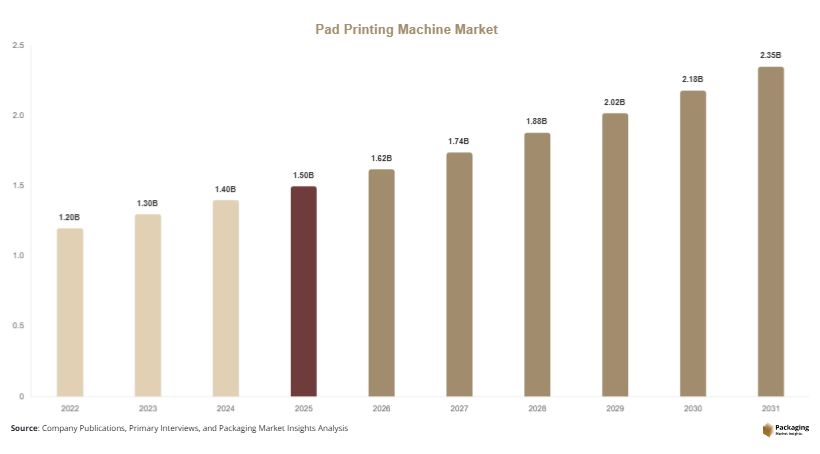
The pad printing machine market size is projected at USD 1.62 billion in 2026 and is expected to hit USD 2.94 billion by 2034 with a CAGR of 7.7%. Rising automation across precision manufacturing, electronics assembly, automotive component marking, and medical device production continues to accelerate industry expansion. The report provides extensive production analysis, market segmentation, competitive landscape evaluation, and regional performance assessment to support strategic decision-making.
The pad printing machine market consists of precision printing systems designed to transfer ink onto flat, curved, textured, and irregular surfaces using silicone pads. Global production exceeded 238,000 pad printing machines in 2026, while annual equipment shipments surpassed 212,000 units. Electronics applications represented approximately 37% of total installations, followed by automotive manufacturing at 31%. Automated printing systems accounted for nearly 58% of newly installed equipment, reinforcing long-term expansion of the pad printing machine market.
Explore more data points, trends and opportunities Download Free Sample Report
Pad Printing Machine Trends
Increasing Adoption of Automated Multi-Color Printing Systems
Manufacturers are investing in servo-driven pad printing equipment capable of high-speed, multi-color operation for precision industrial marking. More than 62% of new installations incorporate programmable logic controllers (PLCs), while automated loading systems improved production efficiency by 21%. Annual production exceeded 238,000 machines, with industrial automation continuing to strengthen the pad printing machine market.
Growing Demand for Precision Printing in Electronics Manufacturing
Miniaturization of electronic components has increased demand for high-resolution pad printing technologies. More than 88 million electronic components are printed daily using pad printing systems worldwide, while UV-curable ink adoption exceeded 54% among electronics manufacturers. Advanced vision inspection technologies have improved print accuracy by 18%, supporting continued innovation in the pad printing machine market.
Pad Printing Machine Drivers
Expanding Demand for Product Identification and Component Decoration
Increasing production of automotive components, consumer electronics, and medical devices is driving demand for precision printing equipment. More than 72% of manufacturers require permanent identification printing for regulatory compliance, while industrial automation investments exceeded USD 1.1 billion globally. Production efficiency improvements of nearly 25% continue supporting the pad printing machine market.
Pad Printing Machine Restraints
High Initial Capital Investment for Automated Printing Systems
Advanced pad printing machines equipped with robotics, vision systems, and multi-color capabilities require substantial capital expenditure. Equipment acquisition costs increased by approximately 14%, while maintenance and calibration expenses account for nearly 11% of annual operating costs. Small manufacturers continue facing investment barriers across the pad printing machine market.
Pad Printing Machine Opportunities
Growing Manufacturing Investments Across Emerging Economies
Expansion of electronics manufacturing, automotive production, and medical device assembly across Asia-Pacific and Latin America creates significant opportunities. Industrial equipment investments increased by 17%, while production facilities expanded by over 9% during 2026. Demand for automated printing equipment continues creating favorable opportunities for the pad printing machine market.
Challenges in Pad Printing Machine Market
Maintaining Print Accuracy Across Complex Surface Geometries
Manufacturers continue addressing challenges associated with high-speed printing on irregular and curved surfaces. Quality inspection systems now perform more than 4,000 print verification cycles per production shift, while nearly 7% of annual revenue is allocated to research and development. Precision engineering remains a key challenge shaping the pad printing machine market.
Report Scope
| Report Metric | Details |
|---|---|
| Market Size in 2025 | USD 1.50 Billion |
| Market Size in 2026 | USD 1.62 Billion |
| Market Size in 2034 | USD 2.94 Billion |
| CAGR | 7.7% (2026-2034) |
| Base Year for Estimation | 2025 |
| Historical Data | 2022-2024 |
| Forecast Period | 2026-2034 |
| Report Coverage | Revenue Forecast, Competitive Landscape, Supply Chain Disruption, Growth Factors, Environment & Regulatory Landscape and Trends |
| Geographies Covered | North America, Europe, APAC, Middle East and Africa, LATAM |
| Countries Covered | U.S., Canada, U.K., Germany, France, Spain, Italy, Russia, Nordic, Benelux, Rest of Europe, China, South Korea, Japan, India, Australia, Singapore, Taiwan, South East Asia, Rest of Asia-Pacific, UAE, Turkey, Saudi Arabia, South Africa, Egypt, Nigeria, Rest of MEA, Brazil, Mexico, Argentina, Chile, Colombia, Rest of LATAM |
Explore more data points, trends and opportunities Download Free Sample Report
Pad Printing Machine Market Segmentation
The market is segmented by type and application to evaluate equipment demand across industrial manufacturing sectors. Multi-color pad printing machines account for approximately 45% of market volume, while electronics applications contribute nearly 37% of global equipment installations. Annual production exceeds 238,000 machines worldwide.
By Type
Single-color machines account for approximately 33% of market demand. Annual production exceeds 78,000 units, offering reliable printing for simple logos, serial numbers, and product identification. These systems provide printing speeds of up to 2,000 cycles per hour with cost-effective operation.
Multi-color machines dominate with approximately 45% market share. Production exceeds 107,000 units annually and supports high-resolution printing with 2 to 8 color stations. These systems are widely adopted across electronics, cosmetics, and consumer goods manufacturing for complex graphics and branding.
Rotary pad printing machines represent approximately 22% of production, exceeding 53,000 units annually. These systems deliver continuous printing for cylindrical and high-volume applications while improving productivity by nearly 20% compared to conventional equipment.
By Application
Automotive applications account for approximately 31% of total demand. Annual equipment utilization supports production of over 2.6 billion automotive components, including switches, dashboards, control panels, and interior trim. High abrasion-resistant inks improve long-term durability.
Electronics represent the largest application with approximately 37% market share. More than 88 million electronic components are printed every day using pad printing systems. High-precision printing supports circuit components, keyboards, connectors, and consumer electronics with positioning accuracy below ±0.02 mm.
Medical device applications contribute approximately 18% of market demand. Annual production supports printing on more than 1.8 billion medical components, including syringes, diagnostic devices, inhalers, and surgical instruments. Regulatory compliance continues accelerating equipment adoption.
Pad Printing Machine Market Segmentations
Type
- Single Color Pad Printing Machine
- Multi-Color Pad Printing Machine
- Rotary Pad Printing Machine
Application
- Automotive
- Electronics
- Medical Devices
Pad Printing Machine Market Regional Outlook
North America
North America accounts for approximately 27% of global market demand. Annual production exceeds 52,000 machines, with the United States contributing nearly 79% of regional installations. Automotive, aerospace, and medical device sectors remain major consumers.
Europe
Europe represents approximately 30% of worldwide demand. Germany, Italy, Switzerland, and France account for nearly 74% of regional equipment manufacturing. Annual production exceeds 61,000 machines, supported by advanced industrial automation and precision engineering.
Asia-Pacific
The Asia-Pacific dominates the market with approximately a 36% share. China, Japan, South Korea, and India contribute nearly 81% of regional production. Manufacturing exceeds 86,000 machines annually, driven by electronics manufacturing and automotive production expansion.
Latin America
Latin America contributes approximately 4% of global demand. Brazil and Mexico collectively account for more than 68% of regional equipment installations, supported by industrial modernization and automotive investments.
Middle East & Africa
The Middle East & Africa represent approximately 3% of worldwide consumption. GCC countries and South Africa continue investing in industrial manufacturing, packaging, and medical equipment production, supporting gradual market expansion.
Top players in the Pad Printing Machine Market
- TAMPOPRINT AG
- ITW Trans Tech
- Kent Pad Printer Ltd.
- Comec Italia S.r. l.
- Teca-Print AG
- Winon Industrial Co., Ltd.
- Inkcups Now Corporation
- Printex USA
- Morlock GmbH
- AutoTran Inc.
- TTN Systems
- SPS Technoscreen GmbH
- LC Printing Machine Factory Limited
- OMSO S.p.A.
- Hoystar Printing Machinery Co., Ltd.
TAMPOPRINT AG
- Estimated market presence: 11–13%
- Global leader in precision pad printing equipment.
- Extensive product portfolio including automated, servo-driven, and multi-color printing systems.
- Strong presence across automotive, electronics, medical device, and industrial manufacturing sectors.
- Continuous investment in digital automation, robotic integration, and high-speed printing technologies strengthens production capabilities exceeding thousands of industrial systems annually. The company maintains strong partnerships with OEM manufacturers while expanding advanced Industry 4.0-compatible printing solutions for global customers.
ITW Trans Tech
- Estimated market presence: 8–10%
- Leading supplier of industrial pad printing and product decoration systems.
- Strong manufacturing and distribution network across North America, Europe, and Asia.
- Specialized expertise in automated printing, laser marking integration, and customized production systems.
- Continuous research in precision printing technology, vision inspection, and automation supports high-performance industrial applications. Long-term relationships with electronics, packaging, and medical manufacturers strengthen the company's competitive position within the global market.