Trifold Packaging Market Size and Growth
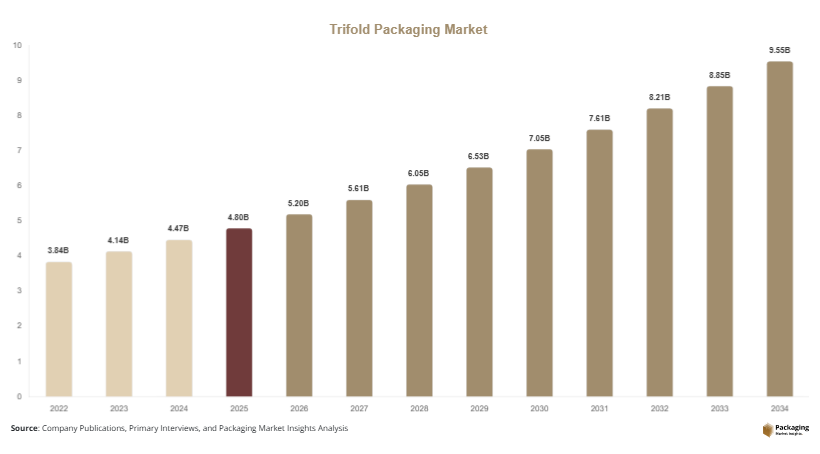
The global trifold packaging market was valued at approximately USD 4.8 billion in 2025 and is expected to reach USD 5.2 billion in 2026, with projections indicating growth to nearly USD 9.6 billion by 2034, registering a CAGR of 7.9% from 2025 to 2034. Trifold packaging refers to foldable packaging formats that consist of three panels, widely used in sectors such as cosmetics, pharmaceuticals, electronics, and food packaging. The trifold packaging market is gaining traction across multiple industries due to its compact design, enhanced presentation capabilities, and functional efficiency.
One of the primary growth factors driving the market is the increasing demand for premium packaging solutions that enhance product visibility and consumer engagement. Trifold packaging provides ample space for branding, product information, and design elements, making it attractive for marketing purposes. Another key factor is the rising adoption of sustainable packaging materials, as manufacturers are increasingly using recyclable paperboard and eco-friendly inks to meet environmental regulations. Additionally, the growth of the e-commerce sector is boosting demand for compact and protective packaging formats that can withstand transportation while maintaining product integrity.
Key Highlights:
- Asia Pacific dominated the market with a 36.8% share in 2025, while Latin America is projected to grow at the fastest CAGR of 8.4%.
- Paperboard trifold packaging led the type segment with a 59.7% share, while biodegradable materials are expected to grow at a CAGR of 8.9%.
- Cosmetics and personal care applications dominated with a 41.6% share, while pharmaceutical packaging is forecasted to grow at a CAGR of 8.2%.
- Retail packaging led the end-use segment with 33.5% share, while e-commerce packaging is expected to grow at a CAGR of 9.1%.
- China remained the dominant country with a market size of USD 1.2 billion in 2025 and USD 1.3 billion in 2026.
Explore more data points, trends and opportunities Download Free Sample Report
Market Trends
Rising adoption of eco-friendly and recyclable packaging materials
Sustainability is shaping the trifold packaging market as manufacturers increasingly adopt eco-friendly materials. Paperboard-based trifold packaging is gaining popularity due to its recyclability and reduced environmental impact. Companies are focusing on biodegradable coatings and water-based inks to improve sustainability performance. Regulatory pressures and consumer awareness are encouraging the use of environmentally responsible packaging solutions. This trend is driving innovation in material selection and production processes, enabling manufacturers to meet sustainability goals while maintaining product quality. The shift toward green packaging is expected to influence market dynamics over the forecast period.
Growing demand for premium and customized packaging designs
The demand for visually appealing and customized packaging is increasing across industries. Trifold packaging offers a unique format that enhances product presentation and branding opportunities. Advanced printing technologies enable high-resolution graphics, embossing, and special finishes, which improve shelf appeal. This trend is particularly evident in the cosmetics and electronics sectors, where packaging plays a crucial role in consumer decision-making. Additionally, customization allows brands to target specific consumer segments and create differentiated products. The ability to combine functionality with aesthetics is driving the adoption of trifold packaging formats.
Market Drivers
Expansion of e-commerce and retail sectors
The growth of e-commerce and organized retail is a significant driver of the trifold packaging market. Online shopping requires packaging solutions that provide protection during transit while maintaining an attractive presentation. Trifold packaging offers structural strength and compact design, making it suitable for e-commerce applications. Additionally, the expansion of retail chains is increasing demand for shelf-ready packaging that enhances product visibility. The ability to combine protective and promotional features is driving the adoption of trifold packaging in these sectors.
Increasing demand from cosmetics and pharmaceutical industries
The cosmetics and pharmaceutical industries are major contributors to market growth. Trifold packaging is widely used in these sectors due to its ability to provide detailed product information and enhance visual appeal. The growing demand for skincare, personal care, and healthcare products is driving the need for innovative packaging solutions. Additionally, regulatory requirements for labeling and safety are supporting the adoption of trifold packaging formats. These industries require packaging that ensures product integrity and compliance, contributing to market expansion.
Market Restraint
Higher production costs and limited scalability
The trifold packaging market faces challenges related to higher production costs and scalability. The manufacturing process involves multiple folding and printing steps, which can increase production complexity and costs. Small and medium-sized manufacturers may face difficulties in adopting advanced technologies required for trifold packaging production. Additionally, compared to simpler packaging formats, trifold designs may require more material and labor, impacting cost efficiency. For example, high-end cosmetic packaging often uses premium finishes and materials, which can increase overall expenses. These factors can limit market growth, particularly in price-sensitive regions.
Market Opportunities
Technological advancements in digital printing and folding
Advancements in digital printing and folding technologies present significant opportunities for the trifold packaging market. These technologies enable high-quality customization, faster production cycles, and reduced waste. Manufacturers can produce small batches with unique designs, catering to niche markets and promotional campaigns. Additionally, innovations in folding machinery are improving efficiency and reducing production costs. These advancements are enhancing the capabilities of trifold packaging and expanding its applications across industries.
Growing demand in emerging markets
Emerging markets offer substantial growth opportunities for the trifold packaging market. Rapid urbanization, increasing disposable incomes, and changing consumer preferences are driving demand for packaged products. The expansion of retail and e-commerce sectors in these regions is further supporting market growth. Additionally, the growing middle-class population is increasing consumption of cosmetics, electronics, and healthcare products. These factors are creating opportunities for manufacturers to expand their presence and capture new market segments.
Report Scope
| Report Metric | Details |
|---|---|
| Market Size in 2025 | USD 4.8 Billion |
| Market Size in 2026 | USD 5.2 Billion |
| Market Size in 2034 | USD 9.6 Billion |
| CAGR | 7.9% (2026-2034) |
| Base Year for Estimation | 2025 |
| Historical Data | 2022-2024 |
| Forecast Period | 2026-2034 |
| Report Coverage | Revenue Forecast, Competitive Landscape, Supply Chain Disruption, Growth Factors, Environment & Regulatory Landscape and Trends |
| Geographies Covered | North America, Europe, APAC, Middle East and Africa, LATAM |
| Countries Covered | U.S., Canada, U.K., Germany, France, Spain, Italy, Russia, Nordic, Benelux, Rest of Europe, China, South Korea, Japan, India, Australia, Singapore, Taiwan, South East Asia, Rest of Asia-Pacific, UAE, Turky, Saudi Arabia, South Africa, Egypt, Nigeria, Rest of MEA, Brazil, Mexico, Argentina, Chile, Colombia, Rest of LATAM |
Explore more data points, trends and opportunities Download Free Sample Report
Segmental Analysis
By Material Type
Paperboard trifold packaging dominated the segment with a market share of 59.7% in 2024, driven by its recyclability and cost efficiency. Paperboard materials are widely used due to their lightweight nature and ability to support high-quality printing. The increasing demand for sustainable packaging solutions is supporting the growth of this segment. Additionally, advancements in coating technologies are improving durability and barrier properties.
Biodegradable materials are expected to grow at a CAGR of 8.9% during the forecast period. The increasing focus on sustainability and environmental regulations is driving the adoption of eco-friendly materials. Manufacturers are developing innovative materials that offer performance similar to traditional options while reducing environmental impact. This trend is supporting segment growth.
By Application
Cosmetics and personal care applications accounted for the largest share of 41.6% in 2024, driven by the demand for attractive and functional packaging. Trifold packaging is widely used in this segment due to its ability to enhance product presentation. The increasing demand for skincare and beauty products is supporting the growth of this segment. Additionally, branding and customization are key factors driving adoption.
Pharmaceutical packaging is expected to grow at a CAGR of 8.2% during the forecast period. The increasing demand for healthcare products and regulatory requirements for labeling are driving the need for advanced packaging solutions. Trifold packaging provides space for detailed information and ensures product safety, supporting segment growth.
By End-Use
Retail packaging dominated the segment with a share of 33.5% in 2024, driven by the expansion of organized retail. Trifold packaging enhances product visibility and shelf appeal, making it suitable for retail applications. The increasing demand for attractive packaging solutions is supporting the growth of this segment. Additionally, the ability to combine functionality and aesthetics is driving adoption.
E-commerce packaging is expected to be the fastest-growing subsegment, registering a CAGR of 9.1% during the forecast period. The growth of online shopping is driving demand for packaging solutions that provide protection during transit. Trifold packaging offers durability and compact design, making it suitable for e-commerce applications. This trend is supporting segment growth.
Trifold Packaging Market Segmentations
By Material Type
- Paperboard
- Plastic
- Biodegradable Materials
By Application
- Cosmetics & Personal Care
- Pharmaceutical
- Electronics
- Food & Beverage
By End-Use
- Retail
- E-commerce
- Industrial
Regional Analysis
North America
North America accounted for approximately 23.6% of the market share in 2025 and is expected to grow at a CAGR of 7.1% during the forecast period. The region’s strong retail infrastructure and high demand for premium packaging solutions are key growth drivers. Technological advancements and the presence of major packaging companies are supporting innovation. Additionally, sustainability initiatives are encouraging the adoption of eco-friendly packaging materials.
The United States dominates the regional market due to its large consumer base and advanced manufacturing capabilities. A unique growth factor is the increasing demand for customized packaging in the cosmetics and electronics sectors. Companies are investing in digital printing technologies to meet consumer preferences, supporting market growth.
Europe
Europe held a market share of around 22.8% in 2025 and is projected to grow at a CAGR of 7.3%. The region’s strict environmental regulations and focus on sustainability are driving demand for recyclable packaging solutions. The cosmetics and pharmaceutical industries are major contributors to market growth. Additionally, innovations in packaging design are supporting the adoption of trifold formats.
Germany leads the European market due to its strong industrial base and technological advancements. A key growth factor is the implementation of stringent packaging regulations that promote sustainable practices. These policies are encouraging manufacturers to adopt eco-friendly materials and improve production processes.
Asia Pacific
Asia Pacific dominated the market with a share of 36.8% in 2025 and is expected to grow at a CAGR of 8.2%. Rapid urbanization, population growth, and increasing disposable incomes are driving demand for packaged products. The expansion of retail and e-commerce sectors is further supporting market growth. Additionally, the growing cosmetics and electronics industries are contributing to increased demand for trifold packaging.
China is the leading country in the region, supported by its large manufacturing capacity and consumer base. A major growth factor is the increasing demand for premium packaging solutions in the cosmetics sector. Government initiatives to promote industrial development are also contributing to market expansion.
Middle East & Africa
The Middle East & Africa region accounted for a market share of 7.4% in 2025 and is projected to grow at a CAGR of 7.6%. Increasing urbanization and rising disposable incomes are driving demand for packaged products. The region is also witnessing growth in the retail and e-commerce sectors. Improvements in distribution networks are further contributing to market growth.
Saudi Arabia is a dominant country in this region, driven by its growing economy and consumer market. A unique growth factor is the increasing investment in retail infrastructure. These investments are enhancing market accessibility and supporting the adoption of trifold packaging solutions.
Latin America
Latin America held a market share of 9.4% in 2025 and is expected to grow at the fastest CAGR of 8.4%. The region’s growing middle-class population and increasing demand for consumer goods are key drivers of market growth. The expansion of retail channels and rising consumption of packaged products are also contributing to market development.
Brazil is the leading country in Latin America, supported by its large consumer base. A key growth factor is the increasing demand for affordable and attractive packaging solutions. This trend is driving demand for trifold packaging, supporting market growth in the region.
Competitive Landscape
The trifold packaging market is characterized by a competitive landscape with several global and regional players focusing on innovation and sustainability. Companies are investing in advanced technologies and eco-friendly materials to strengthen their market position. Strategic partnerships and acquisitions are common as companies aim to expand their product portfolios and geographic reach.
DS Smith plc is considered a leading player in the market due to its strong presence and focus on sustainable packaging solutions. The company recently introduced recyclable trifold packaging designs to meet environmental requirements. Other key players are focusing on digital printing technologies and lightweight materials to enhance product differentiation. Sustainability and customization remain key focus areas for market participants.
Key Players List
- DS Smith plc
- Smurfit Kappa Group
- WestRock Company
- International Paper Company
- Stora Enso Oyj
- Mondi plc
- Amcor plc
- Sonoco Products Company
- Huhtamaki Oyj
- UPM-Kymmene Corporation
- Mayr-Melnhof Karton AG
- Rengo Co., Ltd.
- Oji Holdings Corporation
- Georgia-Pacific LLC
- Graphic Packaging International LLC