Tool Boxes Market Size
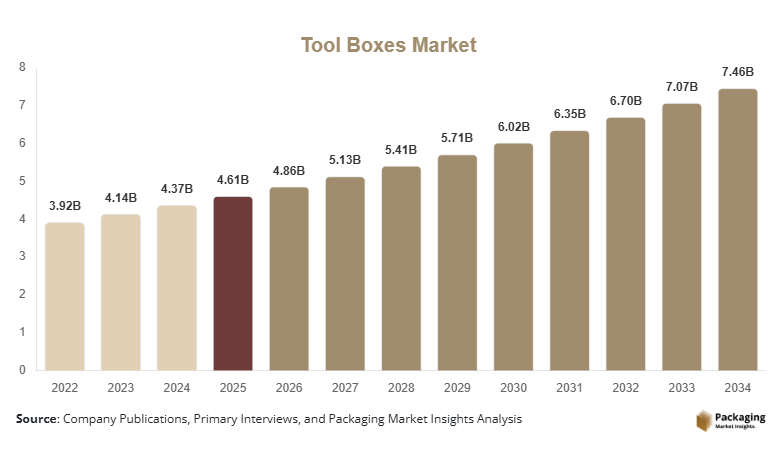
Toolboxes' market size is projected at USD 4.86 billion in 2026 and is expected to hit USD 7.43 billion by 2034 with a CAGR of 5.5%. The report presents detailed quantitative analysis of production capacity, consumption patterns, pricing trends, supply chain dynamics, segmentation, and the competitive landscape across major regional markets. It also evaluates manufacturing developments, technological advancements, and investment opportunities throughout the forecast period.
Tool boxes are portable or stationary storage solutions designed for organizing, transporting, and protecting hand tools, power tools, and accessories across industrial, automotive, construction, and residential applications. Global production surpassed 156 million units during 2025, while industrial applications represented nearly 43% of total consumption. Plastic tool boxes contributed approximately 46% of total shipments, metal variants accounted for 39%, and composite products represented 15%. Household adoption exceeded 58% across developed economies, reinforcing the toolboxes market.
Explore more data points, trends and opportunities Download Free Sample Report
Toolbox Boxes Market Trends
Smart Storage Solutions and Lightweight Materials
Manufacturers are increasingly introducing lightweight composite materials, ergonomic designs, and modular storage systems to improve portability and durability. More than 38 million modular tool boxes were produced during 2025, while demand for impact-resistant polymer products increased by 17% year-over-year. Nearly 54% of newly launched premium models featured integrated organizers and weather-resistant sealing systems, strengthening the toolboxes market.
Digital Manufacturing and Customization
Automation and advanced molding technologies continue improving manufacturing efficiency and product consistency. Automated production facilities manufactured over 92 million units in 2025, while robotic assembly adoption exceeded 49% among leading manufacturers. Customized storage solutions for professional technicians increased by 14%, and industrial maintenance applications expanded by 8.6%, supporting continued expansion of the toolboxes market.
Toolbox Boxes Market Drivers
Growing Construction and Industrial Maintenance Activities
Rapid expansion of infrastructure projects, manufacturing facilities, and automotive repair centers continues driving product demand. Global construction expenditure exceeded USD 13 trillion in 2025, while industrial maintenance spending increased by 7.4%. More than 61 million professional toolboxes were supplied to commercial sectors, with industrial users accounting for approximately 43% of total consumption, accelerating the toolbox market.
Tool Boxes Market Restraints
Fluctuating Raw Material Costs
Steel, aluminum, and engineering plastic price fluctuations continue affecting manufacturing margins. Metal materials account for nearly 47% of production costs, while polymer materials contribute approximately 28%. Raw material prices fluctuated between 9% and 16% during 2025, increasing procurement uncertainty for manufacturers producing over 5 million units annually. These cost pressures continue to restrain the toolboxes' market.
Toolbox Boxes Market Opportunities
Expansion of E-commerce and Professional DIY Culture
The rapid growth of online retail platforms and rising interest in home improvement projects create significant opportunities. Online sales represented approximately 34% of global tool box purchases in 2025, while DIY participation increased by 15% across several developed markets. Investments exceeding USD 420 million in automated fulfillment and customized product offerings further support the Tool Boxes market.
Challenges in the Toolboxes Market
Intense Competition and Product Standardization
The market faces increasing competition from regional manufacturers offering low-cost alternatives. More than 1,800 manufacturers operate globally, while price competition has reduced average selling prices by nearly 6% over the past three years. Counterfeit products account for approximately 4% of selected regional sales, creating ongoing challenges for the toolboxes market.
Report Scope
| Report Metric | Details |
|---|---|
| Market Size in 2025 | USD 4.61 Billion |
| Market Size in 2026 | USD 4.86 Billion |
| Market Size in 2034 | USD 7.43 Billion |
| CAGR | 5.5% (2026-2034) |
| Base Year for Estimation | 2025 |
| Historical Data | 2022-2024 |
| Forecast Period | 2026-2034 |
| Report Coverage | Revenue Forecast, Competitive Landscape, Supply Chain Disruption, Growth Factors, Environment & Regulatory Landscape and Trends |
| Geographies Covered | North America, Europe, APAC, Middle East and Africa, LATAM |
| Countries Covered | U.S., Canada, U.K., Germany, France, Spain, Italy, Russia, Nordic, Benelux, Rest of Europe, China, South Korea, Japan, India, Australia, Singapore, Taiwan, South East Asia, Rest of Asia-Pacific, UAE, Turkey, Saudi Arabia, South Africa, Egypt, Nigeria, Rest of MEA, Brazil, Mexico, Argentina, Chile, Colombia, Rest of LATAM |
Explore more data points, trends and opportunities Download Free Sample Report
Toolbox Boxes Market Segmentation
The market is segmented by material and end user, with plastic tool boxes accounting for approximately 46% of total shipments, while industrial applications contribute nearly 43% of worldwide demand. Annual production exceeded 156 million units, supported by increasing demand from construction, automotive, and household sectors.
By Material
Metal toolboxes represent approximately 39% of market volume, with annual production exceeding 61 million units. Steel and aluminum designs offer load capacities above 40 kg, corrosion-resistant coatings, reinforced hinges, and enhanced durability for industrial applications.
Plastic toolboxes dominate with nearly 46% market share and production exceeding 72 million units annually. Manufactured using polypropylene and ABS polymers, these products provide lightweight construction, impact resistance above 1.5 meters, integrated organizers, and moisture-resistant performance.
Composite toolboxes account for around 15% of total shipments, with production surpassing 23 million units. Composite materials deliver superior strength-to-weight ratios, chemical resistance, ergonomic handles, and enhanced durability for professional users.
By End User
Industrial applications lead with approximately 43% of total demand, consuming more than 67 million units annually. Manufacturing plants, construction companies, energy facilities, and maintenance contractors rely on heavy-duty tool storage with reinforced structural designs.
Automotive applications contribute nearly 34% of global demand and exceed 53 million units annually. Professional workshops, dealerships, and service centers require portable storage systems with compartmentalized organization and secure locking mechanisms.
Household applications represent approximately 23% of total consumption, with shipments exceeding 36 million units. DIY enthusiasts, homeowners, and hobbyists increasingly adopt compact storage solutions featuring lightweight construction and multi-purpose organization.
Tool Boxes Market Segmentations
Material
- Metal Tool Boxes
- Plastic Tool Boxes
- Composite Tool Boxes
End User
- Industrial
- Automotive
- Household
Toolboxes: Regional Outlook
North America
North America accounts for approximately 31% of global demand, with production exceeding 48 million units annually. The United States contributes nearly 79% of regional manufacturing, driven by construction, industrial maintenance, and automotive repair activities.
Europe
Europe represents around 27% of worldwide consumption and manufactures over 42 million units annually. Germany, France, Italy, and the United Kingdom contribute more than 71% of regional output through established industrial manufacturing and automotive sectors.
Asia-Pacific
The Asia-Pacific leads the market with approximately 34% share and annual production exceeding 53 million units. China accounts for nearly 52% of regional manufacturing, followed by India, Japan, and South Korea, supported by expanding manufacturing industries and infrastructure development.
Latin America
Latin America contributes nearly 5% of global demand. Brazil and Mexico together account for approximately 69% of regional consumption, supported by industrial growth and automotive maintenance activities.
Middle East & Africa
The Middle East & Africa represent approximately 3% of total demand. Saudi Arabia, the UAE, and South Africa contribute more than 63% of regional sales, driven by infrastructure expansion and industrial development.
Top Players In The Toolboxes Market
- Stanley Black & Decker, Inc.
- Milwaukee Tool
- Keter Group
- Apex Tool Group
- Snap-on Incorporated,
- Craftsman /li>
- Plano Molding Company
- DeWalt
- Kennedy Manufacturing Company
- Tactix International
- B&W International GmbH
- Montezuma Toolboxes
Stanley Black & Decker, Inc. Estimated global market presence of 15–17% in professional tool storage solutions. Operates advanced manufacturing facilities across North America, Europe, and Asia. Offers a broad portfolio of metal, plastic, and modular tool boxes for industrial and consumer markets. Focuses on continuous innovation, ergonomic product design, and durable storage systems while expanding digital distribution channels and premium product offerings worldwide. Milwaukee Tool has an estimated market presence of 10–12% within professional-grade tool storage products. Maintains strong positioning across construction, industrial maintenance, and automotive sectors. Invests extensively in modular storage systems, impact-resistant materials, and integrated mobile workstation solutions. Expands manufacturing capabilities and product innovation to meet growing professional demand while strengthening global distribution partnerships.