Multi Depth Corrugated Box Market Size and Growth
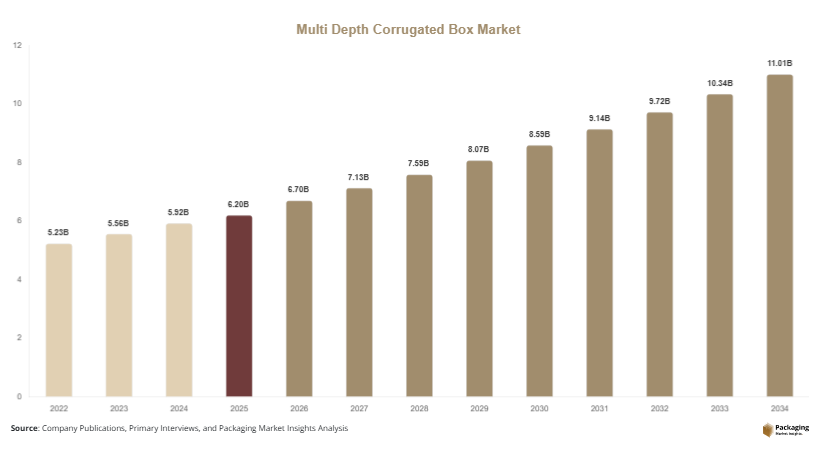
The global multi depth corrugated box market size is estimated at USD 6.2 billion in 2025, which is expected to grow to approximately USD 6.7 billion in 2026. Over the forecast period from 2025 to 2034, the market is projected to reach USD 11.8 billion by 2034, expanding at a CAGR of 6.4%. The multi depth corrugated box market is experiencing consistent growth due to rising demand for flexible and cost-efficient packaging solutions across e-commerce, retail, and industrial supply chains. Multi-depth corrugated boxes are designed with pre-scored fold lines that allow users to adjust the height of the box according to product dimensions. This feature reduces void space, minimizes the need for additional filler materials, and improves shipping efficiency.
The growing importance of efficient packaging in logistics and warehousing is a major factor driving the market. Multi-depth boxes allow businesses to standardize packaging inventory while maintaining flexibility in product handling. This is particularly beneficial for e-commerce companies that handle a wide variety of product sizes. Additionally, the increasing focus on sustainability is encouraging the adoption of corrugated packaging solutions that are recyclable and biodegradable.
Key Market Insights:
- Asia Pacific dominated the market with a 36.8% share in 2025.
- Latin America is projected to grow at the fastest CAGR of 6.9%.
- Regular slotted containers (RSC) led the type segment with a 33.5% share.
- Recycled corrugated board dominated with a 58.4% share.
- E-commerce applications led the segment with 42.7% share.
- China remained the dominant country with a market size of USD 1.6 billion in 2025 and USD 1.8 billion in 2026.
Explore more data points, trends and opportunities Download Free Sample Report
Market Trends
Increasing Demand for Right-Sized Packaging Solutions
The growing focus on right-sized packaging is a key trend in the multi depth corrugated box market. Businesses are seeking packaging solutions that minimize empty space within boxes to reduce shipping costs and material waste. Multi-depth boxes address this need by allowing users to adjust box height according to product size. For example, e-commerce companies shipping a wide range of products are using multi-depth boxes to optimize packaging efficiency and reduce reliance on void fillers such as air pillows.
This trend is expected to strengthen as companies focus on sustainability and cost optimization. Future developments may include advanced scoring technologies that allow more precise adjustments. As logistics operations become more data-driven, the demand for right-sized packaging solutions will continue to grow.
Adoption of Sustainable Corrugated Packaging Materials
Sustainability is becoming a central trend in the multi depth corrugated box market. Companies are increasingly using recycled corrugated materials to reduce environmental impact and comply with regulations. Multi-depth boxes, being made from paper-based materials, align well with sustainability goals. For instance, retailers are adopting recyclable corrugated boxes to replace plastic packaging, reducing waste and improving brand perception.
In the future, innovations in biodegradable coatings and water-resistant corrugated materials will enhance product performance while maintaining sustainability. Governments are also introducing stricter regulations on packaging waste, which will drive further adoption of eco-friendly solutions. This trend is expected to have a long-term positive impact on market growth.
Market Drivers
Expansion of E-commerce and Omnichannel Retail
The rapid growth of e-commerce and omnichannel retail is a major driver of the multi depth corrugated box market. Online retailers require flexible packaging solutions that can accommodate a wide variety of product sizes. Multi-depth boxes provide this flexibility, reducing the need for multiple box sizes and simplifying inventory management.
For example, large e-commerce platforms use multi-depth boxes to ship products ranging from small electronics to larger household items. This reduces packaging complexity and improves operational efficiency. As e-commerce continues to expand globally, the demand for adaptable packaging solutions will increase significantly.
Cost Reduction in Supply Chain Operations
Cost optimization is another key driver of market growth. Multi-depth corrugated boxes help reduce material usage and shipping costs by minimizing empty space within packages. This leads to lower transportation expenses and improved sustainability.
For instance, manufacturers using multi-depth boxes can reduce the number of packaging SKUs required, lowering inventory costs. Additionally, the lightweight nature of corrugated materials reduces shipping weight, resulting in cost savings. As companies focus on improving supply chain efficiency, the adoption of multi-depth boxes is expected to rise.
Market Restraint
Limited Load-Bearing Capacity Compared to Rigid Packaging
One of the main challenges in the multi depth corrugated box market is the limited load-bearing capacity compared to rigid packaging solutions such as wooden crates or plastic containers. While corrugated boxes are suitable for many applications, they may not provide sufficient strength for extremely heavy or high-value items.
For example, industries such as heavy machinery and construction often require more robust packaging solutions. This limitation can restrict the adoption of multi-depth boxes in certain sectors. Additionally, the need for additional reinforcement can increase costs, reducing the overall cost advantage. Addressing this challenge requires advancements in corrugated board technology and structural design.
Market Opportunities
Growth in Subscription-Based Delivery Services
The rise of subscription-based delivery services presents significant opportunities for the multi depth corrugated box market. These services require flexible packaging solutions that can accommodate varying product sizes and quantities. Multi-depth boxes are well-suited for this application due to their adjustable design.
For example, companies offering monthly subscription boxes for cosmetics or food products can use multi-depth boxes to optimize packaging. This reduces material waste and improves customer experience. As subscription services continue to grow, the demand for flexible packaging solutions will increase.
Technological Advancements in Corrugated Packaging
Technological advancements in corrugated packaging are creating new opportunities for the market. Innovations such as high-strength lightweight boards and improved scoring techniques are enhancing the performance of multi-depth boxes.
For instance, manufacturers are developing corrugated materials with higher compression strength, enabling their use in more demanding applications. In the future, the integration of smart packaging features such as QR codes and tracking systems will further expand market potential. These advancements will drive growth and increase adoption across industries.
Report Scope
| Report Metric | Details |
|---|---|
| Market Size in 2025 | USD 6.2 Billion |
| Market Size in 2026 | USD 6.7 Billion |
| Market Size in 2034 | USD 11.8 Billion |
| CAGR | 6.4% (2026-2034) |
| Base Year for Estimation | 2025 |
| Historical Data | 2022-2024 |
| Forecast Period | 2026-2034 |
| Report Coverage | Revenue Forecast, Competitive Landscape, Supply Chain Disruption, Growth Factors, Environment & Regulatory Landscape and Trends |
| Geographies Covered | North America, Europe, APAC, Middle East and Africa, LATAM |
| Countries Covered | U.S., Canada, U.K., Germany, France, Spain, Italy, Russia, Nordic, Benelux, Rest of Europe, China, South Korea, Japan, India, Australia, Singapore, Taiwan, South East Asia, Rest of Asia-Pacific, UAE, Turky, Saudi Arabia, South Africa, Egypt, Nigeria, Rest of MEA, Brazil, Mexico, Argentina, Chile, Colombia, Rest of LATAM |
Explore more data points, trends and opportunities Download Free Sample Report
Segmental Analysis
By Type
Regular slotted containers (RSC) dominated the market in 2024 with a 33.5% share. These boxes are widely used due to their simplicity, cost-effectiveness, and compatibility with automated packaging systems. RSC multi-depth boxes are particularly popular in e-commerce and retail sectors, where large volumes of products need to be shipped efficiently. For example, online retailers use RSC boxes with multiple score lines to adjust box height based on product size. This reduces the need for additional packaging materials and improves operational efficiency.
Die-cut boxes are the fastest-growing segment, with a projected CAGR of 6.8%. These boxes offer greater customization and are suitable for specific product shapes. The growth is driven by increasing demand for tailored packaging solutions. Future innovations in die-cutting technology are expected to enhance product performance and expand applications.
By Material
Recycled corrugated board dominated the market with a 58.4% share in 2024, driven by sustainability trends and cost advantages. Companies are increasingly using recycled materials to reduce environmental impact and comply with regulations. For instance, retailers are adopting recycled corrugated boxes to meet sustainability goals.
Virgin kraft linerboard is the fastest-growing material segment, with a CAGR of 6.1%. This growth is driven by the need for higher strength and durability in demanding applications. Industries such as electronics and healthcare require packaging that can provide enhanced protection. Future advancements in material technology are expected to improve performance and increase adoption.
By End-Use
E-commerce accounted for the largest share of 42.7% in 2024, driven by the need for flexible and efficient packaging solutions. Multi-depth boxes are widely used in online retail to accommodate a variety of product sizes. For example, e-commerce companies use these boxes to optimize packaging and reduce shipping costs.
Healthcare is the fastest-growing end-use segment, with a CAGR of 6.6%. The need for safe and secure packaging of medical products is driving demand. Multi-depth boxes provide flexibility and protection, making them suitable for healthcare applications. As the healthcare industry expands, demand for advanced packaging solutions will increase.
Multi Depth Corrugated Box Market Segmentations
By Type
- Regular Slotted Containers (RSC)
- Die-Cut Boxes
- Telescopic Boxes
By Material
- Recycled Corrugated Board
- Virgin Kraft Linerboard
By End-User
- E-commerce
- Electronics
- Healthcare
- Consumer Goods
Regional Analysis
North America
North America accounted for approximately 26.1% of the global market share in 2025 and is projected to grow at a CAGR of 6.0% through 2034. The region benefits from a mature e-commerce ecosystem and advanced logistics infrastructure. The widespread adoption of automation in warehouses is increasing demand for standardized and flexible packaging solutions such as multi-depth boxes. Additionally, sustainability initiatives are encouraging the use of recyclable packaging materials, supporting market growth.
The United States dominates the regional market due to its large consumer base and strong retail sector. A unique growth driver is the increasing adoption of same-day delivery services, which require efficient packaging solutions. For example, retailers are using multi-depth boxes to optimize packaging for quick deliveries, reducing handling time and improving efficiency.
Europe
Europe held a 22.7% market share in 2025 and is expected to grow at a CAGR of 5.8% during the forecast period. The region’s focus on environmental sustainability and strict regulations on packaging waste are key factors influencing market dynamics. Countries such as Germany, France, and the UK are leading the adoption of eco-friendly packaging solutions.
Germany is the dominant country in the region, driven by its strong manufacturing base. A unique growth driver is the emphasis on circular economy practices, which encourage the use of recyclable materials. For example, German companies are replacing plastic packaging with corrugated solutions, boosting demand for multi-depth boxes.
Asia Pacific
Asia Pacific emerged as the largest regional market with a 36.8% share in 2025 and is projected to grow at a CAGR of 6.7%. Rapid industrialization, expanding e-commerce platforms, and increasing exports are driving market growth. Countries such as China, India, and Japan are major contributors to the market.
China dominates the Asia Pacific market due to its large manufacturing base. A significant growth driver is the expansion of cross-border e-commerce, which requires efficient packaging solutions. For instance, Chinese exporters are using multi-depth boxes to optimize packaging for international shipments.
Middle East & Africa
The Middle East & Africa region accounted for 7.8% of the market share in 2025 and is expected to grow at a CAGR of 6.3%. The region’s growth is driven by increasing investments in logistics and infrastructure development. Countries such as the UAE and South Africa are focusing on improving supply chain efficiency.
Saudi Arabia is a key market in the region, supported by its economic diversification initiatives. A unique growth driver is the expansion of retail and e-commerce sectors. For example, companies are adopting multi-depth boxes to improve packaging efficiency and reduce costs.
Latin America
Latin America held a 6.6% market share in 2025 and is projected to grow at the fastest CAGR of 6.9%. The region is experiencing growth due to expanding e-commerce and increasing trade activities. Countries such as Brazil and Mexico are key contributors to market expansion.
Brazil dominates the regional market, supported by its large consumer base. A key growth driver is the expansion of logistics networks. For instance, companies are using multi-depth boxes to reduce shipping costs and improve packaging efficiency.
Competitive Landscape
The multi depth corrugated box market is moderately fragmented, with several global and regional players competing on innovation, pricing, and sustainability. Companies are focusing on expanding production capacity and developing advanced corrugated solutions to strengthen their market position.
WestRock Company is identified as the market leader due to its extensive product portfolio and strong global presence. The company has been investing in sustainable packaging solutions and expanding its manufacturing capabilities. Other key players are adopting strategies such as mergers, acquisitions, and partnerships to enhance their market reach.
Recent developments include the introduction of high-strength corrugated materials and advancements in packaging automation. Companies are also investing in digital printing technologies to improve customization. These strategies are expected to drive competition and innovation in the market.
Key Players
- WestRock Company
- International Paper Company
- Smurfit Kappa Group
- DS Smith Plc
- Packaging Corporation of America
- Mondi Group
- Stora Enso
- Georgia-Pacific LLC
- Oji Holdings Corporation
- Nine Dragons Paper Holdings
- Rengo Co., Ltd.
- Cascades Inc.
- Klabin S.A.
- SCG Packaging
- Pratt Industries