Non Corrugated Boxes Market Size and Growth
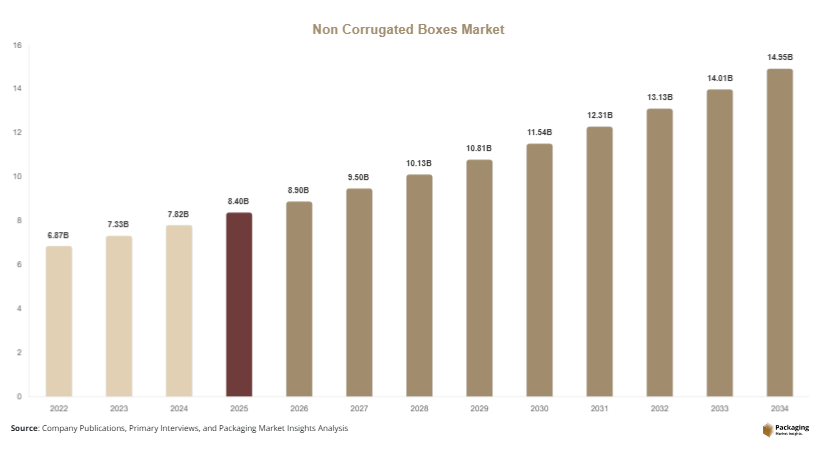
The non corrugated boxes market size is estimated at USD 8.4 billion in 2025 and is expected to reach USD 8.9 billion in 2026. By 2034, the market is forecasted to reach approximately USD 15.6 billion, growing at a CAGR of 6.7% during the forecast period (2025–2034).
One of the primary growth factors is the rapid expansion of e-commerce packaging demand, where lightweight yet durable boxes are preferred for cost-efficient logistics. Another key driver is the increasing adoption of premium packaging in cosmetics and luxury goods, where branding and aesthetics play a major role in consumer purchasing decisions. Additionally, the shift toward sustainable packaging materials is accelerating the replacement of plastic-based packaging with recyclable paperboard solutions.
Key Highlights:
- Asia Pacific dominated the market with a 37.4% share in 2025.
- Latin America is projected to grow at the fastest CAGR of 6.2%.
- Folding cartons led the type segment with a 30.8% share.
- Paperboard packaging dominated with a 55.1% share.
- Food & beverage applications led the segment with 41.7% share.
- The US remained the dominant country with a market size of USD 8.2 billion in 2025 and USD 8.7 billion in 2026.
Explore more data points, trends and opportunities Download Free Sample Report
Market Trends
Rising Demand for Premium and Rigid Packaging Formats
The non corrugated boxes market is witnessing strong adoption of rigid and premium packaging formats, especially in cosmetics, electronics accessories, and luxury retail segments. These boxes are designed to enhance brand perception and improve unboxing experiences, which has become a critical factor in consumer engagement. For example, premium skincare brands are increasingly using magnetic closure rigid boxes with textured finishes and foil stamping. This trend is particularly strong in developed markets such as the United States and Western Europe, where brand differentiation is essential. In the future, demand for premium packaging is expected to grow further due to rising disposable income and influencer-driven consumer behavior.
Expansion of Sustainable Paperboard Packaging Solutions
Sustainability-driven innovation is another major trend shaping the market. Manufacturers are transitioning from plastic-coated packaging to recyclable paperboard and bio-based coatings. For instance, food delivery brands and QSR chains are adopting recyclable folding cartons for takeaway packaging. In Europe, strict environmental regulations are pushing companies to eliminate non-recyclable packaging formats. This shift is also supported by consumer awareness regarding environmental impact. In the future, the development of water-resistant and grease-resistant biodegradable coatings will further enhance the usability of non corrugated boxes across food and pharmaceutical applications.
Market Drivers
Growth of E-commerce and Retail Expansion
The expansion of e-commerce platforms is a major driver of the non corrugated boxes market. Online retailers require packaging that is lightweight, cost-effective, and visually appealing to enhance customer experience. Folding cartons and rigid boxes are widely used for packaging apparel, cosmetics, and electronics accessories. For example, global e-commerce platforms are increasingly using branded packaging to improve customer retention and unboxing appeal. The rise of quick commerce and same-day delivery services has further increased demand for compact and durable packaging solutions that can withstand logistics handling.
Rising Demand from Cosmetics and Personal Care Industry
The cosmetics and personal care industry significantly contributes to market growth. Non corrugated boxes are widely used for skincare, fragrance, and makeup products due to their high printability and premium appearance. For instance, luxury cosmetic brands use embossed and laminated folding cartons to enhance shelf visibility. The increasing popularity of organic and premium beauty products is also driving demand for sustainable and aesthetically appealing packaging formats. In emerging economies, rising middle-class income is further supporting consumption of packaged personal care products.
Market Restraint
High Competition from Flexible Packaging Alternatives
One of the major restraints in the non corrugated boxes market is increasing competition from flexible packaging solutions such as pouches and bags. Flexible packaging offers advantages like lower material usage, reduced transportation costs, and improved storage efficiency. In sectors such as food delivery and personal care, flexible packaging is increasingly replacing rigid and folding carton formats. For example, refill packs and stand-up pouches are gaining popularity among sustainable brands. This shift limits the growth potential of non corrugated boxes in cost-sensitive markets, particularly in Asia and Latin America where price competitiveness is critical.
Market Opportunities
Growth in Personalized and Digital Printing Packaging
The increasing demand for personalized packaging presents a strong opportunity for market expansion. Brands are leveraging digital printing technologies to create customized packaging designs for seasonal campaigns, influencer collaborations, and limited-edition products. For example, cosmetic companies are launching personalized skincare packaging based on customer profiles. This trend is expected to grow further as brands focus on enhancing consumer engagement and brand loyalty through packaging innovation. In the future, integration of AI-driven design tools will enable real-time customization at scale.
Expansion in Pharmaceutical Secondary Packaging
The pharmaceutical sector offers significant growth opportunities for non corrugated boxes. Folding cartons are widely used for secondary packaging of tablets, syringes, and medical devices. Increasing regulatory requirements for labeling, serialization, and anti-counterfeit features are driving demand for advanced packaging solutions. For example, tamper-evident cartons with QR-based authentication are being adopted in several countries. The expansion of healthcare infrastructure in developing regions will further accelerate demand for compliant and secure packaging formats.
Report Scope
| Report Metric | Details |
|---|---|
| Market Size in 2025 | USD 8.4 Billion |
| Market Size in 2026 | USD 8.9 Billion |
| Market Size in 2034 | USD 15.6 Billion |
| CAGR | 6.7% (2026-2034) |
| Base Year for Estimation | 2025 |
| Historical Data | 2022-2024 |
| Forecast Period | 2026-2034 |
| Report Coverage | Revenue Forecast, Competitive Landscape, Supply Chain Disruption, Growth Factors, Environment & Regulatory Landscape and Trends |
| Geographies Covered | North America, Europe, APAC, Middle East and Africa, LATAM |
| Countries Covered | U.S., Canada, U.K., Germany, France, Spain, Italy, Russia, Nordic, Benelux, Rest of Europe, China, South Korea, Japan, India, Australia, Singapore, Taiwan, South East Asia, Rest of Asia-Pacific, UAE, Turky, Saudi Arabia, South Africa, Egypt, Nigeria, Rest of MEA, Brazil, Mexico, Argentina, Chile, Colombia, Rest of LATAM |
Explore more data points, trends and opportunities Download Free Sample Report
Segmental Analysis
By Type
Folding cartons held 34.6% market share in 2024, driven by their versatility, cost-effectiveness, and wide application across industries. These cartons are extensively used in food, pharmaceuticals, and cosmetics packaging due to their lightweight structure and high printability. For example, cereal boxes, toothpaste cartons, and skincare packaging commonly use folding carton formats. Their ability to support branding through advanced printing techniques makes them a preferred choice for retail products.
Rigid boxes are projected to grow at a CAGR of 6.9%, driven by increasing demand for luxury packaging in cosmetics and electronics. These boxes offer superior durability and premium aesthetics. Brands are increasingly adopting rigid packaging for high-value products such as perfumes and smartphones. Future growth will be supported by customization trends and premium unboxing experiences.
By Material
Paperboard accounted for 55.1% market share in 2024 due to its affordability, recyclability, and strong print compatibility. It is widely used in folding cartons across multiple industries, including food and pharmaceuticals.
Recycled fiber-based packaging is expected to grow at a CAGR of 6.4%, driven by sustainability initiatives and regulatory pressure. Brands are shifting toward eco-friendly raw materials to reduce environmental impact.
By End-Use
Food & beverage held 41.7% market share in 2024 due to high demand for packaged food products, takeaway packaging, and branded food cartons.
Cosmetics is expected to grow at a CAGR of 6.8%, driven by rising demand for premium skincare and beauty packaging.
Non Corrugated Boxes Market Segmentations
By Type
- Folding Cartons
- Rigid Boxes
- Set-Up Boxes
- Specialty Boxes
By Material
- Paperboard
- Kraft Paper
- Recycled Fiber
- Laminated Paper
By End-Use
- Food & Beverage
- Cosmetics & Personal Care
- Pharmaceuticals
- Electronics & Accessories
- Retail & E-commerce
Regional Analysis
North America
North America accounted for 29.3% of the non corrugated boxes market in 2025 and is expected to grow at a CAGR of 6.1% through 2034. The region benefits from strong retail infrastructure, high e-commerce penetration, and demand for premium packaging solutions. Growth is also supported by increasing consumption of cosmetics, pharmaceuticals, and packaged food products. Sustainability initiatives are pushing companies toward recyclable and lightweight paperboard packaging formats.
The United States dominates the regional market due to its large consumer goods industry and advanced packaging technologies. A key driver is the rapid expansion of e-commerce packaging requirements, especially in fashion and beauty segments. For example, major online retailers are investing in branded folding cartons to enhance customer experience and reduce return rates. Canada also contributes to growth through increasing demand for eco-friendly packaging in food delivery services.
Europe
Europe held 25.6% market share in 2025 and is projected to grow at a CAGR of 6.4% during the forecast period. The region is strongly influenced by environmental regulations and circular economy initiatives. Demand for recyclable paperboard packaging is high across cosmetics, food, and pharmaceutical industries. Retailers are increasingly adopting plastic-free packaging strategies.
Germany leads the regional market due to its strong manufacturing base and innovation in packaging machinery. A key driver is the adoption of sustainable luxury packaging in cosmetics and premium retail segments. For instance, French cosmetic brands are heavily investing in recyclable folding cartons with premium finishes to meet eco-conscious consumer demand.
Asia Pacific
Asia Pacific dominated the market with a 37.4% share in 2025 and is expected to grow at a CAGR of 7.3% through 2034. Rapid urbanization, expanding retail networks, and rising disposable income are key growth drivers. The region also benefits from strong manufacturing capabilities and cost-effective production.
China is the dominant country due to its large-scale packaging production and booming e-commerce industry. A major driver is the expansion of domestic beauty and personal care brands using customized folding cartons for branding. India is also witnessing strong growth due to rising pharmaceutical packaging demand and organized retail expansion.
Middle East & Africa
Middle East & Africa accounted for 6.5% market share in 2025, with a CAGR of 5.9% projected through 2034. Growth is driven by retail modernization, tourism expansion, and increasing demand for packaged consumer goods. The cosmetics and food sectors are key contributors to market expansion.
The United Arab Emirates leads the region due to strong luxury retail demand and tourism-driven consumption. A unique driver is the growth of high-end retail packaging in Dubai malls, where premium folding cartons are widely used. South Africa also shows steady growth due to expanding pharmaceutical distribution networks.
Latin America
Latin America held 7.7% market share in 2025 and is projected to grow at the fastest CAGR of 6.2% through 2034. Economic development, rising urbanization, and expanding retail chains are driving demand for non corrugated packaging. Food and beverage applications dominate the regional market.
Brazil leads the region due to its strong cosmetics and food packaging industry. A key driver is the expansion of local beauty brands focusing on affordable yet visually appealing packaging formats. Mexico also contributes to growth through increasing pharmaceutical imports and retail modernization.
Competitive Landscape
The non corrugated boxes market is moderately fragmented, with key players focusing on sustainability, digital printing, and capacity expansion. Leading companies include International Paper Company, WestRock Company, Smurfit Kappa Group, DS Smith Plc, and Graphic Packaging International. Among these, Smurfit Kappa Group is a leading player due to its strong global presence and innovation in recyclable packaging solutions.
Companies are investing in automation, sustainable materials, and regional expansion strategies. Recent developments include new paperboard plants, digital printing upgrades, and partnerships with FMCG brands for eco-friendly packaging solutions.
Key Players
- International Paper Company
- WestRock Company
- Smurfit Kappa Group
- DS Smith Plc
- Graphic Packaging International
- Mondi Group
- Nippon Paper Industries
- Mayr-Melnhof Karton AG
- Rengo Co. Ltd.
- Stora Enso Oyj
- Packaging Corporation of America
- ITC Limited
- Sonoco Products Company
- Huhtamaki Oyj
- Oji Holdings Corporation