Mono Cartons Market Size and Growth
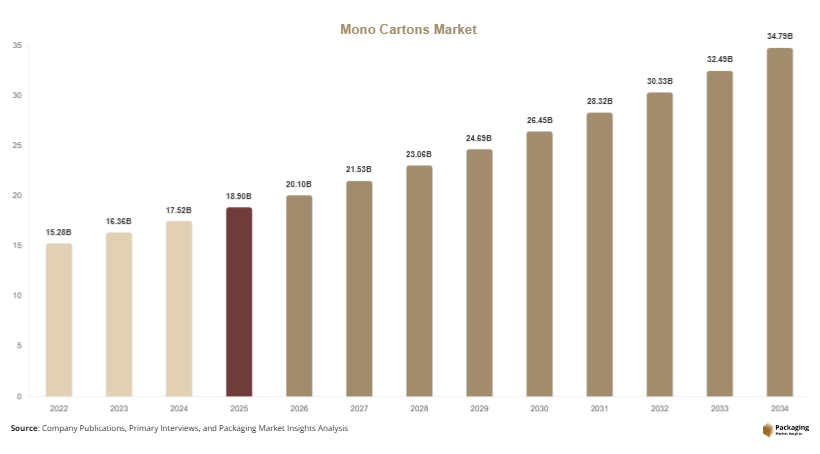
The global mono cartons market size was valued at approximately USD 18.9 billion in 2025 and is expected to reach USD 20.1 billion in 2026. By 2034, the market is projected to expand to nearly USD 34.7 billion, registering a CAGR of 7.1% during 2025–2034. The mono cartons market is experiencing consistent growth due to increasing demand for sustainable and visually appealing packaging solutions across industries such as pharmaceuticals, food & beverages, cosmetics, personal care, and consumer electronics. Mono cartons are widely used for secondary packaging because they offer durability, lightweight handling, easy customization, and enhanced shelf visibility.
One of the primary growth factors driving the mono cartons market is the rising demand for eco-friendly paperboard packaging solutions. Governments and consumers are increasingly discouraging plastic packaging usage, encouraging manufacturers to adopt recyclable carton materials. Another important factor is the rapid growth of pharmaceutical packaging, where mono cartons are used extensively for medicines, healthcare products, and medical devices due to regulatory labeling requirements. In addition, the expansion of e-commerce and retail industries has increased demand for customized folding cartons that provide product protection and branding opportunities.
Key Highlights
- Asia Pacific dominated the market with a 39.1% share in 2025.
- Latin America is projected to grow at the fastest CAGR of 7.5%.
- Folding cartons led the type segment with a 42.8% share.
- Paperboard materials dominated with a 61.5% share.
- Pharmaceutical applications led the segment with 34.6% share.
- The US remained the dominant country with a market size of USD 4.1 billion in 2025 and USD 4.4 billion in 2026.
Explore more data points, trends and opportunities Download Free Sample Report
Market Trends
Rising Adoption of Sustainable and Recyclable Packaging
Sustainability has become a major trend shaping the mono cartons market as packaging manufacturers and brand owners focus on reducing environmental impact. Companies are increasingly replacing plastic-based secondary packaging with recyclable paperboard mono cartons to comply with government regulations and consumer expectations. Many packaging producers are introducing cartons made from recycled fibers and biodegradable coatings to improve environmental performance. Retailers and consumer goods companies are also promoting paper-based packaging as part of their sustainability goals. This trend is particularly visible in food, cosmetics, and healthcare industries, where eco-friendly packaging influences consumer purchasing decisions. As sustainability standards continue to evolve, manufacturers are expected to invest further in renewable packaging materials and energy-efficient production processes.
Growth of Premium Printing and Smart Packaging Features
Premium packaging design and smart labeling technologies are becoming increasingly important in the mono cartons market. Brands are using high-quality digital printing, embossing, foil stamping, and textured finishes to enhance shelf appeal and strengthen product identity. In addition, smart packaging features such as QR codes, RFID tags, and authentication labels are gaining popularity, especially in pharmaceutical and luxury product packaging. These technologies help improve product traceability, customer engagement, and counterfeit protection. Cosmetic and electronics brands are particularly adopting advanced mono carton designs to create a premium unboxing experience. The integration of intelligent packaging technologies is expected to support product differentiation and increase demand for customized carton solutions over the forecast period.
Market Drivers
Expansion of Pharmaceutical and Healthcare Packaging
The pharmaceutical industry is a major driver for the mono cartons market due to increasing demand for safe, informative, and compliant packaging solutions. Mono cartons are widely used for packaging medicines, syringes, medical devices, and healthcare supplements because they provide excellent printability for dosage instructions, warnings, and branding information. Rising healthcare spending, growing pharmaceutical exports, and increasing production of generic medicines are contributing to higher demand for folding cartons. Regulatory authorities also require manufacturers to provide tamper-evident and traceable packaging, encouraging the use of advanced mono carton designs. The expansion of healthcare infrastructure in emerging economies is expected to create additional growth opportunities for pharmaceutical carton packaging manufacturers.
Increasing Demand from Retail and E-Commerce Industries
The rapid growth of retail chains and e-commerce platforms is significantly driving the mono cartons market. Online retailers require durable and lightweight packaging solutions that can protect products during shipping while maintaining attractive presentation. Mono cartons are widely used for electronics, cosmetics, food items, and household products due to their flexibility and branding capabilities. In physical retail stores, visually appealing carton packaging helps improve product visibility and customer engagement. The increasing popularity of direct-to-consumer brands has also accelerated demand for customized carton packaging with premium finishes and personalized printing. As global online shopping continues to expand, the demand for efficient and recyclable carton packaging solutions is expected to rise steadily.
Market Restraint
Fluctuating Raw Material Prices and Supply Chain Challenges
One of the major restraints affecting the mono cartons market is the fluctuation in raw material prices, particularly paperboard and pulp. Packaging manufacturers are highly dependent on stable raw material supply chains, and sudden price increases can significantly impact production costs and profit margins. Environmental regulations related to forestry management and recycling standards can also affect raw material availability. In addition, transportation disruptions and energy cost fluctuations may create operational challenges for packaging producers. For example, during periods of high demand in the food and pharmaceutical industries, shortages of quality paperboard materials can delay production schedules and increase packaging prices. Small and medium-sized manufacturers are particularly vulnerable to these market fluctuations because they may lack long-term supplier agreements or large-scale procurement capabilities. Rising costs may also force some businesses to reduce investments in innovation and sustainable packaging technologies, potentially slowing market growth over the forecast period.
Market Opportunities
Growth in Sustainable Packaging Innovation
The increasing focus on sustainability presents a strong opportunity for companies operating in the mono cartons market. Packaging manufacturers are investing in recyclable, compostable, and biodegradable carton solutions to meet changing consumer preferences and environmental regulations. The development of water-based coatings, plastic-free barriers, and renewable fiber materials is opening new growth opportunities across food, cosmetics, and healthcare industries. Many multinational brands are committing to sustainable packaging targets, encouraging suppliers to develop eco-friendly carton products. This trend is expected to create long-term demand for innovative mono carton designs that reduce waste while maintaining durability and visual appeal. Companies that successfully introduce environmentally responsible packaging solutions are likely to strengthen their market position and expand customer relationships.
Expansion of Luxury and Premium Product Packaging
The growing demand for luxury consumer products is creating new opportunities for premium mono carton packaging. Cosmetics, perfumes, confectionery, electronics, and gift products increasingly require visually attractive packaging with advanced printing and finishing techniques. Manufacturers are introducing textured surfaces, metallic effects, holographic printing, and magnetic closures to improve product presentation and brand value. Premium packaging also supports product differentiation in competitive retail environments. In addition, rising disposable incomes in emerging economies are increasing consumer spending on branded and luxury goods, further supporting demand for high-quality carton packaging. The expansion of premium retail and gifting industries is expected to encourage packaging companies to invest in advanced printing technologies and customized packaging formats.
Report Scope
| Report Metric | Details |
|---|---|
| Market Size in 2025 | USD 18.9 Billion |
| Market Size in 2026 | USD 20.1 Billion |
| Market Size in 2034 | USD 34.7 Billion |
| CAGR | 7.1% (2026-2034) |
| Base Year for Estimation | 2025 |
| Historical Data | 2022-2024 |
| Forecast Period | 2026-2034 |
| Report Coverage | Revenue Forecast, Competitive Landscape, Supply Chain Disruption, Growth Factors, Environment & Regulatory Landscape and Trends |
| Geographies Covered | North America, Europe, APAC, Middle East and Africa, LATAM |
| Countries Covered | U.S., Canada, U.K., Germany, France, Spain, Italy, Russia, Nordic, Benelux, Rest of Europe, China, South Korea, Japan, India, Australia, Singapore, Taiwan, South East Asia, Rest of Asia-Pacific, UAE, Turky, Saudi Arabia, South Africa, Egypt, Nigeria, Rest of MEA, Brazil, Mexico, Argentina, Chile, Colombia, Rest of LATAM |
Explore more data points, trends and opportunities Download Free Sample Report
Segmental Analysis
By Type
Folding cartons dominated the mono cartons market in 2024, accounting for approximately 42.8% of the total market share. These cartons are widely preferred due to their lightweight structure, cost efficiency, and excellent printability. Folding cartons are extensively used across pharmaceuticals, food products, cosmetics, and household goods because they provide efficient product protection and branding opportunities. Their ability to support various shapes, sizes, and finishing options makes them suitable for retail packaging applications. Manufacturers are also adopting advanced digital printing technologies to improve packaging aesthetics and enhance customer engagement. The increasing use of recyclable folding cartons aligns with sustainability initiatives, further supporting demand from consumer goods companies and retail brands globally.
Rigid mono cartons are projected to be the fastest-growing subsegment, registering a CAGR of 7.4% during the forecast period. These cartons offer higher durability, premium presentation, and improved structural integrity compared to standard folding cartons. Luxury cosmetics, electronics, and premium confectionery manufacturers are increasingly using rigid mono cartons to enhance product visibility and create distinctive packaging experiences. The growth of premium consumer products and gift packaging industries is significantly supporting demand for rigid carton solutions. In addition, advancements in decorative printing, embossing, and magnetic closure technologies are helping manufacturers develop attractive packaging formats that improve brand identity and customer satisfaction across high-value retail markets.
By Material
Paperboard materials held the dominant share of the mono cartons market in 2024, accounting for nearly 61.5% of total revenue. Paperboard remains the preferred material because of its lightweight properties, easy printability, recyclability, and cost-effectiveness. It is widely used in pharmaceutical, food, and personal care packaging due to its ability to support high-quality graphics and labeling requirements. Packaging manufacturers are also introducing coated and multilayer paperboard solutions to improve moisture resistance and product protection. The growing emphasis on replacing plastic packaging with sustainable alternatives is further driving demand for paperboard mono cartons across global consumer goods industries.
Recycled fiber materials are expected to witness the fastest growth, expanding at a CAGR of 7.7% through 2034. Increasing environmental concerns and stricter packaging regulations are encouraging companies to adopt recycled content packaging materials. Recycled fibers help reduce carbon emissions and raw material consumption while supporting circular economy goals. Food and beverage companies, in particular, are adopting recycled carton packaging to strengthen their sustainability strategies and improve brand image. Technological advancements in recycling and paper processing are also improving the strength and visual quality of recycled fiber cartons, making them suitable for premium packaging applications across multiple industries.
By End-Use Industry
The pharmaceutical industry dominated the mono cartons market in 2024 with a revenue share of approximately 34.6%. Mono cartons are extensively used for medicine boxes, healthcare devices, and nutritional supplements because they provide clear labeling space, tamper evidence, and product safety. Increasing pharmaceutical production, rising healthcare awareness, and expanding generic medicine markets are driving strong demand for carton packaging solutions. Regulatory compliance requirements related to labeling and traceability are also encouraging pharmaceutical manufacturers to invest in advanced carton packaging technologies. Furthermore, the growth of online pharmacy services is increasing the need for protective and lightweight secondary packaging solutions.
The cosmetics and personal care segment is anticipated to grow at the fastest CAGR of 7.6% during the forecast period. Rising consumer demand for premium beauty products and luxury skincare brands is creating strong opportunities for decorative carton packaging. Cosmetic manufacturers are increasingly adopting customized mono cartons with advanced finishes such as foil stamping, UV coatings, and textured printing to improve shelf appeal. Sustainable beauty packaging trends are also supporting demand for recyclable carton materials. The rapid expansion of online beauty retail platforms and influencer-driven product marketing is expected to further accelerate demand for innovative and visually attractive mono carton packaging solutions.
Mono Cartons Market Segmentations
By Type
- Folding Cartons
- Rigid Mono Cartons
- Window Cartons
- Printed Mono Cartons
By Material
- Paperboard
- Virgin Fiber
- Recycled Fiber
- Coated Paper Materials
By End-Use Industry
- Pharmaceuticals
- Food & Beverages
- Cosmetics & Personal Care
- Consumer Electronics
- Household Products
By Distribution Channel
- Direct Sales
- Packaging Distributors
- Online Packaging Suppliers
- Retail Packaging Vendors
Regional Analysis
North America
North America accounted for approximately 28.6% of the global mono cartons market share in 2025 and is expected to grow at a CAGR of 6.4% during the forecast period. The region benefits from strong demand in pharmaceutical, cosmetics, and packaged food industries. Growing consumer awareness regarding sustainable packaging and increasing adoption of recyclable paperboard materials are supporting market expansion. Advanced printing technologies and established retail networks are also contributing to the region’s steady growth.
The United States dominates the North American market due to its large consumer goods and healthcare industries. One unique growth factor is the increasing demand for premium packaging in the cosmetics and wellness sectors. Brands are adopting customized mono cartons with advanced finishes and sustainable materials to improve product presentation and strengthen customer engagement across retail and e-commerce channels.
Europe
Europe held around 24.1% of the mono cartons market share in 2025 and is projected to grow at a CAGR of 6.2% through 2034. The region has strict environmental regulations encouraging the use of recyclable and biodegradable packaging materials. Demand from pharmaceutical and luxury product manufacturers is also supporting market growth. Many European packaging companies are investing in renewable energy and sustainable production methods to reduce carbon emissions.
Germany remains the dominant country in the European market due to its strong manufacturing and packaging industries. A unique growth factor is the increasing use of mono cartons in premium confectionery and personal care packaging. German brands are focusing on innovative printing designs and recyclable carton materials to align with consumer preferences for environmentally responsible packaging solutions.
Asia Pacific
Asia Pacific dominated the mono cartons market with a 39.1% share in 2025 and is forecast to grow at a CAGR of 7.8% during the assessment period. Rapid urbanization, increasing packaged food consumption, and expanding pharmaceutical production are key growth drivers in the region. The rise of organized retail and e-commerce platforms has also increased demand for cost-effective and attractive carton packaging solutions across multiple industries.
China is the leading country in the Asia Pacific market due to its large-scale manufacturing sector and growing consumer goods industry. One unique growth factor is the rapid expansion of domestic e-commerce packaging demand. Online retailers and direct-to-consumer brands are increasingly using customized mono cartons to improve shipping protection and enhance customer experience during product delivery.
Middle East & Africa
The Middle East & Africa region accounted for approximately 4.7% of the global market share in 2025 and is expected to grow at a CAGR of 6.5% over the forecast period. Increasing investments in retail infrastructure, healthcare services, and food processing industries are supporting market growth. The rising popularity of packaged consumer products and imported pharmaceutical goods is also creating demand for carton packaging solutions across urban markets.
Saudi Arabia dominates the regional market due to its growing retail and healthcare sectors. A unique growth factor is the expansion of packaged food imports and domestic manufacturing activities. Packaging companies are increasingly supplying mono cartons designed for high-temperature storage and transportation conditions, supporting demand for durable and lightweight packaging materials in the country.
Latin America
Latin America represented nearly 3.5% of the mono cartons market share in 2025 and is projected to grow at the fastest CAGR of 7.5% during the forecast period. The region is benefiting from rising demand for packaged foods, pharmaceuticals, and personal care products. Improving retail distribution networks and increasing investments in sustainable packaging production are also contributing to market growth.
Brazil leads the Latin American market because of its large food and beverage industry and expanding cosmetics sector. One unique growth factor is the growing use of recycled paperboard packaging for consumer goods applications. Local manufacturers are increasing investments in eco-friendly carton production to meet environmental standards and changing consumer packaging preferences.
Competitive Landscape
The mono cartons market is moderately fragmented, with global and regional companies competing through product innovation, sustainability initiatives, and strategic partnerships. Key players are investing in advanced printing technologies, recyclable packaging materials, and automation systems to improve production efficiency and strengthen market presence. Companies are also expanding manufacturing capacities to meet rising demand from pharmaceutical, food, and cosmetics industries.
WestRock Company remains one of the leading players in the market due to its broad packaging portfolio and strong global distribution network. In 2024, the company introduced a new range of recyclable mono cartons designed for healthcare and premium consumer goods applications. Other major companies include International Paper Company, Smurfit Kappa Group, Mayr-Melnhof Karton AG, and Graphic Packaging International. These companies focus on mergers, acquisitions, and sustainability-driven product development to enhance competitive positioning. Regional manufacturers are also increasing investments in digital printing and eco-friendly materials to attract consumer goods companies seeking customized packaging solutions.
Key Players List
- WestRock Company
- International Paper Company
- Smurfit Kappa Group
- Mayr-Melnhof Karton AG
- Graphic Packaging International
- DS Smith Plc
- Mondi Group
- Stora Enso Oyj
- Sonoco Products Company
- Huhtamaki Oyj
- UFlex Limited
- Parksons Packaging Ltd.
- TCPL Packaging Ltd.
- Edelmann Group
- Rengo Co., Ltd.