End Of Line Packaging Market Size and Growth
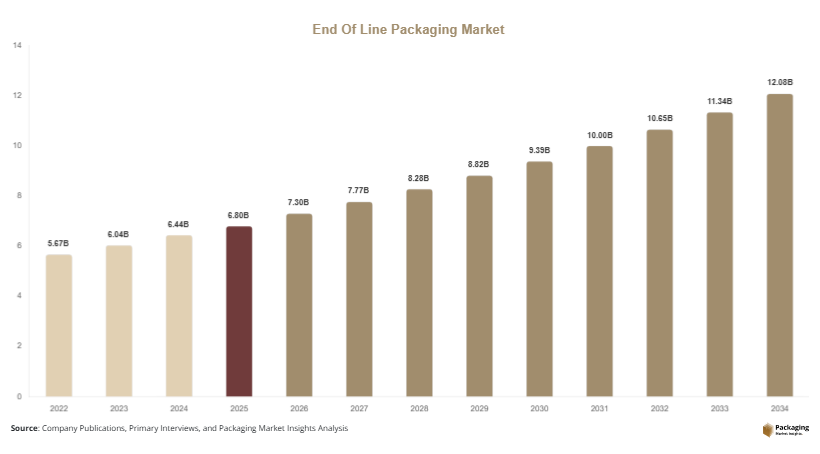
The global end of line packaging market size is estimated at USD 6.8 billion in 2025, while the market is projected to reach USD 7.3 billion in 2026. By 2034, the market is forecasted to attain USD 12.9 billion, registering a CAGR of 6.5% during 2025–2034. The global end of line packaging market is witnessing consistent expansion due to rising automation across manufacturing industries, increasing demand for efficient packaging operations, and rapid growth in e-commerce distribution networks. End of line packaging systems are used in the final stage of packaging operations and include palletizers, stretch wrappers, case packers, labeling systems, and robotic packaging equipment. These solutions help manufacturers improve operational efficiency, reduce labor costs, and enhance packaging consistency.
One of the major growth factors supporting the market is the increasing adoption of automation in packaging facilities. Manufacturers are integrating robotic systems and smart packaging technologies to improve productivity and reduce downtime. Another important factor is the rapid growth of the food and beverage industry, where high-speed packaging systems are essential for handling large production volumes. In addition, expanding e-commerce activities are increasing demand for efficient packaging, labeling, and palletizing solutions capable of supporting fast-moving logistics operations.
Key Highlights
- Asia Pacific dominated the market with a 39.7% share in 2025.
- Latin America is projected to grow at the fastest CAGR of 7.1%.
- Automatic systems led the type segment with a 61.4% share.
- Palletizing equipment dominated the equipment segment with a 28.9% share.
- Food & beverage applications led the end-use segment with 34.6% share.
- The US remained the dominant country with a market size of USD 1.6 billion in 2025 and USD 1.7 billion in 2026.
Explore more data points, trends and opportunities Download Free Sample Report
Market Trends
Growing Integration of Robotics and Smart Automation
The integration of robotics and smart automation technologies is becoming a significant trend in the end of line packaging market. Manufacturers are increasingly deploying robotic palletizers, automated case packers, and intelligent conveyor systems to improve production efficiency and reduce operational errors. These systems enhance speed, consistency, and flexibility while minimizing dependence on manual labor. The adoption of machine vision and sensor-based technologies is also improving packaging precision and quality inspection capabilities. Industries such as food processing, pharmaceuticals, and consumer goods are investing heavily in automated packaging systems to support high-volume production environments. As labor shortages continue to impact manufacturing sectors globally, demand for robotic packaging solutions is expected to rise steadily.
Rising Focus on Sustainable Packaging Operations
Sustainability is emerging as another important trend influencing the end of line packaging market. Companies are adopting packaging systems that reduce material usage, optimize energy consumption, and support recyclable packaging materials. Packaging equipment manufacturers are developing energy-efficient machines capable of minimizing operational waste while maintaining high productivity levels. In addition, businesses are redesigning packaging lines to support eco-friendly packaging formats and lightweight materials. The growing regulatory focus on reducing packaging waste is encouraging manufacturers to modernize existing systems. This trend is particularly strong in Europe and North America, where sustainability goals are influencing investment decisions across packaging and logistics operations.
Market Drivers
Expansion of E-commerce and Logistics Networks
The rapid growth of e-commerce and global logistics operations is a major driver for the end of line packaging market. Online retail companies require efficient packaging systems capable of handling high shipment volumes and varying product sizes. Automated labeling, palletizing, and wrapping systems help improve operational efficiency while reducing shipping errors. The rise of same-day and next-day delivery services has further increased demand for high-speed packaging solutions. Warehousing and fulfillment centers are increasingly investing in advanced packaging technologies to streamline operations and support growing consumer demand. This expansion of e-commerce infrastructure is expected to continue driving long-term market growth.
Increasing Adoption of Industrial Automation
Industrial automation is another key factor accelerating the growth of the end of line packaging market. Manufacturers across industries are focusing on improving productivity, reducing operational costs, and minimizing downtime. Automated packaging systems help companies achieve higher throughput while ensuring packaging consistency and quality. Industries such as pharmaceuticals, food processing, and consumer goods are adopting integrated packaging lines equipped with robotics and intelligent control systems. The growing availability of Industry 4.0 technologies is also enabling real-time monitoring and predictive maintenance, which further enhances packaging efficiency and operational reliability.
Market Restraint
High Initial Investment and Integration Costs
One of the major restraints affecting the end of line packaging market is the high initial investment associated with automated packaging systems. Advanced robotic packaging equipment, conveyor systems, and integrated software solutions require substantial capital expenditure, making adoption challenging for small and medium-sized enterprises. In addition, integrating new systems into existing production lines can involve operational disruptions and additional training costs. Companies with limited technical expertise may face difficulties in managing complex automation systems and maintaining equipment performance. For example, small-scale food manufacturers in developing regions often continue using semi-automatic systems because fully automated packaging lines require significant financial investment and infrastructure upgrades. These cost-related barriers may slow market adoption in price-sensitive industries.
Market Opportunities
Increasing Demand for Flexible Packaging Systems
The growing demand for flexible manufacturing operations is creating strong opportunities for the end of line packaging market. Companies are seeking packaging systems capable of handling multiple package formats, product sizes, and production volumes with minimal changeover time. Flexible packaging lines allow manufacturers to respond quickly to changing consumer preferences and seasonal demand fluctuations. Industries such as food, beverages, and personal care products are increasingly adopting modular packaging equipment that improves production adaptability. The rising demand for customized packaging solutions is expected to encourage further innovation in automated packaging technologies and create new opportunities for equipment manufacturers.
Growth in Emerging Manufacturing Economies
Emerging economies in Asia Pacific, Latin America, and the Middle East are creating significant opportunities for end of line packaging providers. Rapid industrialization, increasing foreign investments, and expanding manufacturing activities are supporting demand for advanced packaging systems. Governments in these regions are investing in industrial infrastructure and promoting domestic manufacturing capabilities, which is increasing adoption of automation technologies. The expansion of food processing, pharmaceutical manufacturing, and consumer goods production is further driving the need for efficient packaging operations. Companies entering these emerging markets are likely to benefit from growing industrial demand and long-term infrastructure development.
Report Scope
| Report Metric | Details |
|---|---|
| Market Size in 2025 | USD 6.8 Billion |
| Market Size in 2026 | USD 7.3 Billion |
| Market Size in 2034 | USD 12.9 Billion |
| CAGR | 6.5% (2026-2034) |
| Base Year for Estimation | 2025 |
| Historical Data | 2022-2024 |
| Forecast Period | 2026-2034 |
| Report Coverage | Revenue Forecast, Competitive Landscape, Supply Chain Disruption, Growth Factors, Environment & Regulatory Landscape and Trends |
| Geographies Covered | North America, Europe, APAC, Middle East and Africa, LATAM |
| Countries Covered | U.S., Canada, U.K., Germany, France, Spain, Italy, Russia, Nordic, Benelux, Rest of Europe, China, South Korea, Japan, India, Australia, Singapore, Taiwan, South East Asia, Rest of Asia-Pacific, UAE, Turky, Saudi Arabia, South Africa, Egypt, Nigeria, Rest of MEA, Brazil, Mexico, Argentina, Chile, Colombia, Rest of LATAM |
Explore more data points, trends and opportunities Download Free Sample Report
Segmental Analysis
By Type
Automatic systems dominated the end of line packaging market in 2024, accounting for approximately 61.4% of total market share. These systems are widely adopted because they improve packaging speed, operational consistency, and production efficiency across manufacturing facilities. Industries such as food processing, pharmaceuticals, and consumer goods rely heavily on automatic systems to reduce manual intervention and maintain packaging quality. Automated equipment also helps companies minimize labor costs and improve production throughput. The growing implementation of industrial automation and smart manufacturing technologies has further strengthened demand for automatic end of line packaging systems globally. Large manufacturing companies continue to prioritize investments in automated solutions to enhance supply chain efficiency and support high-volume production operations.
Robotic packaging systems are expected to be the fastest-growing subsegment, registering a CAGR of 7.3% during the forecast period. These systems offer enhanced flexibility, precision, and scalability for modern packaging operations. Robotic palletizers and case packers are increasingly used in industries that require handling of multiple product formats and rapid packaging changes. Growth in e-commerce fulfillment centers and logistics automation is also contributing to rising adoption of robotic packaging technologies. In addition, advancements in artificial intelligence and machine vision systems are improving robotic performance and enabling more efficient packaging operations. Manufacturers are increasingly deploying collaborative robots to improve workplace safety and optimize packaging productivity.
By Equipment
Palletizing equipment held the dominant position in the market in 2024 with a share of approximately 28.9%. Palletizers are widely used across industries to automate product stacking and improve warehouse efficiency. These systems reduce manual handling requirements while enhancing load stability during transportation and storage. Food and beverage manufacturers represent a major customer segment due to the need for handling large packaging volumes efficiently. The increasing adoption of robotic palletizers in distribution centers and manufacturing facilities is further supporting segment growth. In addition, expanding logistics and export activities are increasing demand for efficient palletizing systems capable of supporting high-speed production operations.
Stretch wrapping systems are projected to witness the fastest CAGR of 6.8% during the forecast period. The segment is growing due to rising demand for secure and stable packaging during transportation and storage. Stretch wrapping systems help reduce product damage and improve load containment efficiency, making them essential for logistics operations. E-commerce companies and warehouse operators are increasingly investing in automated wrapping solutions to improve packaging speed and reduce operational costs. Technological advancements such as automated film tension control and energy-efficient wrapping systems are also contributing to segment growth. The increasing need for protective packaging in global supply chains is expected to support long-term demand.
By End-Use Industry
The food & beverage segment dominated the market in 2024 and accounted for approximately 34.6% of total revenue share. The segment benefits from rising global demand for packaged foods, beverages, and convenience products. Food manufacturers require efficient packaging systems capable of maintaining product safety, hygiene, and high production speeds. Automated labeling, case packing, and palletizing systems are widely used to support large-scale food processing operations. Increasing consumer demand for packaged and ready-to-eat products is further driving investment in modern packaging facilities. Regulatory requirements related to food safety and traceability are also encouraging companies to upgrade end of line packaging technologies.
Pharmaceutical packaging is expected to record the fastest growth, with a projected CAGR of 7.0% during the forecast period. The pharmaceutical industry requires highly accurate and reliable packaging systems to ensure compliance with safety and labeling standards. Increasing production of medicines, vaccines, and healthcare products is driving demand for advanced packaging solutions. Automated systems help pharmaceutical manufacturers improve packaging precision, reduce contamination risks, and maintain product traceability. In addition, rising healthcare expenditure and expansion of pharmaceutical manufacturing facilities in emerging economies are supporting increased adoption of end of line packaging technologies across the healthcare sector.
End Of Line Packaging Market Segmentations
By Type
- Automatic Systems
- Semi-Automatic Systems
- Robotic Packaging Systems
By Equipment
- Palletizing Equipment
- Stretch Wrapping Systems
- Case Packers
- Labeling Systems
- Conveyor Systems
By End-Use Industry
- Food & Beverage
- Pharmaceuticals
- Consumer Goods
- Logistics & Warehousing
- Industrial Manufacturing
Regional Analysis
North America
North America accounted for approximately 27.1% of the global end of line packaging market share in 2025 and is projected to grow at a CAGR of 5.8% during the forecast period. The region benefits from advanced industrial automation infrastructure and high adoption of robotic packaging systems. Strong demand from food processing, pharmaceuticals, and e-commerce industries continues to support market growth. Companies are investing in intelligent packaging technologies that improve operational efficiency and reduce production downtime.
The United States dominates the North American market because of its extensive manufacturing and logistics sectors. A unique growth factor is the rapid expansion of automated fulfillment centers operated by major e-commerce companies. Increasing investment in warehouse automation and high-speed distribution systems is driving demand for advanced palletizing, labeling, and wrapping equipment across the country.
Europe
Europe held nearly 23.6% of the global market share in 2025 and is expected to register a CAGR of 5.6% through 2034. The region is characterized by strong adoption of sustainable packaging technologies and advanced industrial automation systems. Manufacturers are modernizing packaging facilities to improve efficiency and comply with environmental regulations. Demand from food processing and pharmaceutical industries is also contributing to steady market expansion across the region.
Germany remains the leading country in the European market due to its strong industrial manufacturing base and advanced engineering capabilities. A unique growth factor is the country’s emphasis on Industry 4.0 integration in packaging operations. German manufacturers are increasingly implementing smart packaging equipment equipped with predictive maintenance and real-time monitoring capabilities to improve production efficiency.
Asia Pacific
Asia Pacific dominated the end of line packaging market with a 39.7% share in 2025 and is projected to grow at a CAGR of 7.0% during the forecast period. Rapid industrialization, increasing manufacturing activities, and strong growth in e-commerce are major factors supporting regional demand. The region is witnessing increasing adoption of automated packaging systems in food processing, consumer goods, and pharmaceutical industries. Expanding industrial infrastructure is also creating favorable market conditions.
China remains the dominant country in Asia Pacific due to its large manufacturing sector and expanding logistics industry. One unique growth factor is the rapid growth of domestic e-commerce platforms and smart warehousing facilities. The increasing demand for high-speed packaging operations and efficient logistics systems is encouraging large-scale investment in automated packaging technologies throughout the country.
Middle East & Africa
The Middle East & Africa region accounted for approximately 4.9% of the global market share in 2025 and is forecast to grow at a CAGR of 6.1%. Rising investments in industrial diversification and manufacturing infrastructure are supporting demand for advanced packaging systems. Food processing and pharmaceutical manufacturing industries are increasingly adopting automated packaging solutions to improve operational efficiency and product safety.
Saudi Arabia dominates the regional market because of its ongoing industrial development initiatives and expanding logistics infrastructure. A unique growth factor is the government’s investment in domestic food manufacturing and packaging industries under industrial diversification programs. This is encouraging adoption of modern end of line packaging systems across manufacturing facilities.
Latin America
Latin America represented around 4.7% of the global market share in 2025 and is projected to grow at the fastest CAGR of 7.1% during the forecast period. Increasing industrialization, growth in consumer goods manufacturing, and rising demand for packaged food products are driving regional market expansion. Companies are modernizing production facilities to improve packaging efficiency and reduce labor dependence.
Brazil leads the Latin American market due to its large food processing and beverage manufacturing industries. A unique growth factor is the increasing investment in automated packaging systems for export-oriented food production facilities. Growing international trade and demand for packaged agricultural products are encouraging modernization of packaging operations throughout the country.
Competitive Landscape
The global end of line packaging market is moderately competitive, with major companies focusing on automation technologies, strategic partnerships, and product innovation to strengthen their market presence. Packaging equipment manufacturers are increasingly investing in robotic systems, intelligent monitoring technologies, and sustainable packaging solutions to meet evolving customer requirements. Market participants are also expanding their global distribution networks to support growing demand across emerging economies.
ABB Ltd. remains one of the leading companies in the market due to its strong expertise in industrial robotics and automation systems. In 2024, the company introduced an upgraded robotic palletizing solution designed to improve packaging efficiency and reduce energy consumption in manufacturing facilities. Other major companies operating in the market include Bosch Packaging Technology, Krones AG, Schneider Electric, and Mitsubishi Electric Corporation. These companies are emphasizing smart factory integration, modular equipment design, and digital packaging technologies to improve operational flexibility and enhance customer productivity.
Key Players List
- ABB Ltd.
- Krones AG
- Bosch Packaging Technology
- Schneider Electric
- Mitsubishi Electric Corporation
- Rockwell Automation Inc.
- FANUC Corporation
- Siemens AG
- Honeywell International Inc.
- Barry-Wehmiller Companies
- ProMach Inc.
- Tetra Pak International S.A.
- Duravant LLC
- Ishida Co., Ltd.
- Coesia S.p.A.
- BEUMER Group
- Omron Corporation