Stretch Films Market Size
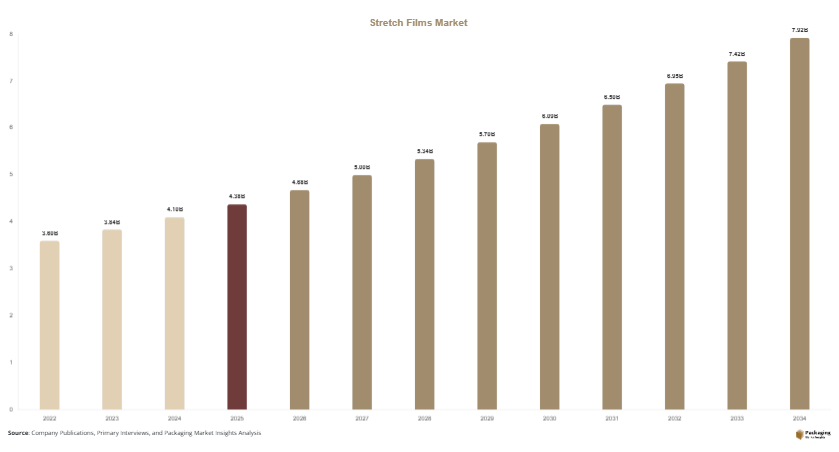
Stretch films market size is projected at USD 4.68 billion in 2026 and is expected to hit USD 7.94 billion by 2034 with a CAGR of 6.80%. Increasing logistics activities, palletized transportation, and warehouse automation continue to strengthen market expansion. Comprehensive market evaluation requires production analysis, segmentation assessment, competitive benchmarking, pricing trends, and supply chain intelligence across major manufacturing regions.
Stretch films are highly elastic plastic packaging materials primarily manufactured from linear low-density polyethylene (LLDPE) for securing palletized goods during storage and transportation. Global production exceeded 9.4 million metric tons in 2025, while consumption surpassed 9.1 million metric tons. Industrial packaging represented approximately 58% of total demand, food and beverage accounted for 24%, and automated stretch-wrapping penetration reached nearly 61%, reinforcing the stretch film market.
Explore more data points, trends and opportunities Download Free Sample Report
Stretch Films Market Trends
Increasing Adoption of High-Performance Multi-Layer Stretch Films
Manufacturers are investing in multi-layer co-extrusion technologies to improve load stability while reducing material consumption. More than 5.8 million metric tons of multi-layer stretch films were produced during 2025, representing nearly 62% of total production. Nano-layer technology adoption increased by 18%, while downgauging initiatives reduced film thickness by 12% without compromising performance, supporting the stretch films market.
Automation continues transforming packaging operations worldwide. Automatic pallet wrapping systems were installed across more than 68% of large distribution centers, while pre-stretched film utilization expanded by 16% year-over-year. Demand from e-commerce logistics, manufacturing, and warehouse operations continues to accelerate production volumes exceeding 780 million rolls annually, strengthening the stretch films market.
Stretch Films Market Drivers
Expansion of Logistics, Warehousing, and E-commerce
Rapid growth in global logistics networks and warehouse infrastructure continues driving product demand. More than 5.2 billion pallets were wrapped using stretch films during 2025, while warehouse automation investments increased by 14%. Industrial manufacturing contributed nearly 58% of overall consumption, and export packaging demand expanded by 9.4%, supporting stretch films' growth.
Stretch Films Market Restraints
Volatility in Polyethylene Resin Prices
Fluctuating crude oil prices continue affecting polyethylene resin costs, creating pricing uncertainty for manufacturers. Raw material expenses account for nearly 72% of total production costs, while resin prices experienced fluctuations exceeding 11% during 2025. Profit margins declined by approximately 4% for several regional manufacturers, limiting expansion across the stretch films market.
Stretch Films Market Opportunities
Growing Demand for Sustainable and Recyclable Packaging
Increasing environmental regulations are encouraging manufacturers to develop recyclable and downgauged stretch films. Recycled-content film production increased by 21%, while investment in sustainable packaging technologies exceeded USD 1.1 billion globally during 2025. More than 39% of large logistics operators adopted recyclable stretch films, creating long-term opportunities throughout the stretch films market.
Challenges in Stretch Films Market
Balancing Performance with Material Reduction
Manufacturers face continuous challenges in reducing film thickness while maintaining puncture resistance and load retention. Average film gauges declined from 23 microns to 17 microns, while maintaining stretchability above 250% requires advanced resin formulations. Production efficiency and quality consistency remain key operational challenges across the stretch films market.
Report Scope
| Report Metric | Details |
|---|---|
| Market Size in 2025 | USD 4.38 Billion |
| Market Size in 2026 | USD 4.68 Billion |
| Market Size in 2034 | USD 7.94 Billion |
| CAGR | 6.80% (2026-2034) |
| Base Year for Estimation | 2025 |
| Historical Data | 2022-2024 |
| Forecast Period | 2026-2034 |
| Report Coverage | Revenue Forecast, Competitive Landscape, Supply Chain Disruption, Growth Factors, Environment & Regulatory Landscape and Trends |
| Geographies Covered | North America, Europe, APAC, Middle East and Africa, LATAM |
| Countries Covered | U.S., Canada, U.K., Germany, France, Spain, Italy, Russia, Nordic, Benelux, Rest of Europe, China, South Korea, Japan, India, Australia, Singapore, Taiwan, South East Asia, Rest of Asia-Pacific, UAE, Turky, Saudi Arabia, South Africa, Egypt, Nigeria, Rest of MEA, Brazil, Mexico, Argentina, Chile, Colombia, Rest of LATAM |
Explore more data points, trends and opportunities Download Free Sample Report
Stretch Films Market Segmentation
The market is segmented by type and application, with machine stretch films accounting for nearly 52% of total revenue, followed by hand stretch films at 33% and specialty stretch films at 15%. Industrial packaging remained the leading application with approximately 58% market share, followed by food and beverage at 24%.
By Type
Hand stretch films accounted for approximately 33% of market demand, with annual production exceeding 3.1 million metric tons. These films are widely used in small warehouses and retail distribution centers due to their flexibility, ease of application, and thickness ranging from 12–23 microns.
Machine stretch films dominated the market with nearly 52% share. Production exceeded 4.9 million metric tons during 2025. High elongation exceeding 300%, superior puncture resistance, and compatibility with automated pallet wrappers make these films suitable for high-volume industrial operations.
Specialty stretch films represented nearly 15% of market revenue. UV-resistant, vented, colored, anti-static, and high-performance films are increasingly adopted across agriculture, pharmaceuticals, and chemical industries. Production exceeded 1.4 million metric tons, supported by specialized packaging requirements.
By Application
Industrial packaging remained the largest application, accounting for approximately 58% of global demand. More than 5.4 million metric tons of stretch films were consumed annually across manufacturing, warehousing, automotive, and logistics industries. High load stability and transportation safety continue driving utilization.
Food and beverage applications represented nearly 24% of market consumption with production utilization exceeding 2.2 million metric tons annually. Stretch films provide moisture protection, pallet stability, and hygienic secondary packaging throughout beverage and food distribution networks.
Consumer goods accounted for approximately 18% of total demand. Annual consumption exceeded 1.5 million metric tons, supported by electronics, household products, personal care, and retail packaging. High transparency, excellent cling properties, and efficient palletization remain critical technical advantages.
Stretch Films Market Segmentations
Type
- Hand Stretch Films
- Machine Stretch Films
- Specialty Stretch Films
- Pre-Stretched Films
Application
- Food & Beverage
- Industrial Packaging
- Consumer Goods
- Pharmaceutical Packaging
Distribution Channel
- Direct Sales
- Distributors & Wholesalers
- Online Sales
- Packaging Solution Providers
- Industrial Supply Stores
Stretch Films Market Regional Outlook
North America
North America accounted for approximately 27% of global revenue, producing over 2.3 million metric tons annually. The United States contributed nearly 81% of regional production, supported by strong logistics infrastructure and warehouse automation investments.
Europe
Europe represented approximately 26% of the global market, with annual production exceeding 2.1 million metric tons. Germany, Italy, France, and the United Kingdom collectively generated nearly 69% of regional output, supported by advanced manufacturing and sustainable packaging initiatives.
Asia-Pacific
Asia-Pacific dominated the market with approximately 38% share, producing over 3.6 million metric tons annually. China accounted for nearly 48% of regional production, followed by India, Japan, and South Korea. Manufacturing expansion and export-oriented industries continue supporting demand.
Latin America
Latin America contributed approximately 5% of global revenue with annual production exceeding 470 thousand metric tons. Brazil and Mexico represented nearly 72% of regional demand, supported by food processing and industrial manufacturing.
Middle East & Africa
The Middle East & Africa accounted for approximately 4% of market revenue, producing over 360 thousand metric tons annually. GCC countries and South Africa remain key contributors due to expanding logistics and industrial sectors.
Top Players in the Stretch Films Market
- Berry Global Inc.
- Amcor plc
- Sigma Stretch Film Corp.
- Manuli Stretch S.p.A.
- Inteplast Group
- Coveris Holdings S.A.
- Scientex Berhad
- POLIFILM GmbH
- Paragon Films Inc.
- ExxonMobil Corporation
- AEP Industries Inc.
- Bolloré Group
- RKW Group
- Duo Plast AG
- Trioworld Group
Berry Global Inc.
- Estimated market position of approximately 11–13% globally.
- Leading manufacturer with extensive production capacity and diversified packaging portfolio.
- The company operates multiple manufacturing facilities worldwide and supplies high-performance machine and hand stretch films for logistics, industrial, and food packaging applications. Continuous investments in downgauged films, recyclable materials, and advanced resin technologies strengthen operational efficiency. Strategic acquisitions, automation capabilities, and an extensive global distribution network support long-term market leadership while addressing sustainability objectives.
Amcor plc
- Estimated organized market share of approximately 8–10%.
- Strong presence across flexible packaging and sustainable material innovation.
- Amcor focuses on lightweight, recyclable, and high-performance stretch film solutions for industrial and consumer packaging. The company continues expanding research into circular packaging technologies, improving resin efficiency, and enhancing barrier performance. Its global manufacturing footprint, customer partnerships, and investments in environmentally responsible packaging solutions strengthen its competitive position across developed and emerging markets.