Transparent Barrier Packaging Film Market Size and Growth
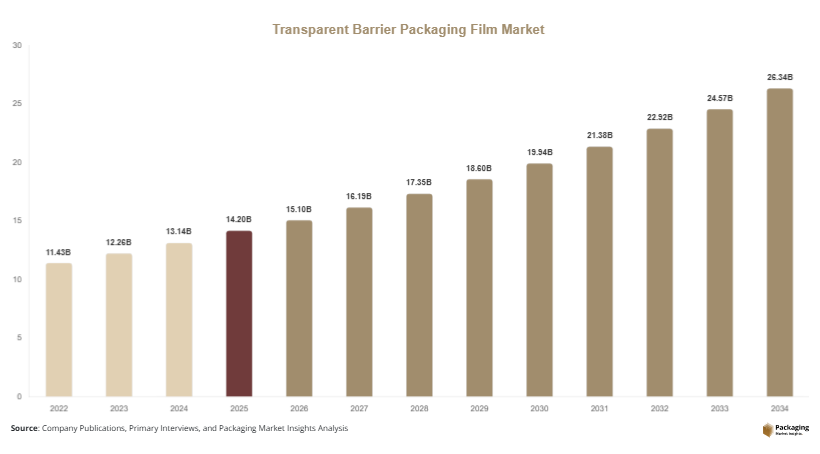
The global transparent barrier packaging film market size is estimated at USD 14.2 billion in 2025, and it is projected to reach USD 15.1 billion in 2026. By 2034, the market is forecasted to reach approximately USD 26.8 billion, expanding at a CAGR of 7.2% during 2025–2034. The transparent barrier packaging film market is witnessing strong expansion as industries increasingly demand high-performance packaging materials that combine visibility, product protection, and extended shelf life. Transparent barrier films are widely used in food packaging, pharmaceuticals, personal care, and industrial goods due to their ability to prevent oxygen, moisture, and aroma transfer while maintaining product visibility.
One of the primary growth factors driving the market is the rising demand for packaged and processed food products. Consumers are increasingly shifting toward convenience foods, which require advanced packaging solutions that maintain freshness and visual appeal. Transparent barrier films allow manufacturers to display product quality while ensuring protection against environmental contamination. Another major factor is the rapid expansion of pharmaceutical packaging requirements, where transparency is essential for product identification and compliance labeling while maintaining sterility and barrier protection. Additionally, increasing global e-commerce activities are boosting demand for durable, lightweight packaging films that reduce transportation costs and enhance product safety.
Key Highlights
- Asia Pacific dominated the market with a 38.9% share in 2025.
- Latin America is projected to grow at the fastest CAGR of 7.9%.
- Polyethylene-based barrier films led the material segment with a 34.5% share.
- Food packaging dominated with a 52.1% share.
- Flexible packaging applications led with a 61.3% share.
- The US remained the dominant country with a market size of USD 3.6 billion in 2025 and USD 3.8 billion in 2026.
Explore more data points, trends and opportunities Download Free Sample Report
Market Trends
Shift Toward Recyclable and Mono-Material Barrier Films
The transparent barrier packaging film market is experiencing a significant shift toward recyclable and mono-material structures as sustainability becomes a key priority for packaging manufacturers and brand owners. Traditional multilayer films, which combine different polymers for barrier performance, are being redesigned into mono-material polyethylene and polypropylene-based structures to improve recyclability. Companies are investing in advanced coating technologies such as water-based barrier coatings and plasma-enhanced surface treatments to achieve high oxygen and moisture resistance without compromising recyclability. This trend is especially prominent in Europe, where regulatory frameworks are pushing for circular packaging systems. Food and beverage companies are adopting recyclable transparent films to reduce environmental impact while maintaining product visibility and shelf appeal.
Adoption of High-Performance Nanocoating Technologies
Nanotechnology is increasingly influencing the development of transparent barrier films, enabling manufacturers to achieve superior barrier properties at reduced material thickness. Nanocoatings based on silicon oxide, aluminum oxide, and organic-inorganic hybrid structures are being applied to flexible films to enhance resistance against oxygen, moisture, and UV radiation. These coatings maintain high transparency, making them ideal for premium food packaging and pharmaceutical applications. Additionally, nanocoated films reduce material usage, contributing to lightweight packaging and lower transportation costs. The trend is gaining momentum in high-value applications such as medical devices, specialty foods, and cosmetics packaging, where product protection and visual appeal are equally important.
Market Drivers
Rising Demand for Packaged and Processed Food
The increasing global consumption of packaged and processed food is a major driver of the transparent barrier packaging film market. Urbanization, busy lifestyles, and changing dietary habits are encouraging consumers to prefer ready-to-eat and convenience food products. Transparent barrier films play a critical role in maintaining product freshness while allowing consumers to visually inspect food quality before purchase. Food manufacturers rely on these films to extend shelf life by preventing oxygen and moisture ingress, which reduces spoilage and food waste. The expansion of supermarkets, hypermarkets, and online grocery platforms is further accelerating demand for high-clarity protective packaging solutions.
Expansion of Pharmaceutical and Healthcare Packaging
The pharmaceutical industry is increasingly adopting transparent barrier films for packaging tablets, capsules, medical devices, and diagnostic kits. These films provide essential protection against environmental factors such as humidity, oxygen, and contamination while maintaining product visibility for labeling and verification. The rise in global healthcare spending, aging populations, and increased production of biologics and specialty drugs are contributing to higher demand for advanced packaging materials. Regulatory requirements for tamper-evident and traceable packaging are also encouraging pharmaceutical companies to invest in high-performance transparent barrier films that ensure compliance and patient safety.
Market Restraint
High Cost of Advanced Barrier Film Technologies
One of the major restraints in the transparent barrier packaging film market is the high production cost associated with advanced multilayer and nanocoated films. The incorporation of high-performance polymers such as EVOH, PVDC, and specialty coatings increases manufacturing complexity and raw material costs. Additionally, advanced production processes such as vacuum deposition and plasma coating require significant capital investment in equipment and technology. These factors result in higher product pricing compared to conventional plastic films, which can limit adoption in price-sensitive markets.
Small and medium-sized packaging converters often face challenges in adopting advanced barrier technologies due to limited capital resources. For example, regional food packaging companies in developing economies may continue using basic polyethylene films instead of high-barrier transparent alternatives due to cost constraints. This price sensitivity can slow market penetration, particularly in low-income regions where cost remains a primary purchasing factor over performance or sustainability benefits.
Market Opportunities
Growth in Sustainable Packaging Solutions
The increasing shift toward sustainable packaging presents a significant opportunity for the transparent barrier packaging film market. Manufacturers are developing bio-based and recyclable barrier films that reduce dependency on fossil fuel-based plastics. These materials include polylactic acid (PLA), bio-polyethylene, and cellulose-based films that offer comparable barrier performance while being environmentally friendly. Food and beverage brands are actively adopting sustainable transparent films to meet consumer expectations and regulatory requirements. This transition is creating opportunities for innovation in coating technologies and biodegradable barrier solutions.
Expansion in Emerging Economies
Emerging economies across Asia Pacific, Latin America, and Africa are experiencing rapid growth in food processing, retail, and pharmaceutical industries, creating strong demand for transparent barrier packaging films. Increasing urban populations, rising disposable incomes, and expanding cold chain infrastructure are driving the consumption of packaged goods. Local manufacturers are investing in flexible packaging production facilities to meet domestic and export demand. Transparent barrier films are gaining traction due to their ability to extend shelf life and enhance product presentation, making them highly suitable for fast-growing consumer markets.
Report Scope
| Report Metric | Details |
|---|---|
| Market Size in 2025 | USD 14.2 Billion |
| Market Size in 2026 | USD 15.1 Billion |
| Market Size in 2034 | USD 26.8 Billion |
| CAGR | 7.2% (2026-2034) |
| Base Year for Estimation | 2025 |
| Historical Data | 2022-2024 |
| Forecast Period | 2026-2034 |
| Report Coverage | Revenue Forecast, Competitive Landscape, Supply Chain Disruption, Growth Factors, Environment & Regulatory Landscape and Trends |
| Geographies Covered | North America, Europe, APAC, Middle East and Africa, LATAM |
| Countries Covered | U.S., Canada, U.K., Germany, France, Spain, Italy, Russia, Nordic, Benelux, Rest of Europe, China, South Korea, Japan, India, Australia, Singapore, Taiwan, South East Asia, Rest of Asia-Pacific, UAE, Turky, Saudi Arabia, South Africa, Egypt, Nigeria, Rest of MEA, Brazil, Mexico, Argentina, Chile, Colombia, Rest of LATAM |
Explore more data points, trends and opportunities Download Free Sample Report
Segmental Analysis
By Material Type
Polyethylene-based transparent barrier films dominated the market in 2024, accounting for approximately 34.5% share. These films are widely used due to their cost efficiency, flexibility, and compatibility with multiple barrier coating technologies. They are commonly used in food packaging applications where clarity and moisture resistance are essential. Manufacturers prefer polyethylene-based films because they can be easily modified with EVOH or coating layers to enhance barrier performance while maintaining transparency. Their widespread use in snack packaging, frozen foods, and fresh produce packaging continues to support segment dominance.
Bio-based barrier films are expected to be the fastest-growing subsegment, registering a CAGR of 8.2%. Increasing environmental concerns and regulatory pressure are driving adoption of sustainable materials such as PLA and bio-polyethylene. These films offer comparable barrier performance while reducing carbon footprint. Growth is particularly strong in Europe and North America, where sustainability regulations are strict. Food and beverage companies are adopting bio-based transparent films to meet brand sustainability commitments and consumer demand for eco-friendly packaging solutions.
By Application
Flexible packaging dominated the market in 2024 with a share of 61.3%. Flexible films are widely used in pouches, wraps, sachets, and lidding applications due to their lightweight structure and cost efficiency. Transparent barrier films enhance product visibility while providing protection against oxygen and moisture. The growing demand for convenience foods and ready-to-eat meals is significantly contributing to segment growth. Flexible packaging is also preferred in e-commerce due to reduced shipping costs and improved logistics efficiency.
Industrial packaging is expected to be the fastest-growing application segment, registering a CAGR of 7.4%. Increasing demand for protective packaging of sensitive components, chemicals, and precision equipment is driving growth. Transparent barrier films are used to ensure product visibility while maintaining environmental protection during storage and transportation. Growth in manufacturing and export-oriented industries is further accelerating adoption of industrial-grade barrier films.
By End-Use Industry
Food & beverage dominated the market in 2024 with a share of 52.1%. Transparent barrier films are extensively used in packaging fresh produce, snacks, dairy products, and frozen foods. They help extend shelf life while maintaining product visibility and appeal. Increasing global demand for packaged food and expansion of retail distribution networks are key growth drivers in this segment.
Pharmaceutical applications are expected to be the fastest-growing segment with a CAGR of 7.8%. Transparent barrier films are widely used in blister packaging, medical kits, and diagnostic packaging. Rising healthcare demand, increasing drug production, and strict regulatory requirements are driving adoption. The need for tamper-evident, sterile, and traceable packaging is further supporting growth in this segment.
Transparent Barrier Packaging Film Market Segmentations
By Material Type
- Polyethylene-Based Barrier Films
- Polypropylene-Based Barrier Films
- PET-Based Barrier Films
- Bio-Based Barrier Films
By Application
- Flexible Packaging
- Industrial Packaging
- Pharmaceutical Packaging
- E-commerce Packaging
By End-Use Industry
- Food & Beverage
- Pharmaceuticals
- Personal Care & Cosmetics
- Industrial Manufacturing
- Consumer Goods
Regional Analysis
North America
North America accounted for approximately 29.6% of the transparent barrier packaging film market share in 2025 and is projected to grow at a CAGR of 6.5% during the forecast period. The region benefits from strong demand in food packaging, pharmaceuticals, and personal care industries. High consumer preference for packaged and convenience foods, combined with advanced packaging technologies, supports market expansion. Additionally, sustainability initiatives are driving adoption of recyclable transparent barrier films across major packaging manufacturers.
The United States dominates the regional market due to its large food processing industry and advanced flexible packaging infrastructure. A unique growth factor is the increasing adoption of high-barrier recyclable films in ready-to-eat food packaging. Major retail chains are actively promoting sustainable packaging formats, accelerating demand for transparent barrier solutions.
Europe
Europe held a 27.8% market share in 2025 and is expected to grow at a CAGR of 6.8%. Strict environmental regulations and strong emphasis on circular economy practices are driving the adoption of recyclable barrier films. Packaging manufacturers are focusing on reducing multilayer structures and increasing mono-material film usage. The region also has a strong pharmaceutical packaging industry contributing to stable demand.
Germany leads the European market due to its strong industrial base and packaging innovation capabilities. A key growth factor is the widespread adoption of bio-based and recyclable barrier coatings in food packaging applications, driven by strict sustainability regulations.
Asia Pacific
Asia Pacific dominated the market with a 38.9% share in 2025 and is projected to grow at the fastest CAGR of 8.0%. Rapid industrialization, population growth, and increasing consumption of packaged food are driving market demand. Expanding pharmaceutical production and export-oriented food industries are further supporting growth in the region.
China is the leading country due to its large-scale manufacturing and packaging production capacity. A unique growth factor is the expansion of online grocery and food delivery services, which significantly increases demand for transparent barrier packaging films in retail logistics.
Middle East & Africa
The Middle East & Africa region accounted for 3.9% of the market share in 2025 and is projected to grow at a CAGR of 6.7%. Growth is supported by increasing food imports, expanding retail infrastructure, and rising demand for packaged consumer goods. Governments are also investing in food security initiatives that increase reliance on advanced packaging solutions.
The United Arab Emirates leads the regional market due to its strong logistics and re-export industries. A key growth factor is the rising demand for premium packaged food products in retail and hospitality sectors.
Latin America
Latin America held 5.8% of the market share in 2025 and is expected to grow at a CAGR of 7.9%. Growth is driven by increasing packaged food consumption, expanding retail networks, and rising pharmaceutical imports. The region is also witnessing investments in flexible packaging manufacturing facilities.
Brazil dominates the market due to its large food processing industry. A unique growth factor is the expansion of agricultural exports requiring high-quality transparent barrier packaging for international trade compliance.
Competitive Landscape
The transparent barrier packaging film market is moderately consolidated, with leading companies focusing on innovation, sustainability, and multilayer film technology development. Key players are investing in recyclable barrier solutions and advanced coating technologies to improve performance and environmental compliance. Strategic collaborations with food and pharmaceutical companies are also increasing.
Amcor Plc is one of the leading companies in the market due to its strong global presence and advanced flexible packaging portfolio. In 2024, Amcor launched a recyclable high-barrier transparent film designed for food packaging applications, enhancing sustainability and performance efficiency.
Other major players include Sealed Air Corporation, Berry Global Inc., Toray Industries Inc., and Uflex Ltd. These companies are focusing on expanding production capacities, developing bio-based films, and improving barrier technologies to strengthen their competitive positions globally.
Key Players List
- Amcor Plc
- Sealed Air Corporation
- Berry Global Inc.
- Toray Industries Inc.
- Uflex Ltd.
- Mitsubishi Chemical Group
- Mondi Group
- Huhtamaki Oyj
- Jindal Poly Films Ltd.
- Taghleef Industries
- Cosmo Films Ltd.
- Dupont Teijin Films
- SKC Co. Ltd.
- Innovia Films
- Winpak Ltd.