Micro Perforated Films Packaging Market Size and Growth
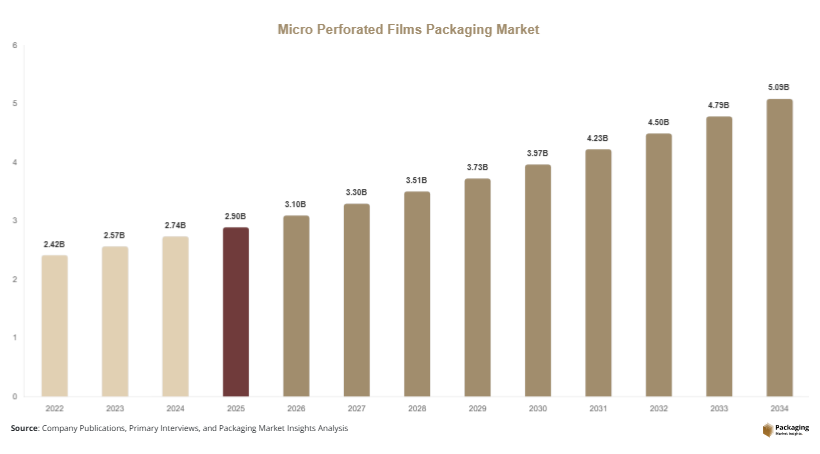
The global micro perforated films packaging market size is estimated at USD 2.9 billion in 2025 and is expected to reach USD 3.1 billion in 2026. Over the forecast period from 2025 to 2034, the market is projected to grow to USD 5.4 billion in 2034, registering a CAGR of 6.4%. The micro perforated films packaging market is witnessing steady growth as demand increases for advanced packaging solutions that enhance product shelf life while maintaining freshness. Micro perforated films are widely used in food packaging, particularly for fresh produce, bakery products, and ready-to-eat meals, as they allow controlled gas exchange.
The rising demand for fresh and minimally processed food products is a key factor driving the micro perforated films packaging market. Consumers are increasingly prioritizing food quality, safety, and extended shelf life, which has led to greater adoption of modified atmosphere packaging solutions. Micro perforated films help maintain optimal oxygen and carbon dioxide levels, thereby preserving freshness and reducing spoilage. This makes them essential for retailers and food manufacturers seeking to minimize food waste.
Key Market Insights:
- Asia Pacific dominated the market with a 37.8% share in 2025.
- Latin America is projected to grow at the fastest CAGR of 6.9%.
- Laser perforated films led the type segment with a 33.2% share.
- Plastic-based films dominated with a 64.5% share.
- Food & beverage applications led the segment with 48.6% share.
- US remained the dominant country with a market size of USD 0.8 billion in 2025 and USD 0.9 billion in 2026.
Explore more data points, trends and opportunities Download Free Sample Report
Market Trends
Rising adoption of breathable packaging for fresh food preservation
The increasing demand for fresh and minimally processed food is driving the adoption of breathable packaging solutions such as micro perforated films. These films allow controlled gas exchange, which helps maintain the freshness and quality of perishable products. Retailers and food manufacturers are using these films to reduce spoilage and extend shelf life, particularly for fruits, vegetables, and bakery items. For example, supermarkets are adopting micro perforated packaging for salad mixes to maintain optimal moisture levels. In the future, this trend is expected to expand with the integration of smart packaging technologies that monitor freshness in real time.
Growing focus on sustainable and biodegradable film materials
Sustainability is becoming a central trend in the micro perforated films packaging market. Manufacturers are increasingly developing films made from biodegradable and recyclable materials to reduce environmental impact. This shift is driven by regulatory requirements and consumer awareness regarding plastic waste. For instance, companies are introducing compostable micro perforated films for fresh produce packaging. In the coming years, advancements in material science are expected to improve the performance of sustainable films, making them a viable alternative to conventional plastic-based solutions.
Market Drivers
Expansion of fresh food retail and consumption
The expansion of fresh food retail is a major driver of the micro perforated films packaging market. Consumers are increasingly purchasing fresh produce, which requires packaging solutions that maintain quality and extend shelf life. Micro perforated films provide an effective solution by enabling controlled gas exchange. For example, grocery chains are using these films for packaging fresh vegetables and fruits to reduce spoilage. As demand for fresh food continues to rise, the adoption of micro perforated films is expected to increase significantly.
Growth of global supply chains and cold chain logistics
The growth of global supply chains and cold chain logistics is another key driver. Food products are being transported across long distances, requiring packaging that ensures product integrity. Micro perforated films help maintain freshness during transit by regulating gas exchange. For instance, exporters of fresh produce use these films to preserve quality during shipping. As international trade expands, the demand for advanced packaging solutions such as micro perforated films will continue to grow.
Market Restraints
Limited recyclability of certain plastic-based films
One of the key restraints in the micro perforated films packaging market is the limited recyclability of conventional plastic-based films. While these films offer excellent performance, their environmental impact poses a challenge. Regulatory pressures and consumer concerns regarding plastic waste are increasing, which may limit market growth. For example, some regions have implemented strict regulations on single-use plastics, affecting the adoption of certain film materials. Manufacturers need to invest in sustainable alternatives to address this challenge and ensure long-term growth.
Market Opportunities
Development of advanced biodegradable film solutions
The development of biodegradable micro perforated films presents a significant opportunity for market growth. These films offer similar performance to conventional plastics while reducing environmental impact. Companies are investing in research and development to create innovative materials that meet sustainability standards. For example, compostable films are being introduced for packaging fresh produce. In the future, advancements in biodegradable materials are expected to drive adoption and create new market opportunities.
Increasing demand from emerging economies
Emerging economies offer substantial growth opportunities for the micro perforated films packaging market. Rapid urbanization, rising disposable income, and changing consumption patterns are driving demand for packaged food products. For instance, countries in Asia Pacific and Latin America are experiencing growth in retail and e-commerce sectors, which increases the need for effective packaging solutions. As infrastructure and supply chains improve, the adoption of micro perforated films is expected to expand significantly.
Report Scope
| Report Metric | Details |
|---|---|
| Market Size in 2025 | USD 2.9 Billion |
| Market Size in 2026 | USD 3.1 Billion |
| Market Size in 2034 | USD 5.4 Billion |
| CAGR | 6.4% (2026-2034) |
| Base Year for Estimation | 2025 |
| Historical Data | 2022-2024 |
| Forecast Period | 2026-2034 |
| Report Coverage | Revenue Forecast, Competitive Landscape, Supply Chain Disruption, Growth Factors, Environment & Regulatory Landscape and Trends |
| Geographies Covered | North America, Europe, APAC, Middle East and Africa, LATAM |
| Countries Covered | U.S., Canada, U.K., Germany, France, Spain, Italy, Russia, Nordic, Benelux, Rest of Europe, China, South Korea, Japan, India, Australia, Singapore, Taiwan, South East Asia, Rest of Asia-Pacific, UAE, Turky, Saudi Arabia, South Africa, Egypt, Nigeria, Rest of MEA, Brazil, Mexico, Argentina, Chile, Colombia, Rest of LATAM |
Explore more data points, trends and opportunities Download Free Sample Report
Segmental Analysis
By Type
Laser perforated films dominated the market in 2024 with a 33.2% share, driven by their precision and consistency. These films are widely used in food packaging due to their ability to provide controlled gas exchange. For example, salad packaging often uses laser perforated films to maintain freshness. Their high accuracy and customization capabilities make them suitable for various applications.
Mechanical perforated films are the fastest-growing segment, with a CAGR of 6.7%. These films offer cost advantages and are suitable for large-scale applications. The growth is driven by increasing demand for affordable packaging solutions. Future advancements in manufacturing technologies are expected to improve performance and expand applications.
By Material
Plastic-based films dominated the market with a 64.5% share in 2024, driven by their durability and flexibility. These materials are widely used due to their cost efficiency and performance. For instance, polyethylene films are commonly used in food packaging.
Biodegradable materials are the fastest-growing segment, with a CAGR of 6.8%. The growth is driven by increasing demand for sustainable packaging solutions. Innovations in material science are improving the performance of biodegradable films. In the future, these materials are expected to gain significant market share.
By End-Use
Food & beverage applications accounted for the largest share of 48.6% in 2024, driven by the need for effective packaging solutions. Micro perforated films are widely used in this industry to maintain freshness and extend shelf life. For example, fresh produce packaging relies heavily on these films.
Healthcare is the fastest-growing segment, with a CAGR of 6.5%. The demand for sterile and breathable packaging solutions is driving growth. Micro perforated films are used in medical packaging to maintain product integrity. As healthcare demand increases, this segment is expected to grow.
Micro Perforated Films Packaging Market Segmentations
By Type
- Laser Perforated Films
- Mechanical Perforated Films
- Needle Perforated Films
By Material
- Plastic Films
- Biodegradable Films
- Paper-Based Films
By End-Use
- Food & Beverage
- Healthcare
- Personal Care
- Industrial Packaging
Regional Analysis
North America
North America accounted for approximately 22.6% of the global market share in 2025 and is projected to grow at a CAGR of 5.9% through 2034. The region benefits from a well-established food retail sector and advanced packaging technologies. The demand for fresh and packaged food products is driving the adoption of micro perforated films. Additionally, the presence of major packaging manufacturers supports innovation and market growth. Sustainability initiatives and regulatory frameworks are also encouraging the development of eco-friendly packaging solutions.
The United States dominates the regional market due to its large consumer base and advanced retail infrastructure. A unique growth driver is the increasing adoption of ready-to-eat and convenience foods, which require effective packaging solutions. For example, meal kit delivery services are using micro perforated films to maintain freshness. This trend is expected to support market growth in the region.
Europe
Europe held a 20.9% market share in 2025 and is expected to grow at a CAGR of 5.7% during the forecast period. The region’s strong focus on sustainability and food safety standards is shaping the market. Countries such as Germany, France, and the UK are leading the adoption of eco-friendly packaging solutions. The demand for recyclable and biodegradable materials is increasing, driven by regulatory requirements and consumer awareness.
Germany is the dominant country in the region, supported by its strong manufacturing sector. A unique growth driver is the emphasis on reducing food waste, which has led to increased adoption of advanced packaging solutions. For instance, retailers are using micro perforated films to extend the shelf life of fresh produce. This trend is expected to drive market growth.
Asia Pacific
Asia Pacific emerged as the largest regional market with a 37.8% share in 2025 and is projected to grow at a CAGR of 6.6%. Rapid urbanization, population growth, and expanding retail sectors are driving market growth. Countries such as China, India, and Japan are major contributors. The increasing demand for fresh and packaged food products is boosting the adoption of micro perforated films.
China dominates the region due to its large manufacturing base and growing consumer market. A key growth driver is the expansion of the food processing industry. For example, food manufacturers are using micro perforated films to improve product shelf life. Government support for industrial growth is also contributing to market expansion.
Middle East & Africa
The Middle East & Africa region accounted for 7.4% of the market share in 2025 and is expected to grow at a CAGR of 6.1%. The region is experiencing growth due to increasing investments in retail and food industries. Countries such as the UAE and South Africa are expanding their retail infrastructure, which drives demand for packaging solutions.
The UAE is a key market, supported by its growing food retail sector. A unique growth driver is the increasing demand for imported fresh food products, which require effective packaging. For example, supermarkets are using micro perforated films for fresh produce. This trend is expected to support market growth.
Latin America
Latin America held a 11.3% market share in 2025 and is projected to grow at the fastest CAGR of 6.9%. The region is experiencing growth due to expanding retail and e-commerce sectors. Countries such as Brazil and Mexico are key contributors. The rising demand for packaged food products is driving the market.
Brazil dominates the regional market due to its large consumer base. A unique growth driver is the growth of agricultural exports, which require effective packaging solutions. For instance, exporters are using micro perforated films to maintain product quality during transportation. This trend is expected to support market growth.
Competitive Landscape
The micro perforated films packaging market is moderately fragmented, with several global and regional players competing on innovation, material quality, and sustainability. Companies are focusing on developing advanced products that meet evolving consumer and regulatory requirements.
Amcor Plc is identified as a market leader due to its strong product portfolio and focus on sustainable packaging solutions. The company invests heavily in research and development to improve material performance and reduce environmental impact. Other key players are adopting strategies such as mergers, acquisitions, and partnerships to strengthen their market position.
Recent developments include advancements in biodegradable materials, adoption of digital manufacturing technologies, and expansion into emerging markets. Companies are also focusing on automation to improve efficiency and reduce costs.
Key Players
- Amcor Plc
- Sealed Air Corporation
- Berry Global Inc.
- Mondi Group
- Sonoco Products Company
- Coveris Holdings S.A.
- Clondalkin Group
- Uflex Ltd.
- Winpak Ltd.
- Constantia Flexibles
- Transcontinental Inc.
- Cosmo Films Ltd.
- Jindal Poly Films Ltd.
- Polyplex Corporation Ltd.
- Innovia Films