Stretch Hooder Packaging Film Market Size and Growth
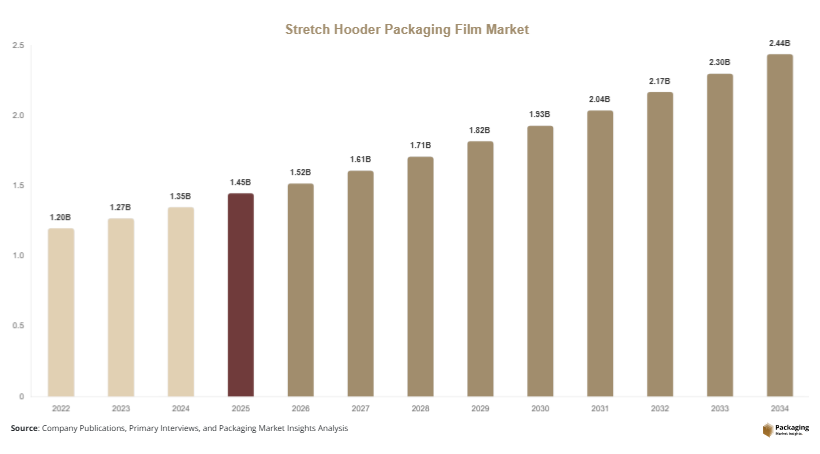
The global stretch hooder packaging film market size was valued at approximately USD 1.45 billion in 2025 and is projected to reach USD 1.52 billion in 2026. Over the forecast period from 2025 to 2034, the market is expected to grow at a CAGR of 6.1%, reaching nearly USD 2.63 billion by 2034. Stretch hooder films are widely used in automated packaging systems, offering enhanced load stability, dust protection, and weather resistance. The stretch hooder packaging film market is experiencing steady expansion due to increasing demand for efficient pallet stabilization and load protection solutions across industries such as food & beverage, construction materials, chemicals, and consumer goods.
One of the key growth factors driving the stretch hooder packaging film market is the rising adoption of automated pallet packaging systems. Industries are increasingly investing in automation to improve operational efficiency, reduce labor costs, and enhance packaging consistency. Stretch hooder systems provide faster packaging speeds and improved load containment, making them suitable for high-volume operations. This is driving demand across logistics and manufacturing sectors.
Key Highlights:
- Asia Pacific dominated the market with a 38.6% share in 2025, while Latin America is projected to grow at the fastest CAGR of 6.6%.
- Polyethylene-based films led the type segment with a 61.2% share, while multi-layer films are expected to grow at a CAGR of 6.4%.
- Industrial packaging dominated with a 54.8% share, while food & beverage applications are forecasted to grow at a CAGR of 6.5%.
- Construction materials applications led the segment with 34.2% share, while consumer goods packaging is expected to grow at a CAGR of 6.7%.
- China remained the dominant country with a market size of USD 0.42 billion in 2025 and USD 0.45 billion in 2026.
Explore more data points, trends and opportunities Download Free Sample Report
Market Trends
Increasing Adoption of Multi-Layer and High-Performance Films
The stretch hooder packaging film market is witnessing a growing shift toward multi-layer and high-performance films. These films are designed to provide enhanced strength, elasticity, and puncture resistance, which are essential for securing heavy and irregular loads. Multi-layer films also offer improved barrier properties against moisture and dust, making them suitable for outdoor storage and transportation. Manufacturers are investing in advanced extrusion technologies to produce films with uniform thickness and superior performance. This trend is particularly evident in industries such as construction and chemicals, where packaging durability is critical.
Rising Focus on Sustainable and Recyclable Packaging Solutions
Sustainability is becoming a key focus area in the stretch hooder packaging film market. Companies are increasingly developing recyclable films and reducing material thickness to minimize environmental impact. The use of bio-based polymers and recycled content is gaining traction, as organizations aim to meet regulatory requirements and corporate sustainability goals. In addition, innovations in film design are enabling the production of thinner films without compromising strength and performance. This trend is expected to drive the adoption of eco-friendly packaging solutions and influence purchasing decisions across industries.
Market Drivers
Growth in Automated Packaging Systems Across Industries
The increasing adoption of automated packaging systems is a major driver of the stretch hooder packaging film market. Industries are focusing on improving efficiency and reducing operational costs, leading to higher demand for automated solutions. Stretch hooder systems offer advantages such as faster packaging speeds, reduced labor requirements, and consistent wrapping quality. These systems are widely used in high-volume production environments, including food processing and construction materials manufacturing. The integration of automation in packaging operations is expected to continue driving market growth.
Expansion of Logistics and Global Trade Activities
The expansion of logistics and global trade is another key driver of the market. The need for reliable packaging solutions that can withstand long-distance transportation is increasing. Stretch hooder films provide excellent load stability and protection against environmental factors such as moisture and dust. As global trade volumes increase, the demand for efficient pallet packaging solutions is expected to grow. The rise of e-commerce is also contributing to the demand for secure packaging solutions.
Market Restraint
Fluctuations in Raw Material Prices and Environmental Concerns
The stretch hooder packaging film market faces challenges related to fluctuations in raw material prices, particularly polyethylene. Price volatility can impact production costs and profit margins for manufacturers. Additionally, environmental concerns regarding plastic waste are influencing market dynamics. Regulatory pressures are increasing, requiring companies to adopt sustainable practices and reduce plastic usage. For example, restrictions on single-use plastics in certain regions may affect demand for conventional stretch hooder films. These factors can create challenges for market participants and influence growth trajectories.
Market Opportunities
Increasing Demand in Emerging Economies
Emerging economies present significant opportunities for the stretch hooder packaging film market. Rapid industrialization, urbanization, and infrastructure development are driving demand for packaging solutions. Industries such as construction, agriculture, and manufacturing are expanding, creating a need for efficient pallet packaging. Companies are investing in these regions to capitalize on growth opportunities and expand their market presence.
Technological Advancements in Film Manufacturing
Technological advancements in film manufacturing are creating new opportunities in the market. Innovations such as advanced extrusion processes and material engineering are enabling the production of high-performance films with improved strength and durability. These advancements are helping manufacturers meet the evolving needs of end-users. The development of smart films with enhanced properties is also expected to drive market growth.
Report Scope
| Report Metric | Details |
|---|---|
| Market Size in 2025 | USD 1.45 Billion |
| Market Size in 2026 | USD 1.52 Billion |
| Market Size in 2034 | USD 2.63 Billion |
| CAGR | 6.1% (2026-2034) |
| Base Year for Estimation | 2025 |
| Historical Data | 2022-2024 |
| Forecast Period | 2026-2034 |
| Report Coverage | Revenue Forecast, Competitive Landscape, Supply Chain Disruption, Growth Factors, Environment & Regulatory Landscape and Trends |
| Geographies Covered | North America, Europe, APAC, Middle East and Africa, LATAM |
| Countries Covered | U.S., Canada, U.K., Germany, France, Spain, Italy, Russia, Nordic, Benelux, Rest of Europe, China, South Korea, Japan, India, Australia, Singapore, Taiwan, South East Asia, Rest of Asia-Pacific, UAE, Turky, Saudi Arabia, South Africa, Egypt, Nigeria, Rest of MEA, Brazil, Mexico, Argentina, Chile, Colombia, Rest of LATAM |
Explore more data points, trends and opportunities Download Free Sample Report
Segmental Analysis
By Type
Polyethylene-based films accounted for the largest share of the stretch hooder packaging film market in 2024, contributing approximately 61.2% of total revenue. These films are widely used due to their flexibility, strength, and cost-effectiveness. Polyethylene films provide excellent load stability and protection against environmental factors. Their widespread use in industrial packaging applications is driving the growth of this segment.
Multi-layer films are the fastest-growing segment, expected to register a CAGR of 6.4% during the forecast period. These films offer enhanced performance characteristics, including improved strength and durability. The increasing demand for high-performance packaging solutions is driving the growth of this segment.
By Application
Industrial packaging accounted for the largest share of the market in 2024, contributing 54.8% of total revenue. This segment includes applications such as construction materials and chemicals. The need for durable packaging solutions is driving the growth of this segment.
Food & beverage packaging is the fastest-growing segment, with a projected CAGR of 6.5%. The increasing demand for packaged food products is driving the adoption of stretch hooder films. These films provide protection and extend product shelf life.
By End-Use
Construction materials accounted for the largest share of the market in 2024, contributing 34.2% of total revenue. The growth of the construction industry is driving demand for packaging solutions. Stretch hooder films provide protection and stability for heavy materials.
Consumer goods packaging is the fastest-growing segment, with a projected CAGR of 6.7%. The rise of e-commerce and retail activities is driving demand for efficient packaging solutions.
Stretch Hooder Packaging Film Market Segmentations
By Type
- Polyethylene-Based Films
- Multi-Layer Films
By Application
- Industrial Packaging
- Food & Beverage Packaging
By End-Use
- Construction Materials
- Chemicals
- Consumer Goods
- Agriculture
Regional Analysis
North America
North America accounted for approximately 24.7% of the stretch hooder packaging film market share in 2025 and is projected to grow at a CAGR of 5.8% during the forecast period. The region benefits from a well-established industrial base and high adoption of automated packaging technologies. The presence of major manufacturing and logistics companies supports market growth.
The United States dominates the North American market due to its advanced packaging infrastructure. A key growth factor is the increasing adoption of automation in packaging operations, which is driving demand for stretch hooder films.
Europe
Europe held around 22.5% of the market share in 2025 and is expected to grow at a CAGR of 5.6% through 2034. The region is characterized by stringent environmental regulations and a strong focus on sustainability. These factors are influencing the adoption of recyclable packaging solutions.
Germany leads the European market, supported by its strong manufacturing sector. The emphasis on sustainable packaging practices is a key growth factor driving market expansion.
Asia Pacific
Asia Pacific emerged as the largest regional market, accounting for 38.6% of the global share in 2025. The region is expected to grow at a CAGR of 6.4% during the forecast period. Rapid industrialization and growth in manufacturing activities are driving demand for packaging solutions.
China dominates the Asia Pacific market due to its large industrial base. The expansion of logistics and infrastructure is a major growth factor supporting market growth.
Middle East & Africa
The Middle East & Africa region accounted for approximately 6.1% of the market share in 2025 and is projected to grow at a CAGR of 6.0%. Increasing investments in infrastructure and industrial development are driving demand for packaging solutions.
The United Arab Emirates leads the regional market, supported by growing logistics and trade activities. The need for efficient packaging solutions is a key growth factor.
Latin America
Latin America held a market share of around 8.1% in 2025 and is expected to grow at the fastest CAGR of 6.6% during the forecast period. The region is experiencing growth in industrial and agricultural sectors.
Brazil dominates the Latin American market due to its expanding manufacturing industry. Increasing demand for efficient packaging solutions is driving market growth.
Competitive Landscape
The stretch hooder packaging film market is moderately competitive, with several global and regional players focusing on innovation and product development. Companies are investing in advanced manufacturing technologies and expanding their product portfolios to meet industry demands. Strategic partnerships and collaborations are common strategies used to strengthen market presence.
Berry Global Inc. is recognized as a leading player in the market, driven by its focus on high-quality packaging solutions. The company recently introduced advanced stretch hood films with improved strength and sustainability features. Other companies are also focusing on developing innovative solutions to enhance product performance and meet evolving customer requirements.
Key Players List
- Berry Global Inc.
- Dow Inc.
- LyondellBasell Industries Holdings B.V.
- ExxonMobil Chemical Company
- Coveris Holdings S.A.
- Trioworld Group
- Manuli Stretch S.p.A.
- RKW Group
- Sigma Plastics Group
- Inteplast Group
- Novolex Holdings, LLC
- Paragon Films, Inc.
- Polifilm GmbH
- FlexSol Packaging Corp.
- Eurofilms Extrusion Ltd.