Peelable Lidding Films Market Size and Growth
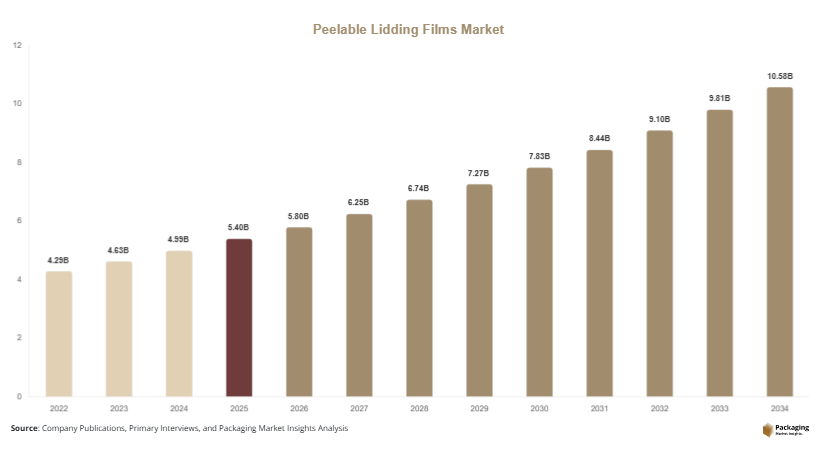
In 2025, the global market size is estimated at USD 5.4 billion, rising to USD 5.8 billion in 2026. The market is projected to reach USD 10.6 billion by 2034, expanding at a CAGR of 7.8% during 2025–2034. The peelable lidding films market is experiencing steady growth driven by increasing demand for convenient, safe, and efficient food packaging solutions.
Peelable lidding films are widely used in packaging applications for dairy products, fresh produce, ready meals, and pharmaceuticals. These films provide controlled sealing and easy opening features, making them suitable for consumer-friendly packaging formats. The demand for such films is growing as manufacturers focus on improving product safety, shelf life, and user convenience.
Key Highlights:
- Asia Pacific dominated the market with a 37.9% share in 2025, while Latin America is projected to grow at the fastest CAGR of 8.9%.
- Flexible films led the type segment with a 66.3% share, while rigid films are expected to grow at a CAGR of 8.4%.
- Polyethylene-based films dominated the material segment with a 54.8% share, while polypropylene-based films are forecasted to grow at a CAGR of 7.9%.
- Food applications led the segment with a 63.5% share, while pharmaceutical applications are expected to grow at a CAGR of 8.1%.
- China remained the dominant country with a market size of USD 1.9 billion in 2025 and USD 2.1 billion in 2026.
Explore more data points, trends and opportunities Download Free Sample Report
Market Trends
Growing Preference for Sustainable and Recyclable Film Structures
Sustainability is reshaping the peelable lidding films market as regulatory bodies and consumers push for environmentally responsible packaging solutions. Manufacturers are focusing on mono-material film structures that simplify recycling processes while maintaining performance standards. Traditional multi-layer films, which combine different polymers, are gradually being replaced with recyclable alternatives to reduce environmental impact.
For example, packaging companies are developing polyethylene-based peelable films that can be recycled within existing waste streams. Retailers are also encouraging suppliers to adopt sustainable packaging formats to meet environmental targets. This shift is expected to drive innovation in material science, leading to the development of bio-based and compostable films. In the long term, sustainability will remain a critical factor influencing product design and market competitiveness.
Advancements in High-Performance Barrier and Sealing Technologies
Technological innovation in barrier properties and sealing performance is a key trend shaping the market. Peelable lidding films are being designed to provide enhanced protection against moisture, oxygen, and contaminants, which is essential for maintaining product quality and extending shelf life. Improved sealing technologies also ensure consistent peel strength, reducing the risk of leakage or product damage.
For instance, modified atmosphere packaging (MAP) applications rely heavily on high-barrier peelable films to preserve freshness. Anti-fog coatings are also being incorporated to improve product visibility, particularly in fresh produce packaging. In the future, advancements in smart packaging technologies, such as temperature-sensitive indicators, are expected to further enhance functionality. These innovations will support the adoption of peelable films across diverse industries.
Market Drivers
Rising Demand for Convenient and User-Friendly Packaging
The increasing demand for convenient packaging solutions is a major factor driving the peelable lidding films market. Consumers prefer packaging that is easy to open without the need for additional tools, particularly for food products consumed on the go. Peelable films offer controlled opening and resealability, which improves user experience and reduces product waste.
Food manufacturers are adopting these films to enhance product differentiation and meet consumer expectations. For example, ready meal trays with peelable lids are widely used in supermarkets and foodservice outlets. This trend is expected to continue as lifestyles become more fast-paced and demand for convenience grows.
Expansion of Packaged Food and Retail Sectors
The growth of the packaged food industry and organized retail sector is significantly contributing to market expansion. Supermarkets and hypermarkets require packaging solutions that ensure product safety, extend shelf life, and enhance visual appeal. Peelable lidding films meet these requirements effectively.
For instance, dairy products such as yogurt and cheese are commonly packaged using peelable films to maintain freshness and prevent contamination. The increasing availability of packaged foods in emerging markets is further driving demand. As retail infrastructure continues to expand, the adoption of peelable lidding films is expected to increase steadily.
Market Restraint
Challenges Associated with Material Complexity and Recycling
One of the key challenges in the peelable lidding films market is the complexity of multi-layer film structures, which can hinder recycling efforts. Many peelable films are made from combinations of different polymers to achieve desired barrier and sealing properties. However, this makes them difficult to process in standard recycling systems.
The impact of this restraint is significant, as regulatory pressures are increasing for sustainable packaging solutions. Manufacturers must invest in research and development to create recyclable alternatives without compromising performance. For example, transitioning from multi-layer to mono-material films requires advanced material engineering and may increase production costs.
Additionally, inconsistent recycling infrastructure across regions further complicates the issue. While developed markets are making progress, emerging economies may lack the necessary facilities. Addressing these challenges will be critical for long-term market growth and sustainability.
Market Opportunities
Increasing Adoption in Pharmaceutical Packaging
The pharmaceutical sector presents significant opportunities for the peelable lidding films market. These films are used in blister packaging and sterile applications, where controlled sealing and easy opening are essential. The growing demand for healthcare products and medicines is driving the need for reliable packaging solutions.
For example, peelable films are used to package medical devices and tablets, ensuring product integrity and safety. As the pharmaceutical industry continues to expand, particularly in emerging markets, the demand for high-quality packaging materials is expected to increase. This creates new growth opportunities for manufacturers.
Growth in Ready-to-Eat and Fresh Food Packaging
The rising consumption of ready-to-eat meals and fresh food products is creating strong demand for peelable lidding films. These films are widely used in packaging salads, fruits, and prepared meals, where maintaining freshness and convenience is critical.
Retailers are expanding their ready meal offerings, which require efficient packaging solutions. For instance, modified atmosphere packaging combined with peelable films helps extend shelf life and improve product quality. In the future, innovations in packaging design and material composition will further enhance the performance of peelable films, supporting market growth.
Report Scope
| Report Metric | Details |
|---|---|
| Market Size in 2025 | USD 5.4 Billion |
| Market Size in 2026 | USD 5.8 Billion |
| Market Size in 2034 | USD 10.6 Billion |
| CAGR | 7.8% (2026-2034) |
| Base Year for Estimation | 2025 |
| Historical Data | 2022-2024 |
| Forecast Period | 2026-2034 |
| Report Coverage | Revenue Forecast, Competitive Landscape, Supply Chain Disruption, Growth Factors, Environment & Regulatory Landscape and Trends |
| Geographies Covered | North America, Europe, APAC, Middle East and Africa, LATAM |
| Countries Covered | U.S., Canada, U.K., Germany, France, Spain, Italy, Russia, Nordic, Benelux, Rest of Europe, China, South Korea, Japan, India, Australia, Singapore, Taiwan, South East Asia, Rest of Asia-Pacific, UAE, Turky, Saudi Arabia, South Africa, Egypt, Nigeria, Rest of MEA, Brazil, Mexico, Argentina, Chile, Colombia, Rest of LATAM |
Explore more data points, trends and opportunities Download Free Sample Report
Segmental Analysis
By Type
Flexible peelable films dominated the market in 2024, accounting for approximately 66.3% of the total share. Their dominance is attributed to their versatility and compatibility with various packaging formats. These films are widely used in food packaging applications, including dairy products, fresh produce, and ready meals. Their ability to provide consistent peel strength and maintain product integrity makes them a preferred choice among manufacturers. Additionally, flexible films support high-speed packaging operations, improving efficiency and reducing costs.
Rigid lidding films are the fastest-growing segment, with a projected CAGR of 8.4%. These films are used in applications requiring higher structural strength and durability. Innovations in material composition and design are improving performance, making rigid films suitable for a wider range of applications. Future growth is expected to be driven by increasing demand for premium packaging solutions.
By Material
Polyethylene-based films dominated the market in 2024 with a share of 54.8%, owing to their excellent sealing properties and cost efficiency. These films are widely used in food packaging due to their compatibility with various substrates and ability to provide strong seals. Their flexibility and durability make them suitable for a wide range of applications.
Polypropylene-based films are the fastest-growing segment, with a CAGR of 7.9%. These films offer improved heat resistance and clarity, making them ideal for high-temperature applications. Innovations in material technology are enhancing their performance, supporting market growth.
By End-Use
Food applications dominated the market in 2024, accounting for 63.5% of the total share. The segment includes packaging for dairy products, fresh produce, and ready meals. The increasing demand for convenient and hygienic food packaging is driving the adoption of peelable films. Their ability to extend shelf life and improve product safety makes them essential in the food industry.
Pharmaceutical applications are the fastest-growing segment, with a CAGR of 8.1%. The demand for reliable and sterile packaging solutions is driving growth in this segment. Peelable films are widely used in blister packaging and medical device packaging. Future growth is expected to be driven by advancements in healthcare and increasing demand for pharmaceutical products.
Peelable Lidding Films Market Segmentations
By Type
- Flexible Films
- Rigid Films
By Material
- Polyethylene (PE)
- Polypropylene (PP)
- Polyethylene Terephthalate (PET)
- Others
End-Use
- Food
- Pharmaceuticals
- Others
By Region
- North America
- Europe
- Asia Pacific
- Middle East & Africa
- Latin America
Regional Analysis
North America
North America accounted for approximately 25.1% of the peelable lidding films market share in 2025 and is projected to grow at a CAGR of 6.9% through 2034. The region benefits from a mature food packaging industry and high demand for convenience-based products. The widespread use of ready meals, dairy products, and fresh produce packaging is driving the adoption of peelable films. Additionally, technological advancements in packaging materials and strong distribution networks support market growth. Increasing consumer awareness of food safety and hygiene standards is also encouraging the use of advanced lidding solutions across retail and foodservice sectors.
The United States dominates the regional market due to its large packaged food industry. A unique growth factor in this region is the increasing demand for premium packaging formats that enhance product differentiation. For example, food brands are adopting peelable films with anti-fog properties and improved seal integrity to attract consumers. This trend is supported by strong retail competition and the need for visually appealing packaging.
Europe
Europe held around 22.4% of the global market share in 2025 and is expected to grow at a CAGR of 6.7% during the forecast period. The region is characterized by strict environmental regulations and a strong focus on sustainability. The demand for recyclable and eco-friendly packaging solutions is driving innovation in peelable film materials. Additionally, the growth of the dairy and fresh food sectors is supporting market expansion.
Germany leads the European market due to its advanced packaging industry. A unique growth driver in this region is the implementation of circular economy initiatives. Companies are investing in recyclable film solutions to comply with regulations and reduce environmental impact. This trend is encouraging the development of mono-material peelable films.
Asia Pacific
Asia Pacific dominated the market with a 37.9% share in 2025 and is projected to grow at a CAGR of 8.2%. The region’s growth is driven by rapid urbanization, increasing disposable incomes, and expanding retail infrastructure. The rising demand for packaged food products and convenience packaging is boosting the adoption of peelable lidding films.
China is the leading country in this region due to its large manufacturing base and high consumption of packaged foods. A unique growth driver is the expansion of e-commerce platforms offering food delivery services. This trend is increasing the need for efficient and reliable packaging solutions, supporting market growth.
Middle East & Africa
The Middle East & Africa region accounted for approximately 9.2% of the market share in 2025 and is projected to grow at a CAGR of 7.3%. The market is driven by the expansion of the foodservice and retail sectors. Rising tourism and hospitality industries are also contributing to demand for high-quality packaging solutions.
The United Arab Emirates leads the market in this region, supported by its strong hospitality sector. A unique growth factor is the increasing demand for premium packaging in hotels and restaurants. Businesses are adopting advanced peelable films to improve product quality and presentation.
Latin America
Latin America held around 5.4% of the market share in 2025 and is expected to grow at the fastest CAGR of 8.9%. The region is experiencing growth in retail infrastructure and packaged food consumption. Increasing urbanization and changing lifestyles are driving demand for convenient packaging solutions.
Brazil dominates the regional market due to its large population and growing food industry. A unique growth driver is the increasing adoption of ready-to-eat meals among urban consumers. Supermarkets are expanding their offerings, which supports the demand for peelable lidding films.
Competitive Landscape
The peelable lidding films market is moderately competitive, with several global players focusing on innovation and sustainability. Amcor Plc is a leading company in the market, known for its advanced packaging solutions and strong global presence. The company invests heavily in research and development to create high-performance and recyclable film solutions.
Other key players are adopting strategies such as mergers, acquisitions, and partnerships to strengthen their market position. Companies are also expanding their production capacities to meet increasing demand. Recent developments include the introduction of recyclable mono-material films and advanced sealing technologies. These strategies are helping companies remain competitive in a dynamic market environment.
Key Players List
- Amcor Plc
- Berry Global Inc.
- Sealed Air Corporation
- Winpak Ltd.
- Coveris Holdings S.A.
- Constantia Flexibles Group
- Toray Plastics (America), Inc.
- Uflex Ltd.
- Cosmo Films Ltd.
- Flexopack S.A.
- Clondalkin Group Holdings B.V.
- DuPont de Nemours, Inc.
- Mondi Group
- ProAmpac LLC
- Schur Flexibles Group