Hard Coat Film Market Size and Growth
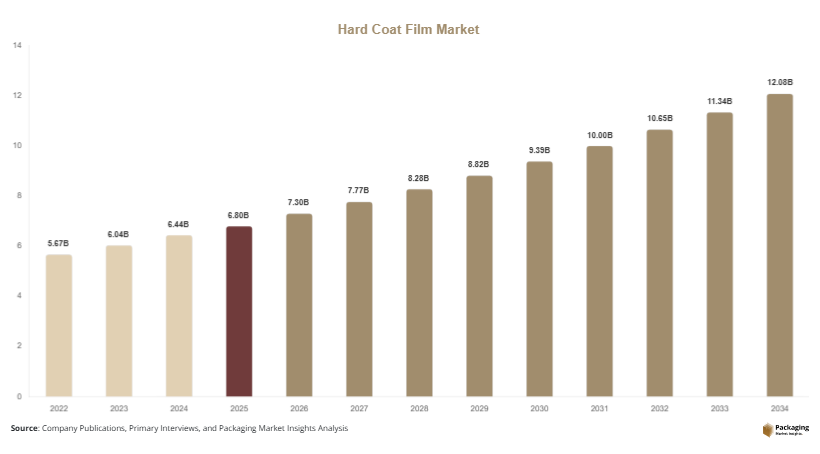
The hard coat film market size was estimated at approximately USD 6.8 billion in 2025 and is expected to reach USD 7.3 billion in 2026. Over the forecast period, the market is projected to grow to USD 12.9 billion by 2034, registering a compound annual growth rate (CAGR) of 6.5% from 2025 to 2034. This growth reflects rising adoption of advanced protective films in touch panels, displays, and optical components. The global hard coat film market is experiencing steady growth driven by increasing demand for durable, scratch-resistant, and high-performance surface protection materials across electronics, automotive, and industrial applications.
Hard coat films are polymer-based films coated with protective layers that enhance resistance to scratches, abrasion, and environmental factors. These films are widely used in applications such as smartphones, tablets, automotive displays, and industrial equipment. The increasing use of touchscreen devices and digital displays is a major factor contributing to the expansion of the hard coat film market.
Key Market Insights:
- Asia Pacific dominated the market with a 39.2% share in 2025, while Latin America is projected to grow at the fastest CAGR of 6.8%.
- UV-cured hard coat films led the type segment with a 46.5% share, while thermal-cured films are expected to grow at a CAGR of 6.9%.
- Plastic-based films dominated with a 52.3% share, while eco-friendly coatings are forecasted to grow at a CAGR of 6.6%.
- Electronics applications led the segment with 44.8% share, while automotive applications are expected to grow at a CAGR of 6.7%.
- China remained the dominant country with a market size of USD 1.9 billion in 2025 and USD 2.1 billion in 2026.
Explore more data points, trends and opportunities Download Free Sample Report
Market Trends
Increasing Integration of Advanced Functional Coatings
The hard coat film market is witnessing a strong trend toward the integration of advanced functional coatings that enhance performance characteristics. Manufacturers are developing films with multi-functional properties such as anti-glare, anti-reflective, anti-fingerprint, and UV resistance. These features are particularly important in applications like smartphones, tablets, and automotive displays, where user experience and durability are critical.
The adoption of these coatings is driven by the need to improve optical clarity and reduce maintenance requirements. Additionally, advancements in nanotechnology are enabling the development of coatings with superior performance and longevity. As industries continue to demand higher-quality materials, the integration of advanced functional coatings is expected to drive market growth.
Rising Demand for Flexible and Lightweight Materials
Another key trend in the hard coat film market is the increasing demand for flexible and lightweight materials. With the growing popularity of foldable and flexible electronic devices, manufacturers are focusing on developing films that can maintain durability while offering flexibility. Hard coat films are being designed to withstand bending and stretching without compromising performance.
This trend is also evident in the automotive and industrial sectors, where lightweight materials are preferred to improve efficiency and reduce energy consumption. The ability of hard coat films to provide protection without adding significant weight makes them an attractive choice. As technological innovations continue, the demand for flexible and lightweight hard coat films is expected to increase.
Market Drivers
Growth of Consumer Electronics Industry
The rapid expansion of the consumer electronics industry is a major driver of the hard coat film market. The increasing production of smartphones, tablets, laptops, and wearable devices is driving demand for protective films that enhance durability and performance. Hard coat films provide essential protection against scratches, fingerprints, and environmental damage, making them a critical component in electronic devices.
The growing adoption of high-resolution displays and touchscreen technologies is further supporting market growth. Consumers are seeking devices with improved durability and user experience, which is encouraging manufacturers to invest in advanced protective materials. As the consumer electronics market continues to grow, the demand for hard coat films is expected to rise.
Increasing Adoption in Automotive Applications
The automotive industry is emerging as a significant driver of the hard coat film market. Modern vehicles are increasingly equipped with digital displays, touchscreens, and advanced infotainment systems, all of which require durable protective films. Hard coat films are used to protect these components from scratches, abrasion, and environmental exposure.
Additionally, the trend toward electric and autonomous vehicles is driving the integration of advanced display technologies, further increasing demand for hard coat films. The need for lightweight and high-performance materials in automotive applications is also supporting market growth. As the automotive industry continues to evolve, the adoption of hard coat films is expected to increase.
Market Restraint
High Production Costs and Technical Complexity
One of the key challenges in the hard coat film market is the high production cost associated with advanced coating technologies. The manufacturing process requires specialized equipment and materials, which increases overall production expenses. Additionally, achieving consistent quality and performance in hard coat films can be technically complex, requiring precise control over coating processes.
The presence of alternative protective materials, such as tempered glass and other coatings, also poses a challenge to market growth. These alternatives may offer comparable performance at lower costs in certain applications. For example, some smartphone manufacturers prefer tempered glass for screen protection due to its durability and cost-effectiveness. These factors can limit the adoption of hard coat films, particularly in price-sensitive markets. However, ongoing technological advancements are expected to reduce production costs and improve efficiency over time.
Market Opportunities
Expansion in Emerging Display Technologies
The development of emerging display technologies presents a significant opportunity for the hard coat film market. Innovations such as flexible displays, foldable devices, and OLED screens are driving the need for advanced protective films. Hard coat films are essential for maintaining the durability and performance of these new technologies.
Manufacturers are investing in research and development to create films that meet the specific requirements of these applications. The ability to provide protection without compromising flexibility or optical clarity is a key advantage. As the adoption of advanced display technologies continues to grow, the demand for hard coat films is expected to increase.
Growth in Industrial and Optical Applications
The expansion of industrial and optical applications is creating new opportunities for the hard coat film market. These films are used in applications such as optical lenses, protective screens, and industrial equipment, where durability and performance are critical. The increasing use of automation and advanced machinery is driving demand for reliable protective materials.
Additionally, the growth of renewable energy and smart technologies is supporting the adoption of hard coat films in various applications. These films help improve the performance and lifespan of components, making them a valuable solution in industrial settings. As industries continue to adopt advanced technologies, the demand for hard coat films is expected to grow.
Report Scope
| Report Metric | Details |
|---|---|
| Market Size in 2025 | USD 6.8 Billion |
| Market Size in 2026 | USD 7.3 Billion |
| Market Size in 2034 | USD 12.9 Billion |
| CAGR | 6.5% (2026-2034) |
| Base Year for Estimation | 2025 |
| Historical Data | 2022-2024 |
| Forecast Period | 2026-2034 |
| Report Coverage | Revenue Forecast, Competitive Landscape, Supply Chain Disruption, Growth Factors, Environment & Regulatory Landscape and Trends |
| Geographies Covered | North America, Europe, APAC, Middle East and Africa, LATAM |
| Countries Covered | U.S., Canada, U.K., Germany, France, Spain, Italy, Russia, Nordic, Benelux, Rest of Europe, China, South Korea, Japan, India, Australia, Singapore, Taiwan, South East Asia, Rest of Asia-Pacific, UAE, Turky, Saudi Arabia, South Africa, Egypt, Nigeria, Rest of MEA, Brazil, Mexico, Argentina, Chile, Colombia, Rest of LATAM |
Explore more data points, trends and opportunities Download Free Sample Report
Segmental Analysis
By Type
UV-cured hard coat films dominated the hard coat film market in 2024, accounting for approximately 46.5% of total revenue. These films offer superior scratch resistance, fast curing times, and excellent optical clarity. They are widely used in electronics and automotive applications due to their high performance.
Thermal-cured hard coat films are expected to grow at the fastest CAGR of 6.9%. This growth is driven by their durability and suitability for high-temperature applications. These films are increasingly used in industrial and automotive sectors where performance under extreme conditions is required.
By Application
The electronics segment dominated the market in 2024, accounting for 44.8% of total revenue. Hard coat films are widely used in smartphones, tablets, and displays to provide protection and enhance performance. The growing demand for electronic devices is supporting segment growth.
The automotive segment is expected to grow at a CAGR of 6.7%. The increasing use of digital displays and advanced infotainment systems in vehicles is driving demand for protective films. These films help improve durability and user experience.
By End-Use
The consumer electronics segment dominated the hard coat film market in 2024, accounting for a significant share of total revenue. The use of hard coat films in electronic devices is driving this segment.
The industrial segment is expected to grow at a CAGR of 6.4%. The increasing adoption of advanced machinery and equipment is driving demand for protective films. Hard coat films provide durability and performance, making them suitable for industrial applications.
Hard Coat Film Market Segmentations
By Product Type
- UV-Cured Hard Coat Films
- Thermal-Cured Hard Coat Films
By Application
- Electronics
- Automotive
- Industrial
- Optical
By Distribution Channel
- Direct Sales (B2B)
- Distributors & Wholesalers
- Online Procurement Platforms
- Specialty Material Suppliers
- Industrial Supply Chains
Regional Analysis
North America
North America accounted for approximately 22.8% of the hard coat film market share in 2025 and is projected to grow at a CAGR of 5.9% during the forecast period. The region’s growth is driven by strong demand from the electronics and automotive industries. Increasing adoption of advanced display technologies is also supporting market expansion.
The United States dominates the North American market due to its large consumer electronics industry. A key growth factor is the increasing investment in research and development for advanced materials, which is driving innovation in hard coat films.
Europe
Europe held a share of approximately 25.6% in 2025 and is expected to grow at a CAGR of 6.1%. The region is characterized by strong demand for high-quality materials and stringent quality standards. These factors are driving the adoption of advanced hard coat films.
Germany is a leading market in Europe, supported by its strong automotive industry. A unique growth factor is the increasing adoption of digital displays in vehicles, which is driving demand for protective films.
Asia Pacific
Asia Pacific dominated the hard coat film market with a share of 39.2% in 2025 and is projected to grow at a CAGR of 6.8%. Rapid industrialization and the presence of major electronics manufacturers are driving market growth in the region.
China leads the regional market due to its large manufacturing base. A key growth factor is the expansion of the consumer electronics industry, which is increasing demand for protective films.
Middle East & Africa
The Middle East & Africa region accounted for approximately 5.1% of the market in 2025 and is expected to grow at a CAGR of 5.4%. The region’s growth is supported by increasing adoption of advanced technologies.
The United Arab Emirates is a key market in the region. A unique growth factor is the growing demand for digital infrastructure, which is supporting the adoption of hard coat films.
Latin America
Latin America held a share of approximately 7.3% in 2025 and is projected to grow at the fastest CAGR of 6.8%. The region’s growth is driven by increasing demand for consumer electronics and industrial applications.
Brazil dominates the market in Latin America. A key growth factor is the expansion of the electronics manufacturing sector, which is driving demand for protective films.
Competitive Landscape
The hard coat film market is moderately competitive, with key players focusing on innovation and product development. Companies are investing in advanced coating technologies to improve product performance and expand their applications.
3M Company is a leading player in the market, known for its advanced materials and innovative solutions. The company has recently introduced new hard coat film products with enhanced durability and optical performance. Other players are focusing on expanding their product portfolios and strengthening their market presence through strategic initiatives.
Key Players List
- 3M Company
- Toray Industries, Inc.
- Mitsubishi Chemical Group Corporation
- Teijin Limited
- Covestro AG
- SABIC
- Eastman Chemical Company
- DuPont de Nemours, Inc.
- LG Chem Ltd.
- Kolon Industries, Inc.
- SKC Co., Ltd.
- Nitto Denko Corporation
- Sumitomo Chemical Co., Ltd.
- DIC Corporation
- Toyobo Co., Ltd.