Perforated Packaging Market Size and Growth
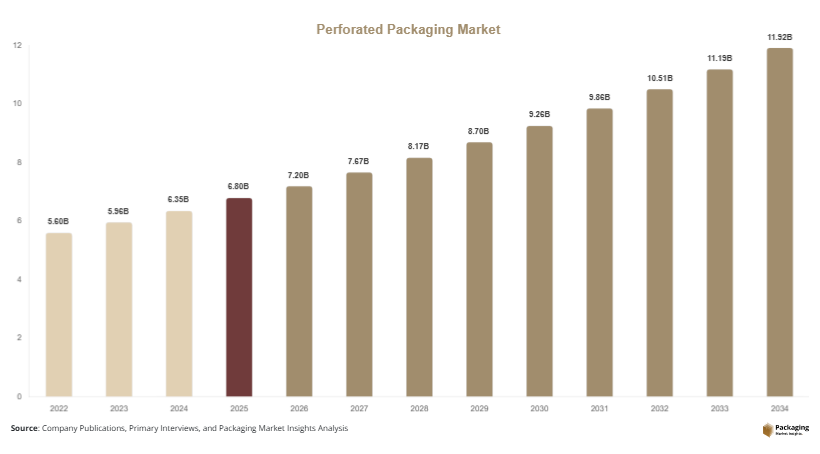
The perforated packaging market size was valued at USD 6.8 billion in 2025 and is projected to reach USD 7.2 billion in 2026. With rising applications in fresh produce packaging and expanding global supply chains, the market is expected to reach approximately USD 11.9 billion by 2034, registering a CAGR of 6.5% during the forecast period from 2025 to 2034. The perforated packaging market is gaining steady traction due to increasing demand for breathable and moisture-regulating packaging solutions across food, agriculture, healthcare, and consumer goods industries.
Perforated packaging plays a critical role in extending the shelf life of perishable products by allowing controlled air circulation. This is particularly important in the food and beverage sector, where fresh fruits, vegetables, and bakery items require optimal moisture and gas exchange to maintain quality. The growing consumption of fresh and minimally processed foods is a key factor driving the adoption of perforated packaging solutions. Additionally, the increasing demand for sustainable packaging is encouraging the use of perforated films that reduce condensation and food waste, aligning with environmental goals.
Key Highlights:
- Asia Pacific dominated the market with a 38.1% share in 2025, while Latin America is projected to grow at the fastest CAGR of 6.9%.
- Micro-perforated films led the type segment with a 31.4% share, while macro-perforated packaging is expected to grow at a CAGR of 6.7%.
- Plastic packaging dominated with a 54.6% share, while paper-based perforated packaging is forecasted to grow at a CAGR of 6.2%.
- Food & beverage applications led the segment with 46.3% share, while agriculture packaging is expected to grow at a CAGR of 6.8%.
- China remained the dominant country with a market size of USD 1.3 billion in 2025 and USD 1.4 billion in 2026.
Explore more data points, trends and opportunities Download Free Sample Report
Market Trends
Increasing Use of Micro-Perforation Technology
The adoption of micro-perforation technology is significantly shaping the perforated packaging market. Micro-perforated films allow precise control of airflow and moisture levels, which is essential for maintaining the freshness of perishable products. This technology is widely used in fresh produce packaging, where different fruits and vegetables require specific gas exchange rates. Manufacturers are investing in advanced laser perforation systems to achieve high precision and consistency. This trend is enabling the development of customized packaging solutions tailored to individual product requirements, thereby enhancing product quality and reducing waste across the supply chain.
Growing Demand for Sustainable Packaging Solutions
Sustainability is becoming a key focus area in the perforated packaging market. Consumers and regulatory bodies are increasingly demanding environmentally friendly packaging solutions, prompting manufacturers to explore biodegradable and recyclable materials. Perforated packaging contributes to sustainability by reducing food waste through improved shelf life. Additionally, the use of paper-based and compostable materials is gaining traction as companies aim to reduce their environmental impact. This trend is encouraging innovation in material science and packaging design, leading to the development of eco-friendly perforated packaging solutions that meet both performance and sustainability requirements.
Market Drivers
Rising Demand for Fresh and Packaged Food Products
The increasing consumption of fresh and packaged food products is a major driver of the perforated packaging market. Consumers are seeking high-quality, fresh products with longer shelf life, which requires effective packaging solutions. Perforated packaging allows controlled airflow, preventing moisture buildup and spoilage. This is particularly important for fruits, vegetables, and bakery items. The growth of organized retail and e-commerce platforms is further driving demand, as these channels require reliable packaging solutions to maintain product quality during storage and transportation.
Expansion of Agricultural Exports
The expansion of agricultural exports is another key factor driving the market. Perforated packaging plays a crucial role in preserving the freshness of produce during long-distance transportation. Countries with strong agricultural sectors are increasingly adopting perforated packaging to reduce post-harvest losses and improve export quality. This is particularly important in regions with varying climatic conditions, where maintaining optimal temperature and humidity levels is essential. The growing focus on reducing food waste and improving supply chain efficiency is further supporting market growth.
Market Restraint
Limited Durability Compared to Non-Perforated Packaging
One of the key challenges in the perforated packaging market is the relatively lower durability compared to non-perforated packaging solutions. The presence of perforations can reduce the structural strength of the packaging, making it more susceptible to damage during handling and transportation. This can be a concern for certain applications where product protection is critical. For example, in the case of heavy or fragile items, perforated packaging may not provide sufficient support, leading to potential product loss. Manufacturers need to balance breathability and strength, which can increase production complexity and costs. This restraint highlights the need for continuous innovation in material design and manufacturing processes.
Market Opportunities
Development of Advanced Perforation Techniques
Advancements in perforation techniques present significant opportunities for the perforated packaging market. Technologies such as laser perforation and precision punching are enabling the production of highly customized packaging solutions. These techniques allow manufacturers to control the size, pattern, and density of perforations, optimizing performance for different products. This innovation is particularly valuable in the food industry, where different products require specific airflow conditions. The development of advanced techniques is expected to enhance product functionality and drive market growth.
Increasing Adoption in Emerging Markets
Emerging markets offer substantial growth opportunities for the perforated packaging market. Rapid urbanization, rising disposable incomes, and changing consumer preferences are driving demand for packaged goods in these regions. Perforated packaging is gaining popularity due to its ability to maintain product freshness and reduce waste. Local manufacturers are expanding their production capabilities, while global companies are entering these markets to capture new opportunities. Government initiatives supporting agricultural and packaging industries are further contributing to market growth.
Report Scope
| Report Metric | Details |
|---|---|
| Market Size in 2025 | USD 6.8 Billion |
| Market Size in 2026 | USD 7.2 Billion |
| Market Size in 2034 | USD 11.9 Billion |
| CAGR | 6.5% (2026-2034) |
| Base Year for Estimation | 2025 |
| Historical Data | 2022-2024 |
| Forecast Period | 2026-2034 |
| Report Coverage | Revenue Forecast, Competitive Landscape, Supply Chain Disruption, Growth Factors, Environment & Regulatory Landscape and Trends |
| Geographies Covered | North America, Europe, APAC, Middle East and Africa, LATAM |
| Countries Covered | U.S., Canada, U.K., Germany, France, Spain, Italy, Russia, Nordic, Benelux, Rest of Europe, China, South Korea, Japan, India, Australia, Singapore, Taiwan, South East Asia, Rest of Asia-Pacific, UAE, Turky, Saudi Arabia, South Africa, Egypt, Nigeria, Rest of MEA, Brazil, Mexico, Argentina, Chile, Colombia, Rest of LATAM |
Explore more data points, trends and opportunities Download Free Sample Report
Segmental Analysis
By Type
Micro-perforated films dominated the market in 2024, accounting for approximately 31.4% of the total share. These films are widely used due to their ability to provide controlled airflow and maintain optimal moisture levels. They are particularly suitable for fresh produce packaging, where maintaining product quality is critical. Continuous advancements in perforation technology are enhancing performance and enabling customization for different applications.
Macro-perforated packaging is expected to be the fastest-growing segment, with a CAGR of 6.7% during the forecast period. These packaging solutions are used for products that require higher airflow, such as bulk agricultural produce. Innovations in design and materials are improving functionality and expanding application areas.
By Material
Plastic-based perforated packaging dominated the market in 2024, accounting for 54.6% of the total share. These materials are widely used due to their durability, flexibility, and cost-effectiveness. Plastic films are commonly used in food and agricultural packaging due to their ability to maintain product quality.
Paper-based perforated packaging is projected to grow at the fastest CAGR of 6.2%. These materials are gaining popularity due to increasing environmental awareness and regulatory pressure to reduce plastic usage. Advances in material technology are improving performance and expanding applications.
By Application
Food and beverage applications dominated the market in 2024, accounting for 46.3% of the total share. Perforated packaging is essential in this sector to maintain product freshness and extend shelf life. The increasing demand for packaged food products is driving growth in this segment.
Agriculture applications are expected to grow at the fastest CAGR of 6.8% during the forecast period. The need to preserve the freshness of produce during transportation is driving demand for perforated packaging solutions.
Perforated Packaging Market Segmentations
By Product Type
- Micro-perforated Films
- Macro-perforated Packaging
- Laser-perforated Films
By Application
- Food & Beverage
- Agriculture
- Industrial
By Material
- Plastic
- Paper
- Others
Regional Analysis
North America
North America accounted for approximately 22.7% of the perforated packaging market share in 2025 and is projected to grow at a CAGR of 5.6% during the forecast period. The region benefits from advanced packaging technologies and strong demand from food, retail, and agricultural sectors. High consumer awareness and stringent quality standards further support market growth.
The United States dominates the regional market due to its large consumer base and well-developed food supply chain. A key growth factor is the increasing demand for fresh produce packaging, where perforated films are widely used to maintain product quality and reduce waste.
Europe
Europe held a 20.9% market share in 2025 and is expected to grow at a CAGR of 5.4%. The region is characterized by strict environmental regulations and a strong focus on sustainability. These factors are driving the adoption of eco-friendly perforated packaging solutions.
Germany leads the European market, supported by its strong manufacturing sector and emphasis on innovation. A unique growth factor is the increasing adoption of biodegradable packaging materials, driven by environmental policies and consumer preferences.
Asia Pacific
Asia Pacific dominated the market with a 38.1% share in 2025 and is projected to grow at a CAGR of 6.9%. Rapid urbanization, increasing disposable incomes, and expanding food and agriculture industries are key factors driving growth in the region.
China is the dominant country in the region, driven by its strong agricultural production and growing consumer market. A significant growth factor is the increasing demand for efficient packaging solutions in large-scale food distribution networks.
Middle East & Africa
The Middle East & Africa region accounted for 7.5% of the market share in 2025 and is expected to grow at a CAGR of 6.2%. The region is witnessing increased demand for packaged food products due to urbanization and changing lifestyles.
The United Arab Emirates is a key market, supported by its growing retail and logistics sectors. A unique growth factor is the increasing adoption of advanced packaging technologies in food distribution systems.
Latin America
Latin America held a 10.8% market share in 2025 and is projected to grow at the fastest CAGR of 6.9%. The region is experiencing steady growth in the packaging industry, supported by increasing consumer demand and agricultural exports.
Brazil dominates the regional market due to its strong agricultural sector and large population. A key growth factor is the increasing use of perforated packaging in fresh produce exports to maintain quality during transportation.
Competitive Landscape
The perforated packaging market is moderately competitive, with several global and regional players focusing on innovation, sustainability, and cost efficiency. Companies are investing in advanced technologies to enhance product performance and meet evolving market demands. Strategic partnerships and product launches are common strategies used to strengthen market position.
Amcor Plc is a leading player in the market, known for its extensive product portfolio and global presence. The company has recently introduced advanced perforated packaging solutions designed to improve product freshness and reduce waste. Other key players are also focusing on developing eco-friendly materials and expanding production capabilities.
Key Players List
- Amcor Plc
- Mondi Group
- Berry Global Inc.
- Sealed Air Corporation
- Sonoco Products Company
- Huhtamaki Oyj
- Constantia Flexibles
- ProAmpac LLC
- Coveris Holdings S.A.
- Uflex Ltd.
- Winpak Ltd.
- Smurfit Kappa Group
- DS Smith Plc
- WestRock Company
- International Paper Company