Blunt Wraps Market Size
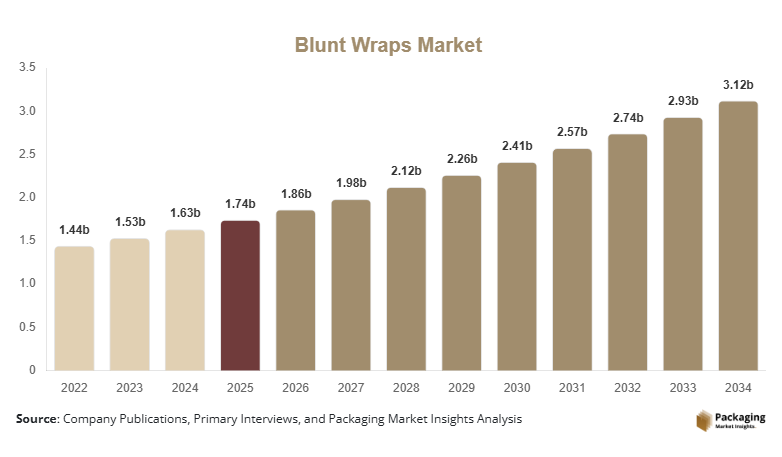
Blunt Wraps market size is projected at USD 1.86 billion in 2026 and is expected to hit USD 3.12 billion by 2034 with a CAGR of 6.7%. The market expansion is supported by increasing product diversification, premium wrap innovations, and growing organized retail distribution. The report evaluates market segmentation, production capacity, pricing trends, supply chain performance, and competitive landscape across major regional markets.
Blunt wraps are rolling wraps manufactured primarily from tobacco, hemp, or herbal materials and are widely used in adult smoking products. Global production exceeded 19.4 billion wraps in 2025, while annual consumption crossed 18.7 billion units with retail penetration approaching 67% across developed markets. Tobacco-based variants represented nearly 58% of worldwide production, hemp wraps accounted for 27%, and herbal alternatives contributed 15%. North America remained the largest consuming region with approximately 43% of global demand, while online retail contributed nearly 22% of worldwide sales. Premium flavored products achieved adoption rates exceeding 36% among adult consumers, reinforcing the Blunt Wraps Market.
Explore more data points, trends and opportunities Download Free Sample Report
Blunt Wraps Trends
Rising Adoption of Hemp-Based Products
Manufacturers are increasingly investing in hemp-derived blunt wraps as consumer preferences shift toward tobacco-free alternatives. Hemp wrap production surpassed 5.2 billion units during 2025, reflecting annual production growth of 11.8%. More than 48% of new product launches introduced natural flavors and biodegradable packaging, while automated converting equipment improved manufacturing efficiency by 15%. Premium product penetration exceeded 39% in specialty retail channels, strengthening the Blunt Wraps Market.
The integration of moisture-lock packaging, natural leaf processing, and flavor encapsulation technologies has enhanced shelf life by nearly 20% while reducing product waste by 12%. Manufacturers invested over USD 180 million in production modernization between 2023 and 2025, with flavored hemp products recording adoption rates above 31% across younger adult demographics. These developments continue supporting the Blunt Wraps Market.
Blunt Wraps Drivers
Growing Demand for Premium Smoking Accessories
Increasing adult consumer preference for premium smoking accessories continues driving industry expansion. Premium blunt wrap sales increased by approximately 13% during 2025, while flavored variants represented nearly 46% of total retail revenue. Convenience stores accounted for almost 41% of product distribution, specialty smoke shops contributed 33%, and e-commerce sales expanded by 18% year-over-year. Rising product innovation and wider retail availability continue supporting the Blunt Wraps Market.
Blunt Wraps Restraints
Increasing Regulatory Restrictions on Tobacco Products
Stringent regulations governing flavored tobacco products, packaging requirements, and marketing restrictions continue limiting expansion opportunities. More than 28 countries introduced tighter tobacco-related regulations between 2022 and 2025, reducing flavored product availability by nearly 9% in selected markets. Compliance costs increased by approximately 14%, while excise taxes raised retail prices by nearly 8%, creating pricing pressure across the Blunt Wraps Market.
Blunt Wraps Opportunities
Expansion of Tobacco-Free Product Portfolio
Growing consumer interest in herbal and hemp-based smoking accessories creates substantial opportunities for manufacturers. Herbal wrap production expanded by approximately 16% during 2025, while tobacco-free products achieved market penetration exceeding 29% globally. Investments exceeding USD 210 million in product development, sustainable materials, and premium packaging are expected to support long-term commercialization across emerging markets, strengthening the Blunt Wraps Market.
Challenges in Blunt Wraps Market
Supply Chain Volatility and Raw Material Availability
Fluctuating tobacco leaf prices, agricultural uncertainties, and transportation costs continue challenging manufacturers. Raw material costs increased by approximately 12% between 2024 and 2025, while logistics expenses rose nearly 9%. Manufacturing lead times extended by 11%, affecting inventory management and production scheduling across global facilities. Companies are increasingly diversifying sourcing strategies to maintain competitiveness within the Blunt Wraps Market.
Report Scope
| Report Metric | Details |
|---|---|
| Market Size in 2025 | USD 1.74 billion |
| Market Size in 2026 | USD 1.86 billion |
| Market Size in 2034 | USD 3.12 billion |
| CAGR | 6.7% (2026-2034) |
| Base Year for Estimation | 2025 |
| Historical Data | 2022-2024 |
| Forecast Period | 2026-2034 |
| Report Coverage | Revenue Forecast, Competitive Landscape, Supply Chain Disruption, Growth Factors, Environment & Regulatory Landscape and Trends |
| Geographies Covered | North America, Europe, APAC, Middle East and Africa, LATAM |
| Countries Covered | U.S., Canada, U.K., Germany, France, Spain, Italy, Russia, Nordic, Benelux, Rest of Europe, China, South Korea, Japan, India, Australia, Singapore, Taiwan, South East Asia, Rest of Asia-Pacific, UAE, Turky, Saudi Arabia, South Africa, Egypt, Nigeria, Rest of MEA, Brazil, Mexico, Argentina, Chile, Colombia, Rest of LATAM |
Explore more data points, trends and opportunities Download Free Sample Report
Blunt Wraps Market Segmentation
The market is segmented according to product type and application. Tobacco-based wraps accounted for approximately 58% of global revenue during 2025, while retail sales represented nearly 52% of worldwide distribution. Hemp-based products continued recording the fastest expansion owing to higher consumer adoption and regulatory acceptance.
By Type
Tobacco-based wraps maintained the largest market position with nearly 58% revenue share and production exceeding 11.2 billion units annually. These wraps provide consistent texture, moisture retention, and flavor compatibility across premium and value product ranges.
Hemp wraps represented approximately 27% of global sales, with production surpassing 5.2 billion units. Natural ingredients, nicotine-free composition, and biodegradable materials have increased consumer preference, particularly among younger adult demographics.
Herbal wraps accounted for around 15% of total demand, producing over 3.0 billion units annually. Manufacturers continue expanding botanical ingredient options and natural flavor profiles while improving product durability and storage performance.
By Application
Retail outlets generated approximately 52% of global sales through supermarkets, convenience stores, and licensed retailers. More than 9.6 billion units were distributed through offline channels with consumer penetration exceeding 61%.
Online channels represented nearly 22% of worldwide revenue. Digital platforms processed more than 1.8 billion units during 2025, benefiting from subscription purchasing and wider product availability.
Specialty smoke shops contributed approximately 26% of industry revenue, offering premium, imported, and limited-edition products. Consumer loyalty exceeded 45% within specialty retail environments due to broader product selection and knowledgeable staff.
Blunt Wraps Market Segmentations
Type
- Tobacco-Based Wraps
- Hemp-Based Wraps
- Herbal Wraps
Application
- Retail Sales
- Online Sales
- Specialty Smoke Shops
Distribution Channel
- Convenience Stores
- Supermarkets & Hypermarkets
- Specialty Smoke Shops
- Online Retail
- Wholesale Distributors
Blunt Wraps Regional Outlook
North America
North America accounted for approximately 43% of global revenue during 2025, supported by production exceeding 8.1 billion units. The United States represented nearly 84% of regional demand, while Canada contributed approximately 11%. Premium flavored products and organized retail networks continued supporting regional consumption.
Europe
Europe represented around 24% of global demand with production exceeding 4.3 billion units. Germany, the United Kingdom, France, Spain, and Italy collectively contributed more than 72% of regional sales. Tobacco-free alternatives recorded annual demand growth exceeding 10%.
Asia-Pacific
Asia-Pacific captured approximately 23% of worldwide revenue, producing nearly 4.6 billion units annually. China, Japan, South Korea, Australia, and Southeast Asian countries expanded premium product consumption while online distribution increased by 17% year-over-year.
Latin America, Middle East & Africa
These regions collectively represented nearly 10% of global demand. Brazil, Mexico, South Africa, and the UAE remained major consumption centers, with production exceeding 2.0 billion units. Urban retail expansion and specialty smoking stores continued improving product accessibility.
Top players in Blunt Wraps Market
- Swisher International Inc.
- Imperial Brands PLC
- Republic Brands LP
- Smoker Friendly International
- Royal Blunts LLC
- Twisted Hemp
- High Hemp Organic Wraps
- Juicy Jay's
- Cyclones
- Kush Herbal Wraps
- King Palm
- Hemparillo
Swisher International Inc.
-
Estimated market position exceeding 18% globally.
-
Extensive distribution across convenience stores and specialty retailers.
-
Strong investment in flavored, premium, and value-oriented product portfolios.
-
Continuous manufacturing expansion and brand diversification support long-term competitiveness across North America and international markets.
Imperial Brands PLC
-
Estimated market share of approximately 11%.
-
Broad international sales network across Europe, North America, and selected emerging markets.
-
Focus on premium smoking accessories, regulatory compliance, and product innovation.
-
Investments in sustainable packaging, tobacco-free products, and supply chain optimization strengthen competitive positioning.