Seaweed Packaging Market Size and Growth
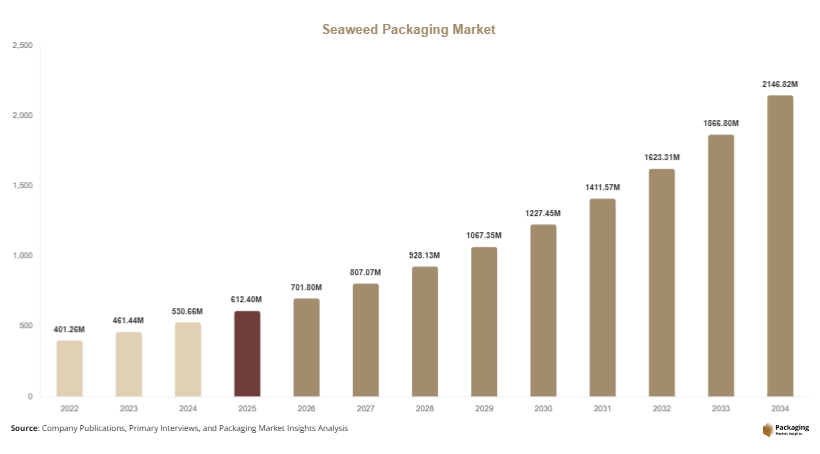
The global seaweed packaging market was valued at approximately USD 612.4 million in 2025 and is projected to reach nearly USD 701.8 million in 2026. By 2034, the market is forecast to reach around USD 2.14 billion, registering a CAGR of 15.0% during 2025–2034. The seaweed packaging market is witnessing rapid development as industries increasingly adopt biodegradable and renewable packaging alternatives to reduce plastic waste. Seaweed-based packaging materials are manufactured using algae-derived biopolymers that naturally decompose without leaving toxic residues, making them suitable for sustainable packaging applications.
Growing environmental concerns associated with single-use plastic waste remain one of the primary factors driving market growth. Governments across Europe, North America, and Asia Pacific are implementing regulations to reduce conventional plastic packaging consumption, encouraging companies to explore compostable and marine-safe packaging materials. Seaweed packaging is gaining attention because it is biodegradable, renewable, and does not require freshwater or agricultural land for cultivation. This sustainability advantage is attracting food service companies, beverage producers, and consumer goods manufacturers seeking eco-friendly packaging alternatives.
Key Highlights
- Asia Pacific dominated the market with a 39.6% share in 2025.
- Latin America is projected to grow at the fastest CAGR of 16.2%.
- Flexible films led the type segment with a 34.8% share.
- Brown seaweed materials dominated the material segment with a 46.5% share.
- Food & beverage applications led the segment with 54.3% share.
- The US remained the dominant country with a market size of USD 128.4 million in 2025 and USD 146.1 million in 2026.
Explore more data points, trends and opportunities Download Free Sample Report
Market Trends
Rising Adoption of Compostable Food Packaging Solutions
Food manufacturers and restaurant chains are increasingly adopting compostable packaging materials to reduce environmental impact and comply with sustainability targets. Seaweed packaging has emerged as a preferred solution because it decomposes naturally and can be safely disposed of without creating long-term waste. Several food service brands are testing seaweed-based sachets, wrappers, and edible packaging formats for condiments, instant beverages, and takeaway products. For example, sustainable packaging startups in Europe and Southeast Asia are introducing seaweed-based food wrappers for snacks and dry foods. This trend is expected to expand further as governments continue restricting single-use plastics and consumers increasingly favor environmentally responsible packaging alternatives across retail and foodservice industries.
Technological Advancements in Seaweed-Derived Biopolymer Processing
Innovation in marine biopolymer extraction and processing technologies is becoming a major trend shaping the seaweed packaging market. Companies are investing in advanced manufacturing systems to improve the moisture resistance, flexibility, and durability of seaweed-based films and containers. Improved processing technologies are enabling seaweed packaging to compete more effectively with traditional plastic packaging in food and consumer goods applications. For instance, biotechnology companies are developing multilayer seaweed films with enhanced oxygen barrier properties suitable for perishable food packaging. Manufacturers are also integrating seaweed materials with paper and plant-based fibers to improve mechanical strength. Future market growth is expected to benefit from increasing commercialization of scalable and cost-efficient seaweed packaging technologies.
Market Drivers
Growing Regulatory Pressure Against Plastic Packaging
Governments worldwide are implementing regulations aimed at reducing plastic pollution and promoting biodegradable packaging alternatives, which is significantly driving demand for seaweed packaging products. Countries across Europe, North America, and Asia Pacific are introducing restrictions on single-use plastics, encouraging manufacturers to adopt renewable materials. Seaweed packaging provides a compostable and marine-safe alternative that aligns with environmental policies and circular economy objectives. For example, several food retailers and beverage companies are replacing plastic sachets and wrappers with biodegradable seaweed-based packaging solutions. The regulatory shift toward sustainable packaging is encouraging investments in research, manufacturing capacity, and commercial adoption of seaweed-derived materials across multiple industries.
Increasing Consumer Preference for Sustainable Packaging
Consumer purchasing behavior is increasingly influenced by environmental awareness and sustainability concerns, creating strong demand for eco-friendly packaging products. Many consumers now prefer brands that use biodegradable, recyclable, or compostable packaging materials. Seaweed packaging has gained attention because it is derived from renewable marine resources and decomposes naturally without producing microplastic pollution. Food delivery services, organic food brands, and premium beverage companies are increasingly incorporating seaweed packaging into their sustainability strategies. For example, specialty beverage startups are using edible seaweed capsules and dissolvable packaging for single-serve drink products. Rising consumer support for sustainable packaging practices is expected to continue driving long-term market growth globally.
Market Restraint
Limited Large-Scale Production Infrastructure and High Manufacturing Costs
One of the primary restraints affecting the seaweed packaging market is the limited availability of large-scale manufacturing infrastructure and relatively high production costs compared to conventional plastic packaging. Seaweed packaging technologies are still in the early commercialization stage, and many manufacturers face operational challenges related to material consistency, moisture resistance, and industrial scalability. In addition, processing seaweed into durable packaging materials requires specialized extraction and manufacturing technologies, which can increase production expenses. For example, smaller packaging companies may struggle to compete with low-cost petroleum-based plastics due to limited economies of scale. Supply chain limitations related to seaweed cultivation and processing capacity can also create raw material shortages during periods of high demand. Furthermore, some seaweed packaging products currently have shorter shelf life and lower durability compared to traditional packaging materials, which may restrict adoption in heavy-duty industrial applications. These challenges could temporarily limit broader market penetration until manufacturing technologies become more efficient and cost-effective.
Market Opportunities
Expansion of Sustainable E-Commerce Packaging
The rapid growth of e-commerce retail and home delivery services is creating strong opportunities for biodegradable packaging materials such as seaweed-based packaging. Online retailers are increasingly seeking sustainable packaging alternatives to reduce packaging waste and improve brand sustainability performance. Seaweed packaging can be used for protective wraps, mailer liners, edible sachets, and compostable cushioning materials in e-commerce logistics operations. Packaging startups are developing lightweight seaweed films and dissolvable packaging formats designed specifically for sustainable shipping applications. Future market opportunities are expected to grow as e-commerce companies strengthen environmental commitments and governments introduce packaging waste reduction regulations across major retail markets.
Increasing Adoption in Personal Care and Cosmetic Packaging
Seaweed packaging manufacturers are increasingly targeting the personal care and cosmetic industry due to rising demand for sustainable beauty packaging solutions. Cosmetic brands are exploring biodegradable sachets, containers, and wrappers derived from marine biopolymers to reduce plastic waste and improve brand image. Seaweed materials are particularly attractive because they support natural and eco-conscious product positioning in premium skincare and cosmetic markets. Several beauty brands are testing compostable sample sachets and dissolvable packaging solutions for travel-size products. Future market growth is expected to benefit from increasing consumer demand for environmentally responsible personal care packaging and expanding investment in sustainable cosmetic product development.
Report Scope
| Report Metric | Details |
|---|---|
| Market Size in 2025 | USD 612.4 Million |
| Market Size in 2026 | USD 701.8 Million |
| Market Size in 2034 | USD 2140 Million |
| CAGR | 15.0% (2026-2034) |
| Base Year for Estimation | 2025 |
| Historical Data | 2022-2024 |
| Forecast Period | 2026-2034 |
| Report Coverage | Revenue Forecast, Competitive Landscape, Supply Chain Disruption, Growth Factors, Environment & Regulatory Landscape and Trends |
| Geographies Covered | North America, Europe, APAC, Middle East and Africa, LATAM |
| Countries Covered | U.S., Canada, U.K., Germany, France, Spain, Italy, Russia, Nordic, Benelux, Rest of Europe, China, South Korea, Japan, India, Australia, Singapore, Taiwan, South East Asia, Rest of Asia-Pacific, UAE, Turky, Saudi Arabia, South Africa, Egypt, Nigeria, Rest of MEA, Brazil, Mexico, Argentina, Chile, Colombia, Rest of LATAM |
Explore more data points, trends and opportunities Download Free Sample Report
Segmental Analysis
By Type
Flexible films dominated the seaweed packaging market in 2024, accounting for approximately 34.8% of total market revenue. Seaweed-based flexible films are widely used for wrapping dry foods, snacks, takeaway products, and lightweight consumer goods because they provide biodegradability and compostability advantages. Food companies increasingly prefer flexible seaweed films because they align with sustainability goals while offering lightweight packaging solutions for retail distribution. Packaging startups are also improving film transparency, moisture resistance, and oxygen barrier performance through advanced marine biopolymer technologies. Several food delivery companies and organic food brands have introduced seaweed-based wrappers for sauces, seasonings, and takeaway meals. Growing consumer preference for sustainable packaging continues to support segment expansion across food and beverage applications.
Edible packaging solutions are expected to be the fastest-growing subsegment, registering a CAGR of 17.1% during the forecast period. Edible seaweed packaging is gaining popularity for single-serve beverages, condiment capsules, and instant food products because it eliminates packaging waste entirely. Beverage startups and event organizers are increasingly using edible seaweed capsules as sustainable alternatives to plastic bottles and cups. Technological advancements in flavor-neutral edible films and dissolvable marine biopolymers are improving product acceptance among consumers. Future market growth is expected to benefit from increasing demand for zero-waste food packaging solutions and rising investments in biodegradable packaging innovation globally.
By Material
Brown seaweed materials accounted for the dominant market share of 46.5% in 2024 due to their abundant availability and strong biopolymer extraction capabilities. Brown seaweed varieties such as kelp and sargassum contain alginate compounds widely used in biodegradable film production and flexible packaging applications. Manufacturers prefer brown seaweed because it provides good film-forming properties, moisture resistance, and compatibility with industrial processing technologies. Food packaging producers are increasingly using alginate-based materials for compostable sachets and wrappers targeting sustainable retail applications. Growing seaweed cultivation activities across Asia Pacific and Europe are also supporting raw material availability and reducing supply chain risks for packaging manufacturers.
Red seaweed materials are projected to grow at the fastest CAGR of 16.4% through 2034. Red seaweed contains carrageenan and agar compounds that provide strong gel-forming and biodegradable packaging characteristics suitable for edible films and dissolvable packaging products. Packaging companies are investing in advanced extraction technologies to improve scalability and product consistency for red seaweed-derived materials. Several cosmetic and beverage brands are exploring red seaweed-based packaging solutions for premium sustainable product lines. Future growth is expected to be supported by increasing research activities and growing consumer demand for renewable marine-based packaging alternatives across global markets.
By End-Use
Food & beverage applications dominated the seaweed packaging market in 2024, accounting for approximately 54.3% of total market revenue. Seaweed packaging is increasingly used for snacks, instant beverages, takeaway foods, sauces, and dry food products because it offers biodegradable and compostable properties. Food manufacturers are integrating seaweed-derived films and edible sachets into packaging strategies to reduce plastic waste and strengthen sustainability branding. Growing demand for environmentally friendly food delivery packaging and organic retail products continues to support market growth. Beverage startups are also adopting edible seaweed capsules and dissolvable packaging formats for single-use drink applications. Rising consumer awareness regarding sustainable food packaging remains a key factor driving segment expansion globally.
Personal care packaging is expected to emerge as the fastest-growing subsegment, expanding at a CAGR of 15.8% during the forecast period. Cosmetic brands are increasingly exploring biodegradable packaging alternatives to reduce environmental impact and improve eco-conscious branding strategies. Seaweed-derived sachets, wrappers, and dissolvable packaging products are gaining attention within skincare, travel-size cosmetics, and sample packaging applications. Sustainable beauty brands are partnering with biodegradable material developers to introduce renewable packaging solutions targeting environmentally aware consumers. Future market growth is expected to benefit from increasing investment in green cosmetic packaging and rising demand for compostable personal care products across premium retail markets.
Seaweed Packaging Market Segmentations
By Type
- Flexible Films
- Edible Packaging
- Sachets & Pouches
- Containers
- Wrappers
By Material
- Brown Seaweed
- Red Seaweed
- Green Seaweed
- Blended Marine Biopolymers
By End-User
- Food & Beverage
- Personal Care
- Pharmaceuticals
- Retail Packaging
- E-Commerce Packaging
By Distribution Channel
- Direct Sales
- Online Retail
- Packaging Distributors
- Sustainable Product Suppliers
- Specialty Packaging Providers
Regional Analysis
North America
North America accounted for approximately 26.1% of the global seaweed packaging market share in 2025 and is projected to grow at a CAGR of 14.3% during the forecast period. The region benefits from strong consumer awareness regarding sustainable packaging and increasing government initiatives aimed at reducing plastic waste. Food service companies, beverage brands, and e-commerce retailers are actively adopting biodegradable packaging solutions to support corporate sustainability targets. Demand for seaweed packaging is particularly strong across organic food, takeaway packaging, and premium beverage applications. In addition, research institutions and packaging startups in the United States and Canada are investing heavily in marine biopolymer technologies to improve packaging durability and scalability.
The United States dominates the North American market due to its advanced sustainable packaging ecosystem and growing investments in biodegradable material innovation. One unique growth driver is the increasing use of seaweed-based packaging in food delivery and meal kit services. Several startups are developing edible condiment sachets and compostable wrappers for restaurant chains and grocery delivery companies. Consumer preference for environmentally responsible packaging continues to influence purchasing behavior across retail markets. Investments in biotechnology partnerships and sustainable material research are expected to support future commercialization of advanced seaweed packaging products in the U.S.
Europe
Europe represented nearly 29.4% of the global seaweed packaging market share in 2025 and is expected to register a CAGR of 14.8% through 2034. Strict environmental regulations and aggressive plastic reduction policies are major factors supporting regional market growth. Countries including Germany, France, the Netherlands, and the United Kingdom are encouraging adoption of biodegradable packaging materials across food service and retail industries. Food manufacturers are increasingly using seaweed-derived films and compostable wrappers to comply with sustainability requirements and improve packaging recyclability. European packaging companies are also investing in circular economy initiatives focused on renewable marine-based materials. Consumer demand for environmentally friendly products continues to accelerate adoption of seaweed packaging solutions across multiple sectors.
The United Kingdom remains the dominant country within the European market due to rising innovation in sustainable food packaging technologies. One unique growth factor is the growing collaboration between seaweed farming companies and packaging manufacturers to establish local marine biopolymer supply chains. Several British food brands are testing seaweed-based edible packaging for snacks and takeaway products as part of plastic reduction programs. Government-supported sustainability initiatives and investment grants for biodegradable packaging research are also supporting market expansion. Increasing retail demand for compostable packaging solutions is expected to strengthen future growth opportunities across the UK market.
Asia Pacific
Asia Pacific dominated the global seaweed packaging market with a 39.6% share in 2025 and is forecast to grow at a CAGR of 15.7% during the forecast period. The region benefits from abundant seaweed cultivation resources, expanding food processing industries, and rising environmental awareness. Countries such as China, Indonesia, Japan, South Korea, and India are witnessing increasing investment in marine-based packaging materials. Packaging companies are collaborating with seaweed farming cooperatives to ensure raw material availability and improve production efficiency. Growing urbanization and rising demand for sustainable takeaway packaging are also supporting market expansion. In addition, strong government support for biodegradable packaging alternatives is encouraging commercialization of seaweed packaging technologies across regional markets.
China dominates the Asia Pacific market because of its large-scale seaweed cultivation industry and expanding packaging manufacturing infrastructure. One unique growth driver is the rapid development of seaweed-based flexible films for packaged food applications. Chinese packaging startups are introducing compostable wrappers and soluble sachets for instant beverages and seasoning products. Increasing export demand for sustainable packaging materials is encouraging investments in industrial seaweed processing technologies. Furthermore, rising environmental regulations related to plastic waste reduction are expected to accelerate adoption of seaweed packaging products across domestic retail and food service sectors.
Middle East & Africa
The Middle East & Africa accounted for approximately 2.8% of the global seaweed packaging market share in 2025 and is expected to expand at a CAGR of 13.9% during the forecast period. Growing awareness regarding sustainable packaging and increasing investments in food processing industries are supporting regional market growth. Countries such as the UAE, Saudi Arabia, and South Africa are gradually adopting biodegradable packaging solutions for premium food products and retail applications. Rising tourism activity and expansion of sustainable hospitality services are also contributing to demand for eco-friendly packaging materials. Packaging companies in the region are exploring partnerships with international sustainable packaging firms to improve product availability and technology transfer.
The United Arab Emirates dominates the regional market due to its growing focus on sustainable retail and hospitality development. One unique growth driver is the increasing adoption of biodegradable packaging within luxury food service and tourism industries. Hotels, restaurants, and airline catering services are testing seaweed-based takeaway packaging and compostable food containers to improve sustainability performance. Government initiatives supporting environmental innovation and green business practices are also encouraging adoption of renewable packaging materials. Rising investments in premium food retail and sustainable tourism infrastructure are expected to create additional opportunities for seaweed packaging suppliers.
Latin America
Latin America held approximately 2.1% of the global seaweed packaging market share in 2025 and is projected to grow at the fastest CAGR of 16.2% during the forecast period. Increasing environmental awareness, rising food delivery services, and growing restrictions on plastic packaging are driving regional market growth. Brazil, Mexico, and Chile are witnessing rising demand for biodegradable packaging solutions across food retail and consumer goods industries. Packaging manufacturers are exploring locally sourced marine materials and renewable biopolymer technologies to reduce dependence on imported plastics. Growth in sustainable agriculture exports and organic food packaging applications is also supporting market expansion across the region.
Brazil dominates the Latin American market because of its expanding sustainable packaging industry and strong consumer demand for eco-friendly products. One unique growth driver is the increasing use of compostable packaging by organic food and beverage brands targeting environmentally conscious consumers. Brazilian packaging startups are developing seaweed-based flexible films and dissolvable sachets for premium food products and cosmetics. Government discussions regarding plastic reduction regulations are encouraging companies to invest in biodegradable alternatives. Future market growth is expected to benefit from expanding sustainable retail distribution and rising environmental awareness among urban populations.
Competitive Landscape
The seaweed packaging market remains highly innovative and moderately fragmented, with packaging startups, biotechnology firms, and sustainable material developers competing to commercialize scalable biodegradable packaging solutions. Notpla Limited is currently recognized as one of the leading companies in the market due to its strong focus on edible seaweed packaging and marine-safe biodegradable materials. The company recently expanded production of seaweed-based takeaway packaging and dissolvable sachets for food service applications.
Other major participants include Evoware, Sway Innovation Co., Loliware Inc., and Kelpi Ltd. These companies are investing heavily in marine biopolymer research, sustainable packaging technologies, and strategic partnerships with food brands and retailers. Manufacturers are also focusing on improving barrier performance, scalability, and commercial affordability of seaweed-derived packaging products. Several companies are expanding pilot manufacturing facilities in Asia Pacific and Europe to strengthen raw material sourcing and production efficiency. Rising investment in sustainable packaging innovation and tightening plastic waste regulations are expected to intensify competition within the global seaweed packaging market over the forecast period.
Key Players List
- Notpla Limited
- Evoware
- Sway Innovation Co.
- Loliware Inc.
- Kelpi Ltd.
- Zerocircle Alternatives Pvt. Ltd.
- FlexSea
- Oceanium Ltd.
- Shellworks
- MarinaTex
- Algopack
- B’ZEOS
- Eranova
- Algaeing
- Smartfiber AG
- Lactips
- TIPA Corp Ltd.
- Biofase