Biopolymer Packaging Market Size and Growth
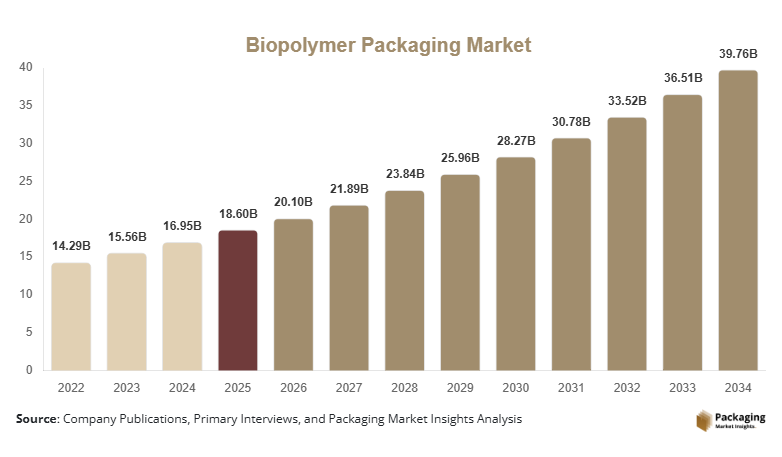
The global biopolymer packaging market size was valued at USD 18.6 billion in 2025 and is projected to reach USD 20.1 billion in 2026. The market is forecast to reach USD 39.8 billion by 2034, expanding at a CAGR of 8.9% during the forecast period from 2025 to 2034. Increasing adoption of biodegradable flexible packaging, rapid expansion of sustainable food delivery solutions, and strong regulatory support for bio-based materials are major contributors to market growth.
The biopolymer packaging market is experiencing significant growth as industries shift toward sustainable and environmentally responsible packaging solutions. Biopolymer packaging materials are derived from renewable sources such as corn starch, sugarcane, cellulose, polylactic acid (PLA), and polyhydroxyalkanoates (PHA). These materials are increasingly used in food packaging, healthcare packaging, personal care products, and industrial applications due to rising environmental concerns and strict regulations on single-use plastics. The transition toward circular economy models and growing consumer awareness regarding biodegradable materials continue to strengthen market demand globally.
Key Highlights
- Europe dominated the market with a 34.2% share in 2025.
- Asia Pacific is projected to grow at the fastest CAGR of 9.6%.
- PLA-based biopolymer packaging led the type segment with a 38.5% share.
- Flexible packaging dominated with a 56.4% share.
- Food & beverage applications led the segment with 47.1% share, while healthcare packaging is expected to grow at a CAGR of 8.8%.
- The US remained the dominant country with a market size of USD 4.3 billion in 2025 and USD 4.7 billion in 2026.
Explore more data points, trends and opportunities Download Free Sample Report
Market Trends
Increasing Adoption of Compostable Flexible Packaging
The growing use of compostable flexible packaging is a major trend in the biopolymer packaging market. Food delivery companies, retail brands, and e-commerce businesses are increasingly adopting compostable pouches, wraps, and films to reduce plastic waste and improve sustainability performance. Flexible biopolymer packaging offers advantages such as lightweight transportation, lower material consumption, and improved shelf presentation. Companies are also focusing on certified compostable packaging materials that comply with international environmental standards. The expansion of organic food retail and sustainable consumer products is further accelerating demand for compostable flexible packaging solutions across developed and emerging markets.
Development of High-Barrier Bio-Based Packaging Materials
Manufacturers are increasingly investing in high-barrier biopolymer packaging technologies to improve moisture resistance, oxygen protection, and product shelf life. Traditional biodegradable packaging materials faced limitations in durability and barrier performance, especially for food and pharmaceutical applications. Recent innovations in multilayer bio-based films, coated cellulose packaging, and advanced PLA formulations are addressing these challenges. Companies are introducing high-performance biopolymer materials suitable for frozen food, dairy products, and healthcare packaging applications. The demand for sustainable packaging with improved functionality is encouraging research and development activities across the packaging industry, supporting long-term market growth.
Market Drivers
Rising Regulations on Single-Use Plastics
Government regulations restricting single-use plastic packaging are a major driver for the biopolymer packaging market. Several countries have introduced bans on conventional plastic bags, food containers, and disposable packaging products to reduce environmental pollution and landfill waste. Regulatory authorities are also promoting recyclable and compostable materials through sustainability targets and waste management policies. These regulations are encouraging food manufacturers, retailers, and packaging companies to adopt bio-based alternatives. The shift toward biodegradable packaging is particularly strong in Europe and North America, where environmental compliance standards continue to become more stringent across consumer goods industries.
Growing Consumer Preference for Sustainable Packaging
Consumers are increasingly demanding environmentally responsible packaging solutions, creating strong growth opportunities for biopolymer packaging manufacturers. Sustainability has become a critical purchasing factor in food, personal care, and healthcare products. Brands are responding by replacing conventional plastic packaging with renewable and biodegradable materials to improve customer perception and reduce environmental impact. Retailers and e-commerce companies are also introducing sustainable packaging strategies to align with consumer expectations. The rising popularity of organic food products and eco-conscious lifestyle trends is accelerating adoption of biopolymer packaging solutions across multiple end-use sectors globally.
Market Restraint
High Production Costs and Limited Industrial Composting Infrastructure
High manufacturing costs associated with biopolymer materials remain a significant restraint for the biopolymer packaging market. Biopolymers such as PLA and PHA generally cost more than traditional petroleum-based plastics due to complex production processes and limited raw material availability. Small and medium-sized packaging manufacturers often face challenges in adopting bio-based materials because of higher operational expenses and limited economies of scale. The cost difference becomes more noticeable in price-sensitive markets where low-cost plastic alternatives continue to dominate packaging applications.
Another major challenge is the limited availability of industrial composting infrastructure in several countries. Although biopolymer packaging materials are designed to biodegrade under controlled conditions, many regions lack proper waste collection and composting systems. As a result, biodegradable packaging products may still end up in conventional landfills, reducing environmental benefits. For example, compostable food packaging used in urban retail markets often requires specialized disposal facilities that are not widely available. This infrastructure gap affects consumer confidence and slows broader market adoption. Additionally, concerns regarding recycling compatibility and material performance continue to create operational challenges for packaging manufacturers and waste management companies.
Market Opportunities
Expansion of Sustainable E-Commerce Packaging
The rapid growth of e-commerce is creating major opportunities for biopolymer packaging manufacturers. Online retailers are increasingly seeking sustainable shipping materials to reduce packaging waste and strengthen environmental commitments. Compostable mailers, biodegradable cushioning materials, and bio-based flexible films are gaining popularity in the e-commerce sector. Consumers are also paying greater attention to packaging sustainability when purchasing products online. Companies introducing lightweight and durable biopolymer packaging tailored for shipping applications are expected to benefit significantly from the expansion of global e-commerce and direct-to-consumer retail channels.
Growth in Bio-Based Healthcare Packaging Applications
Healthcare packaging applications present strong opportunities for the biopolymer packaging market due to rising demand for sustainable medical packaging materials. Hospitals, pharmaceutical manufacturers, and healthcare providers are exploring biodegradable alternatives for medical trays, pouches, blister packaging, and disposable healthcare products. Regulatory pressure to reduce plastic waste in healthcare environments is supporting this transition. Additionally, advancements in sterile biopolymer materials are improving product safety and functionality. The increasing focus on environmentally responsible healthcare operations is expected to encourage broader adoption of bio-based packaging materials across pharmaceutical and medical industries over the forecast period.
Report Scope
| Report Metric | Details |
|---|---|
| Market Size in 2025 | USD 18.6 Billion |
| Market Size in 2026 | USD 20.1 Billion |
| Market Size in 2034 | USD 39.8 Billion |
| CAGR | 8.9% (2026-2034) |
| Base Year for Estimation | 2025 |
| Historical Data | 2022-2024 |
| Forecast Period | 2026-2034 |
| Report Coverage | Revenue Forecast, Competitive Landscape, Supply Chain Disruption, Growth Factors, Environment & Regulatory Landscape and Trends |
| Geographies Covered | North America, Europe, APAC, Middle East and Africa, LATAM |
| Countries Covered | U.S., Canada, U.K., Germany, France, Spain, Italy, Russia, Nordic, Benelux, Rest of Europe, China, South Korea, Japan, India, Australia, Singapore, Taiwan, South East Asia, Rest of Asia-Pacific, UAE, Turky, Saudi Arabia, South Africa, Egypt, Nigeria, Rest of MEA, Brazil, Mexico, Argentina, Chile, Colombia, Rest of LATAM |
Explore more data points, trends and opportunities Download Free Sample Report
Segmental Analysis
By Type
PLA-based biopolymer packaging dominated the market in 2024 with a share of 38.5% due to its commercial availability, cost efficiency, and strong application versatility. Polylactic acid materials are widely used in food containers, cups, trays, flexible films, and disposable packaging products. PLA packaging offers transparency, compostability, and compatibility with conventional processing equipment, making it suitable for high-volume packaging operations. Food service companies and retailers increasingly prefer PLA packaging due to rising restrictions on petroleum-based plastics. Additionally, improvements in PLA blending technologies are enhancing heat resistance and durability, supporting broader use across packaging applications.
PHA-based biopolymer packaging is expected to grow at the fastest CAGR of 10.1% during the forecast period. PHA materials offer improved biodegradability and better environmental performance in marine and soil conditions compared to several conventional biopolymers. Rising concerns regarding ocean plastic pollution are increasing interest in PHA packaging solutions across food and consumer goods industries. Manufacturers are investing in microbial fermentation technologies to improve production efficiency and reduce material costs. Growing demand for high-performance biodegradable packaging with enhanced sustainability characteristics is expected to support strong adoption of PHA materials during the coming years.
By Packaging Type
Flexible biopolymer packaging accounted for the largest market share of 56.4% in 2024 due to its lightweight structure, lower material usage, and suitability for food and retail applications. Flexible packaging products such as compostable films, wraps, pouches, and bags are increasingly used in packaged foods, snacks, and e-commerce shipping. Manufacturers prefer flexible packaging because it reduces transportation costs and supports efficient storage operations. Retail brands are also adopting flexible biopolymer packaging to improve sustainability positioning and meet consumer demand for environmentally friendly products. The segment continues to benefit from technological advancements in biodegradable film production and printing compatibility.
Compostable rigid packaging is projected to expand at the fastest CAGR of 9.3% through 2034. Demand for sustainable rigid trays, cups, bottles, and food containers is increasing rapidly across food service and healthcare industries. Restaurants, cafes, and quick-service chains are replacing plastic containers with compostable rigid alternatives to comply with environmental regulations. Advances in molded fiber technology and reinforced bio-based polymers are improving durability and product performance. Additionally, rising investment in reusable and compostable packaging infrastructure is expected to support strong growth in rigid biopolymer packaging applications globally.
By Application
Food & beverage applications held the largest market share of 47.1% in 2024 due to increasing demand for sustainable packaging in fresh food, snacks, dairy products, and beverages. Food manufacturers are adopting biodegradable packaging materials to comply with sustainability regulations and reduce plastic waste generation. Biopolymer packaging is widely used in takeaway food containers, compostable films, and beverage cups due to growing environmental concerns among consumers. The expansion of organic food markets and sustainable retail initiatives continues to support strong demand for bio-based packaging solutions within the food industry.
Healthcare packaging applications are projected to grow at the fastest CAGR of 8.8% during the forecast period. Pharmaceutical companies and healthcare providers are increasingly exploring biodegradable packaging alternatives for medical trays, blister packs, and disposable healthcare products. Regulatory pressure to reduce healthcare plastic waste and improve environmental sustainability is encouraging adoption of bio-based materials. Advances in sterile biopolymer technologies and high-barrier bio-based films are also improving suitability for medical packaging applications. The increasing focus on environmentally responsible healthcare operations is expected to create strong growth opportunities for biopolymer packaging manufacturers.
Biopolymer Packaging Market Segmentations
By Material Type
- Polylactic Acid (PLA)
- Starch Blends
- Polybutylene Succinate (PBS)
- Polyhydroxyalkanoates (PHA)
- Bio-Polyethylene (Bio-PE)
- Cellulose-Based Polymers
By Packaging Type
- Flexible Packaging
- Rigid Packaging
- Bottles & Containers
- Films & Wraps
- Bags & Pouches
- Trays
By End-Use Industry
- Food & Beverage
- Healthcare
- Personal Care & Cosmetics
- Consumer Goods
- Agriculture
- E-Commerce
Regional Analysis
North America
North America accounted for 28.6% of the global biopolymer packaging market share in 2025 and is projected to expand at a CAGR of 8.4% during the forecast period. The region is witnessing strong demand for sustainable food packaging and compostable retail packaging solutions. Regulatory pressure on plastic waste reduction and increasing consumer awareness regarding biodegradable materials are supporting market growth across the United States and Canada.
The U.S. dominates the North American market due to rising investments in sustainable packaging technologies and strong demand from food service companies. One unique growth factor supporting the U.S. market is the rapid expansion of eco-friendly e-commerce packaging initiatives among retail brands. Major packaging manufacturers are also increasing production capacity for compostable films and bio-based containers to meet growing commercial demand.
Europe
Europe held the largest market share of 34.2% in 2025 and is anticipated to grow at a CAGR of 8.7% through 2034. Strict environmental regulations and strong circular economy policies continue to drive demand for biopolymer packaging solutions. European food manufacturers and retailers are actively replacing petroleum-based plastics with compostable and recyclable materials to comply with packaging waste directives.
Germany remains the dominant country in the European market due to advanced recycling infrastructure and strong industrial sustainability programs. One unique growth factor in Germany is the widespread adoption of biodegradable packaging in supermarket retail chains and organic food distribution networks. Government incentives supporting renewable material innovation are also contributing to the rapid development of biopolymer packaging technologies across the country.
Asia Pacific
Asia Pacific represented 24.8% of the global biopolymer packaging market share in 2025 and is projected to register the fastest CAGR of 9.6% during the forecast period. Rapid urbanization, increasing packaged food consumption, and expanding environmental awareness are supporting regional market growth. Governments across Asia Pacific are introducing plastic reduction initiatives, encouraging adoption of biodegradable packaging alternatives.
China leads the regional market due to large-scale manufacturing capabilities and growing investments in sustainable packaging production. One important growth factor in China is the implementation of national policies restricting non-degradable plastic packaging in retail and food delivery applications. The rapid expansion of e-commerce and food delivery services is also increasing demand for compostable biopolymer packaging materials across the country.
Middle East & Africa
The Middle East & Africa accounted for 5.7% of the global market share in 2025 and is expected to grow at a CAGR of 7.6% through 2034. Rising environmental awareness and increasing investment in sustainable packaging infrastructure are supporting market development across the region. Food service companies and retail businesses are gradually adopting biodegradable packaging solutions to reduce plastic waste generation.
The United Arab Emirates is the dominant country in the regional market due to sustainability-focused government initiatives and expanding retail modernization projects. A unique growth factor in the UAE is the increasing use of compostable packaging materials in hospitality and tourism sectors. Rising demand for environmentally responsible food packaging solutions is encouraging manufacturers to introduce bio-based packaging products in the domestic market.
Latin America
Latin America captured 6.7% of the global biopolymer packaging market share in 2025 and is forecast to grow at a CAGR of 8.1% over the forecast period. Expansion of sustainable agriculture packaging and increasing packaged food exports are supporting regional market growth. Several countries are implementing packaging waste reduction programs, encouraging manufacturers to explore biodegradable material alternatives.
Brazil dominates the Latin American market due to strong agricultural feedstock availability and growing investment in bio-based manufacturing industries. One significant growth factor in Brazil is the increasing use of sugarcane-derived biopolymer materials for packaging production. The country’s renewable resource availability and expanding food processing sector continue to support long-term growth opportunities for biopolymer packaging manufacturers.
Competitive Landscape
The biopolymer packaging market is moderately competitive with the presence of global packaging manufacturers, bio-based material suppliers, and sustainable packaging innovators. Companies are focusing on product innovation, biodegradable material development, and strategic partnerships to strengthen market position. Expansion of compostable packaging production capacity and investments in renewable raw material sourcing remain key competitive strategies across the industry.
NatureWorks LLC, BASF SE, Novamont S.p.A., Amcor plc, and Mondi Group are among the major players operating in the market. NatureWorks LLC remains a leading company due to its extensive PLA material portfolio and strong global distribution network. In 2025, the company introduced a new high-heat resistant PLA packaging grade designed for food service applications.
BASF SE continues expanding its compostable packaging product range for industrial and consumer packaging sectors. Novamont focuses on biodegradable packaging innovation for retail and agricultural applications. Amcor plc and Mondi Group are increasing investments in recyclable and compostable flexible packaging technologies to address rising sustainability demand across global markets.
Key Players List
- NatureWorks LLC
- BASF SE
- Novamont S.p.A.
- Amcor plc
- Mondi Group
- TotalEnergies Corbion
- Danimer Scientific
- FKuR Kunststoff GmbH
- Taghleef Industries
- Sealed Air Corporation
- Huhtamaki Oyj
- Biome Bioplastics
- TIPA Corp Ltd.
- Toray Industries Inc.
- Mitsubishi Chemical Group