Plastic Free Packaging Market Size and Growth
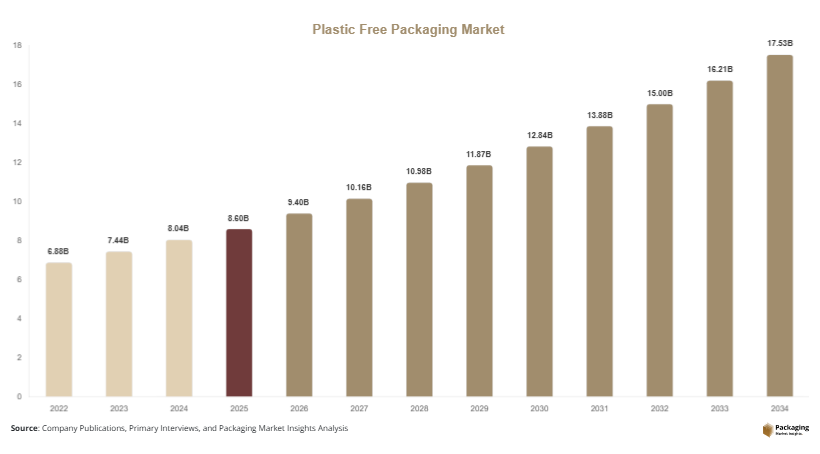
The global plastic free packaging market size was valued at approximately USD 8.6 billion in 2025 and is estimated to reach USD 9.4 billion in 2026, reflecting increasing adoption across food, retail, and healthcare sectors. Over the forecast period from 2025 to 2034, the market is projected to grow at a compound annual growth rate (CAGR) of 8.1%, reaching nearly USD 18.9 billion by 2034. This growth trajectory is supported by regulatory pressures, rising environmental awareness, and continuous innovation in biodegradable materials. The plastic free packaging market is witnessing steady expansion as industries and consumers shift toward sustainable alternatives.
One of the primary growth factors is the implementation of stringent government regulations aimed at reducing plastic waste. Policies banning single-use plastics in several regions are accelerating the transition toward paper-based, compostable, and reusable packaging solutions. Secondly, increasing consumer awareness regarding environmental sustainability is influencing purchasing decisions, encouraging brands to adopt eco-friendly packaging strategies. Thirdly, technological advancements in materials such as molded fiber, seaweed-based packaging, and plant-derived polymers are improving product durability and scalability, making plastic-free alternatives more commercially viable.
Key Market Insights:
- Asia Pacific dominated the market with a 38.1% share in 2025, while Latin America is projected to grow at the fastest CAGR of 8.9%.
- Paper-based packaging led the material segment with a 46.7% share, while edible packaging is expected to grow at a CAGR of 9.4%.
- Food & beverage applications dominated with a 49.3% share, while healthcare packaging is forecasted to grow at a CAGR of 8.7%.
- Flexible packaging held a 41.6% share, while rigid alternatives are expected to expand at a CAGR of 7.8%.
- China remained the dominant country with a market size of USD 2.1 billion in 2025 and USD 2.3 billion in 2026.
Explore more data points, trends and opportunities Download Free Sample Report
Market Trends
Rapid Innovation in Biodegradable and Compostable Materials
The plastic free packaging market is increasingly shaped by advancements in biodegradable and compostable materials. Manufacturers are investing in research to develop packaging derived from natural sources such as cornstarch, bamboo, seaweed, and agricultural residues. These materials not only reduce environmental impact but also meet functional requirements such as moisture resistance and durability. Companies are also focusing on improving shelf life and barrier properties to match conventional plastic packaging. As innovation continues, production costs are gradually declining, making these solutions more accessible to small and medium enterprises. This trend is expected to significantly influence market competitiveness and adoption rates.
Growing Adoption of Circular Economy Practices
Another notable trend is the integration of circular economy principles within packaging strategies. Businesses are increasingly designing products for reuse, recycling, and composting. This includes the development of refillable packaging systems and closed-loop recycling initiatives. Retailers and manufacturers are collaborating to minimize waste generation and optimize resource utilization. Governments and environmental organizations are supporting these initiatives through funding and policy frameworks. The emphasis on lifecycle management is driving companies to rethink packaging design and material selection, contributing to long-term sustainability goals and enhancing brand value in environmentally conscious markets.
Market Drivers
Stringent Environmental Regulations and Policies
Government regulations play a crucial role in driving the plastic free packaging market. Many countries have introduced bans or restrictions on single-use plastics, compelling industries to adopt alternative solutions. These regulations are particularly stringent in regions such as Europe and parts of Asia Pacific. Compliance requirements are pushing manufacturers to invest in sustainable materials and redesign packaging systems. Additionally, penalties for non-compliance and incentives for eco-friendly practices are further accelerating market growth. As regulatory frameworks continue to evolve, companies are proactively aligning their operations with sustainability standards to maintain market presence and competitiveness.
Rising Consumer Demand for Sustainable Products
Consumer behavior is a major factor influencing the growth of the plastic free packaging market. Increasing awareness about environmental issues, such as ocean pollution and landfill waste, is encouraging consumers to choose products with eco-friendly packaging. This shift is particularly evident among younger demographics who prioritize sustainability in purchasing decisions. Brands are responding by adopting plastic-free packaging to enhance customer loyalty and brand reputation. The growing demand for transparency and ethical practices is also prompting companies to disclose packaging materials and environmental impact, further driving the adoption of sustainable solutions.
Market Restraint
High Cost and Limited Scalability of Alternatives
Despite strong growth potential, the plastic free packaging market faces challenges related to cost and scalability. Sustainable materials such as molded fiber, glass, and metal often involve higher production and transportation costs compared to traditional plastics. Additionally, the availability of raw materials and manufacturing infrastructure can be limited, particularly in developing regions. These factors can hinder widespread adoption, especially among small businesses with budget constraints. For example, transitioning from plastic to paper-based packaging in the food industry may require significant investment in machinery and supply chain adjustments. This cost barrier can slow down market penetration and limit growth in price-sensitive markets.
Market Opportunities
Expansion in E-commerce and Retail Packaging
The rapid growth of e-commerce presents significant opportunities for the plastic free packaging market. Online retailers are under increasing pressure to reduce packaging waste and adopt sustainable practices. Plastic-free packaging solutions such as corrugated boxes, paper wraps, and compostable fillers are gaining popularity. Companies are also exploring innovative designs to minimize material usage while ensuring product safety during transit. As e-commerce continues to expand globally, the demand for sustainable packaging solutions is expected to rise, creating new growth avenues for manufacturers and suppliers.
Technological Advancements in Edible and Smart Packaging
Emerging technologies in edible and smart packaging offer promising opportunities for market expansion. Edible packaging made from natural ingredients such as seaweed and starch is gaining attention for its zero-waste potential. Additionally, smart packaging solutions that incorporate sensors and indicators can enhance product safety and shelf life without relying on plastic materials. These innovations are attracting investments from both startups and established companies. As research and development efforts continue, these advanced solutions are expected to become more commercially viable, driving growth in niche segments of the plastic free packaging market.
Report Scope
| Report Metric | Details |
|---|---|
| Market Size in 2025 | USD 8.6 Billion |
| Market Size in 2026 | USD 9.4 Billion |
| Market Size in 2034 | USD 18.9 Billion |
| CAGR | 8.1% (2026-2034) |
| Base Year for Estimation | 2025 |
| Historical Data | 2022-2024 |
| Forecast Period | 2026-2034 |
| Report Coverage | Revenue Forecast, Competitive Landscape, Supply Chain Disruption, Growth Factors, Environment & Regulatory Landscape and Trends |
| Geographies Covered | North America, Europe, APAC, Middle East and Africa, LATAM |
| Countries Covered | U.S., Canada, U.K., Germany, France, Spain, Italy, Russia, Nordic, Benelux, Rest of Europe, China, South Korea, Japan, India, Australia, Singapore, Taiwan, South East Asia, Rest of Asia-Pacific, UAE, Turky, Saudi Arabia, South Africa, Egypt, Nigeria, Rest of MEA, Brazil, Mexico, Argentina, Chile, Colombia, Rest of LATAM |
Explore more data points, trends and opportunities Download Free Sample Report
Segmental Analysis
By Material Type
Paper-based packaging emerged as the dominant subsegment, accounting for approximately 46.7% of the market share in 2024. Its widespread adoption is attributed to its recyclability, biodegradability, and cost-effectiveness compared to other alternatives. Industries such as food and beverage, retail, and personal care heavily rely on paper-based solutions due to their versatility and ease of customization. Additionally, advancements in coating technologies have enhanced the barrier properties of paper packaging, making it suitable for a broader range of applications. The increasing availability of raw materials and established recycling infrastructure further support the dominance of this segment.
Edible packaging is projected to be the fastest-growing subsegment, with a CAGR of 9.4% during the forecast period. This growth is driven by increasing demand for zero-waste solutions and innovative packaging concepts. Edible packaging materials, derived from natural ingredients such as seaweed and starch, offer a sustainable alternative to conventional packaging. The food industry, in particular, is exploring these solutions to reduce waste and enhance customer experience. Continuous research and development efforts are expected to improve product functionality and scalability, further driving growth in this segment.
By Application
The food & beverage segment dominated the market in 2024, holding a share of 49.3%. This dominance is due to the high volume of packaging required in this industry and increasing regulatory scrutiny regarding plastic usage. Companies are actively adopting plastic-free packaging solutions to comply with regulations and meet consumer expectations. The demand for sustainable packaging in this segment is further supported by the growth of the organic and natural food market, where eco-friendly packaging is a key selling point.
Healthcare packaging is expected to be the fastest-growing application segment, with a CAGR of 8.7%. The growth is driven by increasing demand for safe and sustainable packaging solutions in the pharmaceutical and medical sectors. Plastic-free alternatives such as glass, metal, and paper-based materials are gaining traction due to their ability to maintain product integrity while reducing environmental impact. Additionally, regulatory requirements for sustainable practices in healthcare are further supporting the growth of this segment.
By Packaging Type
Flexible packaging held the largest share of 41.6% in 2024, driven by its lightweight nature and cost efficiency. This type of packaging is widely used in food, retail, and personal care industries due to its convenience and adaptability. Innovations in biodegradable films and compostable materials have enhanced the functionality of flexible packaging, making it a viable alternative to plastic-based solutions. The ability to reduce transportation costs and improve shelf appeal further contributes to the dominance of this segment.
Rigid packaging is expected to grow at a CAGR of 7.8%, making it the fastest-growing subsegment. This growth is driven by increasing demand for durable and reusable packaging solutions. Materials such as glass, metal, and molded fiber are gaining popularity due to their strength and sustainability. The shift toward premium packaging in sectors such as cosmetics and beverages is also contributing to the growth of rigid packaging. As consumer preferences continue to evolve, the demand for high-quality, sustainable packaging solutions is expected to rise.
Plastic Free Packaging Market Segmentations
By Material Type
- Paper-Based Packaging
- Glass Packaging
- Metal Packaging
- Edible Packaging
- Others
By Application
- Food & Beverage
- Healthcare
- Personal Care
- Retail & E-commerce
By Packaging Type
- Flexible Packaging
- Rigid Packaging
Regional Analysis
North America
North America accounted for approximately 22.5% of the plastic free packaging market share in 2025 and is projected to grow at a CAGR of 7.6% during the forecast period. The region’s growth is driven by increasing regulatory measures and consumer awareness regarding environmental sustainability. The presence of established packaging companies and strong investment in research and development further supports market expansion.
The United States dominates the regional market due to its advanced infrastructure and high adoption of sustainable practices. A key growth factor is the increasing demand from the food and beverage industry, where companies are actively transitioning to eco-friendly packaging to meet regulatory requirements and consumer expectations.
Europe
Europe held a significant market share of 26.8% in 2025 and is expected to grow at a CAGR of 7.9%. The region is characterized by strict environmental regulations and strong government support for sustainable initiatives. Countries across Europe are implementing policies to reduce plastic waste, driving the adoption of alternative packaging solutions.
Germany leads the European market, supported by its robust manufacturing sector and commitment to sustainability. A unique growth factor is the widespread adoption of circular economy practices, which encourages recycling and reuse, thereby boosting demand for plastic-free packaging solutions.
Asia Pacific
Asia Pacific dominated the market with a 38.1% share in 2025 and is projected to grow at a CAGR of 8.5%. Rapid urbanization, increasing population, and rising environmental awareness are key factors driving growth in this region. Governments are also implementing policies to reduce plastic usage, further supporting market expansion.
China is the leading country in the region, driven by large-scale manufacturing capabilities and strong government initiatives. A unique growth factor is the rapid expansion of the e-commerce sector, which is increasing demand for sustainable packaging solutions across various industries.
Middle East & Africa
The Middle East & Africa region held a smaller share of 6.4% in 2025 but is expected to grow at a CAGR of 7.2%. The market is gradually gaining traction as awareness about environmental issues increases and governments introduce sustainability initiatives.
The United Arab Emirates is a key market in the region, driven by its focus on reducing plastic waste and promoting green initiatives. A unique growth factor is the increasing investment in sustainable tourism, which is encouraging the adoption of eco-friendly packaging solutions.
Latin America
Latin America accounted for 6.2% of the market share in 2025 and is projected to grow at the fastest CAGR of 8.9%. The region is experiencing increasing demand for sustainable packaging due to rising environmental concerns and regulatory measures.
Brazil dominates the regional market, supported by its large consumer base and growing retail sector. A unique growth factor is the increasing adoption of biodegradable materials in the agricultural sector, which is driving demand for plastic-free packaging solutions.
Competitive Landscape
The plastic free packaging market is moderately competitive, with several global and regional players focusing on innovation and sustainability. Companies are investing in research and development to introduce new materials and improve existing solutions. Strategic partnerships, mergers, and acquisitions are common strategies used to expand market presence and enhance product portfolios.
A leading company in the market is DS Smith Plc, known for its focus on sustainable packaging solutions and circular economy practices. The company recently introduced a range of fully recyclable packaging products designed for e-commerce applications. Other key players are also emphasizing innovation and sustainability to remain competitive in the evolving market landscape.
Key Players List
- DS Smith Plc
- Mondi Group
- Smurfit Kappa Group
- International Paper Company
- WestRock Company
- Stora Enso Oyj
- UPM-Kymmene Corporation
- Amcor plc
- Tetra Pak International S.A.
- Huhtamaki Oyj
- Sealed Air Corporation
- Berry Global Inc.
- Crown Holdings Inc.
- Ball Corporation
- Sonoco Products Company