Cornstarch Packaging Market Size and Growth
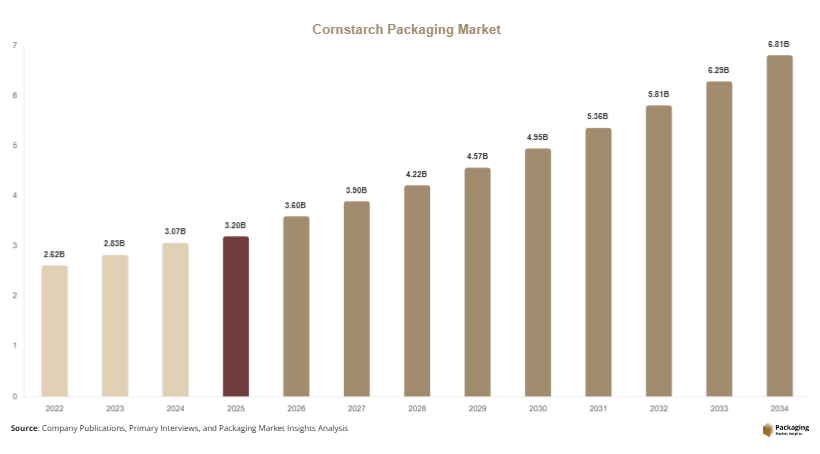
The global cornstarch packaging market size is estimated at USD 3.2 billion in 2025, which is projected to reach USD 3.6 billion in 2026. Over the forecast period from 2025 to 2034, the market is expected to expand to USD 7.4 billion, registering a CAGR of 8.3%. The cornstarch packaging market is gaining significant traction as industries transition toward biodegradable and sustainable packaging solutions. Cornstarch-based packaging materials are derived from renewable agricultural sources and are widely used as an eco-friendly alternative to conventional plastic packaging. These materials are compostable, non-toxic, and suitable for a range of applications including food packaging, protective packaging, and disposable products.
The shift toward sustainable packaging is a primary factor supporting market growth. Governments and regulatory bodies across regions are imposing restrictions on single-use plastics, encouraging industries to adopt biodegradable alternatives such as cornstarch-based materials. Additionally, rising consumer awareness regarding environmental issues is influencing purchasing behavior, leading to increased demand for eco-friendly packaging solutions. The food and beverage industry is a major contributor to this demand, as companies seek packaging materials that align with sustainability goals while maintaining product safety and quality.
Key Market Insights:
- Asia Pacific dominated the market with a 38.2% share in 2025.
- Latin America is projected to grow at the fastest CAGR of 8.9%.
- Loose-fill packaging led the type segment with a 31.4% share.
- Cornstarch-based polymers dominated with a 58.6% share.
- Food & beverage applications led the segment with 46.3% share.
- US remained the dominant country with a market size of USD 1.2 billion in 2025 and USD 1.3 billion in 2026.
Explore more data points, trends and opportunities Download Free Sample Report
Market Trends
Rising adoption of biodegradable and compostable packaging materials
The increasing focus on sustainability is shaping the cornstarch packaging market. Industries are shifting toward biodegradable materials to reduce environmental impact and comply with regulatory requirements. Cornstarch packaging decomposes naturally, making it suitable for applications such as food containers, protective fillers, and disposable items. For example, food delivery companies are replacing plastic containers with cornstarch-based alternatives to meet sustainability targets.
This trend is expected to strengthen as governments implement stricter regulations on plastic waste management. In the future, advancements in composting infrastructure and waste management systems will support the adoption of cornstarch packaging. Manufacturers are also likely to invest in improving product performance, ensuring that biodegradable materials meet industry standards for durability and functionality.
Increasing innovation in material blends and performance enhancement
Material innovation is playing a critical role in expanding the application scope of cornstarch packaging. Manufacturers are developing blended materials that combine cornstarch with other biodegradable polymers to improve strength, flexibility, and moisture resistance. For instance, blended cornstarch packaging is being used for packaging perishable goods, offering better protection compared to traditional biodegradable materials.
The future impact of this trend includes increased adoption across industries such as electronics and industrial packaging. Enhanced material properties will allow cornstarch packaging to replace conventional plastics in more demanding applications. Additionally, innovations in production techniques are expected to reduce costs, making these materials more accessible to small and medium enterprises.
Market Drivers
Growing regulatory pressure against single-use plastics
Government regulations aimed at reducing plastic waste are a major driver for the cornstarch packaging market. Many countries have implemented bans or restrictions on single-use plastics, encouraging industries to adopt biodegradable alternatives. Cornstarch packaging offers a sustainable solution, as it is derived from renewable resources and decomposes naturally.
For example, retail chains and food service providers are transitioning to cornstarch-based packaging to comply with environmental regulations. This shift is creating consistent demand across multiple sectors. As regulations become more stringent, companies are expected to accelerate their adoption of eco-friendly packaging solutions, further driving market growth.
Expansion of food delivery and e-commerce industries
The rapid growth of food delivery and e-commerce sectors is contributing to the increased demand for cornstarch packaging. These industries require packaging solutions that are lightweight, protective, and disposable. Cornstarch-based materials meet these requirements while also supporting sustainability goals.
For instance, online retailers are using cornstarch loose-fill packaging to protect products during transit. This not only ensures product safety but also enhances brand image by demonstrating environmental responsibility. As e-commerce continues to expand globally, the demand for biodegradable packaging solutions is expected to increase significantly.
Market Restraint
High production costs and limited scalability
One of the key challenges in the cornstarch packaging market is the relatively high cost of production compared to conventional plastic packaging. Cornstarch-based materials require specialized processing techniques and raw materials, which can increase manufacturing costs. This makes it difficult for small and medium enterprises to adopt these solutions on a large scale.
For example, while large corporations can invest in sustainable packaging, smaller businesses may find it challenging to justify the higher costs. Additionally, fluctuations in raw material availability, such as corn supply, can impact pricing and production stability. These factors can limit market growth, particularly in price-sensitive regions.
Market Opportunities
Increasing demand in emerging economies
Emerging economies present significant opportunities for the cornstarch packaging market. Rising disposable income and growing environmental awareness are driving demand for sustainable packaging solutions. Countries in Asia Pacific and Latin America are witnessing increased adoption of biodegradable materials across industries.
For instance, local food chains in these regions are transitioning to eco-friendly packaging to meet consumer expectations. In the future, government incentives and investments in sustainable infrastructure are expected to support market growth. This creates opportunities for manufacturers to expand their presence in these regions.
Development of cost-effective and high-performance materials
The development of cost-effective and high-performance cornstarch packaging materials is another key opportunity. Manufacturers are focusing on improving production efficiency and reducing costs through technological advancements. This includes the use of blended materials and optimized manufacturing processes.
For example, innovations in extrusion and molding techniques are enabling the production of durable and lightweight packaging solutions. In the future, these advancements will make cornstarch packaging more competitive with traditional materials, expanding its adoption across industries such as electronics, healthcare, and industrial packaging.
Report Scope
| Report Metric | Details |
|---|---|
| Market Size in 2025 | USD 3.2 Billion |
| Market Size in 2026 | USD 3.6 Billion |
| Market Size in 2034 | USD 7.4 Billion |
| CAGR | 8.3% (2026-2034) |
| Base Year for Estimation | 2025 |
| Historical Data | 2022-2024 |
| Forecast Period | 2026-2034 |
| Report Coverage | Revenue Forecast, Competitive Landscape, Supply Chain Disruption, Growth Factors, Environment & Regulatory Landscape and Trends |
| Geographies Covered | North America, Europe, APAC, Middle East and Africa, LATAM |
| Countries Covered | U.S., Canada, U.K., Germany, France, Spain, Italy, Russia, Nordic, Benelux, Rest of Europe, China, South Korea, Japan, India, Australia, Singapore, Taiwan, South East Asia, Rest of Asia-Pacific, UAE, Turky, Saudi Arabia, South Africa, Egypt, Nigeria, Rest of MEA, Brazil, Mexico, Argentina, Chile, Colombia, Rest of LATAM |
Explore more data points, trends and opportunities Download Free Sample Report
Segmental Analysis
By Type
Loose-fill packaging dominated the market in 2024 with a 31.4% share, driven by its widespread use in protective packaging applications. These materials are commonly used for cushioning fragile items during shipping, particularly in e-commerce and logistics industries. Cornstarch-based loose-fill packaging offers advantages such as biodegradability, lightweight structure, and effective shock absorption. For example, online retailers use these materials to protect electronics and glass items during transit.
Molded packaging is the fastest-growing segment, with a projected CAGR of 8.7%. This growth is driven by increasing demand for customized and durable packaging solutions. Molded cornstarch packaging is used for food containers and protective packaging for electronics. Future advancements in molding techniques are expected to improve product performance and expand applications.
By Material
Cornstarch-based polymers dominated the market with a 58.6% share in 2024 due to their biodegradability and versatility. These materials are widely used in packaging applications such as bags, containers, and protective fillers. For instance, manufacturers use cornstarch polymers to produce compostable packaging solutions for food and retail industries.
Blended biodegradable materials are the fastest-growing segment, with a CAGR of 8.5%. These materials combine cornstarch with other polymers to improve strength and durability. The growth is driven by increasing demand for high-performance packaging solutions. Future innovations are expected to enhance material properties and expand applications.
By End-Use
Food & beverage applications accounted for the largest share of 46.3% in 2024, driven by the need for sustainable packaging solutions. Cornstarch packaging is widely used for food containers, trays, and disposable items. For example, restaurants and food delivery services use biodegradable packaging to reduce environmental impact.
E-commerce packaging is the fastest-growing segment, with a CAGR of 8.8%. The increasing demand for protective and eco-friendly packaging solutions is driving growth. Cornstarch packaging provides cushioning and protection while supporting sustainability goals. As e-commerce continues to expand, demand for these materials is expected to increase.
Cornstarch Packaging Market Segmentations
By Type
- Loose-Fill Packaging
- Molded Packaging
- Bags & Films
By Material
- Cornstarch-Based Polymers
- Blended Biodegradable Materials
- Others
By End-User
- Food & Beverage
- E-commerce
- Healthcare
- Industrial Packaging
Regional Analysis
North America
North America accounted for approximately 22.4% of the cornstarch packaging market share in 2025 and is projected to grow at a CAGR of 7.5% through 2034. The region benefits from strong environmental regulations and high consumer awareness regarding sustainable packaging. Industries such as food and beverage, retail, and healthcare are actively adopting biodegradable materials to reduce their environmental footprint. The presence of advanced manufacturing infrastructure and investment in research and development further supports market growth. Additionally, the expansion of e-commerce is driving demand for protective and eco-friendly packaging solutions.
The United States dominates the regional market due to its large consumer base and strong regulatory framework. A unique growth driver is the increasing adoption of compostable packaging in food service industries. For example, restaurants and delivery platforms are using cornstarch containers and packaging to align with sustainability goals. This trend is expected to continue, supported by government initiatives and consumer demand for eco-friendly products.
Europe
Europe held a 20.8% market share in 2025 and is expected to grow at a CAGR of 7.2% during the forecast period. The region’s focus on sustainability and circular economy principles is driving the adoption of cornstarch packaging. Strict regulations on plastic waste and increasing investment in recycling infrastructure are supporting market growth. Countries such as Germany, France, and the UK are leading the transition toward biodegradable packaging solutions.
Germany is the dominant country in the region, supported by its strong manufacturing base and environmental policies. A unique growth driver is the emphasis on eco-labeling and sustainable branding. For instance, companies are using cornstarch packaging to enhance their brand image and comply with environmental standards. This trend is expected to drive further adoption across industries.
Asia Pacific
Asia Pacific emerged as the largest regional market with a 38.2% share in 2025 and is projected to grow at a CAGR of 8.6%. Rapid urbanization, increasing population, and rising disposable income are driving demand for sustainable packaging solutions. The region’s expanding food and beverage industry is a major contributor to market growth. Additionally, government initiatives to reduce plastic waste are encouraging the adoption of biodegradable materials.
China dominates the Asia Pacific market due to its large manufacturing base and growing consumer market. A significant growth driver is the expansion of e-commerce and food delivery services. For example, companies are adopting cornstarch packaging to meet environmental regulations and consumer expectations. This trend is expected to support market growth in the region.
Middle East & Africa
The Middle East & Africa region accounted for 7.6% of the market share in 2025 and is expected to grow at a CAGR of 7.9%. The region is witnessing increased awareness regarding environmental sustainability and waste management. Investments in retail and food service sectors are driving demand for eco-friendly packaging solutions. Countries such as the UAE and South Africa are focusing on reducing plastic usage and promoting biodegradable alternatives.
The UAE is a key market in the region, supported by its strong retail and tourism sectors. A unique growth driver is the increasing demand for sustainable packaging in hospitality and food services. For instance, hotels and restaurants are adopting cornstarch-based packaging for takeaway and delivery services. This trend is expected to drive market growth.
Latin America
Latin America held a 11.0% market share in 2025 and is projected to grow at the fastest CAGR of 8.9%. The region is experiencing growth due to increasing environmental awareness and government initiatives to reduce plastic waste. Countries such as Brazil and Mexico are leading the adoption of biodegradable packaging solutions.
Brazil dominates the regional market, supported by its large agricultural base and growing consumer demand. A key growth driver is the expansion of the food processing industry, which requires sustainable packaging solutions. For example, companies are using cornstarch packaging to reduce environmental impact and improve brand image. This trend is expected to support market growth in the region.
Competitive Landscape
The cornstarch packaging market is moderately competitive, with a mix of global and regional players focusing on innovation, sustainability, and cost efficiency. Companies are investing in research and development to improve material performance and expand product offerings. Strategic partnerships and collaborations are also common, enabling companies to strengthen their market presence.
Novamont S.p.A. is identified as a market leader due to its strong focus on biodegradable materials and innovative product portfolio. The company has been investing in advanced technologies to develop high-performance cornstarch-based packaging solutions. Other key players are adopting strategies such as product launches, capacity expansion, and acquisitions to remain competitive.
Recent developments include the introduction of blended materials, advancements in production processes, and increased focus on reducing production costs. Companies are also leveraging automation and digital technologies to improve efficiency and scalability. These strategies are expected to drive competition and innovation in the market.
Key Players
- Novamont S.p.A.
- NatureWorks LLC
- BASF SE
- TotalEnergies Corbion
- Biopak Pty Ltd
- Eco-Products Inc.
- Vegware Ltd.
- Green Dot Bioplastics
- TianAn Biologic Materials Co., Ltd.
- Cardia Bioplastics
- Plantic Technologies Ltd.
- TIPA Corp
- Biome Bioplastics
- Danimer Scientific
- FKuR Kunststoff GmbH