Cassava Based Packaging Market Size and Growth
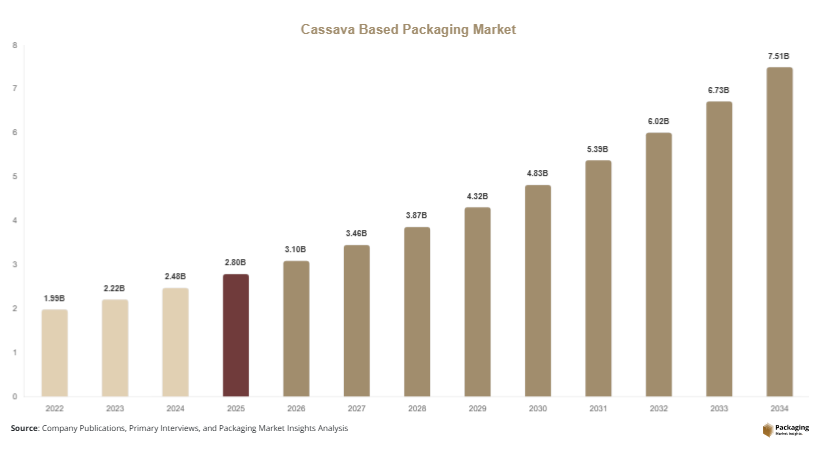
The cassava based packaging market size was valued at approximately USD 2.8 billion in 2025 and is projected to reach USD 3.1 billion in 2026. The market is forecasted to grow significantly and reach nearly USD 8.4 billion by 2034, expanding at a CAGR of 11.7% during 2025–2034. Increasing adoption of biodegradable packaging across food service, retail, and e-commerce sectors continues to support long-term market growth. Governments in several countries are implementing restrictions on traditional plastic packaging, creating strong opportunities for cassava-derived packaging manufacturers.
The global cassava based packaging market is gaining substantial attention as industries increasingly shift toward biodegradable and compostable packaging alternatives. Cassava-based packaging materials are produced using starch extracted from cassava roots, offering an eco-friendly substitute for petroleum-based plastics. These materials are widely used in shopping bags, food packaging films, disposable cutlery packaging, agricultural packaging, and flexible wrapping applications. Growing environmental concerns, tightening regulations on single-use plastics, and increasing consumer demand for sustainable packaging solutions are accelerating market expansion across multiple industries.
Key Highlights
- Asia Pacific dominated the market with a 42.6% share in 2025.
- Latin America is projected to grow at the fastest CAGR of 12.4%.
- Cassava starch bags led the type segment with a 38.9% share.
- Biopolymer blends dominated the material segment with a 49.3% share.
- Food & beverage applications led the end-use segment with 44.7% share.
- The US remained the dominant country with a market size of USD 0.7 billion in 2025 and USD 0.8 billion in 2026.
Explore more data points, trends and opportunities Download Free Sample Report
Market Trends
Increasing Adoption of Compostable Retail Packaging
One of the key trends shaping the cassava based packaging market is the growing use of compostable retail packaging solutions. Supermarkets, fashion retailers, and food delivery businesses are increasingly replacing traditional plastic carry bags with cassava-based biodegradable alternatives. Retail chains are promoting eco-friendly packaging initiatives to meet sustainability goals and comply with plastic waste regulations. For example, several retail companies in Southeast Asia and Europe have introduced cassava-based shopping bags that decompose naturally within months under composting conditions. Consumers are responding positively to packaging solutions that reduce landfill waste and environmental pollution. Future growth in compostable retail packaging is expected to support wider adoption of cassava-based materials across grocery, apparel, and consumer goods industries.
Expansion of Bio-Based Flexible Packaging Films
Another significant trend is the rising development of cassava-based flexible packaging films for food and e-commerce applications. Packaging manufacturers are investing in multilayer biodegradable films that improve moisture resistance, flexibility, and product protection. These films are increasingly used for snack packaging, produce wrapping, courier bags, and disposable packaging applications. For instance, food delivery companies in Indonesia and Thailand are experimenting with cassava-derived mailer bags and food wraps to reduce dependence on petroleum-based plastics. Technological improvements in blending cassava starch with biodegradable polymers are improving film strength and shelf performance. As sustainable logistics and eco-friendly food packaging gain importance, demand for cassava-based flexible films is expected to increase steadily over the forecast period.
Market Drivers
Rising Government Restrictions on Conventional Plastics
Government regulations limiting the use of single-use plastics are a major factor driving the cassava based packaging market. Countries across Europe, Asia Pacific, and North America are introducing bans and taxation policies targeting non-biodegradable plastic packaging products. These regulations are encouraging manufacturers and retailers to adopt renewable and compostable packaging materials. Cassava-based packaging solutions are gaining popularity because they can decompose naturally without generating long-term plastic pollution. For example, Indonesia and Thailand have implemented sustainability programs supporting biodegradable packaging production using cassava starch. Increasing environmental awareness among policymakers and consumers is accelerating the replacement of traditional plastic bags and packaging films with cassava-based alternatives across multiple industries.
Growing Consumer Preference for Sustainable Packaging
The increasing demand for sustainable consumer products is another major driver supporting market growth. Consumers are becoming more conscious of packaging waste and environmental impact, encouraging brands to adopt biodegradable materials. Food delivery businesses, supermarkets, and personal care brands are actively promoting compostable packaging solutions to strengthen sustainability credentials. Cassava-based packaging products are attracting attention because they are plant-derived and compatible with circular economy goals. For example, restaurants and cafés in urban markets are increasingly using cassava-based takeaway packaging and disposable bags to appeal to environmentally conscious customers. Rising public awareness regarding plastic pollution is expected to continue driving demand for biodegradable cassava packaging products worldwide.
Market Restraint
Limited Moisture Resistance and Higher Production Costs
One of the primary restraints affecting the cassava based packaging market is the limited moisture resistance and relatively high production costs associated with biodegradable packaging materials. Cassava-based packaging products may experience reduced durability under humid storage conditions compared to traditional petroleum-based plastics. This can limit their use in certain industrial and long-term packaging applications. In addition, biodegradable packaging production often requires specialized processing technologies and bio-based additives that increase manufacturing costs. Small businesses and price-sensitive industries may hesitate to adopt cassava packaging because of higher material expenses. For example, conventional plastic packaging continues to dominate low-cost retail sectors in several developing economies due to its affordability and long shelf stability. Limited industrial composting infrastructure in some countries also restricts the full environmental benefits of biodegradable packaging. These factors may slow market penetration in cost-sensitive applications and regions with underdeveloped waste management systems.
Market Opportunities
Expansion of Sustainable E-Commerce Packaging
The rapid growth of e-commerce is creating substantial opportunities for the cassava based packaging market. Online retailers and logistics providers are increasingly seeking biodegradable alternatives for courier bags, protective films, and product packaging. Cassava-based mailer bags are gaining popularity because they reduce plastic waste while supporting corporate sustainability initiatives. E-commerce companies are under growing pressure from consumers and regulators to minimize packaging-related environmental impact. Countries such as the United States, China, and India are witnessing rising adoption of compostable packaging for online deliveries. Future advancements in water-resistant cassava packaging films and biodegradable adhesive technologies are expected to further strengthen growth opportunities in sustainable e-commerce packaging applications.
Growth in Food Service and Takeaway Packaging Applications
The increasing demand for sustainable takeaway and food delivery packaging presents another major opportunity for market participants. Restaurants, cafés, and food delivery platforms are replacing plastic packaging with biodegradable alternatives to comply with sustainability commitments and local environmental regulations. Cassava-based packaging materials are increasingly used for disposable carry bags, food wraps, and takeaway packaging products. In Southeast Asia, several food delivery companies are partnering with biodegradable packaging manufacturers to reduce plastic waste generated by takeaway orders. Future growth is expected to emerge from compostable multilayer packaging technologies designed for oily and moisture-sensitive food applications. Rising urban food delivery demand is likely to support long-term expansion of cassava-based food packaging solutions.
Report Scope
| Report Metric | Details |
|---|---|
| Market Size in 2025 | USD 2.8 Billion |
| Market Size in 2026 | USD 3.1 Billion |
| Market Size in 2034 | USD 8.4 Billion |
| CAGR | 11.7% (2026-2034) |
| Base Year for Estimation | 2025 |
| Historical Data | 2022-2024 |
| Forecast Period | 2026-2034 |
| Report Coverage | Revenue Forecast, Competitive Landscape, Supply Chain Disruption, Growth Factors, Environment & Regulatory Landscape and Trends |
| Geographies Covered | North America, Europe, APAC, Middle East and Africa, LATAM |
| Countries Covered | U.S., Canada, U.K., Germany, France, Spain, Italy, Russia, Nordic, Benelux, Rest of Europe, China, South Korea, Japan, India, Australia, Singapore, Taiwan, South East Asia, Rest of Asia-Pacific, UAE, Turky, Saudi Arabia, South Africa, Egypt, Nigeria, Rest of MEA, Brazil, Mexico, Argentina, Chile, Colombia, Rest of LATAM |
Explore more data points, trends and opportunities Download Free Sample Report
Segmental Analysis
By Type
Cassava starch bags dominated the market in 2024 with approximately 38.9% share due to their widespread use in retail shopping, grocery packaging, and food delivery applications. These biodegradable bags are increasingly replacing conventional single-use plastic carry bags across supermarkets, convenience stores, and food service outlets. Businesses prefer cassava starch bags because they decompose naturally while maintaining acceptable load-bearing strength for everyday retail use. Countries in Southeast Asia and Europe are witnessing rapid adoption of compostable shopping bags as governments strengthen plastic waste regulations. Packaging manufacturers are also improving bag durability through advanced starch blending technologies and multilayer biodegradable film structures. Continued expansion of sustainable retail packaging programs is expected to maintain segment dominance during the forecast period.
Cassava-based flexible films are projected to be the fastest-growing type segment, registering a CAGR of 12.8% during the forecast period. Flexible films are increasingly used in food wrapping, courier packaging, disposable liners, and agricultural applications. Manufacturers are investing in moisture-resistant and puncture-resistant biodegradable films to improve commercial performance across multiple industries. Rising demand for eco-friendly e-commerce packaging and compostable food packaging is accelerating adoption of cassava-based flexible films globally. Countries such as Indonesia, Thailand, and India are expanding production capacities for biodegradable flexible packaging products. Future innovation in barrier coating technologies and bio-based polymer blends is expected to strengthen the durability and scalability of cassava-derived flexible films.
By Material
Biopolymer blends dominated the material segment in 2024 with approximately 49.3% share because they offer improved flexibility, strength, and moisture resistance compared to pure starch materials. Manufacturers commonly combine cassava starch with biodegradable polymers such as PLA and PBAT to enhance packaging performance across industrial and retail applications. These blends are widely used in shopping bags, food wraps, and compostable courier packaging. Packaging companies prefer blended materials because they improve product durability while maintaining biodegradability standards. In addition, blended biopolymers support better machine compatibility for high-volume packaging production processes. Increasing commercial demand for durable biodegradable packaging continues to support strong adoption of biopolymer blend materials globally.
Pure cassava starch materials are expected to emerge as the fastest-growing material segment with a CAGR of 13.1% during the forecast period. Rising consumer preference for fully plant-based and renewable packaging products is encouraging manufacturers to reduce dependence on synthetic biodegradable additives. Packaging companies are investing in improved starch processing technologies to strengthen flexibility and moisture resistance of pure cassava packaging materials. Governments and environmental organizations are also promoting fully compostable packaging products to support circular economy goals. Countries with abundant cassava cultivation are expected to witness rising investment in locally sourced pure starch packaging production. Continued technological improvements are likely to improve product performance and expand commercial applications for pure cassava materials.
By End-Use
Food & beverage applications dominated the market in 2024 with approximately 44.7% share due to increasing demand for biodegradable takeaway packaging, shopping bags, and food wrapping solutions. Restaurants, cafés, supermarkets, and food delivery businesses are increasingly replacing traditional plastic packaging with cassava-derived biodegradable alternatives. Rising consumer preference for sustainable food packaging and stricter environmental regulations are supporting segment growth globally. Packaging manufacturers are introducing compostable food wraps and moisture-resistant takeaway packaging designed for hot and oily food products. Rapid growth in online food delivery services across Asia Pacific and North America is also increasing demand for biodegradable flexible packaging products. These factors continue to support strong growth for cassava-based packaging in food-related applications.
E-commerce packaging is projected to grow at the fastest CAGR of 13.4% during the forecast period. Online retail companies are increasingly adopting compostable courier bags and protective packaging materials to reduce plastic waste associated with logistics operations. Businesses are integrating biodegradable packaging into sustainability strategies to improve environmental performance and customer perception. Cassava-based mailer bags are becoming popular because they combine lightweight properties with biodegradability advantages. Packaging suppliers are also developing improved flexible films and water-resistant coatings suitable for e-commerce logistics environments. Rising consumer expectations regarding sustainable packaging and increasing environmental regulations targeting online retail waste are expected to accelerate adoption of cassava-based e-commerce packaging solutions globally.
Cassava Based Packaging Market Segmentations
By Type
- Cassava Starch Bags
- Flexible Packaging Films
- Compostable Wrappers
- Disposable Packaging Products
By Material
- Pure Cassava Starch
- Biopolymer Blends
- Starch-Based Composites
- Fiber-Reinforced Materials
By End-User
- Food & Beverage
- Retail Packaging
- E-Commerce Packaging
- Agriculture Packaging
- Consumer Goods Packaging
Regional Analysis
North America
North America accounted for approximately 21.4% of the global market share in 2025 and is projected to grow at a CAGR of 10.8% during the forecast period. Rising environmental awareness, increasing restrictions on single-use plastics, and strong consumer demand for sustainable products are supporting regional market growth. Businesses across the United States and Canada are increasingly adopting biodegradable shopping bags, flexible films, and compostable food packaging made from cassava starch. Retail chains and restaurant operators are investing in sustainable packaging initiatives to improve environmental compliance and brand image. In addition, growing investment in bio-based material research is encouraging innovation in cassava-derived packaging technologies across the region.
The United States dominates the North American market due to strong sustainability investments and rising adoption of eco-friendly packaging solutions across food service and retail industries. A unique growth driver in the country is the increasing expansion of sustainable e-commerce packaging programs. Major online retailers are experimenting with compostable mailer bags and biodegradable packaging films to reduce plastic waste generated by logistics operations. Rising state-level plastic regulations and growing consumer demand for environmentally responsible packaging are expected to continue driving cassava-based packaging adoption throughout the forecast period.
Europe
Europe represented nearly 24.1% market share in 2025 and is forecasted to expand at a CAGR of 10.5% through 2034. Strong environmental policies and aggressive circular economy targets are major factors supporting regional market expansion. Countries across Europe are implementing regulations aimed at reducing plastic waste and encouraging biodegradable packaging alternatives. Food retailers and supermarkets are increasingly replacing traditional plastic bags with cassava-based compostable packaging solutions. Packaging manufacturers are also investing in bio-based flexible film technologies to meet rising sustainability standards. Demand remains particularly strong in Western Europe where environmentally conscious consumers actively support sustainable packaging products.
Germany remains the dominant country in the European market because of its advanced recycling policies and strong sustainable packaging infrastructure. A unique growth factor in Germany is the rapid adoption of biodegradable packaging within organic food retail chains. Organic grocery stores and environmentally focused retailers are increasingly using cassava-based shopping bags and produce packaging to align with sustainability commitments. In addition, government incentives supporting bio-based material innovation are encouraging packaging companies to expand biodegradable product portfolios. Continued regulatory pressure on plastic waste reduction is expected to strengthen market demand across Germany and neighboring European countries.
Asia Pacific
Asia Pacific dominated the global cassava based packaging market with a 42.6% share in 2025 and is projected to register the highest production volume throughout the forecast period. The region benefits from abundant cassava cultivation, low-cost raw material availability, and increasing government support for biodegradable packaging manufacturing. Countries such as Thailand, Indonesia, Vietnam, China, and India are investing heavily in cassava-based biopolymer production and sustainable packaging technologies. Rapid urbanization and rising packaged food consumption are also supporting demand for biodegradable flexible packaging and retail carry bags. In addition, the expansion of e-commerce and food delivery services is accelerating adoption of compostable packaging solutions across the region.
Thailand remains the dominant country in the Asia Pacific market due to its strong cassava farming industry and growing biodegradable packaging export sector. A unique growth driver in Thailand is the increasing investment in cassava-based bioplastic manufacturing facilities supported by government sustainability initiatives. Domestic packaging companies are exporting cassava-derived compostable products to Europe and North America to meet rising international demand for sustainable packaging. In addition, food service operators and retail chains are rapidly adopting biodegradable carry bags and takeaway packaging formats. Continued investment in bio-based manufacturing infrastructure is expected to support long-term market expansion in Thailand.
Middle East & Africa
The Middle East & Africa region accounted for approximately 5.9% market share in 2025 and is expected to expand at a CAGR of 9.8% during the forecast period. Increasing environmental awareness and gradual implementation of plastic reduction initiatives are supporting regional market development. Governments and businesses are exploring biodegradable packaging alternatives to reduce landfill waste and improve sustainability performance. Food retail and hospitality industries are increasingly adopting eco-friendly packaging solutions for takeaway and grocery applications. In addition, tourism-focused economies are promoting sustainable packaging practices to improve environmental management across hospitality sectors.
South Africa dominates the regional market due to growing sustainability awareness and rising investment in biodegradable consumer packaging. A unique growth factor in the country is the increasing adoption of compostable retail packaging among supermarket chains and food delivery operators. Businesses are introducing biodegradable shopping bags and takeaway packaging products to reduce plastic waste generation in urban areas. In addition, packaging distributors are partnering with international biodegradable material suppliers to expand access to cassava-based packaging solutions. Future market growth is expected to benefit from increasing sustainability regulations and public awareness campaigns across the region.
Latin America
Latin America held nearly 6.0% market share in 2025 and is projected to grow at the fastest CAGR of 12.4% during the forecast period. The region benefits from strong agricultural resources and increasing investment in bio-based packaging manufacturing. Countries such as Brazil and Colombia are expanding cassava cultivation and biodegradable packaging production to support sustainable industrial development. Retailers and foodservice companies are increasingly replacing conventional plastic bags with compostable cassava packaging products. Growing environmental activism and rising awareness regarding plastic pollution are encouraging broader adoption of biodegradable materials across consumer industries.
Brazil remains the dominant country in the Latin American market due to its strong agricultural sector and increasing investment in sustainable packaging technologies. A unique growth driver in Brazil is the expansion of bio-based packaging production linked to the country’s agricultural processing industry. Packaging companies are leveraging domestic cassava supplies to develop affordable biodegradable packaging products for retail and export applications. In addition, government initiatives promoting green industrial development are encouraging adoption of renewable packaging materials. Continued growth in sustainable agriculture and food exports is expected to strengthen future demand for cassava-based packaging solutions in Brazil.
Competitive Landscape
The global cassava based packaging market is moderately fragmented, with companies focusing on biodegradable material innovation, regional manufacturing expansion, and sustainable packaging partnerships. Market participants are investing in advanced starch processing technologies to improve the strength, flexibility, and moisture resistance of cassava-based packaging products. Companies are also expanding compostable packaging portfolios to address rising demand from food service, retail, and e-commerce industries.
Avani Eco remains one of the leading players in the market due to its strong biodegradable product portfolio and large-scale cassava-based bag manufacturing operations. Other major companies including Biogreen Synergy, TIPA Corp, Greenhope, and EcoPack are focusing on sustainable packaging innovations and international expansion strategies. Many manufacturers are partnering with supermarkets, food delivery companies, and online retailers to accelerate adoption of biodegradable packaging products. Recent investments in compostable flexible films and export-oriented biodegradable packaging production are expected to intensify competition across the industry.
Key Players List
- Avani Eco
- Biogreen Synergy
- TIPA Corp
- Greenhope
- EcoPack
- Novamont S.p.A.
- BASF SE
- NatureWorks LLC
- TotalEnergies Corbion
- Plantic Technologies
- BioBag International
- Futamura Group
- Earthsoul India
- EnviGreen Biotech
- Symphony Environmental Technologies