Areca Plates Market Size and Growth
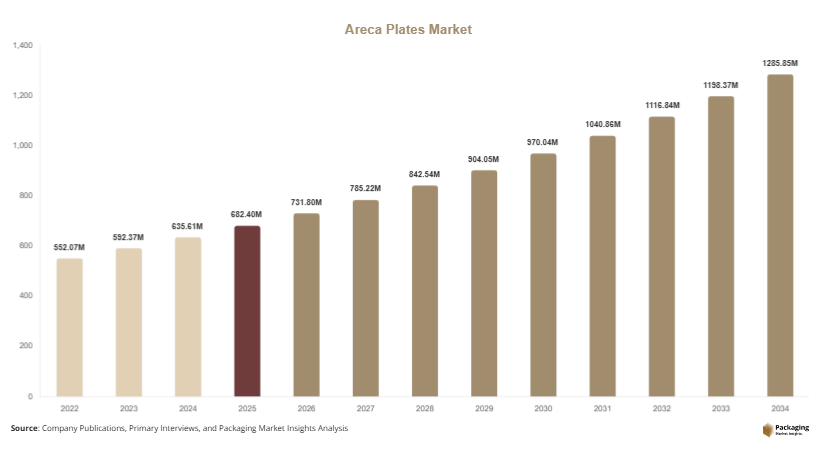
The global areca plates market size was valued at USD 682.4 million in 2025 and is expected to reach USD 731.8 million in 2026. The market is projected to attain approximately USD 1,290 million by 2034, registering a CAGR of 7.3% during the forecast period (2025–2034). Growing adoption of biodegradable foodservice products across restaurants, catering services, quick-service restaurants, and event management companies is contributing to sustained market growth.
The areca plates market is witnessing steady growth as consumers, foodservice providers, and institutional buyers increasingly adopt biodegradable and compostable alternatives to conventional disposable tableware. Areca plates, manufactured from naturally fallen areca palm leaves, have gained significant acceptance due to their eco-friendly properties, durability, chemical-free production process, and ability to decompose naturally without generating harmful waste. Rising environmental awareness, restrictions on single-use plastics, and growing demand for sustainable food packaging products continue to support market expansion across developed and emerging economies.
Key Highlights
- Asia Pacific dominated the market with a 42.7% share in 2025.
- Latin America is projected to grow at the fastest CAGR of 8.1% through 2034.
- Round Areca Plates led the type segment with a 36.5% share.
- Natural Areca Palm Leaf Material dominated the material segment with a 71.8% share.
- Foodservice applications led the end-use segment with a 48.6% share.
- The US remained the dominant country with a market size of USD 108.6 million in 2025 and USD 116.4 million in 2026.
Explore more data points, trends and opportunities Download Free Sample Report
Market Trends
Increasing Adoption of Sustainable Disposable Tableware
Sustainability continues to reshape purchasing decisions across foodservice and hospitality industries. Restaurants, cafes, catering businesses, and event organizers are replacing plastic and foam-based products with biodegradable alternatives such as areca plates. The naturally compostable nature of areca palm leaf products aligns with corporate sustainability goals and consumer expectations. For example, several food chains are introducing eco-friendly serving solutions to reduce plastic waste and strengthen environmental credentials. This trend is expected to accelerate as more countries implement restrictions on single-use plastics. Future demand will likely expand beyond foodservice into institutional dining, educational facilities, and corporate cafeterias, creating new opportunities for areca plate manufacturers.
Product Innovation and Premium Design Development
Manufacturers are increasingly developing premium areca plate designs that offer enhanced aesthetics and functionality. Products now include compartment plates, decorative serving trays, bowls, and customized tableware formats suitable for weddings, events, and premium catering applications. Improved manufacturing techniques enable stronger and more uniform products while maintaining biodegradability. For instance, event management companies are increasingly selecting designer areca tableware for eco-conscious celebrations and corporate events. The future impact of this trend will include higher-value product categories, expanded commercial adoption, and stronger penetration into premium hospitality markets where presentation quality plays a critical role.
Market Drivers
Government Restrictions on Single-Use Plastics
Governments worldwide are implementing regulations to reduce plastic pollution and encourage sustainable alternatives. Bans and restrictions on disposable plastic plates, cups, and containers have created favorable conditions for biodegradable products such as areca plates. As regulatory pressure increases, foodservice businesses are actively transitioning toward environmentally responsible tableware options. For example, multiple municipalities across Asia and Europe have introduced plastic reduction initiatives that encourage compostable alternatives. The direct effect is increased procurement of areca-based products by restaurants, caterers, and institutions seeking compliance with environmental regulations while maintaining operational efficiency.
Growing Consumer Preference for Natural Products
Consumer awareness regarding environmental sustainability continues to influence purchasing behavior. Many consumers prefer products made from renewable resources and free from synthetic chemicals. Areca plates meet these requirements because they are manufactured from naturally fallen palm leaves without requiring extensive chemical processing. The increasing popularity of eco-friendly lifestyles has encouraged foodservice operators to offer sustainable dining experiences. For example, eco-tourism resorts and organic food establishments frequently use areca plates to reinforce their environmental commitments. This growing preference directly contributes to expanding market demand across multiple regions.
Market Restraint
Limited Raw Material Availability and Seasonal Dependence
One of the primary challenges facing the areca plates market is the dependence on areca palm leaf availability. Production volumes are closely linked to agricultural conditions, seasonal variations, and regional cultivation patterns. Since areca plates are manufactured using naturally shed leaves, supply consistency can fluctuate depending on weather conditions and plantation output. This limitation affects manufacturing scalability and inventory management for producers seeking to serve international markets.
In addition, transportation costs can be relatively high because production facilities are concentrated in specific regions where areca palms are cultivated extensively. Export-oriented manufacturers often face logistical challenges associated with maintaining stable supply chains. For example, sudden weather disruptions in key producing regions may temporarily reduce raw material availability, impacting production schedules and pricing stability. These factors can limit market growth and create challenges for companies attempting rapid geographic expansion.
Market Opportunities
Expansion in Food Delivery and Quick-Service Restaurants
The rapid expansion of food delivery platforms and quick-service restaurant networks presents significant growth opportunities for areca plate manufacturers. Restaurants increasingly seek sustainable serving solutions that align with environmental commitments and customer expectations. Areca plates offer durability, heat resistance, and biodegradability, making them suitable for takeaway and delivery applications. As urbanization and digital food ordering continue to grow globally, demand for eco-friendly disposable serving products is expected to increase substantially. This trend creates long-term opportunities for suppliers capable of delivering consistent product quality and large-scale production capacity.
Rising Adoption Across Corporate and Institutional Dining
Corporate campuses, universities, hospitals, and government facilities are increasingly incorporating sustainability targets into procurement policies. This creates opportunities for areca plate suppliers to expand beyond traditional foodservice channels. Institutions seeking to reduce environmental footprints are adopting compostable dining solutions that support waste reduction initiatives. For example, educational institutions are replacing plastic dining products with biodegradable alternatives during events and daily operations. Future growth is expected as procurement regulations increasingly prioritize environmentally friendly products and sustainable sourcing practices.
Report Scope
| Report Metric | Details |
|---|---|
| Market Size in 2025 | USD 682.4 Million |
| Market Size in 2026 | USD 731.8 Million |
| Market Size in 2034 | USD 1,290 Million |
| CAGR | 7.3% (2026-2034) |
| Base Year for Estimation | 2025 |
| Historical Data | 2022-2024 |
| Forecast Period | 2026-2034 |
| Report Coverage | Revenue Forecast, Competitive Landscape, Supply Chain Disruption, Growth Factors, Environment & Regulatory Landscape and Trends |
| Geographies Covered | North America, Europe, APAC, Middle East and Africa, LATAM |
| Countries Covered | U.S., Canada, U.K., Germany, France, Spain, Italy, Russia, Nordic, Benelux, Rest of Europe, China, South Korea, Japan, India, Australia, Singapore, Taiwan, South East Asia, Rest of Asia-Pacific, UAE, Turky, Saudi Arabia, South Africa, Egypt, Nigeria, Rest of MEA, Brazil, Mexico, Argentina, Chile, Colombia, Rest of LATAM |
Explore more data points, trends and opportunities Download Free Sample Report
Segmental Analysis
By Type
Round Areca Plates dominated the market and accounted for approximately 36.5% of total revenue in 2024. These products remain widely preferred because they offer versatility, ease of handling, and compatibility with various foodservice applications. Restaurants, catering companies, and institutional dining facilities extensively use round plates for serving meals, snacks, and desserts. Their simple design supports efficient manufacturing while maintaining durability and aesthetic appeal. In addition, round plates are available in multiple sizes, enabling broad application across foodservice environments. The combination of affordability, functionality, and consumer familiarity continues to support segment leadership.
Compartment Areca Plates are projected to be the fastest-growing subsegment, expanding at a CAGR of 8.4% through 2034. Growth is driven by increasing demand from quick-service restaurants, food delivery operators, and institutional cafeterias that require portion separation. These plates improve food presentation while minimizing mixing of meal components. Product innovation has resulted in stronger compartment designs capable of supporting diverse food items. Future demand is expected to rise as foodservice operators seek convenient and sustainable serving solutions that enhance customer experiences while reducing environmental impact.
By Material
Natural Areca Palm Leaf Material accounted for approximately 71.8% of market share in 2024, making it the dominant material segment. The popularity of this material stems from its fully biodegradable nature and minimal processing requirements. Manufacturers utilize naturally fallen leaves, creating products that align with circular economy principles. Consumers and businesses increasingly value products that avoid chemical additives and synthetic coatings. The natural texture and appearance of areca palm leaves also contribute to premium product perception. Strong environmental credentials continue to support widespread adoption across hospitality, catering, and foodservice applications.
Reinforced Areca Fiber Products are expected to witness the fastest growth, registering a CAGR of 7.9% during the forecast period. Enhanced durability and improved structural integrity make these products attractive for serving heavier meals and liquid-rich foods. Manufacturers are investing in production technologies that combine sustainability with superior performance characteristics. Future growth will be supported by rising demand from commercial foodservice operators seeking biodegradable products that offer greater functionality and reliability.
By End-Use
Foodservice dominated the end-use segment with approximately 48.6% of market share in 2024. Restaurants, cafes, quick-service establishments, and takeaway providers increasingly use areca plates to meet sustainability objectives while satisfying customer preferences. Growing demand for eco-friendly dining experiences has accelerated adoption across both independent and chain-based foodservice operations. The segment benefits from increasing regulatory pressure to replace plastic products with biodegradable alternatives. Continued expansion of foodservice infrastructure worldwide supports ongoing market growth.
Catering and Events is projected to be the fastest-growing end-use segment, expanding at a CAGR of 8.2% through 2034. Event organizers increasingly seek sustainable serving solutions for weddings, corporate gatherings, festivals, and exhibitions. Areca plates provide an attractive balance between functionality, aesthetics, and environmental responsibility. Growing consumer preference for eco-friendly events is encouraging broader adoption. Future opportunities are expected to emerge from large-scale outdoor events, destination weddings, and corporate sustainability initiatives that prioritize biodegradable dining products.
Areca Plates Market Segmentations
By Type
- Round Areca Plates
- Square Areca Plates
- Partition Areca Plates
- Designer Areca Plates
- Custom-Shaped Areca Plates
By Material
- Natural Areca Leaf
- Laminated Areca Leaf
- Blended Natural Fiber Areca Plates
By End-User
- Food Service Providers
- Catering Services
- Households
- Events & Functions
- Restaurants & Cafes
Regional Analysis
North America
North America accounted for approximately 24.6% of the areca plates market share in 2025 and is projected to expand at a CAGR of 7.0% through 2034. Growing environmental awareness, increasing restrictions on plastic products, and rising demand for sustainable foodservice solutions continue to support market growth. Restaurants, catering operators, and event organizers are increasingly adopting biodegradable tableware products. The region also benefits from strong consumer willingness to pay premium prices for environmentally responsible products. Expansion of organic food chains and sustainable hospitality businesses further contributes to growing demand for areca plates throughout North America.
The United States dominates the regional market due to widespread sustainability initiatives and growing demand for compostable foodservice products. A unique growth driver is the increasing adoption of eco-friendly procurement policies among corporations and universities. Many institutions are replacing traditional disposable tableware with biodegradable alternatives to meet sustainability goals. Additionally, large-scale outdoor events and environmentally conscious festivals increasingly utilize areca products, creating consistent commercial demand and strengthening market expansion.
Europe
Europe held approximately 22.1% of the global market share in 2025 and is expected to register a CAGR of 7.1% during the forecast period. Strong environmental regulations and growing emphasis on circular economy principles continue to encourage adoption of biodegradable products. Foodservice providers across the region are transitioning toward sustainable packaging and serving solutions to comply with regulatory requirements. Rising consumer awareness regarding waste reduction further supports market growth. The expansion of environmentally responsible retail and hospitality sectors contributes significantly to increasing demand for areca plates.
Germany remains the dominant country in Europe. A unique growth factor is the country's strong focus on waste management and sustainable consumption practices. Restaurants, event organizers, and institutional dining facilities increasingly prioritize compostable tableware options. An emerging trend involves eco-certified catering services utilizing areca plates to enhance sustainability credentials. Continued investment in environmentally responsible procurement practices is expected to support long-term market growth.
Asia Pacific
Asia Pacific dominated the market with a 42.7% share in 2025 and is projected to expand at a CAGR of 7.8% through 2034. The region benefits from abundant raw material availability, established manufacturing infrastructure, and rising environmental awareness. Rapid urbanization, growth of foodservice businesses, and increasing restrictions on plastic products are driving market expansion. Countries across the region are encouraging sustainable alternatives through policy initiatives and public awareness campaigns. The availability of cost-effective production capabilities further strengthens regional competitiveness.
India represents the leading country within Asia Pacific. A unique growth driver is the extensive cultivation of areca palms, providing reliable access to raw materials. Numerous small and medium-sized enterprises specialize in areca plate manufacturing, supporting domestic consumption and export activities. Growing demand from hospitality, catering, and religious event sectors continues to drive production expansion. Increasing exports to North America and Europe further enhance market opportunities.
Middle East & Africa
The Middle East & Africa accounted for approximately 4.8% of the market share in 2025 and is expected to grow at a CAGR of 7.4% during the forecast period. Rising environmental awareness and increasing tourism activities are contributing to market growth. Hospitality operators are actively seeking biodegradable alternatives to improve sustainability performance and meet evolving consumer expectations. Government initiatives promoting waste reduction also support adoption of eco-friendly tableware products across the region.
United Arab Emirates dominates the regional market. A unique growth factor is the increasing focus on sustainable tourism and hospitality operations. Hotels, resorts, and event venues are adopting biodegradable serving products to align with environmental objectives. Large-scale exhibitions and international events increasingly incorporate sustainable dining solutions, creating growing demand for areca plates and supporting market development.
Latin America
Latin America represented approximately 5.8% of the global market in 2025 and is forecast to grow at the fastest CAGR of 8.1% through 2034. Increasing environmental regulations and rising consumer awareness regarding plastic waste are encouraging adoption of biodegradable alternatives. Expansion of foodservice businesses and outdoor catering activities is creating additional demand for sustainable disposable products. Retailers and hospitality operators are increasingly promoting environmentally responsible solutions to attract eco-conscious consumers.
Brazil remains the dominant country in the region. A unique growth factor is the growing popularity of environmentally focused events and sustainable catering services. Event organizers increasingly utilize biodegradable tableware to comply with sustainability requirements and enhance brand image. The expanding hospitality sector and increasing investment in green business practices are expected to support continued market growth across Latin America.
Competitive Landscape
The areca plates market remains moderately fragmented, with regional manufacturers and specialized eco-friendly tableware producers competing through product quality, sustainability credentials, distribution expansion, and export capabilities. Market participants focus on increasing production efficiency, developing innovative product designs, and strengthening international distribution networks.
Eco Products India Pvt. Ltd. is recognized as one of the leading companies due to its extensive product portfolio, export presence, and manufacturing capabilities. The company recently expanded production capacity to address growing international demand for biodegradable tableware products.
Other significant participants include Areca Eco Products, Biopac India Corporation Ltd., Green Leaf Products, and Nature Palm Plates. These companies continue to invest in automation technologies, customized product offerings, and sustainable manufacturing practices. Strategic collaborations with distributors and foodservice providers are becoming increasingly important competitive strategies.
Growing global demand for eco-friendly tableware solutions is expected to encourage capacity expansion, product diversification, and innovation throughout the forecast period.
Key Players List
- Eco Products India Pvt. Ltd.
- Areca Eco Products
- Biopac India Corporation Ltd.
- Green Leaf Products
- Nature Palm Plates
- Sai Areca Plates
- Bhadra International
- Biomass Packaging Solutions
- Ecoware Solutions Pvt. Ltd.
- Natural Tableware
- Leafware LLC
- Palm Leaf Products Inc.
- GreenPath Packaging
- Earth Friendly Products
- Divine Areca Products