Molded Tableware Products Market Size and Growth
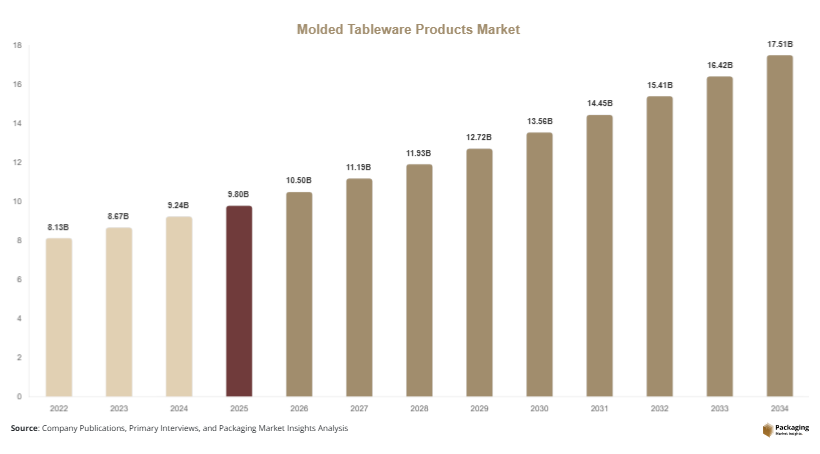
The global molded tableware products market size was valued at USD 9.8 billion in 2025 and is estimated to reach USD 10.5 billion in 2026, progressing further to approximately USD 18.7 billion by 2034, at a CAGR of 6.6% during the forecast period (2025–2034). Molded tableware products, typically made from pulp, bagasse, or bamboo fibers, are gaining traction across food service, hospitality, and institutional sectors due to their biodegradability and cost-effectiveness. The molded tableware products market is experiencing consistent growth due to the increasing global emphasis on sustainable and eco-friendly alternatives to conventional plastic tableware.
One of the primary factors supporting market growth is the global regulatory push against single-use plastics. Governments across developed and emerging economies are implementing strict policies to limit plastic waste, encouraging industries to adopt sustainable alternatives such as molded fiber products. Additionally, the expansion of the food delivery ecosystem, including online platforms and takeaway services, is significantly boosting demand for disposable tableware. These products offer convenience, hygiene, and environmental benefits, aligning well with evolving consumer expectations.
Key Highlights:
- Asia Pacific dominated the market with a 38.2% share in 2025, while Latin America is projected to grow at the fastest CAGR of 7.1%.
- Molded fiber products led the type segment with a 46.5% share, while bagasse-based products are expected to grow at a CAGR of 7.3%.
- Disposable tableware dominated with a 58.7% share, while reusable molded products are forecasted to grow at a CAGR of 6.8%.
- Food service applications led the segment with 49.2% share, while institutional catering is expected to grow at a CAGR of 6.9%.
- China remained the dominant country with a market size of USD 2.3 billion in 2025 and USD 2.5 billion in 2026.
Explore more data points, trends and opportunities Download Free Sample Report
Market Trends
Increasing use of biodegradable raw materials in manufacturing
The transition toward biodegradable raw materials is shaping the molded tableware products market. Manufacturers are increasingly utilizing bagasse, bamboo fiber, and recycled paper pulp to produce environmentally responsible tableware. This shift is driven by both regulatory requirements and changing consumer preferences for sustainable products. Companies are investing in research and development to enhance the performance of these materials, improving attributes such as water resistance, durability, and heat tolerance. The use of agricultural waste, particularly bagasse, is also supporting circular economy initiatives by reducing industrial waste. This trend is gaining momentum across developed and emerging markets, where sustainability is becoming a key purchasing criterion.
Expansion of food delivery platforms and cloud kitchen networks
The rapid growth of food delivery platforms and cloud kitchens is significantly influencing demand for molded tableware products. Urban consumers are increasingly relying on online food services, leading to a surge in takeaway and delivery orders. Molded tableware products are well-suited for this ecosystem due to their lightweight nature and ability to maintain food quality during transit. Food delivery companies are also forming partnerships with eco-friendly packaging providers to reduce environmental impact. As digital food ecosystems expand, the demand for sustainable disposable tableware is expected to rise steadily, reinforcing the importance of molded products in modern food service operations.
Market Drivers
Regulatory pressure to reduce single-use plastic consumption
Government regulations aimed at reducing plastic waste are playing a crucial role in driving the molded tableware products market. Policies banning or restricting single-use plastics are being implemented across multiple regions, creating a favorable environment for biodegradable alternatives. These regulations are compelling manufacturers and food service providers to adopt molded tableware products made from renewable materials. Compliance with environmental standards is becoming essential for businesses, particularly in regions with strict regulatory frameworks. Additionally, governments are offering incentives and subsidies to promote sustainable manufacturing practices, further accelerating market growth.
Growth in global food service and hospitality sectors
The expansion of the food service and hospitality industries is significantly contributing to the demand for molded tableware products. Restaurants, cafes, catering services, and event organizers require large volumes of disposable tableware to maintain operational efficiency. Molded products provide a cost-effective and environmentally friendly solution, making them increasingly popular in commercial settings. The rise of quick-service restaurants and large-scale events is further boosting demand. Additionally, businesses are adopting sustainable practices to enhance their brand image and attract environmentally conscious consumers, driving the adoption of molded tableware.
Market Restraint
High production costs compared to conventional plastic tableware
The relatively high production costs associated with molded tableware products present a significant challenge for market growth. Manufacturing these products involves specialized equipment, energy-intensive processes, and the use of natural raw materials, which can increase overall costs. This makes molded tableware less competitive compared to low-cost plastic alternatives, particularly in price-sensitive markets. Small and medium-sized enterprises may face difficulties in scaling production due to limited financial resources. Additionally, fluctuations in the availability of raw materials such as agricultural residues can impact production consistency. While technological advancements are expected to reduce costs over time, this factor continues to limit widespread adoption in certain regions.
Market Opportunities
Advancements in manufacturing technologies and automation
Technological advancements in molded fiber processing are creating significant opportunities for market expansion. Innovations such as automated molding systems, improved drying techniques, and advanced material formulations are enhancing production efficiency and product quality. These developments enable manufacturers to produce tableware with better strength, design precision, and resistance to moisture and heat. As production processes become more efficient, costs are expected to decrease, making molded tableware more accessible to a broader range of consumers. This opportunity is particularly relevant in regions with strong industrial infrastructure and technological capabilities.
Rising demand from emerging economies
Emerging economies present substantial growth opportunities for the molded tableware products market. Rapid urbanization, increasing disposable incomes, and growing awareness of environmental issues are driving demand for sustainable tableware solutions. Countries in Asia, Latin America, and Africa are witnessing significant growth in the food service sector, creating a strong demand for disposable products. Government initiatives to reduce plastic waste are further supporting market expansion. Additionally, local manufacturers are entering the market, improving product availability and affordability. This trend is expected to contribute significantly to overall market growth during the forecast period.
Report Scope
| Report Metric | Details |
|---|---|
| Market Size in 2025 | USD 9.8 Billion |
| Market Size in 2026 | USD 10.5 Billion |
| Market Size in 2034 | USD 18.7 Billion |
| CAGR | 6.6% (2026-2034) |
| Base Year for Estimation | 2025 |
| Historical Data | 2022-2024 |
| Forecast Period | 2026-2034 |
| Report Coverage | Revenue Forecast, Competitive Landscape, Supply Chain Disruption, Growth Factors, Environment & Regulatory Landscape and Trends |
| Geographies Covered | North America, Europe, APAC, Middle East and Africa, LATAM |
| Countries Covered | U.S., Canada, U.K., Germany, France, Spain, Italy, Russia, Nordic, Benelux, Rest of Europe, China, South Korea, Japan, India, Australia, Singapore, Taiwan, South East Asia, Rest of Asia-Pacific, UAE, Turky, Saudi Arabia, South Africa, Egypt, Nigeria, Rest of MEA, Brazil, Mexico, Argentina, Chile, Colombia, Rest of LATAM |
Explore more data points, trends and opportunities Download Free Sample Report
Segmental Analysis
By Type
The molded fiber segment accounted for the largest share of approximately 46.5% in 2024. This segment dominates due to its widespread application in producing biodegradable plates, bowls, and trays. Molded fiber products are preferred for their cost efficiency, structural strength, and compatibility with various food types. The segment is also supported by increasing environmental regulations that promote sustainable materials.
Bagasse-based products are projected to grow at the fastest CAGR of 7.3% during the forecast period. The increasing availability of sugarcane waste and its excellent biodegradable properties are driving adoption. These products offer improved durability and heat resistance, making them suitable for diverse food service applications.
By Application
The food service segment held the largest share of 49.2% in 2024. This includes restaurants, cafes, and catering services that rely heavily on disposable tableware. The growth of food delivery services and takeaway culture is significantly contributing to this segment’s dominance.
Institutional catering is expected to grow at a CAGR of 6.9%, driven by demand from hospitals, schools, and corporate cafeterias. The need for hygienic and convenient tableware solutions is encouraging the adoption of molded products in these settings.
By End-Use
The commercial segment accounted for 58.7% of the market share in 2024. This includes restaurants, hotels, and event organizers that require large volumes of disposable tableware. The segment benefits from increasing demand for cost-effective and sustainable solutions.
The residential segment is projected to grow at a CAGR of 6.8%, supported by rising consumer awareness and the convenience of disposable tableware for home use. The trend of hosting home events is also contributing to growth.
Molded Tableware Products Market Segmentations
By Type
- Molded Fiber
- Bagasse-Based
- Bamboo Fiber
- Others
By Application
- Food Service
- Institutional Catering
- Household Use
By End-User
- Commercial
- Residential
Regional Analysis
North America
North America accounted for approximately 22.5% of the global molded tableware products market share in 2025 and is projected to grow at a CAGR of 5.9% through 2034. The region benefits from strong environmental regulations and a well-established food service industry. Increasing consumer preference for sustainable packaging solutions is further driving market growth across the United States and Canada.
The United States remains the dominant country in this region, supported by widespread adoption of eco-friendly products in the food service sector. A key growth factor is the integration of sustainability initiatives within corporate strategies, encouraging businesses to transition toward molded tableware products as part of their environmental commitments.
Europe
Europe held a market share of 24.3% in 2025 and is expected to grow at a CAGR of 6.1% during the forecast period. The region is characterized by strict environmental regulations and strong consumer awareness regarding sustainability. These factors are driving the adoption of biodegradable tableware products across multiple industries.
Germany leads the European market due to its advanced manufacturing capabilities and strong regulatory framework. A unique growth factor is the region’s focus on circular economy practices, promoting the reuse and recycling of materials, which supports the demand for molded fiber tableware products.
Asia Pacific
Asia Pacific dominated the molded tableware products market with a 38.2% share in 2025 and is projected to grow at a CAGR of 7.0%. The region’s growth is driven by rapid urbanization, population expansion, and the increasing demand for food delivery services. The availability of raw materials and cost-effective manufacturing further supports market development.
China is the dominant country in this region, benefiting from large-scale production and strong domestic demand. A key growth factor is government support for sustainable manufacturing practices, which is encouraging industries to adopt eco-friendly tableware solutions.
Middle East & Africa
The Middle East & Africa region accounted for 7.8% of the market share in 2025 and is expected to grow at a CAGR of 6.4%. Growth is supported by increasing urbanization and rising demand for disposable tableware in the hospitality sector. Government initiatives to reduce plastic waste are also contributing to market expansion.
The United Arab Emirates leads the region, driven by a strong tourism industry and increasing adoption of sustainable practices. A notable growth factor is the rising number of international events and exhibitions, which require large volumes of disposable tableware products.
Latin America
Latin America held a 7.2% market share in 2025 and is projected to grow at the fastest CAGR of 7.1%. The region is witnessing increasing environmental awareness and regulatory efforts to reduce plastic waste. These factors are driving demand for molded tableware products.
Brazil dominates the market in this region, supported by a growing population and expanding food service industry. A key growth factor is the increasing investment in local manufacturing facilities, improving product availability and reducing costs.
Competitive Landscape
The molded tableware products market is moderately fragmented, with several global and regional players focusing on sustainability and product innovation. Companies are investing in advanced manufacturing technologies to improve product quality and reduce costs. Strategic partnerships, mergers, and capacity expansions are common approaches to strengthening market presence.
Huhtamaki is recognized as a leading player in the market, with a strong focus on sustainable packaging solutions. The company has recently expanded its molded fiber production capacity to meet growing demand. Other players are also introducing innovative products and expanding their geographical reach to capitalize on emerging opportunities.
Key Players List
- Huhtamaki
- Dart Container Corporation
- Genpak LLC
- Pactiv Evergreen Inc.
- Eco-Products Inc.
- Vegware Ltd.
- Biodegradable Food Service LLC
- Natural Tableware
- GreenGood USA
- FiberCel Packaging LLC
- Be Green Packaging
- Sabert Corporation
- World Centric
- Duni Group
- Lollicup USA Inc.