Rigid Food Containers Market Size
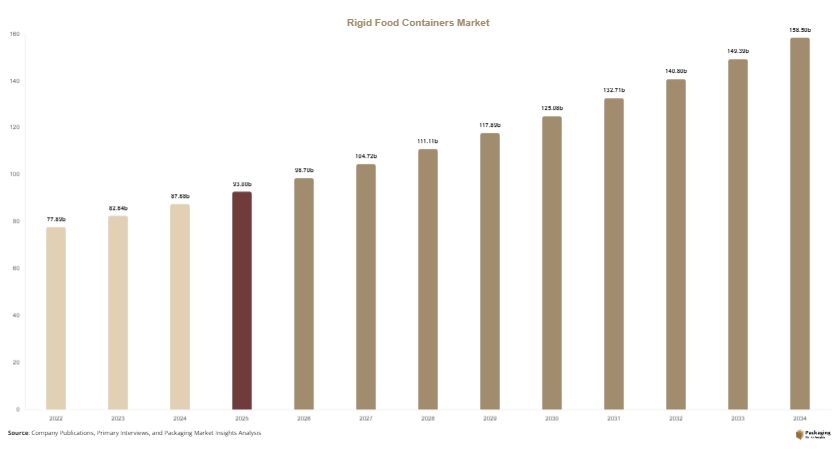
Rigid Food Containers market size is projected at USD 98.7 billion in 2026 and is expected to hit USD 158.6 billion by 2034 with a CAGR of 6.1%. Rising consumption of packaged food, increasing demand for durable food packaging, and advances in sustainable materials continue supporting market expansion. The report provides comprehensive analysis of production capacity, market segmentation, competitive landscape, pricing trends, supply chain developments, and regional performance.
Rigid food containers are durable packaging solutions manufactured from plastic, glass, and metal to protect food products during storage, transportation, and retail distribution. Global production exceeded 410 billion units in 2025, with plastic containers contributing approximately 67% of total output, glass accounting for 20%, and metal representing nearly 13%. More than 74% of packaged food manufacturers rely on rigid containers to improve shelf life, product protection, and consumer convenience, reinforcing the Rigid Food Containers Market.
Explore more data points, trends and opportunities Download Free Sample Report
Rigid Food Containers Market Trends
Growing Adoption of Sustainable and Recyclable Packaging
Food manufacturers continue adopting recyclable polymers, mono-material packaging, recycled plastics, and lightweight rigid containers. Sustainable rigid food containers represented approximately 42% of newly introduced packaging products during 2025, while recycled plastic utilization increased by nearly 23% year-over-year. More than 165 billion recyclable rigid food containers entered commercial production, strengthening the Rigid Food Containers Market.
Packaging companies continue investing in lightweight designs, bio-based plastics, and advanced barrier technologies to reduce environmental impact. Approximately 61% of food packaging manufacturers have established sustainability targets through 2030, while lightweight packaging adoption increased by 19%, supporting long-term Rigid Food Containers Market development.
Convenience Foods Continue Driving Packaging Innovation
Demand for ready meals, frozen foods, dairy products, and takeaway meals continues accelerating innovation across rigid packaging formats. More than 145 billion ready-to-eat food containers were produced globally during 2025, while microwave-compatible packaging adoption increased by approximately 17%. Improved barrier protection and tamper-evident packaging continue strengthening the Rigid Food Containers Market.
Rigid Food Containers Market Drivers
Growing Demand for Packaged and Ready-to-Eat Foods
Urbanization, changing lifestyles, and expanding food retail networks continue increasing packaged food consumption. Ready-to-eat food applications account for approximately 39% of total container demand, while packaged food sales increased by nearly 8% annually. More than 150 billion rigid food containers are consumed by processed food manufacturers every year, supporting the Rigid Food Containers Market.
Rigid Food Containers Market Restraints
Volatility in Raw Material Prices
Fluctuations in resin, aluminum, steel, and glass prices continue affecting production costs. Plastic resin prices increased by approximately 14%, while energy expenses rose by nearly 11% during recent manufacturing cycles. These cost pressures continue limiting profitability and restraining the Rigid Food Containers Market.
Rigid Food Containers Market Opportunities
Expansion of Sustainable Food Packaging Solutions
Growing investments in recyclable packaging, bio-based polymers, and circular economy initiatives create significant business opportunities. Sustainable food packaging demand increased by approximately 21%, while recycled-content packaging production expanded by nearly 18% during 2025. These developments continue generating new opportunities within the Rigid Food Containers Market.
Challenges in Rigid Food Containers Market
Balancing Product Protection with Sustainability Goals
Manufacturers must improve barrier performance while reducing packaging weight and material consumption. More than 13% of new packaging projects require extensive food compatibility testing, while product redesign increases development costs by approximately 10%. These technical requirements continue challenging the Rigid Food Containers Market.
Report Scope
| Report Metric | Details |
|---|---|
| Market Size in 2025 | USD 93.0 billion |
| Market Size in 2026 | USD 98.7 billion |
| Market Size in 2034 | USD 158.6 billion |
| CAGR | 6.1% (2026-2034) |
| Base Year for Estimation | 2025 |
| Historical Data | 2022-2024 |
| Forecast Period | 2026-2034 |
| Report Coverage | Revenue Forecast, Competitive Landscape, Supply Chain Disruption, Growth Factors, Environment & Regulatory Landscape and Trends |
| Geographies Covered | North America, Europe, APAC, Middle East and Africa, LATAM |
| Countries Covered | U.S., Canada, U.K., Germany, France, Spain, Italy, Russia, Nordic, Benelux, Rest of Europe, China, South Korea, Japan, India, Australia, Singapore, Taiwan, South East Asia, Rest of Asia-Pacific, UAE, Turky, Saudi Arabia, South Africa, Egypt, Nigeria, Rest of MEA, Brazil, Mexico, Argentina, Chile, Colombia, Rest of LATAM |
Explore more data points, trends and opportunities Download Free Sample Report
Rigid Food Containers Market Segmentation
The Rigid Food Containers Market is segmented by material and application. Plastic rigid containers account for approximately 67% of total market revenue, while ready-to-eat foods contribute nearly 39% of overall industry demand due to increasing convenience food consumption.
By Material
Plastic Rigid Containers
Plastic rigid containers dominate with approximately 67% market share and annual production exceeding 275 billion units. They provide lightweight construction, impact resistance, moisture protection, excellent processability, and compatibility with PP, PET, and HDPE materials.
Glass Rigid Containers
Glass rigid containers account for nearly 20% of market demand, with production exceeding 82 billion units annually. These containers provide premium appearance, chemical stability, complete recyclability, and excellent preservation for food products.
Metal Rigid Containers
Metal rigid containers contribute approximately 13% of market revenue. Annual production exceeds 53 billion units, offering high durability, superior barrier protection, corrosion resistance, and extended shelf-life for canned food applications.
By Application
Dairy Products
Dairy products represent approximately 33% of total market demand, utilizing more than 135 billion rigid containers annually. Yogurt, butter, cream, desserts, and dairy beverages require secure packaging, contamination protection, and refrigerated storage compatibility.
Ready-to-Eat Foods
Ready-to-eat foods account for nearly 39% of industry consumption. More than 160 billion rigid containers support prepared meals, frozen foods, microwave meals, and takeaway products, improving convenience and product safety.
Beverages
Beverages contribute approximately 28% of market demand. Juices, dairy drinks, nutritional beverages, and specialty drinks require rigid packaging with high strength, leak resistance, and efficient transportation performance.
Rigid Food Containers Market Segmentations
Material Type
- Plastic Rigid Containers
- Glass Rigid Containers
- Metal Rigid Containers
Application
- Dairy Products
- Ready-to-Eat Foods
- Beverages
Distribution Channel
- Direct Sales
- Food Packaging Distributors
- Online Sales
- Retail Packaging Suppliers
- OEM & Contract Packaging
Rigid Food Containers Regional Outlook
North America
North America accounts for approximately 29% of global market revenue. The United States contributes nearly 83% of regional demand, supported by strong packaged food consumption, advanced food processing industries, and sustainable packaging initiatives.
Europe
Europe represents approximately 27% of the global market. Germany, France, Italy, Spain, and the United Kingdom collectively contribute more than 74% of regional production, supported by strict food safety regulations and high recycling rates.
Asia-Pacific
Asia-Pacific accounts for nearly 36% of worldwide demand and remains the fastest-growing region. China, India, Japan, and South Korea collectively manufacture more than 155 billion rigid food containers annually due to rapid urbanization and growing processed food industries.
Latin America
Latin America contributes approximately 5% of global market demand. Brazil and Mexico together account for nearly 67% of regional consumption, supported by expanding food processing industries and modern retail networks.
Middle East & Africa
The Middle East & Africa represent approximately 3% of market revenue. Saudi Arabia, the UAE, and South Africa continue investing in food manufacturing, cold chain infrastructure, and packaged food production.
Top players in Rigid Food Containers Market
- Amcor plc
- Berry Global Inc.
- Silgan Holdings Inc.
- Sonoco Products Company
- Pactiv Evergreen Inc.
- Greiner Packaging International GmbH
- Plastipak Holdings, Inc.
- Alpla Group
- Mondi plc
- DS Smith Plc
- Huhtamaki Oyj
- Sealed Air Corporation
Amcor plc
-
Estimated market share of approximately 14%, supported by a diversified global packaging portfolio and manufacturing operations across multiple continents.
-
The company focuses on recyclable rigid packaging, lightweight container technologies, advanced barrier materials, and sustainable product innovation. Strong partnerships with leading food manufacturers, continuous investments in circular packaging solutions, and global production capabilities reinforce its competitive leadership across the Rigid Food Containers Market.
Berry Global Inc.
-
Estimated market share of approximately 11%, with a strong presence in rigid plastic food packaging solutions.
-
Berry Global continues investing in recycled materials, lightweight packaging technologies, and advanced manufacturing automation. Its extensive product portfolio, sustainable packaging initiatives, and worldwide customer network position the company among the leading suppliers in the Rigid Food Containers Market.