Grab And Go Containers Market Size and Growth
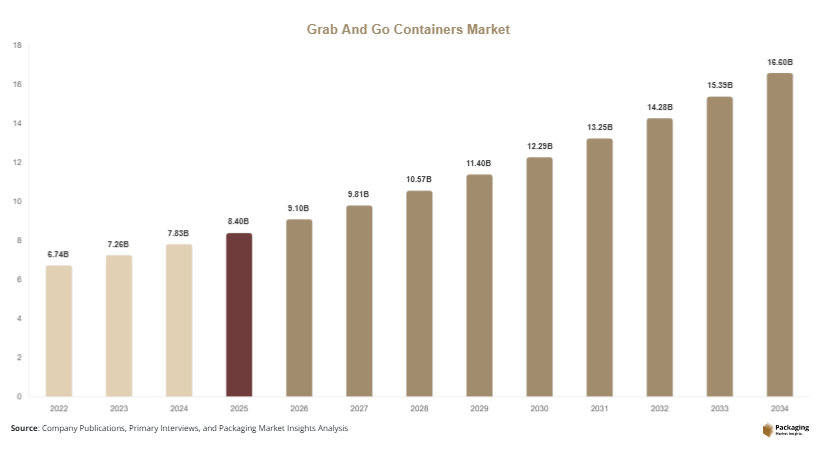
The global grab and go containers market is estimated at USD 8.4 billion in 2025, and it is projected to reach USD 9.1 billion in 2026. By 2034, the market is forecasted to reach approximately USD 16.8 billion, expanding at a CAGR of 7.8% (2025–2034). Growth is strongly influenced by increasing demand for packaged convenience foods, expansion of organized retail chains, and rising penetration of online food delivery ecosystems.
The grab and go containers market is experiencing strong expansion driven by the global shift toward convenience food consumption, increasing urbanization, and rapid growth of quick-service restaurants (QSRs) and food delivery platforms. Grab and go containers are widely used in ready-to-eat meals, packaged salads, bakery items, snacks, and chilled beverages, offering portability, portion control, and extended shelf stability. These containers include plastic clamshells, paperboard boxes, molded fiber trays, compostable bowls, and hybrid material packaging formats designed for both retail and foodservice applications.
Key Highlights:
- Asia Pacific dominated the market with a 37.4% share in 2025.
- Latin America is projected to grow at the fastest CAGR of 6.2%.
- Plastic-based containers led the material segment with a 52.3% share.
- Foodservice applications led with a 43.1% share.
- Paperboard containers dominated the type segment with a 29.6% share, while compostable containers are expected to grow at a CAGR of 7.4%.
- The US remained the dominant country in North America with a market size of USD 3.2 billion in 2025 and USD 3.5 billion in 2026.
Explore more data points, trends and opportunities Download Free Sample Report
Market Trends
Shift Toward Sustainable and Compostable Packaging Solutions
One of the most significant trends shaping the grab and go containers market is the rapid transition toward sustainable and compostable packaging materials. Environmental regulations and rising consumer awareness regarding plastic waste are pushing manufacturers to develop alternatives such as molded fiber, bagasse-based containers, and PLA bioplastics. Foodservice providers and QSR chains are actively replacing traditional plastic clamshells with eco-friendly packaging formats to align with ESG commitments.
For example, several café chains in Europe have replaced plastic salad bowls with compostable fiber containers that decompose within industrial composting facilities. In the United States, grocery chains are increasingly offering pre-packed meals in recyclable paperboard containers to reduce landfill waste. This trend is expected to significantly reshape supply chains, requiring investment in new material processing technologies and sustainable sourcing models over the forecast period.
Smart Packaging Integration and Functional Design Innovation
Another emerging trend is the integration of functional and smart packaging features in grab and go containers. Manufacturers are focusing on improving usability through leak-proof sealing, microwave-safe materials, tamper-evident closures, and temperature retention systems. Additionally, QR codes and digital labeling are being introduced to provide nutritional information, sourcing transparency, and recycling instructions.
For instance, Asian food delivery platforms are increasingly using QR-coded containers that allow consumers to track meal preparation time and ingredients. In airport retail chains, insulated grab-and-go containers are being used to maintain food temperature for extended periods. Future developments are expected to include IoT-enabled freshness indicators and advanced barrier coatings that extend shelf life, especially for high-protein and dairy-based meals.
Market Drivers
Expansion of Quick-Service Restaurants and Food Delivery Platforms
The rapid expansion of QSR chains and online food delivery platforms is a major driver of the grab and go containers market. Global brands such as burger chains, sandwich shops, and coffee outlets rely heavily on standardized packaging to ensure food safety, portability, and brand consistency. With the rise of mobile ordering apps, demand for ready-to-consume packaged meals has surged significantly.
For example, in India and Southeast Asia, food delivery platforms have expanded into tier-2 and tier-3 cities, increasing demand for durable and leak-proof containers. Similarly, in the United States, QSR chains are using compartmentalized grab-and-go boxes for combo meals. This structural shift in food consumption is directly boosting packaging volume across retail and delivery channels.
Urbanization and Rising Demand for Convenience Foods
Urbanization and changing consumer lifestyles are significantly driving demand for grab and go packaging solutions. Increasing working populations, especially in metropolitan cities, are preferring pre-packaged meals due to time constraints and mobility needs. Convenience stores, supermarkets, and vending machine operators are expanding their ready-to-eat food offerings.
For instance, Japanese convenience stores (konbini culture) heavily rely on grab-and-go meal containers for bento boxes, salads, and snacks. In European cities, supermarkets are expanding fresh meal sections with pre-packed containers designed for immediate consumption. This growing reliance on convenience food ecosystems is directly increasing packaging consumption and innovation.
Market Restraint
Environmental Concerns and Regulatory Pressure on Plastic Packaging
A major restraint in the grab and go containers market is the increasing regulatory pressure on single-use plastic packaging. Governments across Europe, North America, and parts of Asia are implementing strict bans or restrictions on non-recyclable plastic containers. This is creating compliance challenges for manufacturers heavily dependent on plastic-based packaging.
For example, foodservice operators in the European Union are required to shift toward recyclable or compostable alternatives, increasing operational costs. In developing regions, limited recycling infrastructure further complicates sustainable packaging adoption. Additionally, biodegradable materials often come at a higher production cost, which affects profitability for small and mid-sized food vendors. This cost-pressure dynamic is slowing down the full-scale transition from plastic to eco-friendly materials.
Market Opportunities
Expansion of Online Food Delivery Ecosystems
The rapid growth of online food delivery platforms presents a major opportunity for the grab and go containers market. These platforms require packaging that ensures food safety, prevents leakage, and maintains temperature during last-mile delivery. Increasing demand for cloud kitchens and virtual restaurants is further expanding packaging consumption.
For example, food delivery startups in Latin America and Southeast Asia are investing in custom-designed containers optimized for stacking and thermal retention. This shift is expected to drive demand for lightweight, durable, and cost-effective packaging solutions over the coming years.
Growth in Retail Ready-to-Eat Meal Segments
Retail expansion of ready-to-eat meals in supermarkets and convenience stores is another strong opportunity. Consumers are increasingly purchasing pre-packed salads, pasta, and snacks due to time efficiency and product variety. This is pushing retailers to adopt attractive and functional grab-and-go containers.
For instance, European supermarket chains are launching premium meal kits in compartmentalized containers designed for microwave heating. This trend is expected to expand further with innovations in transparent packaging and sustainable materials, improving both product visibility and environmental compliance.
Report Scope
| Report Metric | Details |
|---|---|
| Market Size in 2025 | USD 8.4 Billion |
| Market Size in 2026 | USD 9.1 Billion |
| Market Size in 2034 | USD 16.8 Billion |
| CAGR | 7.8% (2026-2034) |
| Base Year for Estimation | 2025 |
| Historical Data | 2022-2024 |
| Forecast Period | 2026-2034 |
| Report Coverage | Revenue Forecast, Competitive Landscape, Supply Chain Disruption, Growth Factors, Environment & Regulatory Landscape and Trends |
| Geographies Covered | North America, Europe, APAC, Middle East and Africa, LATAM |
| Countries Covered | U.S., Canada, U.K., Germany, France, Spain, Italy, Russia, Nordic, Benelux, Rest of Europe, China, South Korea, Japan, India, Australia, Singapore, Taiwan, South East Asia, Rest of Asia-Pacific, UAE, Turky, Saudi Arabia, South Africa, Egypt, Nigeria, Rest of MEA, Brazil, Mexico, Argentina, Chile, Colombia, Rest of LATAM |
Explore more data points, trends and opportunities Download Free Sample Report
Segmental Analysis
By Type
Paperboard containers dominated the market in 2024 with a 29.6% share, driven by their cost-effectiveness, recyclability, and widespread use in retail and foodservice sectors. These containers are widely used for sandwiches, bakery items, and salads. For example, supermarkets in the United States and Europe rely heavily on paperboard trays for pre-packed meals due to regulatory compliance and consumer preference for eco-friendly packaging.
The fastest-growing segment is compostable containers, expected to grow at a CAGR of 7.4%, driven by sustainability regulations and corporate ESG commitments. Restaurants are increasingly shifting toward biodegradable materials such as bagasse and PLA-based containers. Future growth will be supported by advancements in composting infrastructure and material science innovations.
By Material
Plastic materials dominated in 2024 with a 52.3% share, due to durability, affordability, and versatility. Plastic containers are widely used in fast food chains and delivery services due to leak resistance and structural strength.
Molded fiber is the fastest-growing material segment with a CAGR of 6.9%, driven by environmental concerns and regulatory restrictions. It is increasingly used in premium food packaging and airline catering services. Future demand will be driven by innovation in water-resistant fiber coatings.
By End-Use
Foodservice dominated with a 43.1% share in 2024, driven by QSR expansion and restaurant chains. These containers are essential for takeaway meals and delivery services.
Online food delivery is the fastest-growing segment with a CAGR of 7.1%, driven by digital ordering platforms and cloud kitchens. Growth is supported by increasing urban demand for convenience foods.
Grab And Go Containers Market Segmentations
By Material Type
- Plastic Containers (PP, PET, rPET)
- Paper & Paperboard Containers
- Biodegradable Containers
- Aluminum-Based Containers
By Product Type
- Clamshell Containers
- Bowls & Cups
- Compartment Trays
- Food Boxes & Lids
By End-Use Application
- Quick Service Restaurants (QSR)
- Food Delivery & Takeaway
- Supermarkets & Retail Food Chains
- Institutional Catering (Hospitals, Offices, Schools)
Regional Analysis
North America
North America accounted for approximately 24.6% market share in 2025, with a projected CAGR of 7.2% through 2034. The region is characterized by strong penetration of QSR chains, advanced food delivery networks, and high consumer demand for convenience foods. Growth is strongly supported by increasing preference for packaged ready-to-eat meals and expansion of retail meal kits across supermarkets.
The United States dominates the region, driven by widespread adoption of online food delivery platforms and subscription-based meal services. A unique growth driver is the rise of corporate meal programs, where companies provide pre-packaged lunches to employees in grab-and-go containers. For example, tech companies in California and Texas are increasingly outsourcing meal services using standardized packaging systems.
Europe
Europe held around 27.8% share in 2025, growing at a CAGR of 7.0%. The region is heavily influenced by strict environmental regulations and strong consumer demand for sustainable packaging. Countries like Germany, France, and the UK are leading the transition toward biodegradable and recyclable containers.
Germany is the dominant country, driven by its strong retail infrastructure and sustainability policies. A key growth driver is the widespread adoption of compostable foodservice packaging in supermarkets and university cafeterias. For example, German retail chains have replaced plastic meal containers with molded fiber alternatives.
Asia Pacific
Asia Pacific dominated the market with a 37.4% share in 2025, growing at the highest CAGR of 8.5%. The region benefits from large population density, rapid urbanization, and strong expansion of food delivery platforms. Rising disposable income and changing dietary habits are increasing demand for packaged meals.
China leads the region due to massive food delivery ecosystems and convenience store networks. A key growth driver is the expansion of cloud kitchens and AI-enabled food ordering systems. For example, Chinese delivery platforms use standardized grab-and-go containers optimized for automated sorting and logistics efficiency.
Middle East & Africa
The region accounted for 6.8% share in 2025, growing at a CAGR of 6.6%. Growth is supported by rising tourism, expanding hospitality sectors, and increasing adoption of western-style fast food chains. Gulf countries are witnessing strong demand for premium packaged meals.
The UAE dominates the region, driven by its tourism industry and airport retail expansion. A key growth driver is the rise of luxury travel catering services, where high-quality grab-and-go containers are used in airlines and hotel buffets.
Latin America
Latin America held a 3.4% share in 2025, growing at the fastest CAGR of 8.7%. The region is experiencing rapid expansion of QSR chains and food delivery startups. Brazil and Mexico are key contributors due to urban population growth.
Brazil is the leading country, driven by expansion of delivery-focused restaurants and convenience stores. A key growth driver is the increasing penetration of digital food platforms offering affordable meal packages in standardized containers.
Competitive Landscape
The grab and go containers market is moderately consolidated, with key players focusing on sustainable innovation, material diversification, and supply chain optimization. Major companies include Amcor plc, Berry Global Inc., Mondi Group, Huhtamaki Oyj, and Smurfit Kappa Group. Among these, Amcor plc leads the market due to its strong global footprint and advanced sustainable packaging portfolio.
Companies are increasingly investing in biodegradable materials, lightweight packaging designs, and digital printing technologies. Strategic partnerships with QSR chains and food delivery platforms are becoming common to develop customized packaging solutions. For example, Berry Global has expanded its molded fiber packaging capacity to meet rising demand from foodservice clients.
Key Players List
- Amcor plc
- Berry Global Inc.
- Mondi Group
- Huhtamaki Oyj
- Smurfit Kappa Group
- DS Smith Plc
- WestRock Company
- International Paper Company
- Sonoco Products Company
- Sealed Air Corporation
- Coveris Holdings
- Stora Enso Oyj
- Uflex Ltd
- Reynolds Group Holdings
- Transcontinental Inc.