Food Container Market Size and Growth
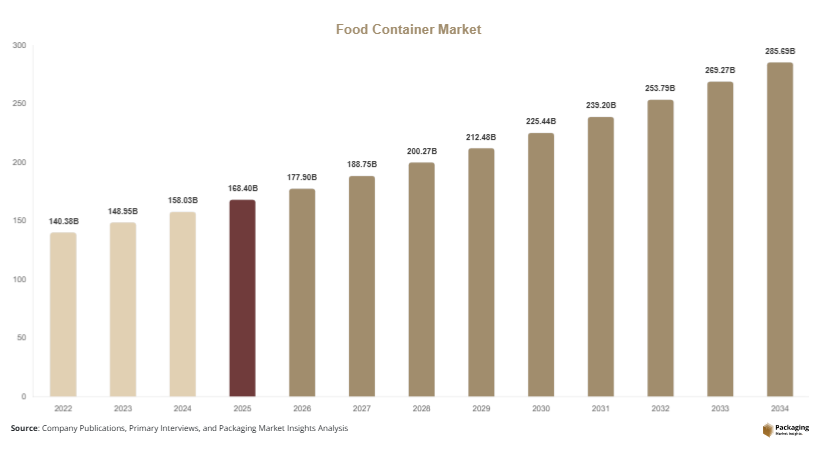
The global food container market size was valued at approximately USD 168.4 billion in 2025 and is projected to reach USD 177.9 billion in 2026. By 2034, the market is forecast to reach nearly USD 286.7 billion, expanding at a CAGR of 6.1% during the forecast period from 2025 to 2034. Growing urbanization, changing consumer eating habits, and rapid expansion of organized retail channels are contributing significantly to industry expansion. The food container market is witnessing stable growth due to the rising demand for convenient food storage, expanding food delivery services, and increasing consumption of packaged meals across developed and emerging economies.
Food containers are widely used across restaurants, supermarkets, institutional catering, food processing units, and household applications. Demand for durable, leak-resistant, lightweight, and recyclable packaging formats continues to rise as food manufacturers seek to improve product safety and shelf life. Plastic containers currently dominate the industry because of their affordability and versatility, while paperboard and biodegradable materials are gaining traction due to sustainability regulations and environmental awareness.
Key Highlights
- Asia Pacific dominated the market with a 39.1% share in 2025.
- Latin America is projected to grow at the fastest CAGR of 6.8%.
- Plastic containers led the material segment with a 48.6% share.
- Rigid food containers dominated the product type segment with a 56.3% share.
- Ready-to-eat food applications led the segment with 34.9% share.
- The US remained the dominant country with a market size of USD 29.7 billion in 2025 and USD 31.1 billion in 2026.
Explore more data points, trends and opportunities Download Free Sample Report
Market Trends
Rising Adoption of Sustainable and Compostable Food Containers
Sustainability has become a major trend in the food container market as governments and consumers increasingly prefer environmentally responsible packaging solutions. Food service providers and retailers are replacing conventional plastic containers with biodegradable alternatives made from bagasse, bamboo fiber, molded pulp, and recyclable paperboard. Many restaurant chains are introducing compostable takeaway containers to reduce landfill waste and comply with single-use plastic regulations. Packaging manufacturers are also investing in water-based coatings and recyclable barrier materials to maintain product safety while improving sustainability performance. This transition toward circular packaging systems is expected to influence procurement strategies and product innovation across the industry throughout the forecast period.
Growth of Smart and Tamper-Evident Packaging Technologies
Smart packaging integration is becoming increasingly important in the global food container market. Food manufacturers and delivery companies are adopting tamper-evident lids, QR-code-enabled packaging, freshness indicators, and temperature-sensitive labels to improve safety and customer confidence. The rapid growth of online food delivery platforms has accelerated demand for containers that preserve food quality during transportation. Advanced packaging technologies also help restaurants and retailers monitor supply chains and improve traceability. Consumers are showing greater interest in packaging that supports hygiene, transparency, and convenience. As a result, manufacturers are introducing digitally integrated food containers that enhance operational efficiency while strengthening brand engagement and consumer trust.
Market Drivers
Expansion of Online Food Delivery and Takeaway Services
The rapid expansion of food delivery applications and takeaway services is a major driver supporting food container market growth. Urban consumers increasingly prefer convenient meal solutions because of busy lifestyles and changing work patterns. Restaurants and cloud kitchens require durable, leak-resistant, and temperature-retaining food containers to maintain product quality during transportation. Demand for compartmentalized meal packaging has also increased significantly across quick-service restaurants and meal subscription platforms. Packaging suppliers are responding by introducing lightweight and stackable container solutions that improve logistics efficiency. The growing penetration of smartphone-based food ordering platforms across emerging economies is expected to sustain long-term demand for advanced food container products.
Rising Consumption of Packaged and Ready-to-Eat Foods
The growing popularity of packaged, frozen, and ready-to-eat food products is another important driver in the market. Consumers increasingly prefer packaged meals because of convenience, longer shelf life, and reduced preparation time. Food processors require high-performance containers that protect products from moisture, contamination, and temperature fluctuations. Microwave-safe and freezer-compatible packaging solutions are becoming widely adopted in supermarkets and convenience stores. The expansion of dual-income households and urban lifestyles is also contributing to higher consumption of packaged foods globally. Manufacturers are therefore focusing on innovative container designs with improved barrier protection, portability, and sustainability features to meet changing consumer expectations.
Market Restraint
Volatility in Raw Material Prices and Regulatory Restrictions on Plastics
Fluctuating raw material prices and strict environmental regulations remain significant restraints for the food container market. Plastic resins, aluminum, and specialty barrier materials are subject to supply chain disruptions and pricing instability caused by geopolitical tensions, energy costs, and transportation challenges. Sudden increases in material costs can reduce profit margins for packaging manufacturers and food service providers. At the same time, many governments are implementing restrictions on single-use plastics and imposing extended producer responsibility requirements. Compliance with evolving regulations increases operational complexity and investment costs for manufacturers.
For example, several countries in Europe and North America have introduced bans on specific plastic food packaging products, forcing companies to redesign product portfolios and invest in sustainable alternatives. Small and medium-sized manufacturers often face financial difficulties while transitioning to recyclable or compostable packaging materials. Additionally, biodegradable materials may not always provide the same durability and moisture resistance as conventional plastics, creating technical challenges for food packaging applications. These factors may limit market expansion in price-sensitive regions where low-cost plastic containers remain widely used.
Market Opportunities
Development of Reusable and Circular Packaging Systems
The increasing adoption of reusable packaging systems presents significant opportunities in the food container market. Restaurants, supermarkets, and delivery platforms are exploring returnable food containers to reduce packaging waste and improve sustainability performance. Subscription-based reusable packaging programs are gaining popularity in urban regions where consumers are willing to participate in environmentally responsible initiatives. Packaging manufacturers are developing durable containers with extended life cycles and easy-cleaning features for commercial reuse applications. Growing investments in reverse logistics infrastructure and digital tracking technologies are expected to accelerate adoption of reusable food packaging systems over the next decade.
Increasing Demand for Premium Food Packaging Solutions
Premiumization in the food industry is creating new opportunities for high-quality and visually appealing food containers. Consumers increasingly prefer attractive packaging that enhances convenience, product freshness, and brand perception. Luxury confectionery, gourmet meals, organic foods, and premium beverages require innovative container designs with advanced barrier properties and aesthetic appeal. Manufacturers are introducing customized printing, transparent lids, and compartmentalized packaging to improve consumer experience. Demand for premium packaging is particularly strong in urban retail chains and online grocery platforms. This trend is encouraging companies to invest in differentiated packaging solutions that combine functionality, sustainability, and visual branding.
Report Scope
| Report Metric | Details |
|---|---|
| Market Size in 2025 | USD 168.4 Billion |
| Market Size in 2026 | USD 177.9 Billion |
| Market Size in 2034 | USD 286.7 Billion |
| CAGR | 6.1% (2026-2034) |
| Base Year for Estimation | 2025 |
| Historical Data | 2022-2024 |
| Forecast Period | 2026-2034 |
| Report Coverage | Revenue Forecast, Competitive Landscape, Supply Chain Disruption, Growth Factors, Environment & Regulatory Landscape and Trends |
| Geographies Covered | North America, Europe, APAC, Middle East and Africa, LATAM |
| Countries Covered | U.S., Canada, U.K., Germany, France, Spain, Italy, Russia, Nordic, Benelux, Rest of Europe, China, South Korea, Japan, India, Australia, Singapore, Taiwan, South East Asia, Rest of Asia-Pacific, UAE, Turky, Saudi Arabia, South Africa, Egypt, Nigeria, Rest of MEA, Brazil, Mexico, Argentina, Chile, Colombia, Rest of LATAM |
Explore more data points, trends and opportunities Download Free Sample Report
Segmental Analysis
By Material
Plastic food containers dominated the market in 2024, accounting for approximately 48.6% of the global share. Their popularity is primarily linked to durability, lightweight characteristics, affordability, and strong moisture resistance. Polypropylene and PET containers are widely used across takeaway meals, frozen foods, dairy products, and ready-to-eat applications because they offer high convenience and compatibility with automated packaging lines. Food manufacturers also prefer plastic containers for their transparency and ability to support customized branding. Despite growing environmental concerns, demand remains strong due to the availability of recyclable plastic options and continuous improvements in barrier technologies that enhance product freshness and shelf life.
Biodegradable food containers are projected to register the fastest CAGR of 7.2% during the forecast period. Growth is largely supported by increasing environmental regulations limiting the use of single-use plastics across multiple countries. Foodservice companies are rapidly adopting containers made from sugarcane bagasse, bamboo fiber, and compostable bioplastics to improve sustainability performance. Consumer awareness regarding plastic pollution is also encouraging restaurants and retailers to transition toward eco-friendly packaging materials. In addition, technological advancements are improving the durability, heat resistance, and moisture barrier performance of biodegradable containers, making them suitable for both hot and cold food applications.
By Product Type
Rigid food containers dominated the Food Container Market in 2024 with a market share of approximately 57.4%. These containers are widely used in frozen foods, dairy products, salads, meal kits, and takeaway applications because they provide excellent structural integrity and product protection. Rigid packaging solutions also offer enhanced stackability and transportation efficiency, reducing the risk of food spillage and contamination. Manufacturers continue to introduce microwave-safe and compartmentalized rigid containers to meet changing consumer preferences. The growth of organized retail and expanding packaged food industries have further strengthened demand for rigid food containers in both household and commercial foodservice sectors.
Flexible food containers are expected to grow at the fastest CAGR of 6.9% through 2034. Flexible packaging formats such as pouches, wraps, and collapsible containers are gaining popularity because they reduce material usage and transportation costs. Their lightweight structure improves logistics efficiency while offering convenience for consumers seeking portable food packaging solutions. Flexible food containers are increasingly used in snack foods, sauces, frozen meals, and ready-to-cook products. Growing demand for resealable and easy-to-store packaging is also supporting adoption. Manufacturers are developing multilayer flexible materials with improved barrier properties to extend shelf life and enhance food preservation.
By Application
Food delivery and takeaway applications accounted for the dominant market share of 41.7% in 2024. The rapid expansion of online food ordering platforms and cloud kitchen operations has significantly increased demand for secure, leak-resistant, and temperature-retaining food containers. Restaurants and quick-service chains require packaging that ensures food quality during transportation while maintaining presentation standards. Multi-compartment containers and insulated packaging solutions are increasingly used to separate ingredients and preserve freshness. Rising urban lifestyles and increasing consumer preference for convenient meal options continue to strengthen the role of food delivery packaging across developed and emerging economies.
Frozen food packaging is expected to register the fastest CAGR of 6.7% during the forecast period. Consumers are increasingly purchasing frozen meals, vegetables, seafood, and ready-to-cook products due to convenience and extended shelf life benefits. This trend is driving demand for food containers capable of withstanding low temperatures while preventing moisture and oxygen penetration. Manufacturers are introducing advanced freezer-safe materials and tamper-resistant lids to improve storage performance. The growth of modern retail channels and increasing adoption of frozen foods in developing economies are also supporting expansion of this application segment within the global Food Container Market.
Food Container Market Segmentations
By Material
- Plastic
- Paperboard
- Glass
- Metal
- Biodegradable Materials
By Product Type
- Rigid Containers
- Flexible Containers
- Bottles & Jars
- Trays
- Cups & Bowls
By Application
- Ready-to-Eat Food
- Frozen Food
- Dairy Products
- Bakery & Confectionery
- Food Delivery Services
- Fresh Produce
Regional Analysis
North America
North America accounted for approximately 27.8% of the global food container market share in 2025 and is projected to expand at a CAGR of 5.7% through 2034. The region benefits from strong demand for packaged food products, advanced retail infrastructure, and rapid adoption of food delivery services. Increasing investments in recyclable packaging technologies and sustainable foodservice products are supporting market growth. Rising consumer awareness regarding food safety and packaging hygiene also contributes to higher demand for premium food containers across the United States and Canada.
The United States dominates the regional market due to high consumption of ready-to-eat meals and widespread use of takeaway packaging. One unique growth factor is the expansion of automated grocery delivery systems, which require durable and insulated food containers for transportation efficiency. Restaurants and retail chains are increasingly adopting tamper-evident packaging formats to improve customer trust. Growing investments in compostable packaging facilities are expected to support long-term market development across the country.
Europe
Europe represented nearly 24.6% of the global food container market share in 2025 and is forecast to grow at a CAGR of 5.5% during the study period. The region has witnessed rising demand for sustainable packaging products due to strict environmental regulations and increasing consumer preference for recyclable materials. Food manufacturers are adopting paperboard and molded fiber containers to comply with European Union packaging directives. Expansion of frozen food consumption and convenience food categories also contributes to consistent market demand.
Germany remains the leading country in the European market because of its advanced food processing industry and strong recycling infrastructure. A unique growth factor supporting the market is the widespread adoption of circular economy initiatives within the packaging sector. Retailers and restaurant chains are introducing reusable food container systems to reduce packaging waste. Growing investment in eco-friendly barrier coatings and fiber-based packaging innovation is expected to strengthen market expansion across Germany.
Asia Pacific
Asia Pacific dominated the food container market with a 39.1% share in 2025 and is anticipated to register a CAGR of 6.7% through 2034. Rapid urbanization, rising disposable incomes, and growing consumption of packaged foods are driving regional growth. Expanding e-commerce grocery delivery and foodservice industries are generating substantial demand for lightweight and affordable food containers. Increasing industrialization and investments in packaging manufacturing facilities are also supporting market expansion across developing economies.
China is the dominant country in the regional market due to its extensive food manufacturing sector and large consumer population. A unique growth factor is the rapid expansion of convenience stores and online meal delivery services across urban centers. Food packaging companies are investing in smart packaging technologies and automated production lines to improve efficiency. Rising government initiatives promoting recyclable materials are further encouraging innovation in sustainable food container products throughout the country.
Middle East & Africa
The Middle East & Africa region accounted for approximately 4.9% of the global food container market share in 2025 and is expected to grow at a CAGR of 5.9% during the forecast period. Increasing tourism activity, urban population growth, and expansion of quick-service restaurant chains are supporting demand for disposable and reusable food containers. Rising investments in food processing and cold chain logistics infrastructure are also contributing to regional market development.
Saudi Arabia leads the regional market because of strong growth in food retail and hospitality industries. One unique growth factor is the increasing demand for halal-certified packaged food products, which require secure and hygienic packaging solutions. Government efforts to diversify the economy and strengthen domestic food manufacturing capabilities are encouraging investments in packaging production facilities. Adoption of sustainable packaging practices is also gradually increasing across urban commercial sectors.
Latin America
Latin America held around 3.6% of the global food container market share in 2025 and is projected to grow at the fastest CAGR of 6.8% through 2034. Expansion of supermarket chains, increasing packaged food consumption, and growth in food delivery applications are supporting market demand. Rising middle-class populations and urbanization trends are encouraging adoption of convenient food packaging formats. Packaging manufacturers are also expanding regional production capacities to meet increasing domestic demand.
Brazil dominates the Latin American market due to its large food processing industry and growing retail sector. A unique growth factor is the increasing popularity of locally produced sustainable packaging materials derived from agricultural waste. Foodservice providers are adopting biodegradable containers to align with changing environmental regulations and consumer expectations. Investments in regional logistics and cold chain infrastructure are expected to further support market growth across Brazil and neighboring countries.
Competitive Landscape
The food container market is moderately fragmented, with global and regional manufacturers competing through product innovation, sustainability initiatives, and strategic partnerships. Key companies focus on recyclable materials, lightweight packaging formats, and improved barrier technologies to strengthen their market presence. Increasing demand for environmentally responsible packaging is encouraging manufacturers to invest in biodegradable and reusable food container solutions.
Berry Global Inc., Amcor plc, Sealed Air Corporation, Sonoco Products Company, and Tupperware Brands Corporation are among the major participants operating in the market. Berry Global remains one of the leading companies because of its extensive product portfolio and strong manufacturing network. The company recently expanded its recyclable food packaging product line to support sustainability goals in the foodservice industry.
Amcor plc continues to invest in high-barrier packaging technologies for ready-to-eat food applications. Sealed Air Corporation is strengthening its smart packaging capabilities through digital traceability features and temperature-sensitive packaging solutions. Sonoco Products Company focuses on paper-based packaging innovation and sustainable container production. Tupperware Brands Corporation maintains strong consumer recognition in reusable food storage solutions and household packaging products.
Key Players List
- Berry Global Inc.
- Amcor plc
- Sealed Air Corporation
- Sonoco Products Company
- Tupperware Brands Corporation
- Huhtamaki Oyj
- Silgan Holdings Inc.
- Pactiv Evergreen Inc.
- Dart Container Corporation
- Graphic Packaging International LLC
- Genpak LLC
- Coveris Holdings S.A.
- DS Smith Plc
- Winpak Ltd.
- Reynolds Consumer Products Inc.