Disposable Food Containers Market Size and Growth
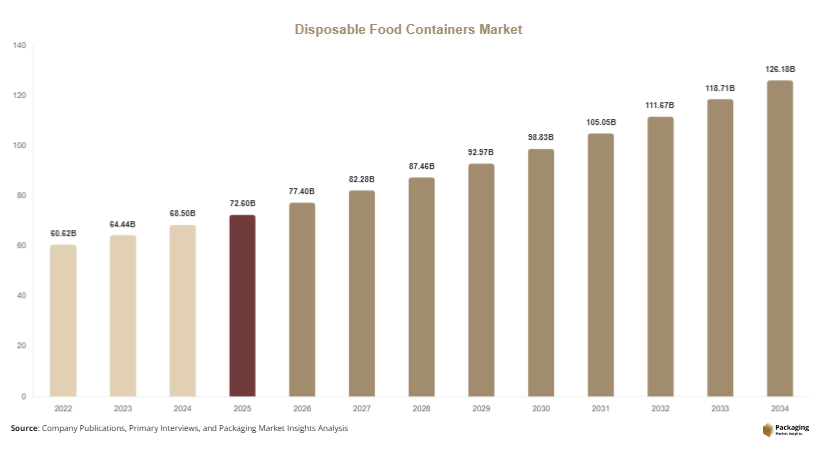
The disposable food containers market is witnessing steady expansion due to the growing demand for convenient, hygienic, and cost-effective food packaging solutions across foodservice, retail, and delivery platforms. Disposable food containers are widely used for packaging ready-to-eat meals, takeout orders, frozen foods, and fresh produce. In 2025, the global market size is estimated at USD 72.6 billion and is expected to reach USD 77.4 billion in 2026. The market is projected to grow to approximately USD 126.8 billion by 2034, registering a compound annual growth rate (CAGR) of 6.3% during the forecast period (2025–2034).
One of the primary growth factors driving the disposable food containers market is the rapid expansion of the food delivery and takeaway sector. Increasing urbanization and changing consumer lifestyles have led to higher consumption of packaged and ready-to-eat food, boosting demand for disposable packaging solutions. Another key factor is the growth of quick-service restaurants (QSRs) and cloud kitchens, which rely heavily on disposable containers to maintain food safety and convenience. Additionally, rising awareness regarding hygiene and food safety has increased the adoption of single-use containers in both developed and emerging markets.
Key Highlights:
- Market size projected to grow from USD 72.6 billion (2025) to USD 126.8 billion (2034)
- CAGR of 6.3% during the forecast period
- Strong demand from food delivery and QSR sectors
- Rising adoption of biodegradable and sustainable packaging materials
- Continuous innovation in container design and functionality
Explore more data points, trends and opportunities Download Free Sample Report
Market Trends
Shift Toward Biodegradable and Compostable Materials
A significant trend in the disposable food containers market is the increasing shift toward biodegradable and compostable materials. With growing environmental concerns and regulatory pressures, manufacturers are focusing on developing eco-friendly alternatives to traditional plastic containers. Materials such as bagasse, paperboard, and polylactic acid (PLA) are gaining traction as sustainable options. These materials offer similar functionality while reducing environmental impact. Foodservice providers and retailers are increasingly adopting such solutions to align with consumer preferences and sustainability goals. This trend is expected to drive innovation and reshape the competitive landscape in the coming years.
Growth of Smart and Functional Packaging
Another emerging trend is the development of smart and functional packaging solutions in the disposable food containers market. Manufacturers are integrating features such as temperature resistance, tamper-evident seals, and improved ventilation systems to enhance food quality and safety. These innovations are particularly important in the food delivery segment, where maintaining product integrity during transit is crucial. Additionally, the use of advanced materials and coatings is improving the durability and performance of disposable containers. This trend is supporting the growth of premium packaging solutions and meeting the evolving needs of consumers and businesses.
Market Drivers
Expansion of Food Delivery and Takeaway Services
The rapid expansion of food delivery and takeaway services is a major driver of the disposable food containers market. The increasing popularity of online food ordering platforms has significantly boosted the demand for disposable packaging solutions. Consumers prefer convenient and hygienic packaging that ensures food safety during transportation. Disposable containers provide an effective solution by offering durability, leak resistance, and ease of use. The growth of cloud kitchens and quick-service restaurants has further accelerated demand, as these businesses rely heavily on disposable packaging to operate efficiently. This trend is expected to continue driving market growth.
Rising Demand for Hygiene and Food Safety
The growing emphasis on hygiene and food safety is another key driver of the disposable food containers market. Consumers are increasingly concerned about contamination and prefer single-use packaging to minimize health risks. This has led to higher adoption of disposable containers in both residential and commercial settings. Foodservice providers are also prioritizing hygiene to comply with regulatory standards and maintain customer trust. Disposable containers offer a practical solution by reducing the risk of cross-contamination and ensuring product safety. This factor is particularly important in the post-pandemic environment, where hygiene has become a critical consideration.
Market Restraints
Environmental Concerns and Regulatory Restrictions
Environmental concerns related to plastic waste are a significant restraint for the disposable food containers market. Governments and regulatory bodies are implementing strict policies to reduce the use of single-use plastics, which directly impacts the demand for disposable containers. While alternative materials are being developed, they often come with higher costs and limited availability, posing challenges for manufacturers.
The impact of this restraint is evident in regions where bans on plastic packaging have been introduced. For example, foodservice providers may need to switch to biodegradable or reusable alternatives, which can increase operational costs. Additionally, the lack of proper waste management infrastructure in some regions limits the effectiveness of recycling initiatives. This creates challenges for both manufacturers and end-users, affecting market growth. Despite these challenges, ongoing advancements in sustainable materials are expected to mitigate the impact of regulatory restrictions over time.
Market Opportunities
Development of Eco-Friendly Packaging Solutions
The development of eco-friendly packaging solutions presents a significant opportunity for the disposable food containers market. Manufacturers are investing in research and development to create biodegradable, compostable, and recyclable materials that meet environmental standards. These innovations are helping companies address regulatory requirements and consumer preferences for sustainable products. The adoption of eco-friendly packaging is expected to increase across various industries, including foodservice and retail. Companies that focus on sustainable solutions can gain a competitive advantage and expand their market presence.
Growth in Emerging Markets
Emerging markets offer substantial growth opportunities for the disposable food containers market. Rapid urbanization, rising disposable incomes, and changing consumer lifestyles are driving demand for packaged and ready-to-eat food in these regions. The expansion of retail and foodservice industries is further supporting market growth. Additionally, increasing investments in infrastructure and logistics are improving the distribution of packaged food products. Companies that establish a strong presence in emerging markets can benefit from growing demand and favorable economic conditions.
Report Scope
| Report Metric | Details |
|---|---|
| Market Size in 2025 | USD 72.6 Billion |
| Market Size in 2026 | USD 77.4 Billion |
| Market Size in 2034 | USD 126.8 Billion |
| CAGR | 6.3% (2026-2034) |
| Base Year for Estimation | 2025 |
| Historical Data | 2022-2024 |
| Forecast Period | 2026-2034 |
| Report Coverage | Revenue Forecast, Competitive Landscape, Supply Chain Disruption, Growth Factors, Environment & Regulatory Landscape and Trends |
| Geographies Covered | North America, Europe, APAC, Middle East and Africa, LATAM |
| Countries Covered | U.S., Canada, U.K., Germany, France, Spain, Italy, Russia, Nordic, Benelux, Rest of Europe, China, South Korea, Japan, India, Australia, Singapore, Taiwan, South East Asia, Rest of Asia-Pacific, UAE, Turky, Saudi Arabia, South Africa, Egypt, Nigeria, Rest of MEA, Brazil, Mexico, Argentina, Chile, Colombia, Rest of LATAM |
Explore more data points, trends and opportunities Download Free Sample Report
Segmental Analysis
By Material Type
Plastic containers dominated the disposable food containers market in 2024, accounting for approximately 58% of the total share. These containers are widely used due to their durability, cost-effectiveness, and versatility. Plastic materials offer excellent barrier properties, making them suitable for a wide range of food products. The availability of different types of plastics, such as polypropylene and polyethylene, further supports their widespread adoption.
Biodegradable materials are expected to be the fastest-growing segment, with a CAGR of 7.5% during the forecast period. This growth is driven by increasing environmental concerns and regulatory pressures. Materials such as bagasse and paperboard are gaining popularity as sustainable alternatives. The growing demand for eco-friendly packaging solutions is expected to drive the growth of this segment.
By Application
The foodservice segment held the largest market share in 2024, accounting for approximately 42%. Disposable food containers are widely used in restaurants, cafes, and catering services for packaging and serving food. The increasing demand for takeaway and delivery services is driving the growth of this segment.
The retail segment is expected to grow at the fastest rate, with a CAGR of 7.0%. The rising demand for packaged food products in supermarkets and convenience stores is driving this growth. Disposable containers provide a convenient and hygienic packaging solution for a wide range of food items.
By End-Use
The commercial segment dominated the market in 2024, accounting for approximately 65% of the total share. This includes restaurants, hotels, and catering services that rely heavily on disposable containers for their operations. The growing foodservice industry is driving the demand for disposable packaging solutions.
The household segment is expected to grow at a CAGR of 6.8% during the forecast period. The increasing consumption of ready-to-eat and packaged food products is driving the demand for disposable containers in households. Convenience and ease of use are key factors supporting this growth.
Disposable Food Containers Market Segmentations
Material Type
- Plastic
- Paper & Paperboard
- Biodegradable Materials
Application
- Foodservice
- Retail
- Institutional
End-Use
- Commercial
- Household
Regional Analysis
North America
North America accounted for approximately 30% of the disposable food containers market share in 2025 and is expected to grow at a CAGR of 5.9% during the forecast period. The region’s growth is driven by high demand for food delivery services and the presence of a well-established foodservice industry. Increasing adoption of sustainable packaging solutions is also supporting market expansion.
The United States dominates the North American market due to its large consumer base and advanced logistics infrastructure. A unique growth factor is the widespread adoption of online food delivery platforms, which has significantly increased demand for disposable containers.
Europe
Europe held around 25% of the market share in 2025 and is projected to grow at a CAGR of 5.7%. The region’s growth is influenced by strict environmental regulations and a strong focus on sustainability. Companies are increasingly adopting eco-friendly packaging solutions to comply with regulatory requirements.
Germany is a leading country in the European market, supported by its robust foodservice industry. A unique growth factor is the implementation of circular economy initiatives, encouraging the use of recyclable and biodegradable materials.
Asia Pacific
Asia Pacific accounted for the largest market share of approximately 32% in 2025 and is expected to grow at a CAGR of 7.2%. Rapid urbanization, population growth, and increasing demand for convenience foods are key factors driving market growth in the region.
China dominates the Asia Pacific market due to its large population and expanding food delivery sector. A unique growth factor is the rapid growth of mobile-based food ordering platforms, which has increased demand for disposable packaging.
Middle East & Africa
The Middle East & Africa region held around 7% of the market share in 2025 and is projected to grow at a CAGR of 6.0%. The growth is driven by increasing demand for packaged food and beverages and the expansion of the hospitality sector.
Saudi Arabia is a key market in the region, supported by growing tourism and foodservice industries. A unique growth factor is the increasing number of international restaurant chains entering the market, boosting demand for disposable containers.
Latin America
Latin America accounted for approximately 6% of the market share in 2025 and is expected to grow at a CAGR of 6.1%. The region’s growth is supported by increasing urbanization and rising demand for convenience foods.
Brazil leads the Latin American market due to its large population and growing foodservice sector. A unique growth factor is the expansion of quick-service restaurants, which is increasing the demand for disposable food containers.
Competitive Landscape
The disposable food containers market is highly competitive, with the presence of several global and regional players focusing on product innovation, sustainability, and cost efficiency. Companies are investing in research and development to introduce eco-friendly packaging solutions and improve product performance. Strategic partnerships and acquisitions are common as companies aim to expand their market presence.
Berry Global Group Inc. is considered a leading player in the market, known for its extensive product portfolio and strong focus on sustainable packaging solutions. The company has recently introduced a range of recyclable and biodegradable containers to meet evolving market demands. Other key players are also focusing on incorporating advanced materials and technologies to enhance product quality and reduce environmental impact.
Key Players List
- Berry Global Group Inc.
- Amcor plc
- Dart Container Corporation
- Huhtamaki Oyj
- Genpak LLC
- Sabert Corporation
- Pactiv Evergreen Inc.
- Anchor Packaging Inc.
- Coveris Holdings S.A.
- Sealed Air Corporation
- Winpak Ltd.
- Tetra Pak International S.A.
- Novolex Holdings Inc.
- Greiner Packaging International GmbH
- Placon Corporation