Meal Prep Containers Market Size and Growth
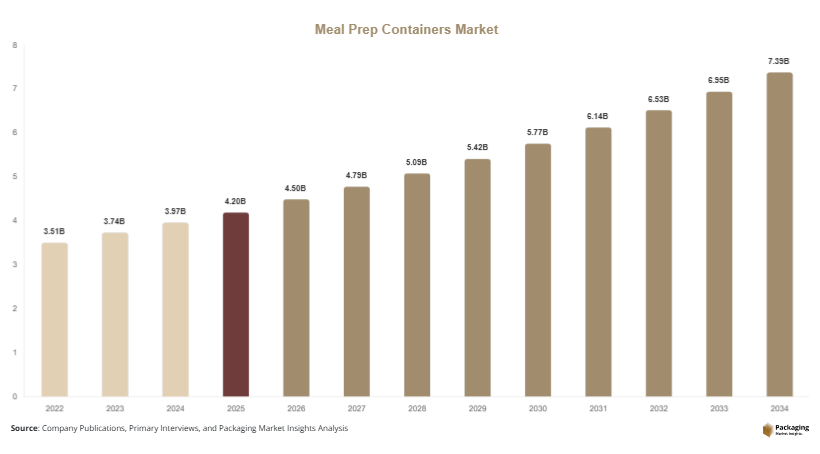
The meal prep containers market size has witnessed steady expansion over the past few years as consumers increasingly adopt structured meal planning habits. The growing focus on health management, portion control, and convenience-based food consumption has contributed significantly to the adoption of meal preparation solutions. In 2025, the global meal prep containers market size was estimated at USD 4.2 billion. The market continued its growth trajectory in 2026 and is projected to reach USD 4.5 billion as more households, fitness enthusiasts, and food service providers integrate organized meal storage solutions into daily routines.
Over the long-term forecast period, the market is expected to maintain stable growth. By 2034, the meal prep containers market is forecast to reach approximately USD 7.8 billion, expanding at a compound annual growth rate (CAGR) of 6.4% from 2025 to 2034. The rising adoption of meal planning practices across working professionals and urban households has played an important role in supporting demand for durable, reusable, and compartmentalized containers.
Key Highlights
- The meal prep containers market reached USD 4.2 billion in 2025 and is projected to grow to USD 7.8 billion by 2034, reflecting steady industry expansion.
- The market is expected to register a CAGR of 6.4% during 2025–2034, supported by increasing adoption of organized meal planning practices.
- Rising consumer preference for reusable, sustainable, and durable food storage solutions is contributing significantly to market growth.
Explore more data points, trends and opportunities Download Free Sample Report
Market Trends
Rising Demand for Sustainable and Reusable Containers
Sustainability has become an important trend shaping the meal prep containers market . Consumers are increasingly aware of the environmental impact of disposable plastic packaging. This awareness has encouraged a shift toward reusable containers made from eco-friendly materials such as glass, stainless steel, bamboo fiber, and recyclable polymers. Many households now prefer containers that can be used repeatedly without degrading in quality. Manufacturers have responded by launching products that combine durability with sustainable production practices. In addition, governments and regulatory bodies in several countries have introduced guidelines to reduce plastic waste, further supporting the adoption of reusable meal prep containers across residential and commercial food applications.
Integration of Smart Design and Multi-Compartment Solutions
Another prominent trend in the meal prep containers market is the development of innovative and functional product designs. Modern consumers prefer containers that support organized meal planning, portion control, and convenient storage. Multi-compartment containers have become particularly popular because they allow users to separate different food items within the same container. These designs help maintain food texture and flavor while supporting balanced meal planning. Manufacturers are also introducing stackable containers with airtight and leak-resistant lids to improve portability. Some premium product lines include temperature-resistant materials that allow containers to move directly from freezer to microwave. These design innovations improve usability and support continued market expansion.
Market Drivers
Increasing Health Awareness and Meal Planning Culture
The growing focus on personal health and nutrition is a major driver of the meal prep containers market . Consumers are paying closer attention to diet quality and portion control as part of broader wellness routines. Meal preparation enables individuals to plan balanced meals in advance and avoid unhealthy food choices during busy schedules. Fitness communities and nutrition professionals frequently encourage meal prep as a strategy for maintaining consistent dietary habits. As more people adopt structured meal planning practices, the demand for durable containers designed specifically for food portioning and storage continues to increase. This trend is particularly strong among urban professionals and individuals following fitness or weight management programs.
Growth of Online Meal Delivery and Meal Kit Services
The rapid expansion of meal delivery platforms and subscription-based meal kit services has also contributed to the growth of the meal prep containers market . These services rely heavily on reliable food packaging that preserves freshness and prevents leakage during transportation. Many meal kit providers supply ingredients in reusable or recyclable containers designed for easy storage and reheating. This business model encourages consumers to retain and reuse the containers for future meal preparation. As the online food delivery ecosystem continues to expand globally, demand for practical and reusable food storage containers is expected to grow in parallel. The trend also encourages innovation in packaging materials and container design.
Market Restraint
Competition from Disposable Packaging Alternatives
Despite the steady growth of the meal prep containers market , competition from disposable food packaging remains a notable restraint. Single-use containers made from thin plastic, paperboard, or aluminum are widely available and often offered at lower prices than reusable meal prep containers. Food service outlets, quick-service restaurants, and takeaway businesses frequently rely on disposable packaging due to its convenience and low upfront cost. As a result, some consumers continue to use disposable options rather than investing in reusable containers.
The price sensitivity of certain consumer segments can slow the adoption of durable meal prep containers. While reusable containers offer long-term value, their initial purchase cost may be higher compared to single-use packaging. This cost difference can discourage price-conscious buyers, particularly in developing regions where disposable packaging remains affordable and easily accessible.
Another challenge is the perception of convenience. Disposable containers eliminate the need for washing and maintenance, which appeals to consumers with extremely busy schedules. In addition, food service providers may prefer disposable packaging to avoid logistics associated with container returns or cleaning.
For example, many takeaway restaurants still rely heavily on disposable containers to manage large volumes of orders. This practice limits the immediate adoption of reusable meal prep containers in the food service sector. To address this restraint, manufacturers are focusing on producing cost-efficient and lightweight reusable containers that compete more effectively with disposable alternatives while highlighting their long-term environmental benefits.
Market Opportunities
Expansion of E-Commerce Distribution Channels
The rapid growth of online retail platforms presents a major opportunity for the meal prep containers market . E-commerce platforms allow manufacturers to reach a broader customer base beyond traditional retail stores. Consumers can easily compare product features, prices, and customer reviews before purchasing containers online. This accessibility supports higher product visibility and encourages impulse buying behavior.
Online retail also enables niche brands to introduce specialized containers tailored for specific consumer needs, such as fitness meal prep kits, stackable storage sets, or eco-friendly containers. Subscription-based product bundles are becoming increasingly popular on e-commerce platforms, allowing consumers to purchase coordinated sets designed for weekly meal planning. As internet penetration and digital payment adoption continue to increase worldwide, online channels are expected to play a major role in expanding market reach.
Product Innovation in Temperature-Resistant Materials
Product innovation in advanced materials offers another promising opportunity for the meal prep containers market . Consumers are increasingly seeking containers that can withstand multiple temperature environments, including freezer storage, microwave heating, and dishwasher cleaning. Manufacturers are developing high-performance materials that maintain durability under these conditions while remaining safe for food storage.
Glass containers with silicone seals, high-grade stainless steel designs, and BPA-free polymer materials are gaining traction among consumers seeking long-lasting food storage solutions. These innovations extend the lifespan of containers and improve usability across different meal preparation routines. As research in food-safe materials progresses, companies have opportunities to differentiate their products through improved durability, safety standards, and user convenience.
Report Scope
| Report Metric | Details |
|---|---|
| Market Size in 2025 | USD 4.2 Billion |
| Market Size in 2026 | USD 4.5 Billion |
| Market Size in 2034 | USD 7.8 Billion |
| CAGR | 6.4% (2026-2034) |
| Base Year for Estimation | 2025 |
| Historical Data | 2022-2024 |
| Forecast Period | 2026-2034 |
| Report Coverage | Revenue Forecast, Competitive Landscape, Supply Chain Disruption, Growth Factors, Environment & Regulatory Landscape and Trends |
| Geographies Covered | North America, Europe, APAC, Middle East and Africa, LATAM |
| Countries Covered | U.S., Canada, U.K., Germany, France, Spain, Italy, Russia, Nordic, Benelux, Rest of Europe, China, South Korea, Japan, India, Australia, Singapore, Taiwan, South East Asia, Rest of Asia-Pacific, UAE, Turky, Saudi Arabia, South Africa, Egypt, Nigeria, Rest of MEA, Brazil, Mexico, Argentina, Chile, Colombia, Rest of LATAM |
Explore more data points, trends and opportunities Download Free Sample Report
Segmental Analysis
By Material Type
Plastic meal prep containers dominated the meal prep containers market in 2024, accounting for approximately 48% of total market share. Their popularity is largely due to their lightweight structure, affordability, and wide availability across retail stores and online platforms. Many households prefer plastic containers because they are easy to transport and often come in multi-piece sets designed for weekly meal preparation. Manufacturers continue to produce BPA-free plastic containers to address consumer concerns about food safety. These products are commonly used for everyday meal storage in households, offices, and school lunch programs.
Glass containers represent the fastest-growing material segment, with an expected CAGR of around 7.6% during the forecast period. Consumers increasingly prefer glass containers due to their durability and resistance to odor and stain absorption. Glass containers are also suitable for microwave and oven use, which improves convenience during reheating. The shift toward sustainable and reusable household products further supports the adoption of glass containers. Many manufacturers now offer glass containers with airtight silicone lids that improve food preservation while maintaining portability.
By Product Type
Single-compartment containers held the largest share of the meal prep containers market in 2024, representing approximately 55% of total demand. These containers are widely used for simple meal storage where food separation is not required. They are commonly used by households that prepare bulk meals such as rice, pasta, or salads in advance. Their straightforward design makes them affordable and easy to stack in refrigerators and freezers. Food service providers also rely on single-compartment containers when packaging uniform meals for delivery.
Multi-compartment containers are projected to be the fastest-growing product type, with a forecast CAGR of 7.1%. These containers allow users to store multiple food items in separate compartments, which helps maintain texture and flavor. The design also supports portion control, making it attractive to consumers following structured diet plans. Fitness enthusiasts and working professionals often prefer multi-compartment containers because they simplify meal organization for daily consumption.
By End-Use
Household applications accounted for the largest share of the meal prep containers market in 2024, contributing approximately 62% of global demand. Many families prepare meals in advance to save time during busy weekdays. Containers are commonly used for storing leftovers, packing lunches, and organizing weekly meal plans. The availability of affordable multi-container sets has further encouraged adoption among households. In addition, the popularity of cooking content on digital platforms has promoted the concept of meal preparation as an efficient lifestyle practice.
The commercial segment, which includes restaurants, meal delivery companies, and catering services, is expected to record the fastest growth with a CAGR of 7.3% during the forecast period. The expansion of food delivery services has increased the need for reliable containers that maintain food quality during transportation. Many commercial operators now prefer reusable containers for internal meal preparation and storage before packaging meals for delivery.
Meal Prep Containers Market Segmentations
Material Type
- Plastic
- Glass
- Stainless Steel
- Silicone
- Others
Product Type
- Single-Compartment Containers
- Multi-Compartment Containers
- Stackable Container Sets
- Bento-Style Containers
End-Use
- Household
- Commercial
- Food Service Providers
- Meal Kit Companies
Distribution Channel
- Online Retail
- Supermarkets & Hypermarkets
- Specialty Kitchen Stores
- Department Stores
- Wholesale & Bulk Retailers
Regional Analysis
North America
North America accounted for a significant share of the meal prep containers market in 2025, representing approximately 34% of global revenue. The region is expected to maintain stable growth with a projected CAGR of 5.9% through 2034. High consumer awareness of health and fitness routines has encouraged widespread adoption of meal planning practices. In addition, the strong presence of organized retail chains and e-commerce platforms supports product availability across multiple consumer segments.
The United States remains the dominant country in this region due to its large population of health-conscious consumers and fitness enthusiasts. The growing popularity of meal preparation among gym communities and nutrition programs has increased demand for portion-controlled containers. Another growth factor is the expansion of meal kit subscription services that distribute ingredients in reusable containers.
Europe
Europe held approximately 27% of the global meal prep containers market share in 2025 and is expected to grow at a CAGR of 6.1% during the forecast period. Consumers in this region increasingly prefer sustainable and reusable packaging solutions. Regulatory measures aimed at reducing single-use plastics have further encouraged households to adopt durable food storage containers.
Germany represents one of the leading markets in Europe. The country has a strong culture of sustainability and recycling, which promotes the use of reusable household products. The increasing popularity of home cooking and meal preparation among working professionals has contributed to higher demand for organized storage containers across urban households.
Asia Pacific
Asia Pacific is emerging as one of the fastest-growing regions in the meal prep containers market . In 2025, the region accounted for 23% of global revenue, and it is projected to expand at a CAGR of 7.8% through 2034. Rapid urbanization and rising disposable incomes have increased demand for convenient food storage solutions across major metropolitan areas.
China plays a central role in regional market expansion. The country's growing middle-class population and busy urban lifestyles encourage consumers to prepare meals in advance. Additionally, the rapid expansion of online retail platforms has improved product accessibility, allowing manufacturers to reach millions of consumers through digital marketplaces.
Middle East & Africa
The Middle East & Africa region held approximately 9% of the meal prep containers market share in 2025 and is projected to grow at a CAGR of 6.2% over the forecast period. Increasing urbanization and the expansion of modern retail infrastructure are contributing to gradual market development. Consumers in major cities are increasingly adopting organized food storage solutions for household use.
United Arab Emirates is one of the leading markets within this region. The country's growing population of expatriates and working professionals has created demand for convenient meal preparation solutions. The popularity of fitness centers and healthy eating programs has also contributed to increased adoption of portion-controlled food containers.
Latin America
Latin America accounted for around 7% of the global meal prep containers market share in 2025 and is expected to grow at a CAGR of 6.0% through 2034. Increasing awareness of healthy eating habits and the gradual expansion of modern retail networks are supporting market growth. Urban households are increasingly adopting meal planning practices to manage busy work schedules.
Brazil represents the largest market in this region. The country's expanding urban population and rising middle-income households are driving demand for reusable food storage products. Another important growth factor is the increasing influence of social media fitness communities, which often promote meal preparation as part of structured dietary routines.
Competitive Landscape
The meal prep containers market is moderately competitive, with several global and regional manufacturers focusing on product innovation and distribution expansion. Companies compete primarily on material quality, durability, product design, and pricing strategies. Many manufacturers are introducing containers with leak-proof lids, stackable structures, and temperature-resistant materials to differentiate their product portfolios.
One of the prominent leaders in the market is Rubbermaid, which has established a strong presence through its extensive range of durable food storage containers designed for household and commercial use. The company focuses on product innovation and ergonomic design to enhance consumer convenience.
Other major companies are expanding their product lines through sustainable materials and modular container systems that support organized meal preparation. Strategic partnerships with e-commerce platforms and retail chains have also helped companies improve product accessibility across global markets.
Recent industry activity shows increasing investment in reusable container solutions and environmentally responsible manufacturing processes. Companies are also focusing on attractive packaging and bundled container sets to appeal to consumers who prefer complete meal preparation kits.
Key Players List
- Rubbermaid
- Tupperware Brands Corporation
- LocknLock Co., Ltd.
- Sistema Plastics
- OXO International
- Prep Naturals
- Glasslock
- Bentgo
- Freshware
- Snapware
- Joseph Joseph Ltd.
- Pyrex
- Zojirushi Corporation
- Luminarc
- Ello Products