Canned Food Packaging Market Size and Growth
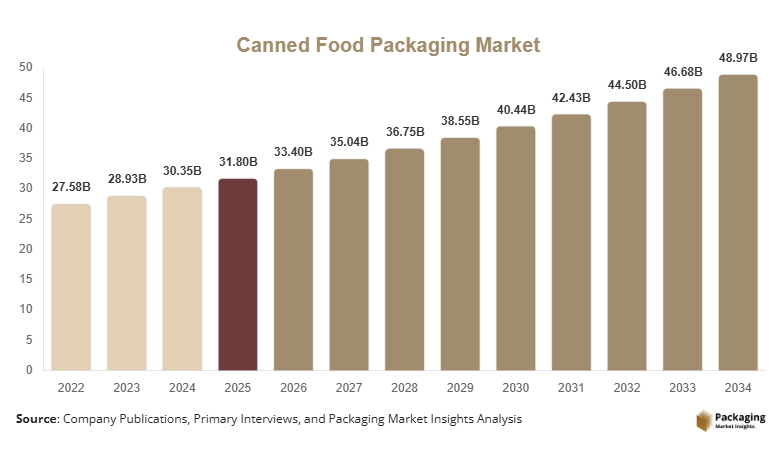
The global canned food packaging market size was valued at USD 31.8 billion in 2025 and is projected to reach USD 33.4 billion in 2026. By 2034, the market is forecast to attain USD 49.2 billion, expanding at a CAGR of 4.9% during 2025–2034. Canned food packaging plays a major role in preserving food quality, extending shelf life, and supporting efficient transportation across global supply chains. The canned food packaging market is experiencing stable growth due to rising demand for shelf-stable food products, increasing urbanization, and the expansion of organized retail channels.
The growing popularity of ready-to-eat meals and processed food products is supporting market expansion across developed and emerging economies. Consumers are increasingly purchasing canned vegetables, seafood, soups, pet food, and meat products due to convenience and long storage capability. Manufacturers are also investing in lightweight metal packaging, recyclable aluminum containers, and BPA-free coatings to improve sustainability and consumer safety.
Key Highlights
- North America dominated the market with a 34.2% share in 2025.
- Asia Pacific is projected to grow at the fastest CAGR of 5.8%.
- Aluminum cans led the material segment with a 41.6% share.
- Food cans dominated the product segment with a 48.9% share.
- Ready-to-eat food applications led the segment with 36.8% share.
- The US remained the dominant country with a market size of USD 8.7 billion in 2025 and USD 9.1 billion in 2026.
Explore more data points, trends and opportunities Download Free Sample Report
Market Trends
Rising Adoption of Sustainable Metal Packaging
Sustainability has become a major trend in the canned food packaging market as food companies focus on recyclable and environmentally responsible packaging solutions. Aluminum and steel cans are gaining preference because they can be recycled multiple times without significant material degradation. Governments and regulatory agencies are also encouraging recycling initiatives and reducing plastic waste, which supports metal packaging demand. Food manufacturers are increasingly promoting canned products with eco-friendly labels and lower carbon footprints. In addition, lightweight can technologies are reducing transportation costs and material usage. The integration of water-based inks and BPA-free internal coatings is also helping companies meet environmental standards and improve consumer trust in packaged food products.
Growth of Premium and Convenience Food Packaging
The increasing demand for premium canned foods and convenient meal solutions is transforming packaging design and functionality. Consumers are looking for easy-open lids, resealable cans, attractive labeling, and portion-controlled packaging formats. Brands are investing in advanced printing technologies and visually appealing packaging to improve shelf differentiation in supermarkets and online retail platforms. Premium canned seafood, organic vegetables, soups, and gourmet ready meals are becoming popular among urban consumers. Companies are also introducing microwave-compatible containers and compact packaging designs to support busy lifestyles. This trend is creating opportunities for innovative can structures and customized packaging solutions across multiple food categories globally.
Market Drivers
Increasing Demand for Long Shelf-Life Food Products
The growing demand for food products with extended shelf life is one of the major drivers of the canned food packaging market. Consumers prefer canned food because it remains safe and consumable for long periods without refrigeration. This packaging format supports food preservation while reducing spoilage during transportation and storage. Rising urban populations and changing consumer lifestyles are increasing purchases of ready-to-eat and easy-to-store food products. Food retailers also benefit from reduced inventory losses and efficient supply chain management. In developing countries, canned food packaging is supporting food availability in remote regions where cold storage infrastructure remains limited, further contributing to market growth.
Expansion of Organized Retail and E-Commerce Grocery Platforms
The rapid expansion of supermarkets, hypermarkets, and online grocery delivery services is driving demand for durable canned food packaging solutions. Canned packaging offers high resistance against physical damage during storage and transportation, making it suitable for e-commerce distribution networks. Consumers are increasingly purchasing packaged foods online due to convenience and wider product availability. Retailers prefer canned packaging because of its stackability, longer shelf life, and low product return rates. Food manufacturers are also expanding canned product portfolios across vegetables, meat, seafood, and beverages to meet evolving retail demand. This retail transformation is supporting consistent market growth globally.
Market Restraint
Rising Concerns Regarding Metal Price Volatility and Alternative Packaging Competition
Fluctuations in raw material prices, particularly aluminum and steel, remain a major restraint for the canned food packaging market. Packaging manufacturers are facing increasing production costs due to volatility in metal supply chains and energy prices. Higher material costs directly impact profit margins and create pricing challenges for food producers. In addition, flexible plastic packaging and carton-based packaging formats are emerging as alternative solutions for several food categories due to lower manufacturing costs and lightweight properties.
For example, ready meal and soup manufacturers are increasingly adopting retort pouches because they reduce transportation expenses and require less storage space compared to metal cans. Smaller food brands often prefer flexible packaging due to lower initial investment costs and easier customization. Environmental concerns related to mining activities and industrial emissions associated with metal production also influence consumer perception in some markets. These factors may limit adoption rates in price-sensitive regions and create challenges for traditional canned packaging manufacturers during the forecast period.
Market Opportunities
Development of BPA-Free and Smart Packaging Solutions
The development of BPA-free coatings and intelligent packaging technologies presents strong growth opportunities for the canned food packaging market. Consumers are increasingly concerned about food safety and chemical migration from packaging materials. As a result, manufacturers are investing in safer internal can coatings and advanced barrier technologies. Smart packaging features such as QR codes, freshness indicators, and digital traceability systems are also gaining popularity. These innovations help brands improve transparency, strengthen consumer engagement, and comply with evolving food safety regulations. Companies adopting smart and health-focused packaging solutions are expected to gain competitive advantages in premium canned food categories globally.
Growth Potential in Emerging Economies
Emerging economies across Asia Pacific, Latin America, and Africa offer substantial opportunities for canned food packaging manufacturers. Rising disposable income, rapid urbanization, and changing dietary preferences are increasing demand for processed and packaged foods. Expansion of modern retail infrastructure and cold-chain limitations in several developing countries further support canned food consumption. Local food manufacturers are investing in affordable canned packaging formats to improve product shelf life and expand regional distribution networks. Government programs supporting food security and packaged food manufacturing are also contributing to market expansion. These factors create favorable conditions for packaging companies to establish new production facilities and strengthen regional supply chains.
Report Scope
| Report Metric | Details |
|---|---|
| Market Size in 2025 | USD 31.8 Billion |
| Market Size in 2026 | USD 33.4 Billion |
| Market Size in 2034 | USD 49.2 Billion |
| CAGR | 4.9% (2026-2034) |
| Base Year for Estimation | 2025 |
| Historical Data | 2022-2024 |
| Forecast Period | 2026-2034 |
| Report Coverage | Revenue Forecast, Competitive Landscape, Supply Chain Disruption, Growth Factors, Environment & Regulatory Landscape and Trends |
| Geographies Covered | North America, Europe, APAC, Middle East and Africa, LATAM |
| Countries Covered | U.S., Canada, U.K., Germany, France, Spain, Italy, Russia, Nordic, Benelux, Rest of Europe, China, South Korea, Japan, India, Australia, Singapore, Taiwan, South East Asia, Rest of Asia-Pacific, UAE, Turky, Saudi Arabia, South Africa, Egypt, Nigeria, Rest of MEA, Brazil, Mexico, Argentina, Chile, Colombia, Rest of LATAM |
Explore more data points, trends and opportunities Download Free Sample Report
Segmental Analysis
By Material
Aluminum cans dominated the material segment and accounted for 41.6% of the global market share in 2024. Aluminum remains widely used due to its lightweight structure, corrosion resistance, and strong recyclability profile. Food manufacturers prefer aluminum cans because they help preserve food freshness while reducing transportation costs. The material is extensively utilized in canned beverages, seafood, vegetables, and ready meals. Increasing consumer awareness regarding sustainable packaging has also contributed to the growing adoption of recyclable aluminum containers. Manufacturers are further improving packaging efficiency through lightweight can designs and advanced coating technologies that improve durability and food safety compliance.
Steel packaging is projected to be the fastest-growing subsegment, expanding at a CAGR of 5.5% during the forecast period. Steel cans offer excellent strength and are highly suitable for high-pressure sterilization processes used in canned food production. Growing demand for durable packaging for meat products, soups, and pet foods is supporting steel packaging adoption globally. Manufacturers are introducing thinner steel structures with improved protective coatings to reduce material consumption while maintaining packaging performance. In addition, increasing investments in metal recycling infrastructure and industrial sustainability programs are supporting long-term growth opportunities for steel-based canned food packaging solutions.
By Product Type
Food cans held the dominant share of 48.9% in 2024 due to extensive use across vegetables, fruits, soups, meat, and seafood applications. These packaging solutions provide long shelf life and strong protection against contamination and moisture exposure. Food manufacturers rely on metal cans because they support efficient large-scale processing and distribution. The segment is also benefiting from advancements in easy-open lid systems and high-quality printing technologies that improve convenience and branding opportunities. Demand remains particularly strong in supermarkets, convenience stores, and institutional food supply channels where long-term product stability is essential.
Aerosol food packaging is expected to register the fastest CAGR of 5.2% during the forecast period. Growth is supported by increasing demand for whipped creams, cooking sprays, sauces, and specialty food products packaged in aerosol containers. Consumers prefer aerosol formats due to convenience, hygiene, and controlled dispensing capabilities. Food brands are increasingly using lightweight aerosol cans with improved valve technologies and recyclable materials to enhance packaging efficiency. Expansion of premium culinary products and rising interest in innovative food preparation solutions are also contributing to the growing demand for aerosol-based canned food packaging worldwide.
By Application
Ready-to-eat food applications accounted for 36.8% of the market share in 2024 due to rising demand for convenient meal solutions among urban consumers. Busy lifestyles, increasing workforce participation, and growing dependence on packaged meals continue to support this segment. Canned ready meals offer extended shelf life and easy storage without refrigeration, making them suitable for households and institutional food services. Manufacturers are expanding product portfolios with healthier and premium meal options packaged in visually attractive cans. Improved sterilization technologies and flavor preservation methods are also helping brands maintain product quality and consumer satisfaction.
Pet food packaging is anticipated to grow at the fastest CAGR of 5.9% during the forecast period. Rising pet ownership and increasing spending on premium pet nutrition products are major growth factors supporting this segment. Canned pet food packaging provides better moisture retention and preserves nutritional content compared to several alternative packaging formats. Manufacturers are introducing portion-controlled cans and sustainable packaging materials to meet consumer expectations. Growth in online pet food retailing and premium pet care products is also creating strong opportunities for innovative canned packaging solutions globally.
Canned Food Packaging Market Segmentations
By Material
- Aluminum
- Steel
- Tin
- Plastic
- Paperboard
By Product Type
- Food Cans
- Beverage Cans
- Aerosol Cans
- Containers
- Closures & Lids
By Application
- Ready-to-Eat Meals
- Seafood
- Fruits & Vegetables
- Pet Food
- Soups & Sauces
- Meat Products
Regional Analysis
North America
North America accounted for 34.2% of the global canned food packaging market share in 2025 and is expected to grow at a CAGR of 4.5% through 2034. Strong demand for packaged foods, established retail infrastructure, and high consumption of canned seafood and ready meals continue to support regional growth. The region also benefits from advanced recycling systems and increasing adoption of sustainable aluminum packaging solutions among major food manufacturers and retailers.
The United States dominated the North American market due to high consumer demand for convenience foods and emergency food storage products. One unique growth factor is the rising popularity of premium canned organic foods and protein-rich meal products. Food brands in the country are increasingly investing in recyclable cans with improved labeling technologies to strengthen consumer engagement and product visibility in competitive retail environments.
Europe
Europe represented 26.4% of the global market share in 2025 and is projected to register a CAGR of 4.3% during the forecast period. The region continues to witness steady demand for canned vegetables, soups, and seafood products. Strict environmental regulations and increasing focus on recyclable packaging materials are encouraging the use of metal-based food containers across multiple food categories in European countries.
Germany remained the dominant country in the European market due to strong packaged food manufacturing and advanced recycling infrastructure. A unique growth factor supporting the German market is the country’s emphasis on circular economy initiatives and sustainable material recovery systems. Food packaging companies are increasingly developing lightweight cans and eco-friendly coatings to meet environmental compliance standards and consumer expectations.
Asia Pacific
Asia Pacific held 24.8% of the global canned food packaging market share in 2025 and is forecast to expand at the fastest CAGR of 5.8% through 2034. Rapid urbanization, rising middle-class populations, and increasing consumption of processed foods are driving regional demand. Growth in supermarket chains and online grocery platforms is also contributing to greater sales of canned food products throughout the region.
China dominated the Asia Pacific market due to its large food manufacturing sector and growing demand for shelf-stable packaged foods. One unique growth factor is the expansion of cross-border food exports requiring durable packaging solutions for international transportation. Domestic food companies are also adopting modern canning technologies and automated production systems to improve operational efficiency and product quality.
Middle East & Africa
The Middle East & Africa accounted for 7.1% of the global market share in 2025 and is projected to grow at a CAGR of 4.7% during the forecast period. Demand for canned food products is increasing due to changing dietary patterns, urban development, and rising food import activities. Metal packaging is preferred for preserving food quality in regions with high temperatures and limited cold storage infrastructure.
Saudi Arabia emerged as the leading market within the region because of strong demand for imported canned foods and expanding retail chains. A unique growth factor is the country’s increasing investment in domestic food processing facilities under industrial diversification programs. These initiatives are encouraging local production of canned meat, vegetables, and ready-to-eat meals, thereby supporting packaging demand.
Latin America
Latin America captured 7.5% of the global market share in 2025 and is expected to grow at a CAGR of 5.1% through 2034. Rising urban populations and increased consumption of affordable packaged foods are driving regional market expansion. Growth in canned meat, seafood, and fruit products continues to create opportunities for packaging manufacturers across major economies in the region.
Brazil dominated the Latin American market due to its strong agricultural processing industry and expanding food export sector. One unique growth factor is the increasing production of canned tropical fruit and protein products for international markets. Packaging companies in Brazil are investing in corrosion-resistant cans and improved sealing technologies to maintain food quality during long-distance transportation and export activities.
Competitive Landscape
The global canned food packaging market is moderately consolidated, with major players focusing on sustainable packaging innovation, lightweight can manufacturing, and regional production expansion. Companies are investing in recyclable materials, BPA-free coatings, and advanced printing technologies to strengthen product portfolios and maintain competitive positioning. Strategic partnerships with food manufacturers and retail companies continue to influence market dynamics.
Ball Corporation remains one of the leading companies in the market due to its strong global manufacturing presence and advanced aluminum packaging technologies. In 2025, the company introduced a new lightweight food can design aimed at reducing material consumption and transportation costs. Crown Holdings, Inc. continues to expand its recyclable metal packaging solutions for processed food manufacturers worldwide. Silgan Holdings Inc. focuses on food safety innovations and enhanced sealing technologies for canned food applications. Ardagh Group is investing in sustainable metal packaging facilities across Europe and North America, while CANPACK Group is strengthening its regional production capabilities in emerging economies to support growing packaged food demand.
Key Players List
- Ball Corporation
- Crown Holdings, Inc.
- Silgan Holdings Inc.
- Ardagh Group S.A.
- CANPACK Group
- Sonoco Products Company
- Kian Joo Can Factory Berhad
- CPMC Holdings Limited
- Toyo Seikan Group Holdings Ltd.
- Independent Can Company
- Mauser Packaging Solutions
- Trivium Packaging
- Massilly Holding SAS
- Orora Packaging Australia Pty Ltd
- Tata Steel Packaging